Politics
Iran won’t bow to pressure amid US nuclear talks: President Pezeshkian

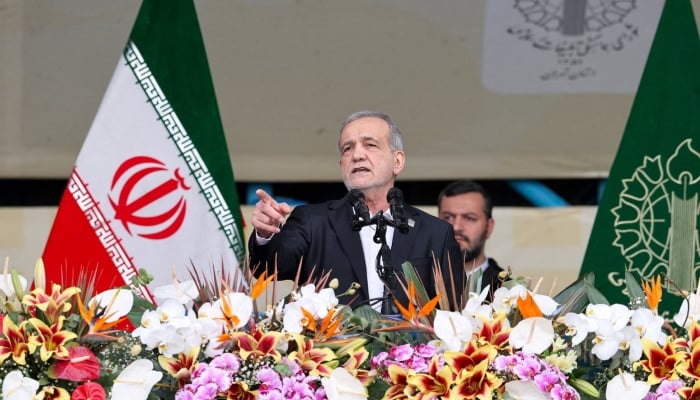
- World powers creating problems for Iran: Pezeshkian.
- His comments come after Feb 17 indirect talks in Geneva.
- Washington orders two aircraft carriers to Middle East.
Iranian President Masoud Pezeshkian on Saturday said that his country would not bow its head to pressure from world powers amid nuclear talks with the United States.
“World powers are lining up to force us to bow our heads… but we will not bow our heads despite all the problems that they are creating for us,” Pezeshkian said in a speech carried live by state TV.
The Iranian president’s remarks come as President Donald Trump pushed the US to the brink of war with Tehran despite aides urging him to focus more on voters’ economic worries.
The US wants Iran to give up its nuclear programme, and Iran has refused and denied that it is trying to develop an atomic weapon.
Trump had suggested on Thursday that “bad things” would happen if Tehran did not strike a deal within 10 days, which he subsequently extended to 15.
Asked by a reporter on Friday whether he was contemplating a limited military strike, Trump answered: “The most I can say — I am considering it.”
Trump has ordered a huge buildup of forces in the Middle East and preparations for a potential multi-week air attack on Iran.
Washington has ordered two aircraft carriers to the region as it piles on pressure. The first — the USS Abraham Lincoln, with nearly 80 aircraft — was positioned about 700 kilometres (435 miles) from the Iranian coast, satellite images showed on February 18.
Its location puts at least a dozen US F‑35s and F‑18 fighter jets within striking distance. A second carrier, USS Gerald R Ford, was also dispatched to the Middle East.
Iran and the US renewed negotiations earlier this month to tackle their decades-long dispute over Tehran’s nuclear programme and avert a new military confrontation.
The two nations held indirect talks in Geneva on February 17, with little clear indication of compromise by any party.
US envoys Steve Witkoff and Jared Kushner took part in the negotiations, mediated by Oman, alongside Iranian Foreign Minister Abbas Araqchi.
After the talks in Geneva, Tehran said the two sides had agreed to submit drafts of a potential agreement, which Araghchi told US media would be the “next step”.
“I believe that in the next two, three days, that would be ready, and after final confirmation by my superiors, that would be handed over to Steve Witkoff,” he said, referring to Trump’s main Middle East negotiator.