Tech
Kazakhstan: Where data is set to be the real new oil | Computer Weekly

If one were to ask most people what they know about Kazakhstan, it wouldn’t be much of a surprise if they were to describe it as a fossil fuel-rich former Soviet republic. Indeed, that is what the world’s ninth-largest country by land area and largest landlocked nation is.
Yet while that is accurate to say right now, the Kazakhstan government is planning a future that looks rather different. A digital transformation across the nation is in play, looking to take advantage of the country’s natural resources and its strategic geographic position between Russia and China to create a land where critical infrastructure encompasses data networks and connectivity lines in addition to oil pipelines. And where telcos are already primed to plug in to the opportunity coming from a national story that a global audience is ready to hear.
This story begins at Kazakhstan’s Ministry of Artificial Intelligence and Digital Development, also home to a digital government, where the minister of the department and the country’s deputy prime minister, Zhaslan Madiyev, is keen to show the country’s high-tech transitions and just how advanced technology will play a part in the nation’s future. This process has been 10 years in the making.
Digital ambitions
Madiyev is helming what is claimed to be one of the most ambitious digital transformation programmes in Central Asia, where artificial intelligence (AI), aerospace and infrastructure will underpin daily life for 20 million people. Freedom Holding Group – a leading retail brokerage and investment bank in Central Asia and Eastern Europe, which has a variety of assets including one of Kazakhstan’s leading telcos – believes that under Madiyev’s watch, Kazakhstan has already boosted AI from a buzzword into international policy, making it part of life in restaurants, public services and the general economy alike.
Explaining the current state of transformation, Madiyev reveals that at the beginning of April 2026, more than 90% of government public services were available online – 1,300 in total – almost 40 official documents are now available in digital format, and Kazakh law regards digital documents as the equivalent of physical documents. This spans travel, trains, flights, public government services and banking services.
In the latter use case, service creation has been done in collaboration between the government and the private sector, especially banking institutions, which typically develop products and then share them with the national authority to extend them to the broader marketplace, such as the whole banking system.
The net result has been quick commerce. “For example, through the bank application, you can register a client and sell a car in a matter of three to five minutes, without going to any windows outside,” says Madiyev. “You just register and sell the car online through the [digital] application. You can [do the same] to apply for a mortgage approval. This is the Freedom bank’s product, and through the smart bridge platform … the private sector can get access to all public services and databases.”
Creating a cashless economy is another key objective. The minister notes that 90% of transactions in Kazakhstan are currently cashless, and he praises the banking industry for assisting the wider development of the industry after the Central Bank of Kazakhstan became one of the first central banks in the world to not only pilot a national digital currency but also to optimise blockchain programming.
Tech hub
Madiyev also claims that Kazakhstan is already running the largest IT hub in the region. Capital city Astana is home to more than 2,000 companies – spanning startups to big tech – and calculations show Kazakhstan exports surpassed €1bn in 2025, around 65% to 70% of which accounted for by companies in the Astana region.
Looking at the global potential of the country’s IT sector, Madiyev emphasises the contribution of the country’s offices and teams in Silicon Valley and that from new facilities opened in Shanghai and Dubai over the past 12 months, and just how investment is being used to facilitate growth.
“This is the infrastructure that our startups can use to expand to global markets, to go through the acceleration programmes there, to meet with the VCs [venture capitalists], to have co-working spaces there and to expand markets. Also, last year, we launched the venture fund of funds with the target size of US$1bn – $150m is already committed,” he says.
“We have used those funds to support local [firms] because we see that our startups are growing, and perceived [startup]-level financing requires amounts less than $1m. It’s available for the stages like Series A, B and C [where] there is not enough financing,” adds Madiyev.
“But to become a unicorn, most of the companies need six to seven rounds of financing. And that’s why we need larger cheques – one million, five million, 10 million cheques – which [to date are] not available. But we created a large venture fund, and now we will be developing the regulation, and we will try to involve the banking sector. We think this VC market is so important.”
National strategy
As it goes forward, the country is pursuing a national digital strategy based on three constituent parts: an institutional framework, new infrastructure and data, and advances in human capital.
The institutional framework takes the form of an AI development council under the chairmanship of the president of the Republic of Kazakhstan, Kassym-Jomart Tokayev, with 17 members of the global technology community.
The latter include American theoretical computer scientist John Hopcroft and compatriot computer scientist Peter Norvig; Taiwanese computer scientist, investor and author Kai-Fu Lee; American economist Laura D’Andrea Tyson, who was formerly an adviser to Bill Clinton when he was US president; UAE minister of state for artificial intelligence, digital economy and remote work applications Omar Sultan Al Olama; American AI and robotics scientist and entrepreneur Cynthia Breazeal; Joseph Ito, a leading AI policy adviser in Japan and expert in crypto industry; and Olaf Groth, a futurist and strategist for transformations of economies, industries and organisations driven by AI, data, compute and cyber.
AI is indeed the key focus and driver of the venture, and in 2024, the ministry approved a five-year AI development programme. In addition to technological developments, the programme also encompasses AI law and a digital code. Yet Madiyev stressed that the aim was not to over-regulate AI, but instead to take into account ethical standards, terminology and labelling of AI components. Such a framework is particularly necessary given that AI is extending into all areas of the digital programme, such as being embedded into the educational system.
As regards the essential infrastructure on which the digital transformation will be based, the programme boasts that it has launched the two largest supercomputer clusters in the region.
The Alem.Cloud and AL-Farabium supercomputers were launched in 2025, both based on an Nvidia H200 graphics processing unit (GPU), which is designed with high-bandwidth memory capacity to accelerate generative models and large language models (LLMs). These are used to support the Kaz national LLM on Llama 3.1 with 70 billion parameters, the AlemLLM with Yi-Lightning DeepSeek with 246 billion parameters, and Sherkala on Llama 3.2 for eight billion parameters.
This technical capability is said to have ultimately allowed the infrastructure to have a “Kazakhstani context”, embedding local cultural aspects in the language models, and being able to use them in a closed on-premise format. Yet in this regard, Madiyev is also keen to point out that the framework does not geo-politicise sensitive data to external datacentres.
Kazakh public sector employees have access to the GPUs, the supercomputer resources, datasets, LLMs and training through a national AI platform. The AI ministry takes responsibility for developing AI agents and adopting them throughout the government, and then trains people to use AI in their specific industries.
Datacentre valley
One key future infrastructure project is the creation of a datacentre valley, which will be offered to leading hyperscalers and big tech companies. In this, Madiyev stresses that the project will leverage Kazakhstan’s “abundance” of cheap energy, which is leading the ambition to offer at least 1GW (gigawatt) of computing power. The programme has already allocated 300MW (megawatts) of capacity available at the price of 2.5 cents per kilowatt. Added to these technical capabilities, the Kazakhstan government says it is ready to provide zero tax and other regulatory incentives and offer services on a one-stop shop format.
From a networking perspective, the infrastructure offers low latency to Europe, ranging from 57ms (milliseconds) to 70ms, which is said to be enough for inference work. There is also a commitment to a national fibre optic network, and the ambition is for 92% of the country’s villages to have fibre access coverage by 2027. At the same time, the government plans to have 60% to 75% national 5G mobile connectivity, for smaller conurbations and large cities respectively.

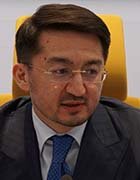
“Our startups can use [the new infrastructure] to expand to global markets, to go through the acceleration programmes there, to meet with the VCs, to have co-working spaces there and to expand markets”
Zhaslan Madiyev, Ministry of Artificial Intelligence and Digital Development
The Kazakh government is launching two major transit projects: a trans Caspian diversified internet traffic route and a west-east backbone. Madiyev stresses that having such connectivity with low latencies is an absolute necessity to attract the hyperscalers to the country.
The government is also accelerating satellite connectivity, something wholly logical given the place that the Baikonur Cosmodrome has in the history of space travel, being the launch site of Sputnik 1 and Yuri Gagarin’s Vostok 1. It is still the world’s largest operational space launch facility, and Madiyev proudly observes that Kazakhstan is almost vertically integrated in terms of the space industry. He remarks that, in addition to the launch facilities, it also has a satellite production facility in partnership with Airbus, it is building an international satellite constellation and, since 2025, the country is exporting satellites.
Eutelsat’s OneWeb and Starlink are already available, and the next 12 months will see the availability of Chinese state-owned Shanghai Spacecom and Amazon Leo, which has been ramping up its footprint in recent months. To underline the commitment of these companies to the country, Madiyev notes that they are all building gateway stations and ground infrastructure in Kazakhstan to service not only the local territory but also the broader Central Asian region.
Digital heart
Another key aspect of the programme is Astana Hub, a tech cluster regarded officially as the heart of the country’s technology ecosystem. Located in the next block from the Kazakhstan’s Ministry of Artificial Intelligence and Digital Development, the facility – employing more than 32,000 people – has the stated mission to “foster a startup culture and support high-tech projects to strengthen the country’s economy”.
There are four strategic goals: train 10,000 AI talents by 2030, create a startup culture and support high-tech projects, create five unicorns (startups valued at over $1bn) by 2030, and achieve $5bn of annual tech services and product exports by 2030. In 2025, the hub generated $1.7bn in total revenues and $634m in expert revenues. It has also raised investment of more than $910m.
There are five technology development centres in the hub. These encompass defence, drone technology, blockchain, space tech and game development. The Astana Hub Cloud looks to accelerate AI development by providing access to next-generation GPU infrastructure. Key features include Nvidia H100 and H200 GPUs optimised for deep learning and generative AI, an AI datacentre, 64 GPUs (eight per server), an InfiniBand Network, and an infrastructure-as-a-service (IaaS) model offering flexible access to resources.
Already, the hub hosts offices of major tech companies such as Playrix, TikTok, Telegram, Yandex, Glovo, in Drive, Damumed and Presight. In terms of startup developments, the hub also has the Google-backed Sılkway Accelerator. Claimed to be the leading programme of its kind in Central Eurasia, it supports startups that have reached the product-market fit stage – those that already meet market demand and have an established user base. The programme helps them scale, solidify their market position and prepare for investments.
Talent acquisition forms the nub of the hub’s success. The Kazakh government says it has created special conditions for digital nomads, in particular as regards arrangements for the entry and stay of foreign specialists. Indeed, there is what is described as a “simplified procedure” for obtaining a residence permit for specialists and their family members from Visa category countries.
Partnering for success
Yet while there is no doubt about the ambition regarding the programme, it is equally clear that there are challenges for the government and the Astana Hub to overcome. Will they be technological, such as connecting a national infrastructure in such a vast country? Will they be social? Will they be educational? Will there be regulatory headwinds?
Speaking with Computer Weekly, Madiyev accepts the existence of regulation and infrastructure issues and also highlights development, which he says should also be taken into account, something he says is a common challenge for many countries.
“Fraud and scams are happening more and more, and they are growing. It’s becoming more difficult to cope with that and to catch up with the regulations and measures against this. Also, with SMEs [small and medium-sized enterprises], we should take seriously how to teach them and how to embed AI in their [sector]. SMEs make up around 40% of national GDP, and there are around three million SMEs. That’s why we are launching those educational programmes.
“Another challenge is that in the government, public sector and social services, it’s easier to measure AI because of the huge collection of data. But if you take the [private] economy sectors, the digitalisation of the data in those industries is somewhat around 50% to 53% in the energy sector, agriculture, industries and so on. This year, we’ll [also] be concentrating on issuing proper regulations on establishing the internet of things and the various tech solutions that will help to generate data. This is another challenge.”
As seen with the activities at the Astana Hub, partnerships will be the key to overcoming challenges and headwinds – whatever form they take. And from a communications and connectivity perspective, Freedom Telecom, the comms division of the aforementioned holding group, will be a key player in realising the connectivity ambitions of the government, not only in terms of regular fixed and wireless offerings, but also in terms of realising the west-east fibre optic backbone.
In part two of our look at Kazakhstan’s digital transformation, we will find out which telecoms operator could be at the vanguard of this process.