

Politics
Kirk killing sparks fierce US free speech debate

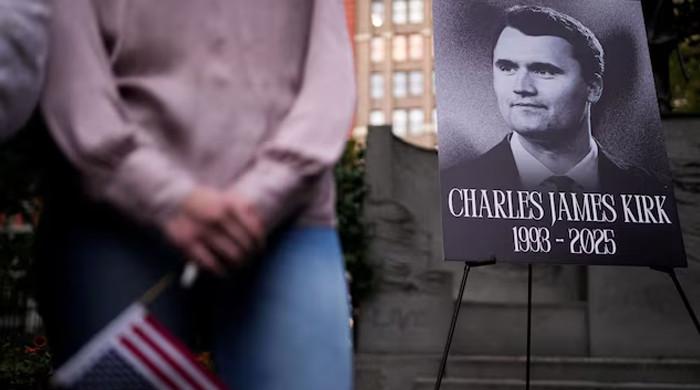
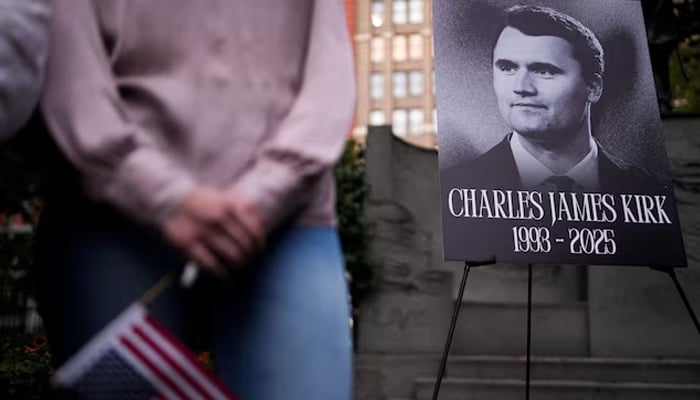
For Americans, the words are practically sacred: the First Amendment to the US Constitution guarantees freedom of speech.
But that right is now the subject of bitter debate, following the assassination of right-wing activist Charlie Kirk.
On Thursday, several high-ranking Democrats accused President Donald Trump of waging war on free speech, after he celebrated ABC’s suspension of talk show host Jimmy Kimmel, who accused the political right of using Kirk’s death to score points.
The American Civil Liberties Union, a rights advocacy group, accused the Trump administration of operating outside constitutional safeguards to target its opponents, likening it to the Red Scare of the late 1940 and 1950s under senator Joseph McCarthy.
“This is beyond McCarthyism. Trump officials are repeatedly abusing their power to stop ideas they don’t like, deciding who can speak, write, and even joke,” said Christopher Anders, director of the ACLU’s democracy and technology division.
So what does the First Amendment say? And why is it up for debate?
‘How we identify ourselves’
Ratified in 1791, the Bill of Rights comprises the first 10 amendments to the US Constitution, protecting the fundamental rights of Americans.
“Congress shall make no law respecting an establishment of religion, or prohibiting the free exercise thereof; or abridging the freedom of speech, or of the press; or the right of the people peaceably to assemble,” the First Amendment says.
For David Super, a professor at Georgetown University’s law school, the amendment is “really how we identify ourselves as a nation.”
Beyond the varied ethnicities and background of the nation’s 340 million people, “we are thought to be drawn together by a belief in open discussion and a belief that the government can’t shut any of us up,” Super told AFP.
The First Amendment even protects speech that is “morally repulsive,” explained Eugene Volokh, a professor of law at the University of California, Los Angeles.
Volokh however emphasised that the history of the United States has been marked by attempts to stifle dissident voices.
‘Malicious writings’
In 1798, America’s second president John Adams signed into law the Sedition Act, which forbade “any false, scandalous and malicious writing or writings against the government of the United States.”
Then during World War I, the expression of pacifist ideology was banned.
From the 1920s to the 1950s, anyone expressing support for communist ideals risked serious repercussions. And in the 1960s, officials in several southern US states battled to silence the civil rights movement.
One of the key pillars of Trump’s political movement has been to eviscerate “cancel culture” — the process of criticising someone for voicing an opinion seen as unacceptable, to the point of that person being ostracised or fired.
Trump has often called “cancel culture” a scourge of leftist progressives, claiming that it has been used to silence conservative pundits and politicians.
But Democrats have turned the tables on Trump, accusing him of doing the same to US media organisations, major universities and, now, Kimmel — a frequent target of Trump’s ire.
“After years of complaining about cancel culture, the current administration has taken it to a new and dangerous level,” Democratic former president Barack Obama wrote Thursday on X.
Conservative push-back
US Attorney General Pam Bondi sparked controversy among conservatives by saying earlier this week that the Justice Department would pursue anyone guilty of “hate speech” linked to the slain influencer.
Republican Senator Ted Cruz quickly countered that the Constitution “absolutely protects hate speech.” Bondi then said she meant to refer to “threats of violence that individuals incite against others.”
Conservative commentator Tucker Carlson called for “civil disobedience” should Kirk’s murder result in an uptick in laws limiting free speech.
And some voices on the far right have criticised a decree signed by Trump in August that makes burning the American flag punishable by up to a year in prison.
The US Supreme Court ruled in 1989 that burning the Stars and Stripes indeed amounted to free speech, and was protected by the First Amendment.
“I would never in a million years harm the American flag,” conservative radio host Jesse Kelly wrote on X.
“But a president telling me I can’t has me as close as I’ll ever be to lighting one on fire. I am a free American citizen. And if I ever feel like torching one, I will.”
- Khamenei terms wave of protests “American conspiracy”.
- Iran’s supreme leader says will not spare domestic criminals.
- DPM Dar expresses hope for peace and stability in region.
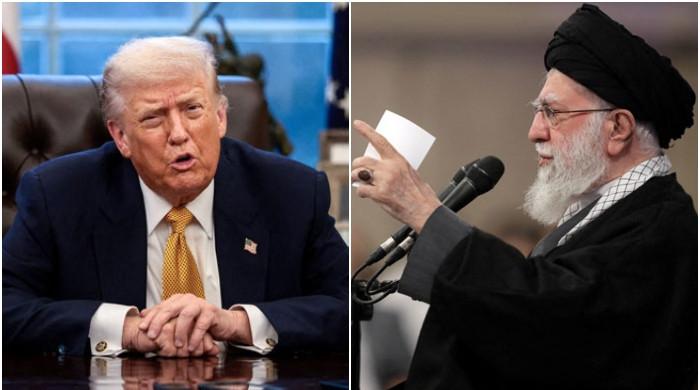
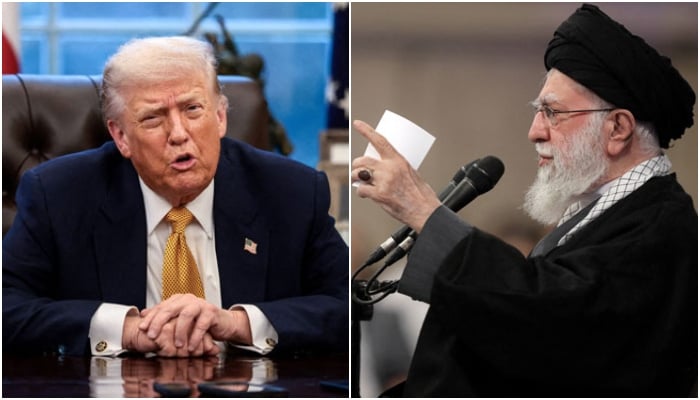
Iran’s supreme leader Ayatollah Ali Khamenei on Saturday accused US President Donald Trump of being responsible for “casualties” during a protest wave in the country.
“We hold the American president guilty for the casualties, damages and accusations he has levelled against the Iranian nation,” he told a crowd of supporters during an address marking a religious holiday.
“This was an American conspiracy,” he said, adding that “America’s goal is to swallow Iran… the goal is to put Iran back under military, political and economic domination”.
He further said authorities “must break the back of the seditionists” after a crackdown on the protest wave.
“We do not intend to lead the country to war, but we will not spare domestic criminals… worse than domestic criminals, international criminals, we will not spare them either,” he added.
“By God’s grace, the Iranian nation must break the back of the seditionists just as it broke the back of the sedition.”
It is pertinent to mention here that more than 3,000 people have died in Iran’s nationwide protests, rights activists said on Saturday, while a “very slight rise” in internet activity was reported in the country after an eight-day blackout.
The protests erupted on December 28 over economic hardship and swelled into widespread demonstrations calling for the end of clerical rule in the country, culminating in mass violence late last week.
Tensions in Iran, however, subsided after three weeks of protests under an internet blackout. The capital Tehran, however, has been comparatively quiet for four days, said several residents reached by Reuters.
Drones were flying over the city, but there were no signs of major protests on Thursday or Friday, said the residents, who asked not to be identified for their safety.
Separately, Deputy Prime Minister Ishaq Dar held telephonic conversation with Iran’s Foreign Minister Abbas Araghchi today.
They discussed the current situation in Iran and the wider region.
DPM Dar expressed hope for peace and stability, and both sides agreed to continue bilateral consultations on matters of mutual interest.
Earlier, US President Donald Trump thanked Iran’s leaders for cancelling what he said were hundreds of planned executions of protesters after a crackdown.
Taking to his social media platform, he said the mass hangings had been called off and praised Tehran for the move.
US President Donald Trump, whose repeated threats to act had included a vow to “take very strong action” if Iran executed protesters, said Tehran’s leaders had called off mass hangings.
“I greatly respect the fact that all scheduled hangings, which were to take place yesterday (Over 800 of them), have been cancelled by the leadership of Iran. Thank you!” he posted on social media.
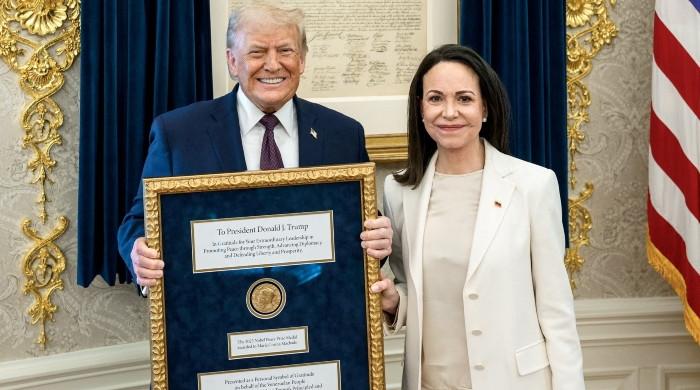
- Venezuela’s Machado gave her Nobel medal to Trump.
- Donald Trump says he intends to keep the medal.
- Original laureate recorded in history as prize recipient.
OSLO: The Nobel Peace Prize remains inseparably linked to the person or organisation that won it, though the medal can be given away, the Norwegian Nobel Committee said on Friday, a day after last year’s winner gave her medalto US President Donald Trump.
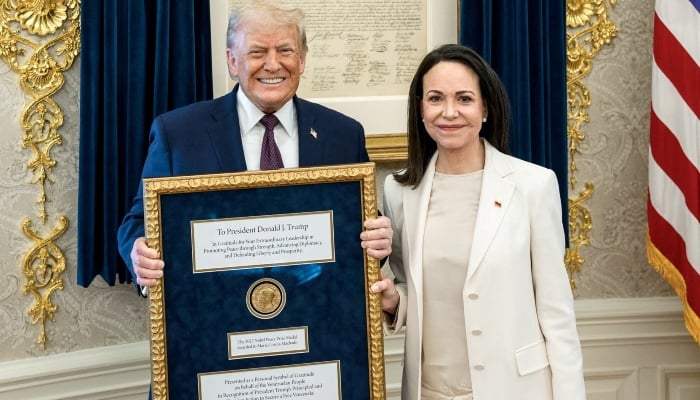
Venezuelan opposition leader Maria Corina Machado gave her medalon on Thursday to Trump, who thanked her for it. The White House released a photo of Trump and Machado, with Trump holding up a gold-coloured frame displaying it, and a White House official said Trump intends to keep it.
Machado’s award also consists of a diploma and 11 million Swedish crowns ($1.19 million).
“Regardless of what may happen to the medal, the diploma, or the prize money, it is and remains the original laureate who is recorded in history as the recipient of the prize,” the award body said in a statement.
“There are no restrictions in the statutes of the Nobel Foundation on what a laureate may do with the medal, the diploma, or the prize money. This means that a laureate is free to keep, give away, sell, or donate these items,” it added.
‘Inseparably linked’
The medal and the diploma are physical symbols confirming that an individual or organisation has been awarded the prize, said the five-strong award committee.
“The prize itself – the honour and recognition – remains inseparably linked to the person or organisation designated as the laureate by the Norwegian Nobel Committee,” it said.
The committee, which did not refer to Trump and Machado by name in its statement, said it does not comment on a laureate’s statements, decisions or actions after the prize is announced.
It was not the first time a Nobel laureate has given away the medal. In 1943, Nobel literature laureate Knut Hamsun gave his to Nazi propaganda minister Joseph Goebbels.
In 2022, Nobel Peace laureate Dmitry Muratov sold his medal for $100 million to raise money for the UN children’s fund Unicef to help Ukrainian refugee children.
In 2024, the widow of former UN Secretary-General Kofi Annan donated his 2001 Nobel Peace Prize medal and diploma to the UN office in Geneva.

US President Donald Trump purchased about $100 million in municipal and corporate bonds from mid-November to late December, his latest disclosures showed, including up to $2 million in Netflix and Warner Bros Discovery bonds just weeks after the companies announced their merger.
Financial disclosures posted on Thursday and Friday showed the majority of Trump’s purchases were municipal bonds from cities, local school districts, utilities and hospitals.
But he also bought bonds from companies including Boeing, Occidental Petroleum and General Motors.
The investments were the latest reported assets added to Trump’s expanding portfolio while he is in office.
It includes holdings in sectors that benefit from his policies, raising questions about conflicts of interest.
For example, Trump said in December that he would have a say in whether Netflix can proceed with its proposed $83 billion acquisition of Warner Bros Discovery, which faces a rival bid from Paramount Skydance.
Any deal to acquire Warner Bros will need regulatory approval.
A White House official, who spoke on the condition of anonymity, said on Friday that Trump’s stock and bond portfolio is independently managed by third-party financial institutions and neither Trump nor any member of his family has any ability to direct, influence or provide input regarding how the portfolio is invested.
Like many wealthy individuals, Trump regularly buys bonds as part of his investment portfolio.
He previously disclosed at least $82 million in bond purchases from late August to early October.


Premier League live updates: Liverpool vs. Burnley, Chelsea vs. Brentford

Kim Kardashian losing North West to Kanye?

George Kittle’s wife shares live reaction to husband’s Achilles injury: ‘Doesn’t make any f—ing sense’

-
 Tech5 days ago
New Proposed Legislation Would Let Self-Driving Cars Operate in New York State
-
 Sports7 days ago
Clock is ticking for Frank at Spurs, with dwindling evidence he deserves extra time
-
Sports1 week ago
Commanders go young, promote David Blough to be offensive coordinator
-
 Entertainment4 days ago
X (formerly Twitter) recovers after brief global outage affects thousands
-
 Fashion6 days ago
South India cotton yarn gains but market unease over US tariff fears
-
 Fashion7 days ago
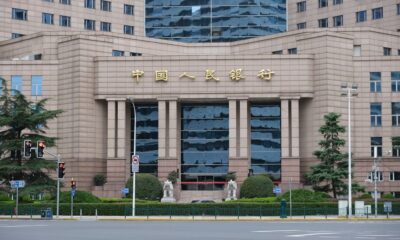
China’s central bank conducts $157-bn outright reverse repo operation
-
 Business1 week ago
SoftBank reduces Ola Electric stake to 13.5% from 15.6% – The Times of India
-

 Sports6 days ago
US figure skating power couple makes history with record breaking seventh national championship