

Tech
Logitech’s MX Master 4 Is Still the Best Productivity Mouse

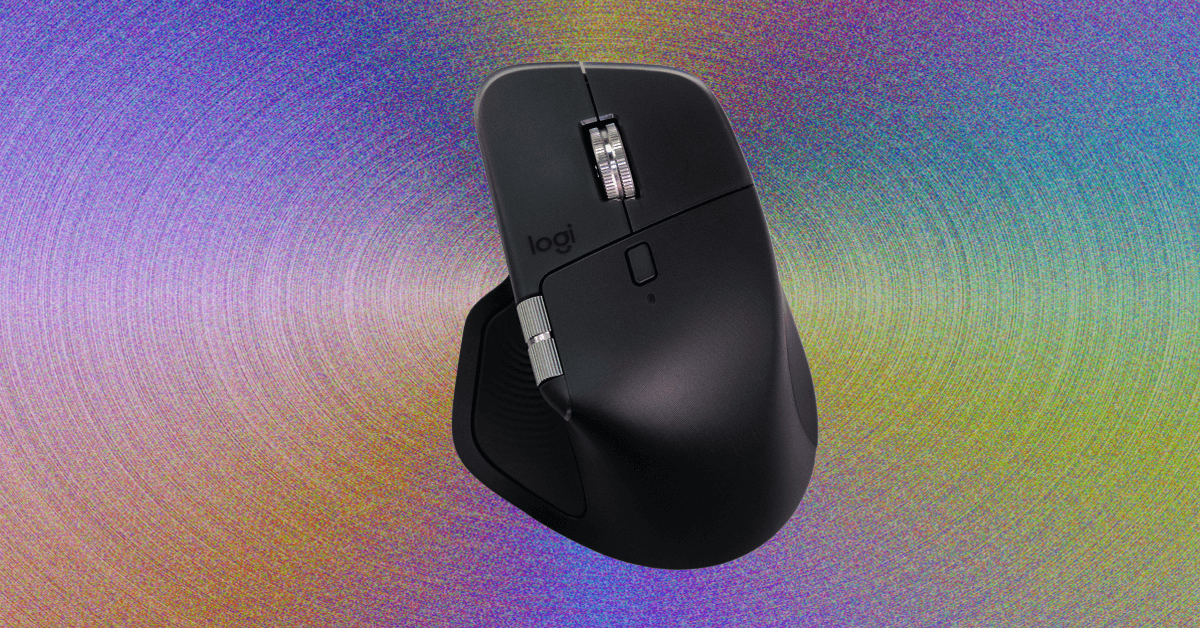
The loss of soft-touch plastics may seem like a downgrade at first, but I vastly prefer uncoated plastics for long-term use: My MX Master 2S developed unsightly smooth spots on both mouse buttons where the soft-touch coating wore down, and other long-term users have reported the coatings becoming tacky over time.
Photograph: Henri Robbins
The two primary mouse buttons and the scroll wheel are nearly dead-silent. Despite this, they still have clear feedback with a distinct bump and no mushy feeling. In the ratcheting mode, the mouse wheel has a noticeable bump between each scroll. In the smooth mode, the wheel has just enough resistance to be controlled easily, while still spinning freely.
The horizontal scroll wheel on the side permanently scrolls smoothly and has significantly more resistance than the primary scroll wheel. This allows for greater control of the wheel and helps protect against accidental scrolling when moving your thumb. Scrolling is incredibly smooth, without any catching or scratchiness, and the ridged texture of the aluminum wheel feels comfortable and easy to manipulate. Clicking the wheel is still fairly loud, like any mouse. The three side buttons and the top button have a muted click, and it’s not disruptive.
Despite weighing 150 grams, this mouse is easy to glide around a surface. The feet are smooth, sliding easily while still having enough friction for precise control, and the sculpted shape makes it easy to move and lift. While the high weight means it won’t be ideal for competitive, high-intensity gaming, the shape is preferable for longer sessions, whether you’re grinding out dungeons or slogging through spreadsheets.
The sensor is capable of up to 8,000 dots per inch, but most people will likely leave the sensitivity well below that. I didn’t have any issues with input registration, skipping, or shaking, and the sensor felt incredibly precise on all surfaces, even frosted and transparent glass.
Gesture Controls and Haptics

Photograph: Henri Robbins
The MX Master 4’s gesture controls are one of its most prominent features. These have been featured on every generation of the MX Master line, with only small changes across generations. The gesture control button was previously located on the bottom of the thumb rest, hidden underneath the rubber surface, but has now been moved to a standard button on the side, which I found more comfortable and natural to use.










The iPhone is the least fixable phone on the market, according to repairability experts. Phones from Samsung and Google are not far behind.
The latest repairability ratings are from an annual report called “Failing the Fix” put out today by the consumer advocacy group US PIRG. A 2021 French law required products to be labeled with repairability scores, and US PIRG says this is the first report since then that really shows which companies are—or are not—making progress. The answer is that repairability is progressing much more quickly in some places than others.
The results were good for phones made by Motorola, which got a B+. Google’s phones got a C–. The verdict was worse for Samsung phones, which got a D. Last on the list was Apple with a D–. Apple and Samsung did not immediately respond to requests for comment.
Scores were better for laptops than smartphones, with Asus at the top with a B+ and Apple on the bottom with its MacBooks at a C–.
The authors of the report are hoping that publishing these low scores will encourage manufacturers to do better.
“Putting these right incentives in place could push these companies to make innovations that are actually beneficial,” says Nathan Proctor, senior director of the US PIRG campaign for the right to repair. “Instead of coming up with new ways to jam AI down our throats, you can make stuff that lasts and that we can fix.”
Despite many right-to-repair concessions companies have made—like making their tools, parts, and repair instructions publicly available—those rankings are lower than in years past, largely because of the new information that has been gleaned from European laws requiring repair scores to be printed on product packaging.
The French law grades products based on how easily they can be disassembled, whether documentation and tools are provided, and the availability and price of spare parts. In 2023, the European Union passed a law establishing the European Product Registry for Energy Labelling, a process that grades devices on key repairability factors like whether products have easy access and disassembly, battery endurance, ingress protection like waterproofing, and the durability to handle repeated falls. The rankings go from A to F.
To arrive at its own ratings, US PIRG collates the EPREL and France’s repair indexes with other US-specific factors, like whether companies are actively lobbying against the right to repair or are members of trade associations that do so.
“If you’re buying your equipment from a company that’s spending their money to lobby against your right to repair that thing, that doesn’t speak well for their support, for your ability to fix that,” Proctor says. “So we also dock points for some of those legislative activities.”
Apple’s phones are getting better scores than in years past, like when iPhones were assigned an F rating in 2022. (iPhones got a C– in 2025.) The low rating for Apple’s phones comes down to software support, and how the EU laws track the information about what companies enable in their products. Based on the EU laws, companies have to self-report how their devices meet repair requirements. And those rankings tend to score pretty low.
“When we’ve been grading on a curve, Apple has not been a standout in the bad column,” Proctor says. “But why are we grading on a curve? We should just have longer-lasting products.”
The ultimate goal of these rankings, Proctor says, is to bring attention to the importance of repairability, accessibility, and waste reduction.
“This is an emerging, vitally important issue that we need better leadership on from companies and from other public policy officials,” Proctor says. “We should not be trashing all of our internet-connected stuff every couple of years because it’s impossible to use it with the software. It’s totally unsustainable. It’s crazy. Let’s not build that world. That world is a dystopia.”
“I’m actually pretty confident that some of that stuff’s going to get addressed,” Proctor adds. “Apple engineers are good at making stuff. They’re good at solving problems.”

Following leaked revelations at the end of March that Anthropic had developed a powerful new Claude model, the company formally announced Mythos Preview on Tuesday along with news of an industry consortium it has convened, known as Project Glasswing, to grapple with the cybersecurity implications of the new model and advancing capabilities more generally across the AI field.
The group includes Microsoft, Apple, and Google as well as Amazon Web Services, the Linux Foundation, Cisco, Nvidia, Broadcom, and more than 40 other tech, cybersecurity, critical infrastructure, and financial organizations that will have private access to the model, which is not yet being generally released. The idea, in part, is simply to give the developers of the world’s foundational tech platforms time to turn Mythos Preview on their own systems so they can mitigate vulnerabilities and exploit chains that the model develops in simulated attacks. More broadly, Anthropic emphasizes that the purpose of convening the effort is to kickstart urgent exploration of how AI capabilities across the industry are on the precipice, the company says, of upending current software security and digital defense practices around the world.
“The real message is that this is not about the model or Anthropic,” Logan Graham, the company’s frontier red team lead, tells WIRED. “We need to prepare now for a world where these capabilities are broadly available in 6, 12, 24 months. Many things would be different about security. Many of the assumptions that we’ve built the modern security paradigms on might break.”
Models developed and trained by multiple companies have increasingly been able to find vulnerabilities in code and propose mitigations—or strategies for exploitation. This creates a next generation of security’s classic cat-and-mouse game in which a tool can aid defenders but can also fuel bad actors and make it easier to carry out attacks that were once too expensive or complex to be practical.
“Claude Mythos preview is a particularly big jump,” Anthropic CEO Dario Amodei said on Tuesday in a Project Glasswing launch video. “We haven’t trained it specifically to be good at cyber. We trained it to be good at code, but as a side effect of being good at code, it’s also good at cyber.” He adds in the video that “more powerful models are going to come from us and from others. And so we do need a plan to respond to this.”
Anthropic’s Graham notes that in addition to vulnerability discovery—including producing potential attack chains and proofs of concept—Mythos Preview is capable of more advanced exploit development, penetration testing, endpoint security assessment, hunting for system misconfigurations, and evaluating software binaries without access to its source code.
In carrying out a staggered release of Mythos Preview, beginning with an industry collaboration phase, Graham says that Anthropic sought to draw on tenets of coordinated vulnerability disclosure, the process of giving developers time to patch a bug before it is publicly discussed.
“We’ve seen Mythos Preview accomplish things that a senior security researcher would be able to accomplish,” Graham says. “This has very big implications then for how capabilities like this should be released. Done not carefully, this could be a meaningfully accelerant for attackers.”
Project Glasswing partners, including some of Anthropic’s competitors, struck a collaborative tone in statements as part of the launch.
“Google is pleased to see this cross-industry cybersecurity initiative coming together,” Heather Adkins, Google’s vice president of security engineering, says in a statement. “We have long believed that AI poses new challenges and opens new opportunities in cyber defense.”

The UK’s National Cyber Security Centre (NCSC) and Microsoft have exposed an extensive Domain Name System (DNS) hijacking campaign against vulnerable consumer and small and home office (Soho) broadband routers conducted by the Russian cyber intelligence services.
Orchestrated by APT28 or Forest Blizzard – more widely-known as Fancy Bear – the operations saw the threat actor alter the settings of compromised devices to reroute internet traffic through malicious servers they held.
In this way, Fancy Bear was able to steal data such as login credentials, passwords and access tokens from personal web and email services belonging to their victims in a so-called adversary-in-the-middle (AiTM) attack.
The NCSC said the campaign was likely opportunistic, with Fancy Bear having cast a wide net to ensnare as many victims as possible. By targeting insecure home and small office equipment, Fancy Bear took advantage of less closely-monitored or managed assets to pivot into larger enterprise environments or targets of interest to Russian intelligence.
Indeed, Microsoft said it had identified over 200 organisations and 5,000 consumer devices impacted since the campaign began in August 2025.
“This activity demonstrates how exploited vulnerabilities in widely used network devices can be leveraged by sophisticated hostile actors,” said NCSC operations director Paul Chichester.
“We strongly encourage organisations and network defenders to familiarise themselves with the techniques described in the advisory and to follow the mitigation advice.
“The NCSC will continue to expose Russian malicious cyber activity and provide practical guidance to help protect UK networks,” he added.
Routers on trial
The exposure of Fancy Bear’s latest campaign comes amid a fierce debate on the other side of the Atlantic following the Federal Communications Commission’s (FCC’s) implementation of tight restrictions on routers built outside the US – which in effect means virtually every commercially available router.
The US’ decision was framed on the basis that such hardware poses an unacceptable risk to the country’s national security and that of its citizens and residents.
However it has been criticised on the basis that while it eases fears over the potential for other governments – such as China – to interfere with networking hardware produced in their factories, it does not address the fact that security vulnerabilities such as those exploited by Fancy Bear will still exist regardless of where they were manufactured.
Writing in Computer Weekly, Forescout vice president of security intelligence, Rik Ferguson, said routers present a highly attractive footholds for attackers because they sit at the network edge, generally face the public internet, and are easily overlooked once deployed.
“Many of the weaknesses we see come from familiar, measurable issues like outdated software components, slow patching cycles, weak credentials, exposed management interfaces and long lifespans that extend well beyond vendor support,” he said.
“In firmware analysis, we regularly see common components that are years behind current versions, carrying known vulnerabilities that attackers can and do exploit.”
Ferguson advised security teams to treat routers and similar network infrastructure as part of the active attack surface, which in practice means keeping accurate inventories, prioritising their lifecycle management, and enforcing firmware updates and patching.
To prevent attackers like Fancy Bear from scoring easy wins, security teams should also look to disable any internet-exposed management interfaces, enforce unique credentials, and apply network segmentation measures so that one compromised router does not necessarily enable wider access.


Ranking the top 20 men’s basketball players to enter the transfer portal

Oil slides after US-Iran ceasefire deal to open Strait of Hormuz

What are the 10 points tabled by Iran for ending war with US?

-
Uncategorized5 days ago
[CinePlex360] Please moderate: “Trump signals p
-
Uncategorized1 week ago
[CinePlex360] Please moderate: “Further tariff
-

 Entertainment4 days ago
Joe Jonas shares candid glimpse into parenthood with Sophie Turner
-

 Tech4 days ago
Our Favorite iPad Is $50 Off
-

 Fashion7 days ago
China’s Anta Sports posts record $11.62 bn revenue in 2025
-

 Politics4 days ago
Iran can sustain Strait of Hormuz closure for years, will cut US military logistics: Official
-

 Sports4 days ago
UConn Final Four run could trigger a $50M furniture giveaway for Massachusetts-based Jordan’s Furniture
-

 Politics1 week ago
Trump considers asking Arab allies to help to pay for Iran war