

Fashion
Louis Vuitton Watch Prize for Independent Creatives announces finalists and jury members for 2025-26 edition


Published
December 16, 2025
On December 16, Louis Vuitton unveiled its five finalists and five final jury members for the second edition of the Louis Vuitton Watch Prize for Independent Creatives, to be awarded at an exclusive celebration ceremony on March 24, 2026.
Watch Prize finalist Daizoh Makihara of Daizoh Makihara Watchcraft Japan’s ‘Beauties of Nature’ wristwatch entry incorporates the delicate, traditional Japanese cut-glass technique ‘Edo Kiriko’ into watchmaking in a world first and his botanical design features an automatic petal mechanism, perpetual moon phase, and 25-jewel movement running at 18,000 vibrations per hour. Independent watchmaker Xinyan Dai of Fam Al Hut’s mechanical, manual-wind wristwatch named ‘Möbius’ presents the most compact bi-axis tourbillon conceived to date, blending tradition and future-facing innovation with over 200 hours of handcraftsmanship.
Victor Monnin and Alexandre Hazemann of Hazemann & Monnin’s ‘School Watch’ entry celebrates the Morteau school of watchmaking with a fully in-house made HM01 calibre, synchronising complex mechanics and precise poetry. Bernhard Lederer of Lederer’s wristwatch ‘CIC 39 mm Racing Green’ presents the first fully functional dual detent escapement in a wristwatch, highlighted by a transparent case back and sanded, matte dial.
Quiet Club’s Norifumi Seki has entered ‘Fading Hours,’ designed to innovate “new mechanics that respond to everyday needs,” according to the watchmaker. Created almost entirely in-house, the watch has a first-of-its-kind alarm with a vertically mounted hammer and minimalist, concealed elements.

“Since the launch of the Louis Vuitton Watch Prize, our admiration for the dynamism of independent watchmaking has continued to grow,” said Louis Vuitton’s watch director Jean Arnault in a release. “These artisans create truly audacious timepieces, uniting extraordinary technical mastery with the boldness to challenge convention, and in doing so, they push the very boundaries of what is possible. As we celebrate this year’s finalists, I also want to thank the entire watchmaking community for the enthusiasm and support behind this initiative. I would also like to extend my gratitude to the members of the expert committee.”
After receiving submissions from around the world, Louis Vuitton’s five finalists were chosen from a group of 20 semi-finalists, whose work was evaluated by a Committee of Experts. The 65 watch enthusiasts, industry representatives, and global collectors measured the candidates’ timepieces against the principles of design, creativity, innovation, craftsmanship, and technical complexity to discern the five top entries.

Carole Forestier-Kasapi, haute horlogerie and movements strategy director at Tag Heuer will take up the role of president of the Watch Prize’s jury after being nominated by the Committee of Experts. The jury also welcomes journalist Frank Geelen, founder and editor-in-chief of Monochrome Watches; Matthieu Hegi, La Fabrique du temps Louis Vuitton artistic director; watch enthusiast François-Xavier Overstake, founder and editor of Equation du Temps; and Kari Voutilainen, master watchmaker and owner of the Voutilainen workshops.
The winner of the Louis Vuitton Watch Prize for Independent Creatives will receive 150,000 euros and a one-year specially tailored mentorship by experts from La Fabrique du Temps and Louis Vuitton. “The future looks promising, and we’re excited to see what’s next,” said Jean Arnault.
Copyright © 2025 FashionNetwork.com All rights reserved.







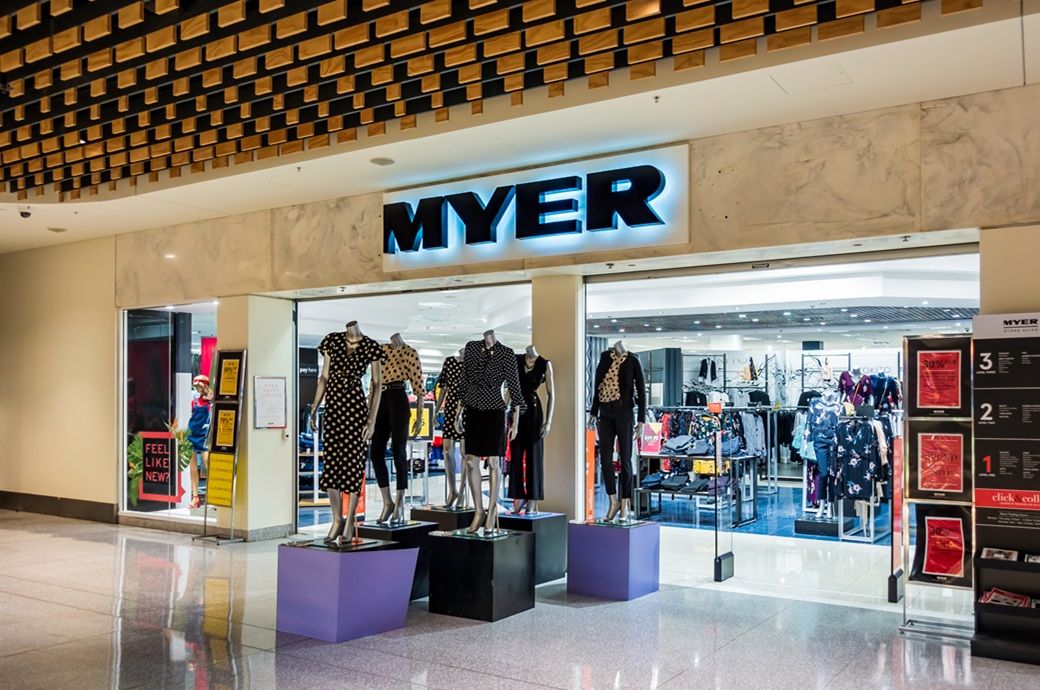
Operating gross profit surged 35.1 per cent to $886.0 million, while underlying earnings before interest and tax (EBIT) rose 10.5 per cent to $112.8 million. Underlying net profit after tax (NPAT) increased 21.7 per cent to $51.7 million, with statutory net profit after tax (NPAT) up 32.8 per cent to $40.3 million.
Myer has reported strong H1 FY26 results, with total sales rising 24.5 per cent to $2,279.5 million and NPAT up 21.7 per cent to $51.7 million.
Growth was supported by Apparel Brands integration and strategic investments.
Loyalty members reached 5.1 million.
Early H2 FY26 sales rose 1.7 per cent, though the company remains cautious amid macroeconomic pressures and weak discretionary demand.
The company maintained strong financial discipline, with cost of doing business at 27.9 per cent of total sales, within its FY26 target of around 29 per cent. Myer also reported a robust net cash position of $287 million, reflecting strong cash conversion and balance sheet flexibility, Myer said in a press release.
Myer’s ongoing transformation strategy continued to gain traction during the period, particularly through its customer engagement and brand expansion initiatives. The relaunched Myer one loyalty programme reached a record 5.1 million active members, supported by enhanced personalisation driven by AI-led data modelling.
The company also strengthened its product portfolio, introducing new exclusive brands and securing partnerships with global names such as Fenty Beauty, La Mer, Gap, and Topshop.
“Our H1 result reflects momentum across our business as we continue to implement the Myer Group Growth Strategy. Sales growth was achieved both in store and online, and our disciplined cost management allowed us to make targeted investments including in e-commerce, marketing, product, merchandise and supply chain to deliver on our plan,” said Olivia Wirth, executive chair at Myer.
“We achieved our biggest Black Friday on record for Myer Retail, and total sales for the group through the important trading months of December and January were in line with last year—a good outcome that demonstrates the resilience of the business,” added Wirth.
The integration of Myer Apparel Brands progressed steadily, with the company targeting at least $30 million in annualised synergies, alongside an additional $10 million from integrating sass & bide, Marcs, and David Lawrence.
Operationally, Myer continued to optimise its store network, closing 22 stores and opening 12 during the period, while advancing its omni-channel capabilities. The company is set to launch an expanded Myer Marketplace platform in May 2026.
Supply chain efficiency also improved, with 32 per cent of online orders fulfilled through third-party logistics and distribution centres, compared to 13 per cent a year earlier.
In the first seven weeks of the second half (H2), total sales grew 1.7 per cent YoY, with Myer Retail sales up 2.2 per cent, driven by strong performance in home and kids categories.
Despite the positive momentum, the company remains cautious amid macroeconomic uncertainty and pressure on discretionary spending.
“Given the current volatility in the wider macroeconomic environment and the ongoing pressures on discretionary spending, we are more focused than ever on delivering value for our customers,” added Wirth.
Fibre2Fashion News Desk (SG)
EIF is a mechanism aimed at leveraging and coordinating support for trade and investment priorities in least-developed countries (LDCs).
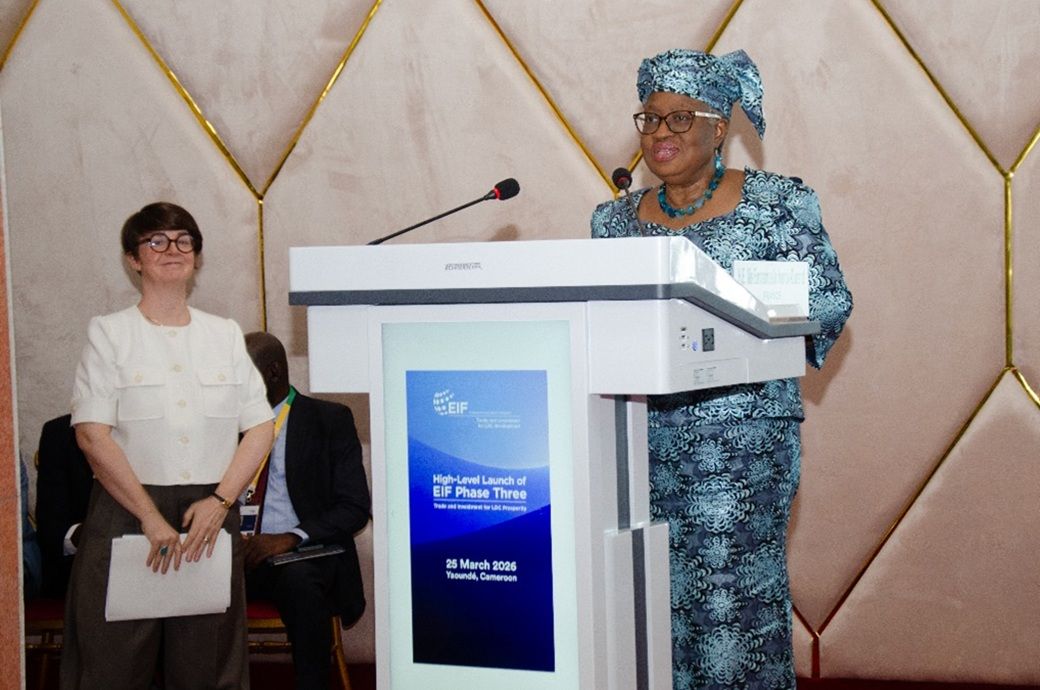
WTO Director-General Ngozi Okonjo-Iweala called for stronger partnerships to achieve the objectives of the Enhanced Integrated Framework’s (EIF) third phase, launched yesterday in Yaounde.
It aims to coordinate support for trade and investment priorities in LDCs.
The latest six-year phase has also secured fresh contribution pledges from Germany, Liechtenstein, Norway, Switzerland and the UK.
The new phase was launched at a side event to the 14th WTO Ministerial Conference (MC14) in Yaounde, Cameroon, co-organised by Cambodia, the United Arab Emirates and the EIF executive secretariat.
The third phase of the EIF introduces a shift from stand-alone projects to multi-year country programming. It is designed to help LDCs better integrate into the global trading system while addressing structural vulnerabilities and seizing new opportunities in areas such as digital trade, services, green value chains and regional integration.
The latest six-year phase also received new contribution pledges from Germany ($1.964 million), Liechtenstein (~$63,139), Norway ($4.15 million), Switzerland ($3.16 million) and the United Kingdom ($6.67 million).
“This third phase of the EIF comes at a defining moment for the LDCs and recently graduated countries. Familiar structural vulnerabilities are being compounded by a disrupted global trading system, power politics, debt pressures, climate change, and global economic uncertainty. At the same time, the current global context offers some important opportunities for LDCs to use trade to drive growth, development, and job creation,” Okonjo-Iweala said in a release issued by the WTO.
The DG also emphasised the need to scale up support and partnerships to match the ambition of the new phase.
Fibre2Fashion News Desk (DS)


Just Eat and Autotrader among five firms under investigation over online reviews

Australia’s Myer posts strong H1 FY26 sales growth, up 24.5% YoY

John Mellencamp wins Icon Award at 2026 iHeartRadio Music Awards

-
 Fashion1 week ago
Sales at US apparel, clothing accessories stores up 4% YoY in Jan 2026
-

 Entertainment1 week ago
Val Kilmer revived 1 year after death through AI
-
 Fashion1 week ago
US’ G-III Apparel’s FY26 sales fall 7% to $2.96 bn
-
 Business1 week ago
Brits cashing in jewellery as gold price hits record high
-

 Sports1 week ago
March Madness 2026 – How to watch in SA, start time, schedule, TV channel for NCAA championship basketball tournament
-

 Fashion6 days ago
China’s textile & apparel exports surge 17% to $50 bn in Jan-Feb 2026
-
 Business1 week ago
Video: The Effects of High Oil Prices
-
 Business6 days ago
Flipkart group CFO to leave co amid IPO plans – The Times of India