

Entertainment
NA expected to pass 27th Amendment Bill as crucial session resumes today

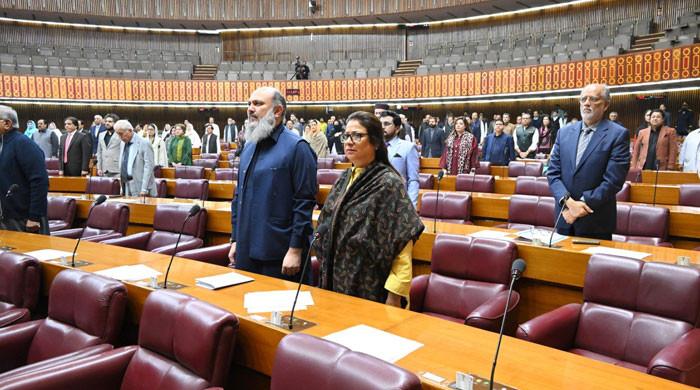
- Law Minister Tarar tabled bill in lower house yesterday.
- PTI’s Barrister Gohar calls tweaks “Baku Amendments”.
- 27th Amendment seeks to overhaul military, judicial structures.
The 27th Constitutional Amendment Bill, tabled by Law Minister Azam Nazeer Tarar in the National Assembly on Tuesday, is likely to be approved by the lower house today (Wednesday), as the PML-N-led ruling coalition holds the required two-thirds majority.
The 59-clause amendment, passed by the Senate on Monday, seeks to overhaul the country’s military and judicial structures. It was moved by the law minister and secured 64 votes in the 96-member House, with no votes against it, as opposition lawmakers boycotted the proceedings and tore up their copies in protest.
Apart from treasury members, ANP’s senators, PTI-backed Saifullah Abro, and JUI-F’s Ahmed Khan also supported the bill. In a surprise move, Abro refrained from joining the protest and later announced his resignation from the Senate.
The lower house session began half an hour late on Tuesday with prayers offered for PML-N Senator Irfan Siddiqui, who passed away after brief illness.
The 27th Constitutional Amendment Bill requires a two-thirds majority in the 336-member National Assembly for passage. The ruling coalition appears well-positioned to secure the numbers, with the PML-N holding 125 seats, the PPP 74, MQM-P 22, PML-Q four, Istehkam-e-Pakistan Party four, and one seat each held by the PML-Z, Balochistan Awami Party (BAP), and National Peoples Party.
In contrast, the opposition benches collectively have 103 members.
Tarar defends bill
Speaking on the floor of the NA a day earlier, Tarar said: “[The] Senate has passed the 27th Constitutional Amendment Bill with a two-thirds majority. In the joint parliamentary committee, the opposition should also have attended the session.”
During his speech, the opposition benches staged a strong protest over the 27th Constitutional Amendment and raised slogans.
“World over, constitutional benches handle matters related to the Constitution… judicial appointments are made through judicial commissions. In Pakistan, we have established a proper procedure and removed the powers of suo motu action in this bill,” said the law minister while explaining the 27th Amendment.
Tarar further explained the changes regarding judicial transfers, saying: “Previously, under Article 200, judges were transferred, and these transfers were often challenged. The judicial commission is now authorised to transfer judges. If a judge refuses a transfer, they will be considered retired. The commission will include five judges from the Supreme Court and Federal Constitutional Court, and two members each from the government and opposition.”
“Provincial matters and constitutional cases will be handled by the Federal Constitutional Court, while the Supreme Court will hear over 62,000 cases, including civil and other matters,” he added.
Tarar also highlighted the role of the military in Pakistan’s defence and the reforms proposed under the 27th Constitutional Amendment.
“The military played a crucial role when India attacked, and the entire House witnessed unity against the threat. After our victory, the Organisation of Islamic Cooperation (OIC) and Arab countries praised and supported us,” he added.
The law minister explained the status of military ranks, stating: “The appointment of the army chief is made under the Army Act. A Field Marshal is a rank held in many countries and remains a lifetime honour. Appointments in the armed forces are based on rank, and the Field Marshal distinction continues to be a lifelong title.”
He added: “After a Field Marshal receives the rank, it is necessary to bring it within constitutional limits. We were part of the war committee and observed the army chief demonstrating exceptional performance and skill.”
Tarar further touched on constitutional provisions regarding presidential exemption, saying: “A special exemption has been proposed for the president… if the president returns to public office, the exemption will end. We request that this matter be debated and then put to a vote.”
On the proposed 27th Amendment, Tarar said: “Out of 59, 47 amendments were made due to the establishment of the Federal Constitutional Court. I urge our opposition [bench members] to listen to each other and make constructive suggestions.
Gohar calls tweaks ‘Baku Amendments’
Pakistan Tehreek-e-Insaf (PTI) Chairman Barrister Gohar described the constitutional amendments as deeply problematic.
“Buildings constructed for personal gain are considered monuments of slavery,” he said.
Gohar referred to the legal tweaks as the “Baku Amendments”, saying that the “head of a nuclear state” was approving amendments from abroad, in a jibe at Prime Minister Shehbaz Sharif, who was on an official visit to Azerbaijan when the federal cabinet approved the 27th Constitutional Amendment draft.
He added that cases have been closed and sidelined to benefit certain interests. “Amending the constitution is a sensitive matter.”
“Today is a day of mourning for democracy, and steps are being taken to bury it,” he said. “We do not accept these Baku Amendments.”
He recalled that when the PDM government came to power for the first time, the first action taken was to amend the NAB Ordinance.
“Being answerable before the constitution and the law is what democracy is,” he said. “Accountability before the law is the supremacy of law. We make laws and then take exemption from the law. Are we bringing an elite class that will be above the law?” Gohar asked.
PTI chairman highlighted the ongoing corruption cases against President Asif Zardari, asking why he could not appear and deny the allegations. Barrister Gohar also referred to a precedent in Britain, saying the chief justice had told the monarch that the law is supreme.
“We will bring them to the bar of law and make them accountable,” he added.
Gohar also criticised the amendment process, stating that the chief justice of Pakistan had effectively been abolished and replaced with the “Chief Justice of the Supreme Court”.
He further noted that the amendments were passed with only two votes from dissenting members, and warned that such amendments cannot serve the public.
Highlights of new amendment
- Chief of Army Staff to assume role as Chief of Defence Forces
- Field Marshal, Marshal of Air Force, Admiral of Fleet titles to remain for life
- Federal Constitutional Court to be established
- Equal provincial representation approved in Federal Constitutional Court
- FCC empowered to take suo motu notice upon petitions
- Islamabad High Court to have one judge on FCC bench
- President and prime minister to play a key role in judicial appointments
- Supreme Court powers to be reduced, with some authorities shifted to the new court
- Presidential immunity limited if president assumes any public office after tenure
- Judges must serve five years in high court for eligibility of Constitutional Court
- Judicial Commission to decide transfer of high court judges
- Objections on transfers to be reviewed by Supreme Judicial Council

Hosted by Jane Pauley. Featured: The Vatican’s Mosaic Studio; a fight over history at West Bank archaeological sites; Dan Levy on his new series “Big Mistakes”; the creative talents behind “Hacks”; the latest on the Artemis II lunar mission; the works of Renaissance artist Raphael; and the beauty of moss.
Source link
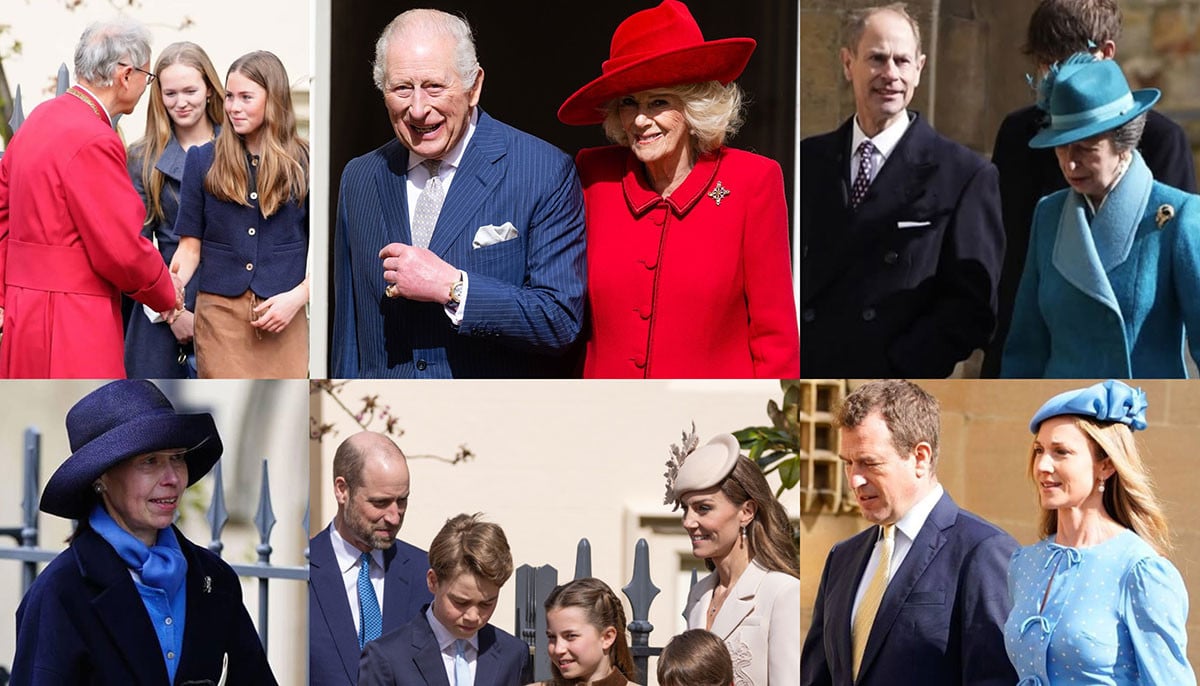
The Royal Family brought a burst of springtime charm to Windsor this Easter Sunday as King Charles and Queen Camilla led the festivities at St George’s Chapel.
Buckingham Palace shared a series of sunny snaps celebrating the occasion, following the announcement earlier this week that His Majesty would not issue an official Easter message.
The social media post featured a simple cross graphic with the message: “Happy Easter. He is risen!” alongside emojis of a chick hatching from an egg.
Before entering the chapel, the King shared a tender family moment, blowing a kiss to his three grandchildren and giving young Prince Louis a gentle tap on the shoulder.
Princess Kate marked the sovereign’s arrival with a perfect curtsy, standing beside the Earl of Wessex as the royal family filed into the service.
The Princess of Wales and Princess Charlotte were pictured, like two peas in a pod.
Kate revisited a tailored boucle and chiffon midi dress previously worn during a joint engagement with Princess Anne and topped it off with a new, custom wide-brim saucer hat.
Prince Edward, The Duke of Edinburgh, attended with his 18-year-old son, James, Earl of Wessex, making a rare public outing together.
Sophie, The Duchess of Edinburgh, and their daughter, Lady Louise Windsor, were absent.
Peter Phillips also joined the service, accompanied by his future stepdaughter, Harriet Sperling.

Raphael was believed to be 17 when he did this chalk sketch, likely a self-portrait. “What is really extraordinary is the perfection of his technique in drawing,” said curator Carmen Bambach.
CBS News
You can see in this chalk sketch, by a kid, what was coming … how, in an incredibly short time, Raphael would be regarded as one of the greatest artists of the Italian Renaissance, right up there with Michelangelo and Leonardo da Vinci. “I think posterity sometimes sees him in third place,” said Bambach. “I believe he is in equal place.”
Bambach spent eight years putting together the first comprehensive exhibition of Raphael’s work ever in the United States – 237 works in total. It has just opened at the Metropolitan Museum of Art in New York City.
Born in Urbino in 1483, Raphael’s precociousness exploded into brilliance when he moved to Florence at the age of 21. “He encounters Leonardo, who is very interested in, sort of, the way that an artist can let the creative juices flow on the paper,” said Bambach. “Raphael absorbs this, and all of a sudden, we see this tremendous sense of movement, of drama, storytelling. He’s able to pick the climactic point of any story. He’s got to be one of the most amazing storytellers that way.”
The humanity, the tenderness of a mother with her baby … his drawings and paintings of the Madonna and Child are beautiful exercises in wishful thinking.
National Gallery of Art, Washington, D.C., Andrew W. Mellon Collection 
“Mortality of women of child-bearing age was stratospheric, and the same thing for children,” Bambach said. “When one has Madonnas that look like they’re a beautiful picture of health, these bambini that are plump and delightful – you want to pinch them! – it’s like producing a kind of idealized universe that was entirely aspirational.”
As opposed to his portraits, which look like the real people he painted.
National Gallery of Art, Washington, D.C. 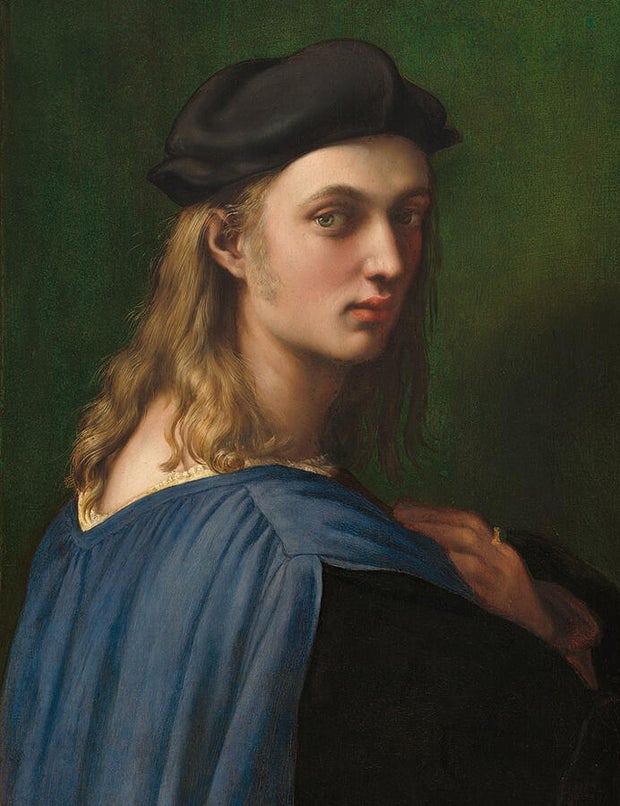
Bindo Altoviti was one of the pope’s bankers, and a friend of Raphael’s, who captured his gaze, the tendrils of hair down his back, the personification of sensuality. “Bindo Altoviti is kind of my favorite portrait in that I have always had a crush on that guy,” said Bambach.
Raphael’s friendships with well-connected patrons led to bigger and bigger commissions, and ultimately to Rome and the Vatican, at the age of 25, to produce frescoes for the pope’s private offices and library. (They are reproduced in the Met show at ¾ size.)
He slipped a likeness of himself into the most famous, “The School of Athens,” and of Leonardo. Some scholars say one brooding figure is Michelangelo.
Bildagentur-online/Universal Images Group via Getty Images 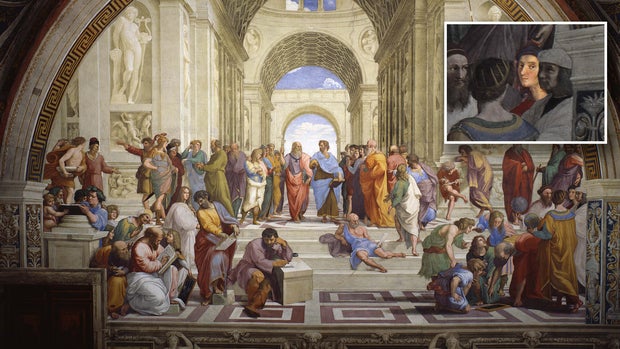
Bambach said, “Michelangelo was intensely envious of Raphael. Raphael was the tragedy that happened to Michelangelo in many ways, because it came so easily to him.”
Raphael was commissioned to create the designs for enormous tapestries meant to hang directly below Michelangelo’s Sistine Chapel ceiling.
Of the artist’s drawing of an old and young man, Bambach noted, “This is the most beautiful drawing that Raphael ever produced. For somebody to get that foreshortening of the fingers, and the different planes of the hands in a credible way, this is how you tell the greatest artists from somebody who is just good.”
CBS News 
The drawing was for “The Transfiguration,” what would turn out to be his last painting.
On April 6, 1520, his 37th birthday, Raphael died of a fever in Rome. The inscription on his tomb in the Pantheon reads, “While he was alive, Nature feared she would be surpassed by him. When he died, she feared that she would die, too.”
For more info:
Story produced by Robert Marston. Editor: Remington Korper.
See also:


4/5: Sunday Morning

Royal Family out in full bloom with Kate and Charlotte like two peas in pod

The sublime perfection of Raphael

-

 Sports1 week ago
USMNT handed reality check by Doku, Belgium ahead of World Cup
-

 Sports1 week ago
2026 NCAA men’s hockey tournament: Schedule, results
-

 Fashion1 week ago
EU apparel imports slump 15.48% YoY in Jan; Bangladesh hardest hit
-
Uncategorized6 days ago
[CinePlex360] Please moderate: “Further tariff
-
Uncategorized1 week ago
[CinePlex360] Please moderate: “Apple scrapping
-
 Entertainment1 week ago
The Avett Brothers’ bassist explains why he wrote a book about John Quincy Adams
-

 Sports1 week ago
Man City show why they are worthy WSL title winners as tired United wilt
-

 Entertainment1 week ago
Demystifying the PTI