

Business
Nike tops earnings estimates but shares fall as China sales plunge, tariffs hit profits


A shopper carries Nike bags in San Francisco, California, US, on Wednesday, Dec. 17, 2025.
David Paul Morris | Bloomberg | Getty Images
Nike on Thursday posted quarterly earnings and revenue that topped Wall Street’s estimates, as strength in North America helped to offset a plunge in China sales.
The company’s stock slid more than 6% in extended trading Thursday, as investors digested the weakness in China and the sustained hit Nike is taking from higher tariffs.
Here’s what Nike reported for its second fiscal quarter of 2026, according to consensus estimates from LSEG:
- Earnings per share: 53 cents vs. 38 cents expected
- Revenue: $12.43 billion vs. $12.22 billion expected
The athletic apparel retailer said sales in North America rose 9% to $5.63 billion. But revenue in its Greater China market dropped 17% to $1.42 billion.
The sneaker company is just over a year into CEO Elliott Hill’s turnaround strategy, focusing on regaining its growth and market share, clearing out old inventory and investing in wholesale relationships.
“Fiscal year ’26 continues to be a year of taking action to rightsize our classics business, return Nike digital to a premium experience, diversify our product portfolio, deepen our consumer connection, strengthen our partner relationships and realign our teams and leadership,” Hill said on a call with analysts. “And I say we’re in the middle inning of our comeback.”
“We’re nowhere near our potential,” he added.
Hill said Nike’s improvements in its China market are “not happening at the level or the pace we need to drive wider change,” though he said the country remains one of the company’s most powerful long-term opportunities.
Nike expects fiscal third quarter revenues to fall by a low single digit percentage, with modest growth in North America. It also anticipates gross margins will drop 1.75 to 2.25 percentage points – including a 3.15 percentage point hit from tariffs.
The company said wholesale revenues climbed 8% to $7.5 billion during the quarter. But direct sales — which were a focus for Nike in the years before Hill took over and moved away from the strategy — fell 8% to $4.6 billion.
Nike has also been feeling the impact of tariff increases. It said Thursday that its gross margin decreased by 3 percentage points and inventories dropped 3% primarily due to higher tariffs.
The sneaker company has been reporting weakness in its Converse brand, too. In its first fiscal quarter, Nike said Converse sales dropped 27% – on Thursday, it reported a 30% drop in revenues for the sneaker brand.
Despite the weakness in some parts of Nike’s business, the company highlighted some areas of strength and new initiatives ahead. CFO Matt Friend said on the call that Nike.com posted its best Black Friday ever this year, partially driven by its Air Jordan “Black Cat” launch.
Nike also plans to launch a new footwear platform in January called Nike Mind, which aims to help athletes prepare for performance and competition, Hill said on the call.
Nike has been making larger internal changes under Hill.
Earlier this month, Nike underwent leadership changes to “remove layers,” according to Hill. Under its “Win Now” strategy, the company announced that Chief Commercial Officer Craig Williams would leave the sneaker giant.
Hill called the shakeup a move “about growth and offense.”
“Collectively, these changes amount to us eliminating layers and better positioning Nike to continue to have an impact the way only Nike can,” Hill said in a statement at the time.
Nike shares have dropped more than 13% this year as of Thursday’s close.



Low-income families are being offered help with the cost of food during the Easter holidays.
Source link

new video loaded: What Soaring Fuel Costs Mean for Your Air Travel
By Niraj Chokshi, Léo Hamelin, Stephanie Swart, Rebecca Suner and Lauren Pruitt
March 25, 2026
Business
Delay in FSSAI finalising front of pack labelling rules unusual by its own norm – The Times of India
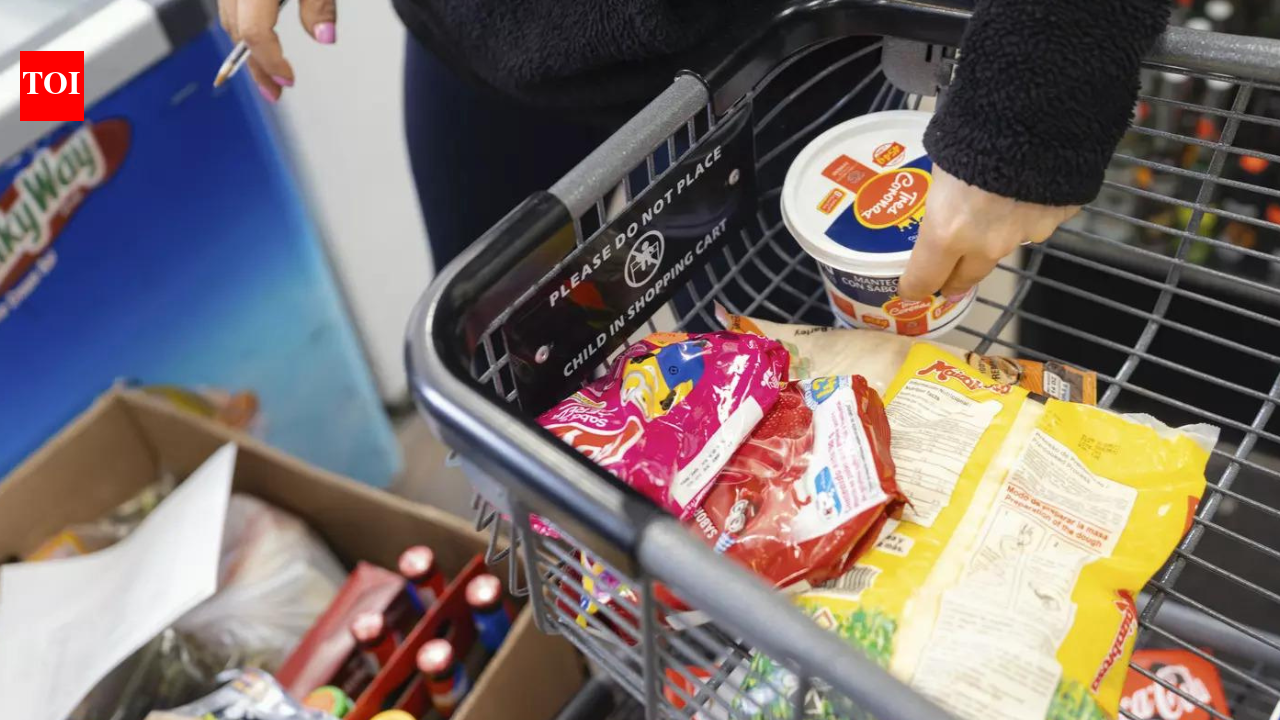
While the Food Safety and Standards Authority of India (FSSAI) has claimed in the Supreme Court that the framing of front-of-pack labelling (FOPL) regulations would take longer and sought more time, a look at several regulations framed by the authority in the last ten years shows that the average time taken to frame one or make amendments to existing ones has been about two years. In the case of the FOPL, the process has been dragging on for about a decade.After framing guidelines in 2014 which included front-of-pack labelling specifying how much fat, sugar or salt a packaged food contained, when the FSSAI put it in the public domain in 2015, it had stated that the guidelines would be “converted into regulation in due course after following the process of inviting suggestions and comments, suggestions etc. from various stakeholders”. FSSAI put out the draft Food Safety and Standards (Labelling and Display) Regulations, 2018 in public domain in April 2018. However, since then there have been half a dozen stakeholder consultations and more drafts put out, but no regulation in sight yet.In response to a public interest petition in the Supreme Court seeking directions to FSSAI to make FOPL regarding high fat, sugar and salt mandatory for packaged foods, the court has been monitoring the process even as the authority has been seeking repeated extensions. In its latest affidavit in court, the FSSAI laid out a long process before the Supreme Court.It told the court that it is “contemplating” a tabular or pictorial representation to reflect high fat sugar or salt on front of pack labelling. It stated that it is a complex matter “requiring further consultation and examination” and hence stakeholder consultation is proposed before deciding on the modalities of FOPL. The latest stakeholder consultation had over 60 food industry and industry association representatives and just two public health experts representing civil society or public health interest.There remain several steps:1. After stakeholder consultations a draft amendment will be prepared2. Draft amendment will be placed before scientific panel (consist of nine eminent food scientists from different government organizations/institutions). Scientific committee comprising of chairpersons of the 21 scientific panels and six independent members, FSSAI and Health ministry “for due consideration”3. To include amendment in the regulation a draft regulation including the proposed amendment/s is placed before the scientific panel concerned4.Recommendations of the scientific panel will be placed before the scientific committee5. On endorsement of the scientific committee it will be placed before FSSAI for approval and if there are substantial changes in the notified draft regulation, another draft regulation will have to be notified6. Once approved by FSSAI, the draft or final regulation is sent to health ministry7. After ministry approval, if it is a draft regulation, it has to be notified in the gazette for public comments giving 60 days’ time and the entire process spelt out above is repeated before it is finally notified.8. In case what the health ministry approves is the final regulation, it has to be sent to the legislative department of the law ministry for vetting followed by approval of the health ministry. The approved final regulation is published in the Gazette of India for implementation.In short, the FSSAI stated in court that the regulation is far from becoming a reality any time soon. However, the longest time FSSAI has taken for framing any of the existing regulations or amendments has been over three years. The only other regulation that the FSSAI has not framed even after seven years is the Food Safety and Standards (Genetically Modified and Engineered Foods) Regulations which have been in the works since 2019.Average time to bring in various regulations/amendments to regulations
| New regulations | Draft notified in the gazette | Put in public domain for feedback from stakeholders | Date of gazette notification | Gap between draft and final notification |
| Food Safety and Standards (Health Supplements, Nutraceuticals, Food for Special Dietary Use, Food for Special Medical Purpose, Functional Food and Novel Food) Regulations, 2016. | Jul 30, 2015 | Sep 11, 2015 | Dec 23, 2016 | 17 months |
| Food Safety and Standards (Alcoholic Beverages) Regulations, 2018 | Sep 5, 2016 | Sep 9, 2016 | Mar 19, 2018 | 18 months |
| Food Safety and Standards (Fortification of Foods) Regulations, 2018 | Dec 23, 2016 | Jan 3, 2017 | Aug 2, 2018 | 19 months |
| Food Safety and Standards (Organic Foods) Regulations, 2017 | Jun 19, 2017 | Jun 22, 2017 | Dec 29, 2017 | 6 months |
| Food Safety and Standards (Advertising and Claims) Regulations, 2018 | Mar 13, 2018 | Mar 23, 2018 | Nov 19, 2018 | 8 months |
| Food Safety and Standards (Packaging) Regulations, 2018 | Mar 19, 2018 | Apr 2, 2018 | Dec 24, 2018 | 9 months |
| Regulation amendments | ||||
| Food Safety and Standards (Contaminants, toxins and Residues) First Amendment Regulations, 2024 | Aug 20, 2020 | Aug 26, 2020 | Oct 17, 2024 | 26 months |
| Food Safety and Standards (Packaging) First Amendment Regulations, 2025. | May 17, 2022 | May 24, 2022 | Mar 28, 2025 | 34 months |
| Food Safety and Standards (Food Products Standards and Food Additives) First Amendment Regulations, 2024. | May 25, 2022 | May 31, 2022 | Oct 21, 2024 | 29 months |
| Food Safety and Standards (Food Products Standards and Food Additives) First Amendment Regulations, 2025 | Oct 31, 2022 | Nov 3, 2022 | Jul 10, 2025 | 32 months |
| Food Safety and Standards (Prohibition and Restrictions on Sales) first Amendment Regulations, 2024 | Apr 27, 2023 | Apr 28, 2023 | Oct 17, 2024 | 18 months |


Graham Carey’s partner Rachel Borthwick passes away in India after breast cancer battle

Cristiano Ronaldo’s eldest son trained with Real Madrid’s academy – sources

"NCIS" star Rocky Carroll on shocking twist in show's 500th episode

-

 Fashion1 week ago
Sales at US apparel, clothing accessories stores up 4% YoY in Jan 2026
-

 Tech1 week ago
Justice Department Says Anthropic Can’t Be Trusted With Warfighting Systems
-
 Business1 week ago
Stocks and pound rise as US rate call approaches
-

 Entertainment7 days ago
Val Kilmer revived 1 year after death through AI
-

 Sports1 week ago
March Madness 2026 – How to watch in SA, start time, schedule, TV channel for NCAA championship basketball tournament
-
 Business1 week ago
Brits cashing in jewellery as gold price hits record high
-

 Entertainment1 week ago
With few new leads 45 days after Nancy Guthrie’s disappearance, investigation “becomes much harder,” expert says
-

 Politics1 week ago
Iran strikes Tel Aviv with cluster-warhead missiles in retaliation of Larijani’s martyrdom