

Business
Reeves could raise billions without breaking Labour pledges – IFS


Rachel Reeves could raise tens of billions from tax reforms without breaking Labour’s manifesto pledges but must avoid “half-baked fixes” to Britain’s economic woes at the Budget, leading economists have said.
The Government is under pressure to balance the books ahead of November’s autumn statement amid warnings of a black hole estimated to be as much as £50 billion in the public finances.
But in a wide-ranging report, the Institute for Fiscal Studies urged the Chancellor to resist “simply hiking rates” without making other changes to an “unfair” and “inefficient” tax system.
It also warned that restricting income tax relief on pension contributions “should be avoided” and repeated its cautions against an annual wealth tax, which it says would penalise savers, or increasing stamp duty.
Among the options available to the Chancellor as set out by the IFS are:
– Ending capital gains tax relief on death, which allows for assets to be inherited without paying CGT on the increase in value over the deceased person’s lifetime, to raise £2.3 billion in 2029-30.
– Impose a “one-off” tax on wealth, while avoiding what it described as “serious drawbacks” of a recurring wealth tax.
– Double council tax rates on the top two property bands to raise £4.4 billion. Any extra cash from changes to council tax would flow to local authorities rather than central government, but Ms Reeves could in turn reduce the grants paid to local authorities if she wanted to bolster the Treasury’s coffers, the IFS said.
– Reforming death duties to abolish the additional £175,000 tax-free allowance that can be used when passing on a primary residence to a direct descendant, raising around £6 billion.
– Increasing the bank levy and the bank surcharge, which taken together will already raise a total of £2.4 billion in 2025-26. A one percentage point increase in the bank surcharge would raise around £0.4 billion in 2029-30.
– Tackling non-compliance to narrow a widening corporation tax gap between the amount of tax the Government thinks should be paid and how much it actually collects.
“It would be possible for the Chancellor to raise tens of billions of pounds a year more in revenue without breaking the letter of Labour’s manifesto promise not to increase the ‘big three’ taxes.
“But doing so would not be straightforward,” the IFS said.
On the other hand, extending the freeze on personal tax thresholds including national insurance contributions (NICs) further would be expected to raise around £10.4 billion a year from 2029-30.
But this would amount to a breach of Labour’s manifesto pledge not to increase taxes for “working people” which includes income tax, national insurance and VAT, the IFS said.
The think tank also called for a wider overhaul of the council tax system, arguing that banding is still based on the value of properties as of 1991 and must be updated to end a “regressive” and “hard to justify” rate structure.
It said a “good end goal” would be to replace stamp duty on housing and council tax with a “new recurrent property tax” proportionate to updated values.
“Changing rates and thresholds is all very well, but unless the Chancellor is willing to pursue genuine reform it will be taxpayers that shoulder the cost of her neglect,” the report, which forms a chapter in the IFS’ wider budget assessment for 2025, says.
Economists have warned Ms Reeves is set for a £41 billion shortfall on her self-imposed rule of balancing day-to-day spending with tax receipts in 2029-30 ahead of her Budget next month.
Isaac Delestre, a senior research economist at the think tank and an author of the chapter, said Ms Reeves would have “fallen short” if she limits her ambition to a dash for revenue without wider reform.
“Almost any package of tax rises is likely to weigh on growth, but by tackling some of the inefficiency and unfairness in our existing tax system, the Chancellor could limit the economic damage,” he said.
“The last thing we need in November is directionless tinkering and half-baked fixes. There is an opportunity here.
“The Chancellor should use this Budget to take real steps down the road towards a more rational tax system that is better geared to promoting the prosperity and well-being of taxpayers.”

The boss of insurer Aviva has cautioned that a lengthy conflict in the Middle East could send the cost of vehicle parts and repairs surging in an echo of the aftermath seen after Russia’s invasion of Ukraine.
Chief executive Amanda Blanc said the group has seen limited claims so far relating to the US-Israel war with Iran, but flagged the potential for claims costs to jump if supply chains are badly disrupted for a long time.
She said: “We have a good case study on this in terms of the Ukraine situation back in 2022 and the impact on the supply chain, which had an inflationary impact on vehicle parts and replacement vehicles.
“Obviously, if this goes on for a prolonged period of time, we would expect that this could have some impact, but to speak about this from an Aviva perspective, we are very well placed to manage that with our supply chain and our owned garage network.”
Ms Blanc added: “We will take action as necessary to make sure we look after our customers and price accordingly for any new inflationary impact.”
She said there had been “very limited” travel claims so far.
Ms Blanc added: “We have had calls from customers asking about whether they should travel and those sorts of things, and we are pointing them to the Foreign Office guidance on that.”
Full-year results from Aviva on Thursday showed annual earnings leaped 25% higher, while the firm also announced it was resuming share buybacks as it continues to benefit from its £3.7 billion takeover of Direct Line.
The group unveiled an earnings haul of £2.2 billion for 2025, up from £1.8 billion in 2024, including a £174 million contribution from Direct Line, helping the group hit its financial targets a year early.
Aviva unveiled a £350 million share buyback after putting these on hold due to the Direct Line deal, which completed last year.
Ms Blanc cheered an “outstanding performance”.
She said: “We have transformed Aviva over the last five years and whilst we have made significant progress, there is so much more to come.”
Artificial intelligence (AI) is also a big area of focus for the firm, according to Ms Blanc.
“We have clear strengths in artificial intelligence which are creating major opportunities to transform claims, underwriting and customer experience,” she said.

The firm was unable to cope during high demand, Ofwat says, leading to “immense stress” for customers.
Source link
Business
Middle East heat may ripple across India’s energy supply chain, flags Goldman Sachs – The Times of India
As tensions continue to heat up in the Middle East, concerns are raising about disruptions to one of the world’s most critical energy shipping routes, the Strait of Hormuz. Any disruption could significantly affect major oil-importing countries such as India, as the narrow Strait of Hormuz is central to global energy trade. The strait sees almost 20 million barrels of oil passing through each day, or about a fifth of the world’s consumption, pass through the route. The waterway also carries roughly 19% of global liquefied natural gas (LNG) shipments, making it a crucial corridor for energy-importing economies.A recent report by Goldman Sachs has flagged early signs of stress in the region. The report warned that tanker traffic through the Strait of Hormuz has already begun showing signs of disruption, with shipping firms, oil producers and insurers adopting a cautious approach following reports of damaged vessels in nearby waters.According to the firm, financial markets have already begun factoring in the geopolitical risk. Oil prices currently carry an estimated risk premium of $18-per-barrel, reflecting the potential market impact if energy flows through the Strait of Hormuz were disrupted for about a month.
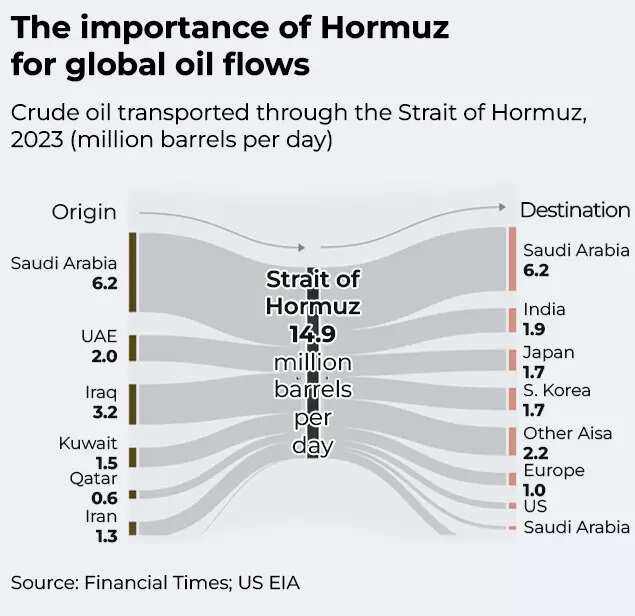
Even is the oil facilities are not directly damaged, a shutdown of the shipping route could expose a significant portion of global supply. The report estimates that in an event of full closure, about 16 million barrels per day of oil flows could be affected, despite the availability of some pipeline routes designed to bypass the strait.And the risks are not limited to crude oil shipments with almost 80 million tonnes of LNG exports annually, much of it from Qatar, moving through the passage. Any prolonged disruption could tighten gas supply globally and potentially drive European benchmark gas prices back to levels seen during the 2022 energy crisis.
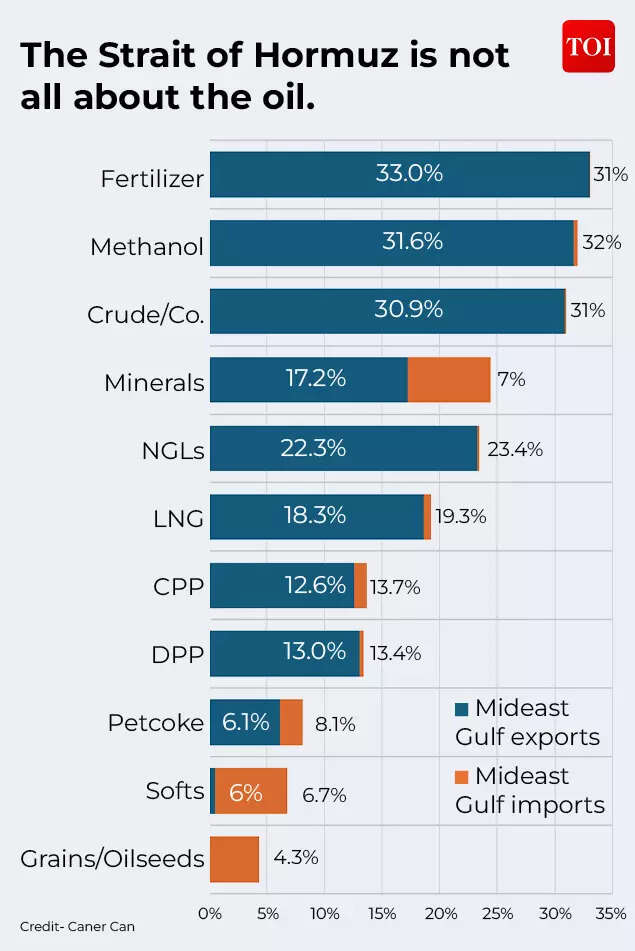
Asian economies stand among the most exposed to such disruptions. Major importers such as China, India, Japan and South Korea depend heavily on oil and LNG shipments that transit through the strategic corridor.While global oil inventories and spare production capacity could help cushion short-term shocks, the report warned that sustained disruption to Gulf shipping routes could trigger sharp volatility in global energy markets and push prices higher across oil, gas and refined fuel products.Market participants and governments are closely watching tanker traffic in the Strait of Hormuz, along with diplomatic and military developments involving the United States, Iran and Gulf nations, to assess whether the current disruptions remain temporary or escalate into a broader energy supply shock.


China targets 4.5 to 5% GDP growth for 2026

Michigan parts ways with alleged mistress of fired football coach Sherrone Moore
Aviva flags potential for Iran conflict to send claims costs rising

What are Iran’s ballistic missile capabilities?

India Us Trade Deal: Fresh look at India-US trade deal? May be ‘rebalanced’ if circumstances change, says Piyush Goyal – The Times of India

Attock Cement’s acquisition approved | The Express Tribune

-
 Politics1 week ago
What are Iran’s ballistic missile capabilities?
-
Business6 days ago
India Us Trade Deal: Fresh look at India-US trade deal? May be ‘rebalanced’ if circumstances change, says Piyush Goyal – The Times of India
-
Business7 days ago
Attock Cement’s acquisition approved | The Express Tribune
-

 Politics1 week ago
US arrests ex-Air Force pilot for ‘training’ Chinese military
-
 Business1 week ago
Households set for lower energy bills amid price cap shake-up
-

 Fashion7 days ago
Policy easing drives Argentina’s garment import surge in 2025
-

 Sports6 days ago
LPGA legend shares her feelings about US women’s Olympic wins: ‘Gets me really emotional’
-

 Fashion6 days ago
Texwin Spinning showcasing premium cotton yarn range at VIATT 2026