

Business
Removed Ben & Jerry’s chair says Magnum aimed to ‘smear’ her

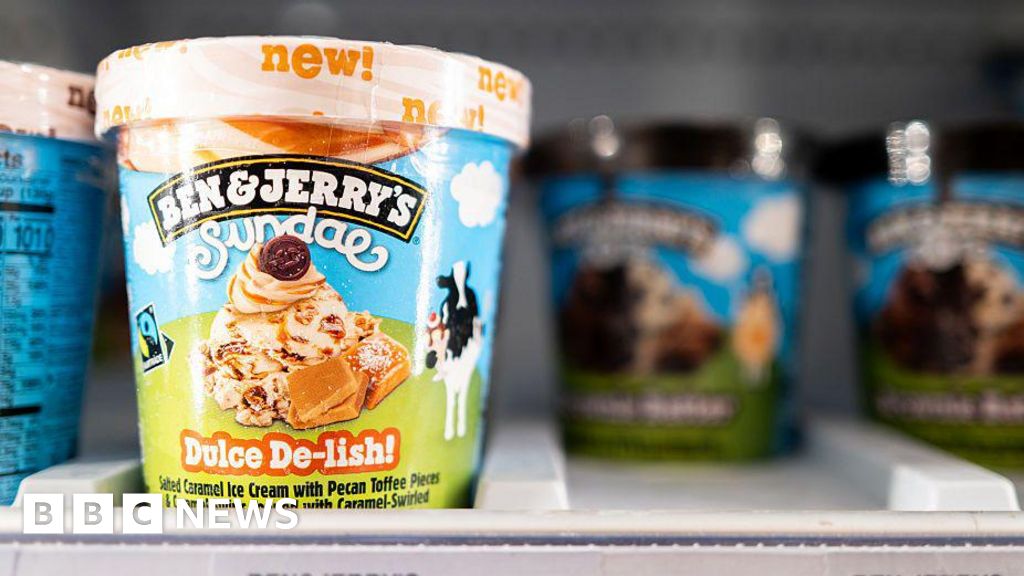
The ousted chair of Ben & Jerry’s has accused the company which owns the brand of threatening to launch a public smear campaign against her.
Anuradha Mittal, who chaired Ben & Jerry’s independent board for seven years, told the BBC that Magnum had threatened to publish “defamatory statements” about her if she did not step down from her role.
It relates to an increasingly bitter dispute between the Vermont-based activist ice cream maker and its owner over the independence of the board and its freedom to pursue its social missions.
Magnum said in its view Mittal “no longer met the criteria to serve” on the board, following an investigation it had commissioned by external advisors.
In a statement on Monday, Magnum outlined changes to the way the board operates including a nine-year limit for people serving on it.
As well as Mittal, who said she had received a letter telling her she had been removed from the board, two other board members will be required to leave as a result.
It also said that an audit of the Ben & Jerry’s Foundation, a charitable organisation, had “identified a series of material deficiencies in financial controls, governance and other compliance policies, including conflicts of interest”.
Speaking to the BBC’s World Business Report, Mittal said there had been an escalation of the friction between Ben & Jerry’s board and its owner, over the brand’s independence, social mission and integrity.
“For several years now, we have been resisting their overreach, including their efforts to muzzle us from speaking out for human rights, for peace,” she said.
The brand, which is also known for the playful puns in its flavour names, was owned by Unilever until earlier this month, when the household goods giant spun off its ice cream unit to create, Magnum Ice Cream Company.
Ben & Jerry’s was sold to Unilever in 2000 in a deal which allowed it to retain an independent board and the right to make decisions about its social mission.
This was a frequent source of friction while owned by Unilever.
In 2021, Ben & Jerry’s refused to sell its products in areas occupied by Israel, resulting in its Israeli operation being sold by Unilever to a local licensee, and in October, Ben Cohen said it was prevented from launching an ice cream which expressed “solidarity with Palestine”.
This row has now been inherited by Magnum, culminating in this week’s stand-off, and Mittal’s removal.
“This October, Unilever-Magnum executives threatened me with defamatory statements in their forthcoming prospectus if I did not resign,” Mittal said.
“At the same time, they offered me a prominent role in a multimillion dollar Unilever-funded non-profit if I gave in,” she added.
She said she had turned down that “inappropriate” offer.
Magnum is now the world’s largest ice cream maker, with its brands include Cornetto, Wall’s and Carte D’Or.
Mittal, founder of the Oakland Institute, a human rights and development focused think tank in California, described Magnum’s approach as a “public smear campaign” and said the allegations were unfounded.
One of the firm’s original founders Jerry Greenfield left the firm in September saying he felt its social mission was being stifled. The other, Ben Cohen, has also hit out at Magnum saying it was “not fit” to own the firm.
In a statement a spokesperson for Magnum said the steps it had taken were aimed at strengthening corporate governance and to “reaffirm the responsibilities of the Board of Ben & Jerry’s”.
“These actions aim to preserve and enhance the brand’s historical social mission and safeguard its essential integrity,” a spokesperson said.
When Ben & Jerry’s was created in 1978 it made its mark selling flavours such as Cherry Garcia named after the guitarist from rock band Grateful Dead, Bohemian Raspberry, a play on the Queen track, and the now discontinued Vermonty Python.
Magnum said in its statement: “We remain unequivocally committed to Ben & Jerry’s three-part mission – product, economic and social – and its progressive, non-partisan values.
“Ben & Jerry’s continues to advocate for a range of causes and be a bold voice for social justice, as a glance at its social media channels demonstrates.”

Low-income families are being offered help with the cost of food during the Easter holidays.
Source link

new video loaded: What Soaring Fuel Costs Mean for Your Air Travel
By Niraj Chokshi, Léo Hamelin, Stephanie Swart, Rebecca Suner and Lauren Pruitt
March 25, 2026
Business
Delay in FSSAI finalising front of pack labelling rules unusual by its own norm – The Times of India
While the Food Safety and Standards Authority of India (FSSAI) has claimed in the Supreme Court that the framing of front-of-pack labelling (FOPL) regulations would take longer and sought more time, a look at several regulations framed by the authority in the last ten years shows that the average time taken to frame one or make amendments to existing ones has been about two years. In the case of the FOPL, the process has been dragging on for about a decade.After framing guidelines in 2014 which included front-of-pack labelling specifying how much fat, sugar or salt a packaged food contained, when the FSSAI put it in the public domain in 2015, it had stated that the guidelines would be “converted into regulation in due course after following the process of inviting suggestions and comments, suggestions etc. from various stakeholders”. FSSAI put out the draft Food Safety and Standards (Labelling and Display) Regulations, 2018 in public domain in April 2018. However, since then there have been half a dozen stakeholder consultations and more drafts put out, but no regulation in sight yet.In response to a public interest petition in the Supreme Court seeking directions to FSSAI to make FOPL regarding high fat, sugar and salt mandatory for packaged foods, the court has been monitoring the process even as the authority has been seeking repeated extensions. In its latest affidavit in court, the FSSAI laid out a long process before the Supreme Court.It told the court that it is “contemplating” a tabular or pictorial representation to reflect high fat sugar or salt on front of pack labelling. It stated that it is a complex matter “requiring further consultation and examination” and hence stakeholder consultation is proposed before deciding on the modalities of FOPL. The latest stakeholder consultation had over 60 food industry and industry association representatives and just two public health experts representing civil society or public health interest.There remain several steps:1. After stakeholder consultations a draft amendment will be prepared2. Draft amendment will be placed before scientific panel (consist of nine eminent food scientists from different government organizations/institutions). Scientific committee comprising of chairpersons of the 21 scientific panels and six independent members, FSSAI and Health ministry “for due consideration”3. To include amendment in the regulation a draft regulation including the proposed amendment/s is placed before the scientific panel concerned4.Recommendations of the scientific panel will be placed before the scientific committee5. On endorsement of the scientific committee it will be placed before FSSAI for approval and if there are substantial changes in the notified draft regulation, another draft regulation will have to be notified6. Once approved by FSSAI, the draft or final regulation is sent to health ministry7. After ministry approval, if it is a draft regulation, it has to be notified in the gazette for public comments giving 60 days’ time and the entire process spelt out above is repeated before it is finally notified.8. In case what the health ministry approves is the final regulation, it has to be sent to the legislative department of the law ministry for vetting followed by approval of the health ministry. The approved final regulation is published in the Gazette of India for implementation.In short, the FSSAI stated in court that the regulation is far from becoming a reality any time soon. However, the longest time FSSAI has taken for framing any of the existing regulations or amendments has been over three years. The only other regulation that the FSSAI has not framed even after seven years is the Food Safety and Standards (Genetically Modified and Engineered Foods) Regulations which have been in the works since 2019.Average time to bring in various regulations/amendments to regulations
| New regulations | Draft notified in the gazette | Put in public domain for feedback from stakeholders | Date of gazette notification | Gap between draft and final notification |
| Food Safety and Standards (Health Supplements, Nutraceuticals, Food for Special Dietary Use, Food for Special Medical Purpose, Functional Food and Novel Food) Regulations, 2016. | Jul 30, 2015 | Sep 11, 2015 | Dec 23, 2016 | 17 months |
| Food Safety and Standards (Alcoholic Beverages) Regulations, 2018 | Sep 5, 2016 | Sep 9, 2016 | Mar 19, 2018 | 18 months |
| Food Safety and Standards (Fortification of Foods) Regulations, 2018 | Dec 23, 2016 | Jan 3, 2017 | Aug 2, 2018 | 19 months |
| Food Safety and Standards (Organic Foods) Regulations, 2017 | Jun 19, 2017 | Jun 22, 2017 | Dec 29, 2017 | 6 months |
| Food Safety and Standards (Advertising and Claims) Regulations, 2018 | Mar 13, 2018 | Mar 23, 2018 | Nov 19, 2018 | 8 months |
| Food Safety and Standards (Packaging) Regulations, 2018 | Mar 19, 2018 | Apr 2, 2018 | Dec 24, 2018 | 9 months |
| Regulation amendments | ||||
| Food Safety and Standards (Contaminants, toxins and Residues) First Amendment Regulations, 2024 | Aug 20, 2020 | Aug 26, 2020 | Oct 17, 2024 | 26 months |
| Food Safety and Standards (Packaging) First Amendment Regulations, 2025. | May 17, 2022 | May 24, 2022 | Mar 28, 2025 | 34 months |
| Food Safety and Standards (Food Products Standards and Food Additives) First Amendment Regulations, 2024. | May 25, 2022 | May 31, 2022 | Oct 21, 2024 | 29 months |
| Food Safety and Standards (Food Products Standards and Food Additives) First Amendment Regulations, 2025 | Oct 31, 2022 | Nov 3, 2022 | Jul 10, 2025 | 32 months |
| Food Safety and Standards (Prohibition and Restrictions on Sales) first Amendment Regulations, 2024 | Apr 27, 2023 | Apr 28, 2023 | Oct 17, 2024 | 18 months |


Graham Carey’s partner Rachel Borthwick passes away in India after breast cancer battle

Cristiano Ronaldo’s eldest son trained with Real Madrid’s academy – sources

"NCIS" star Rocky Carroll on shocking twist in show's 500th episode

-

 Fashion1 week ago
Sales at US apparel, clothing accessories stores up 4% YoY in Jan 2026
-

 Tech1 week ago
Justice Department Says Anthropic Can’t Be Trusted With Warfighting Systems
-
 Business1 week ago
Stocks and pound rise as US rate call approaches
-

 Entertainment7 days ago
Val Kilmer revived 1 year after death through AI
-

 Sports1 week ago
March Madness 2026 – How to watch in SA, start time, schedule, TV channel for NCAA championship basketball tournament
-
 Business1 week ago
Brits cashing in jewellery as gold price hits record high
-

 Sports1 week ago
WBC championship: USA-Venezuela preview, live updates, analysis
-

 Tech1 week ago
Meta Is Shutting Down Horizon Worlds on Meta Quest