

Business
Rising share prices propel Pakistan Stock Exchange to all-time high – SUCH TV


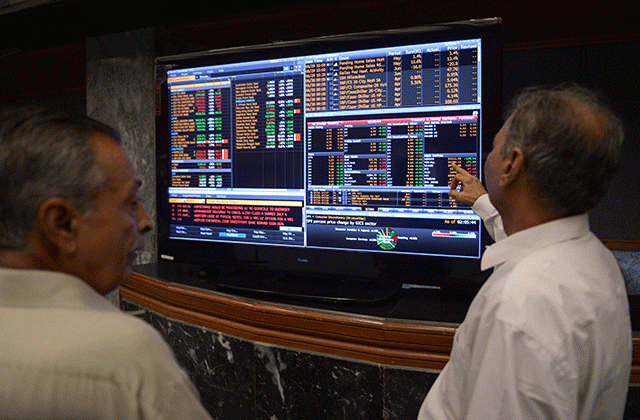
The Pakistan Stock Exchange (PSX) opened the week with a bang as share price went through the roof tossing the index to another historic level on Monday. At 12.15 pm, the PSX’s benchmark KSE-100 index was hovering at 187,144.34, an increase of 2,045.51 points or 1.09%.
Out of 562 active companies in the market, share prices of 304 companies advanced, 146 declined, while 112 remained unchanged.
Buying interest was observed in key sectors, including automobile assemblers, cement, commercial banks, fertilizer, oil and gas exploration companies, OMCs, power generation, and refinery.
Index-heavy stocks, including ARL, HUBCO, MARI, OGDC, POL, PPL, PSO, SNGPL, SSGC, MCB, MEBL, and NBP, traded in the green.
Analysts attributed the buying rally to expectations of a policy rate cut in the upcoming Monetary Policy Committee (MPC) meeting, which is scheduled for 26 January 2026.
Earlier on Friday, the PSX had staged a strong recovery, snapping days-long bearish momentum as increasing forex reserves had lifted investor sentiments.
The KSE-100 index gained a whopping 3,159.72 points to climb to 184,616.05 points, marking a positive change of 1.74% compared to the previous close of 181,456.33 points.
Pakistan’s foreign exchange reserves inched up by $16 million over the past week, according to figures released by the State Bank of Pakistan.
The central bank said its official reserves rose from $16.0557 billion to $16.0718 billion, showing a modest gain during the week.
Overall, the country’s total reserves climbed to $21.2484 billion.
The State Bank also noted that commercial banks’ holdings went up by $5.6 million, reaching $5.1927 billion.
Officials said the uptick offers some breathing space for the economy, even as the country continues to keep a close watch on external inflows and outflows.



Business
Stock market today: Which are the top losers and gainers on March 6- check list – The Times of India

Benchmark equity indices Sensex and Nifty fell sharply on Friday, retreating by more than 1 per cent after a brief recovery in the previous session as escalating tensions in West Asia and surging crude oil prices weighed on investor sentiment.The 30-share BSE Sensex declined 1,097 points, or 1.37 per cent, to close at 78,918.90. During the session, it had plunged 1,203.72 points, or 1.50 per cent, to 78,812.18. The NSE Nifty dropped 315.45 points, or 1.27 per cent, to settle at 24,450.45.
Nifty50 top gainers
- Bharat Electronics (1.84%)
- Reliance Industries (1.11%)
- ONGC (0.95%)
- Sun Pharma (0.84%)
- NTPC (0.68%)
- Hindalco (0.42%)
- HCL Tech (0.20%)
- Infosys (0.20%)
- Bajaj Auto (0.12%)
- Nestle India (0.12%)
Nifty50 top losers
- ICICI Bank (-3.26%)
- Eternal (-3.16%)
- Shriram Finance (-3.08%)
- Axis Bank (-2.47%)
- UltraTech Cement (-2.45%)
- Kwality Wall’s (-2.42%)
- InterGlobe Aviation (-2.41%)
- Adani Enterprises (-2.36%)
- HDFC Bank (-2.36%)
- HDFC Life (-2.31%)
BSE Sensex top gainers
- Bharat Electronics (1.84%)
- Reliance Industries (1.11%)
- Sun Pharma (0.84%)
- NTPC (0.68%)
- HCL Tech (0.20%)
- Infosys (0.20%)
BSE Sensex top losers
- ICICI Bank (-3.26%)
- Eternal (-3.16%)
- Axis Bank (-2.47%)
- UltraTech Cem. (-2.45%)
- Kwality Wall’s (-2.42%)
- InterGlobe (-2.41%)
- HDFC Bank (-2.36%)
- SBI (-2.27%)
- Bajaj Finserv (-2.25%)
- L&T (-2.21%)
The decline came as Brent crude, the global oil benchmark, jumped 2.53 per cent to $87.57 per barrel, raising concerns about inflation and macroeconomic stability.“Indian equity markets extended their decline following the prior session’s relief rally, as escalating US-Iran tensions disrupted key Middle Eastern oil and gas supplies, driving crude prices higher. A sustained rise in oil prices could weigh on investor sentiment and adversely affect India’s twin deficits, inflation trajectory, and the RBI’s monetary stance,” said Vinod Nair, Head of Research, Geojit Investments Ltd, PTI quoted.Elsewhere in Asia, South Korea’s Kospi, Japan’s Nikkei 225, Shanghai’s SSE Composite index and Hong Kong’s Hang Seng index ended higher.European markets, however, were trading in the red, while US markets ended lower on Thursday.Foreign Institutional Investors (FIIs) sold equities worth Rs 3,752.52 crore on Thursday, while Domestic Institutional Investors (DIIs) purchased stocks worth Rs 5,153.37 crore, according to exchange data.On Thursday, the Sensex had rebounded 899.71 points, or 1.14 per cent, to settle at 80,015.90, snapping its four-day losing streak. The Nifty had climbed 285.40 points, or 1.17 per cent, to close at 24,765.90, ending its three-day decline.

As the US and Israel continue strikes on Iran, and with retaliatory strikes hitting nearby Middle East states, key shipping routes are being disrupted. Oil and gas production in the region is also being affected.
The BBC’s Nick Marsh examines how the war could cause a rise in living costs around the world.
Business
Stock Market Updates: Sensex Tanks 1,100 Points, Nifty Tests 24,450; India VIX Jumps Over 11%
Last Updated:
The Nifty50 and the Sensex declined at open amid weak global cues.




Sensex Today
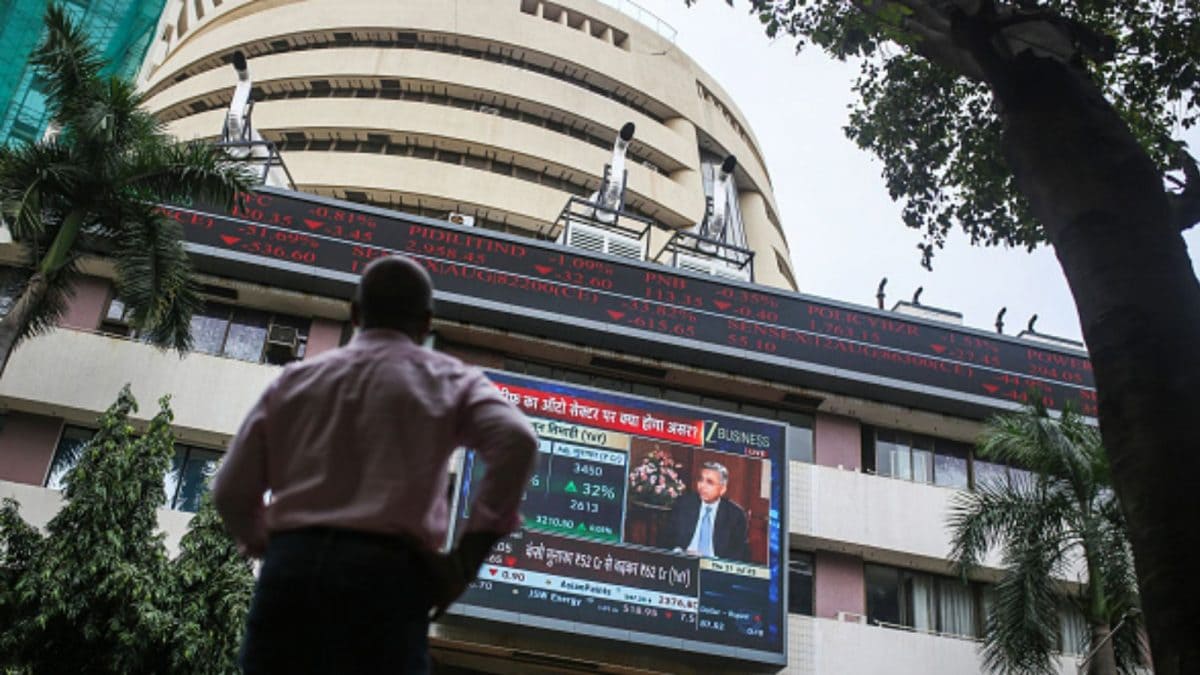
Indian benchmark equity indices extended their losses in a volatile trading session on Friday as investors remained cautious amid escalating tensions in West Asia linked to the US-Iran conflict.
As of 3:19 PM, the Nifty50 was trading 1.21 per cent or 300 points down at 24,465, and the Sensex was trading 1,136 points or 1.42 per cent down at 78.879.
Market volatility spiked during the session, with the India VIX rising as much as 11.31% to 19.88.
Among Nifty50 constituents, InterGlobe Aviation, ICICI Bank, and Max Healthcare Institute were the top losers. On the other hand, Bharat Electronics Limited, Reliance Industries, and NTPC Limited were among the top gainers.
Broader markets also traded lower, with the Nifty Midcap 100 and Nifty Smallcap 100 declining 0.47% and 0.06%, respectively.
On the sectoral front, the Nifty IT Index was the only major gainer, rising 0.34% on the back of gains in Persistent Systems and Infosys.
Meanwhile, the Nifty Realty Index emerged as the worst-performing sector, falling nearly 2%, dragged down by losses in Godrej Properties, The Phoenix Mills, and Prestige Estates Projects.
The Nifty Private Bank Index and Nifty Financial Services Index were also among the major laggards during the session.
Global cues
Most markets across the Asia-Pacific region traded in the red as crude oil prices climbed amid rising concerns over supply disruptions linked to the escalating conflict involving the United States, Israel, and Iran.
In Asia, mainland China’s CSI 300 Index slipped around 0.1%, while South Korea’s Kospi Index declined 1.6%.
Overnight on Wall Street, the S&P 500 fell 0.57%, while the Dow Jones Industrial Average dropped 1.61%. The Nasdaq Composite ended 0.26% lower.
Market uncertainty also intensified after Letitia James and attorneys general from 23 US states reportedly filed another lawsuit seeking to block tariff measures announced by Donald Trump.
Oil and gold prices
Oil prices surged as traders remained concerned about potential supply disruptions. According to a Reuters report, Brent crude futures rose nearly 5% to $85.41 per barrel in the previous session.
During the Asian trading session, Brent Crude Oil was trading 0.15% higher at $84.16 per barrel.
Meanwhile, safe-haven demand pushed Gold Futures up 1.34% to $5,146.39, supported by ongoing geopolitical tensions.
 Click here to add News18 as your preferred news source on Google.
Follow News18 on Google. Join the fun, play games on News18. Stay updated with all the latest business news, including market trends, stock updates, tax, IPO, banking finance, real estate, savings and investments. To Get in-depth analysis, expert opinions, and real-time updates. Also Download the News18 App to stay updated.
March 06, 2026, 09:20 IST
Read More

Stock market today: Which are the top losers and gainers on March 6- check list – The Times of India

Bangladesh road map aims at raising tax-to-GDP ratio to 15% by 2035
Watch: How war in Iran may affect food and fuel prices

Attock Cement’s acquisition approved | The Express Tribune

Policy easing drives Argentina’s garment import surge in 2025

India Us Trade Deal: Fresh look at India-US trade deal? May be ‘rebalanced’ if circumstances change, says Piyush Goyal – The Times of India

-
Business1 week ago
Attock Cement’s acquisition approved | The Express Tribune
-
Business1 week ago
India Us Trade Deal: Fresh look at India-US trade deal? May be ‘rebalanced’ if circumstances change, says Piyush Goyal – The Times of India
-
 Fashion1 week ago
Policy easing drives Argentina’s garment import surge in 2025
-

 Politics1 week ago
What are Iran’s ballistic missile capabilities?
-

 Politics1 week ago
US arrests ex-Air Force pilot for ‘training’ Chinese military
-

 Sports7 days ago
LPGA legend shares her feelings about US women’s Olympic wins: ‘Gets me really emotional’
-

 Entertainment7 days ago
What’s new in Pokémon? Every game, update, surprise from 30th anniversary event
-

 Fashion1 week ago
Texwin Spinning showcasing premium cotton yarn range at VIATT 2026