

Politics
Row deepens over vanished river wave in Munich



A row over the disappearance of a famous river surfing wave in Munich escalated on Sunday as authorities removed a beam inserted over Christmas to recreate the attraction.
The Eisbach wave on a side branch of the Isar River had been a landmark in the Bavarian city since the 1980s but it vanished in October after annual cleanup work along the riverbed.
Activists had placed a beam in the water early on December 25 to partially recreate the wave, according to German media reports, and hung a banner above the water that read “Merry Christmas”.
But a spokesman for the Munich fire service told AFP the “installation was removed” on Sunday at the request of city authorities.
Activists have made several attempts to reinstate the wave in the city’s Englischer Garten park since October — only to see them reversed.
The local surfers’ association IGSM on Thursday posted a statement on its website saying it had abandoned its campaign to save the wave, accusing city authorities of dragging their feet.
The Eisbach wave was considered the largest and most consistent river wave in the heart of a major city and had become a tourist attraction in Bavaria’s state capital.
Franz Fasel, head of the IGSM, told AFP in July that 3,000 to 5,000 local surfers were using it.
Access to the wave was cut off for several months earlier this year after the death of a 33-year-old Munich woman who became trapped under the surface while surfing at night.
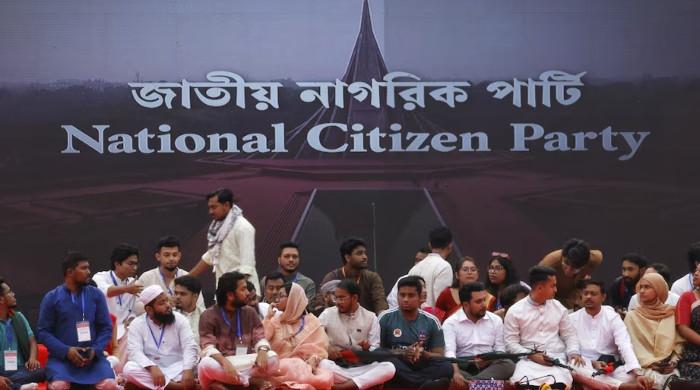
- NCP chief says final list of candidates to be announced on Monday.
- Tasnim Jara, several other leaders quit NCP in protest.
- Critics of NCP’s move say it undermined party’s founding ideals.
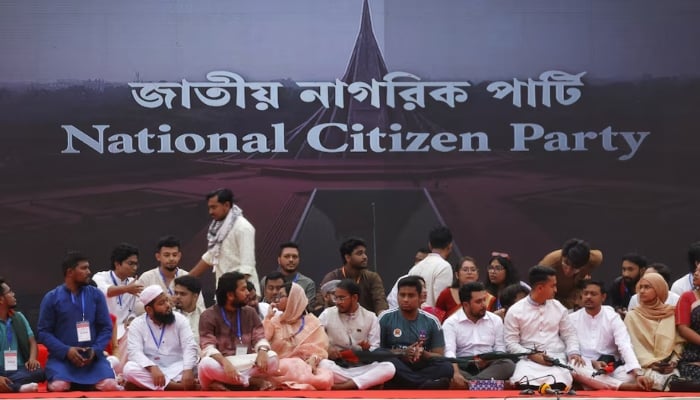
DHAKA: The student-led Bangladeshi party born out of the protest movement that toppled Prime Minister Sheikh Hasina has forged an electoral alliance with Jamaat-e-Islami ahead of February’s parliamentary election, stirring internal rifts.
Since last year’s uprising, the National Citizen Party (NCP) has cast itself as a centrist, reformist alternative to nepotism and two-party dominance, but as the election nears, it is struggling to turn street power into voter support.
NCP chief Nahid Islam said on Sunday the party had decided to enter into the alliance for greater unity, adding that the final list of candidates would be announced on Monday. Other NCP figures have described the alliance as a pragmatic step in a fragmented political landscape.
But the decision to join forces with JI has already prompted internal ructions.
Tasnim Jara, a doctor who left a career in Britain to join the NCP, becoming a leader in the party, resigned on Saturday and said she would contest the election as an independent candidate. Several other members have also quit.
BNP regains momentum
Critics of the NCP’s move said it undermined the party’s founding ideals.
“The moral support I had for the NCP will no longer exist due to this ideological mismatch,” said one university student, asking not to be named.
The partnership comes amid broader political realignments, with the Bangladesh Nationalist Party (BNP) — aligned with ailing former Prime Minister Khaleda Zia and effectively led by her son, acting chair Tarique Rahman — regaining momentum following Rahman’s return after nearly 17 years in exile.
The February 12 election will be held under an interim administration headed by Nobel laureate Muhammad Yunus, who took charge after Hasina’s ouster and is seen as crucial to restoring political stability after nearly two years of turmoil.
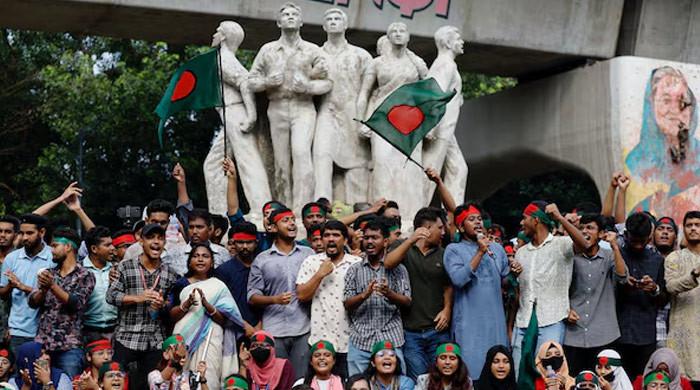
- Police identify suspects in Sharif Osman Hadi murder case.
- Bangladesh seeks cooperation from India over Hadi killing.
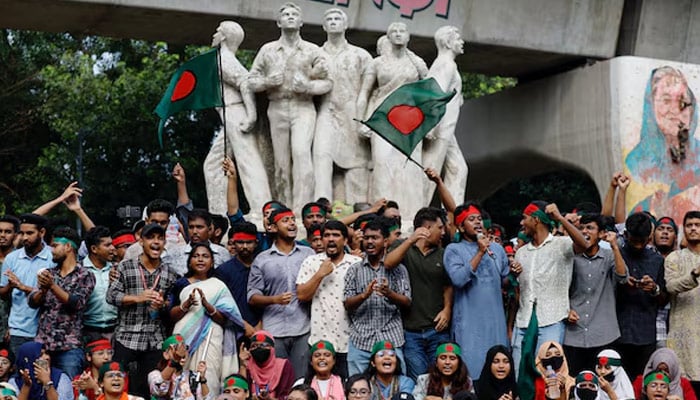
- Protests intensify in Bangladesh after student leader’s death.
DHAKA: Bangladesh police on Sunday said the alleged killers of popular student leader Sharif Osman Hadi had fled to India, in comments likely to further strain relations with its neighbour.
Hadi, a vocal Indian critic who took part in last year’s mass uprising, was shot by masked assailants in Dhaka earlier this month and later succumbed to his injuries at a hospital in Singapore.
His death set off violent protests with angry mobs torching several buildings, including two major newspapers deemed to favour India, as well as a prominent cultural institution.
With protests being held across the country almost daily, pressure has been growing on Bangladesh’s interim government to arrest the killers of Hadi, who was set to contest the general elections in February next year.
“The killing was premeditated. Those behind it have been identified,” SN Nazrul Islam, a senior Dhaka Metropolitan Police officer, said at a news conference.
Suspects Faisal Karim Masud and Alamgir Sheikh left Bangladesh through the Haluaghat border with India shortly after attacking Hadi on December 12, Islam said.
They were received at the border by two Indian citizens, who escorted them into the northeastern state of Meghalaya before handing them over to two accomplices.
Bangladeshi investigators were in contact with their Indian counterparts who had arrested the two suspected accomplices, Islam said.
“We are communicating with Meghalaya police, who have confirmed the arrest of two Indian nationals,” he added.
Two senior Meghalaya police officers, however, did not comment when contacted by AFP.
The Indian foreign ministry had earlier said it rejects “false narratives” about New Delhi´s involvement in Hadi´s killing.
Ties between the neighbours have deteriorated since the ousted prime minister, Sheikh Hasina, fled the pro-democracy uprising and sought refuge in India.
India says it is still considering Dhaka’s requests to extradite Hasina, who was sentenced to death in absentia for orchestrating a deadly crackdown on the uprising.
The lynching of a Hindu garment worker by a mob on December 18 has also hit ties.
Amid the deteriorating security situation in the Muslim-majority country, Khuda Baksh Chowdhury, special assistant to interim leader Muhammad Yunus, overseeing the home department, stepped down on Wednesday.
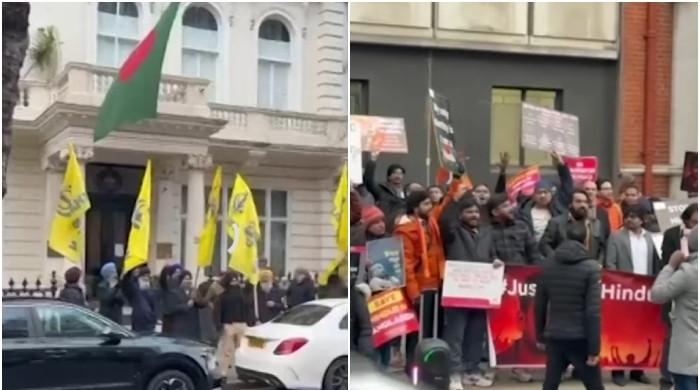
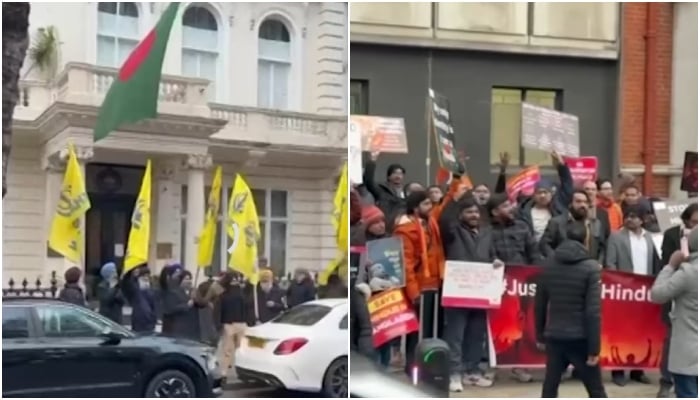
- Hindu groups’ protest met with pro-Khalistan activists.
- Police addresses scuffle, intervenes and restores order.
- India persecuting Sikhs, Muslims, Christians: Sikh leader.
LONDON: Tensions flared outside the Bangladesh Embassy as a confrontation broke out between Pro-Khalistan Sikh activists from Sikhs For Justice (SFJ) and a group of British Indian Hindu groups aligned with India’s ruling Bhartiya Janata Party (BJP) during a demonstration related to the alleged killings of Hindus in Bangladesh.
The protest, which sought to stand in solidarity with minorities, was met with anti-India slogans from the Khalistani group, which also raised Khalistani flags.
Veteran Khalistani activist Paramjeet Singh Pamma, a coordinator of the Khalistan Referendum campaign, confronted the Hindu protest group gathered outside the embassy premises.
A scuffle occurred between Pamma and the BJP’s Hindutva supporters, prompting swift intervention by Metropolitan Police officers stationed at the scene who separated the two groups and restored order.
Pro-Khalistan Sikh activists formed a protective presence around the embassy building. Demonstrators raised slogans accusing the Indian government of responsibility for deaths linked to Sikh activists, including chants of, “who Killed Hadi — Modi”, and “who killed [Hardeep Singh] Nijjar — Modi, Modi, India”.
Pamma is designated by India as a “most wanted terrorist,” a label applied by Indian security agencies to several Khalistan-linked figures. However, the legal status of Pamma in the UK differs from India’s position.
Expressing his views on Indian allegations, the Sikh leader said, “I reside openly in the United Kingdom; no UK court has convicted me of terrorism-related offences; no extradition request by India has resulted in my removal, and UK authorities have not legally upheld India’s allegations against me.
“We gathered here today to expose India’s dirty face. India is involved in persecuting Sikhs, Muslims and Christians at home; it cannot blame Bangladesh for human rights violations. We are focused on the next phase of the Khalistan Referendum, which will reveal the full scale of atrocities committed by India against the Sikhs,” remarked Pamma.
The clash comes as ties between New Delhi and Dhaka have been strained since the ouster of former prime minister Sheikh Hasina, who currently resides in India. The bilateral relations further took a dive following the killing of Bangladesh student leader Sharif Osman Hadi and the lynching of a Hindu worker in Bangladeshi capital.


Broncos linebacker rips Chiefs in explicit posts after team clinches AFC West title

Bangladesh’s student-led party allies with JI ahead of election

Olympic hopeful Jutta Leerdam, Jake Paul’s fiancée, bounces back after crushing fall during trials
Alabama turned Oklahoma’s College Football Playoff dream into a nightmare

Rare look inside the secret LEGO Museum reveals the system behind a toy giant’s remarkable longevity

Gold prices in Pakistan Today – December 20, 2025 | The Express Tribune

-
Sports1 week ago
Alabama turned Oklahoma’s College Football Playoff dream into a nightmare
-
 Entertainment1 week ago
Rare look inside the secret LEGO Museum reveals the system behind a toy giant’s remarkable longevity
-
Business1 week ago
Gold prices in Pakistan Today – December 20, 2025 | The Express Tribune
-
 Business1 week ago
Rome: Tourists to face €2 fee to get near Trevi Fountain
-

 Entertainment1 week ago
Zoe Kravitz teases fans with ring in wedding finger
-

 Entertainment1 week ago
India drops Shubman Gill from T20 World Cup squad
-

 Tech1 week ago
We Tried and Tested the Best Gifts for Plant Lovers With Our Own Green Thumbs
-

 Politics1 week ago
US intercepts oil tanker off Venezuelan coast, Reports