Connect with us

Entertainment

Salt-N-Pepa, Outkast, Cyndi Lauper, White Stripes being inducted into Rock & Roll Hall of Fame

Published

on

Salt-N-Pepa, Outkast, Cyndi Lauper, White Stripes being inducted into Rock & Roll Hall of Fame
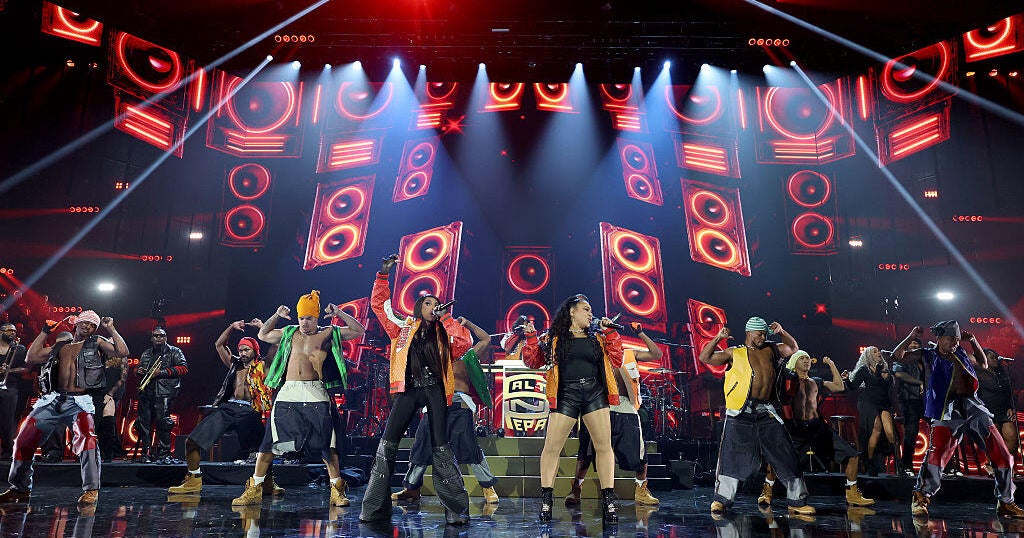

Salt-N-Pepa threw on the multicolored leather jackets from their “Push It” video and brought the crowd at the Rock & Roll Hall of Fame induction ceremony to its feet with a romping rendition of their 1987 breakthrough hit.

“This is for every woman who picked up a mic when they told her she couldn’t,” Cheryl “Salt” James said Saturday while accepting the musical influence award that made her, Sandra “Pepa” Denton and DJ Spinderella members of the hall.

In a rousing speech at the Peacock Theater in Los Angeles, James brought up their fight to reclaim their master recordings from Universal Music Group.

“The industry still doesn’t want to play fair, Salt-N-Pepa have never been afraid of a fight,” James said.

(L-R) Inductees Sandra Denton aka Pepa and Cheryl James aka Salt of Salt N Pepa perform onstage during the 2025 Rock & Roll Hall of Fame induction ceremony at the Peacock Theater on Nov. 8, 2025, in Los Angeles, California.

Kevin Mazur/Getty Images


They took the stage for a medley of their hits. They opened with “Shoop” then slid into “Let’s Talk About Sex” before En Vogue joined them for their joint hit “What a Man.” “Push It” pushed the energy up another notch.

Spinderella became the first female DJ to enter the hall.

“The female rappers had to step to the mic and show that they could go toe to toe with the guys. And Salt, Pepa and Spinderella did it,” Missy Elliott said while inducting the trio.

Donald Glover inducted Outkast and Chappell Roan was set to induct Cyndi Lauper. 

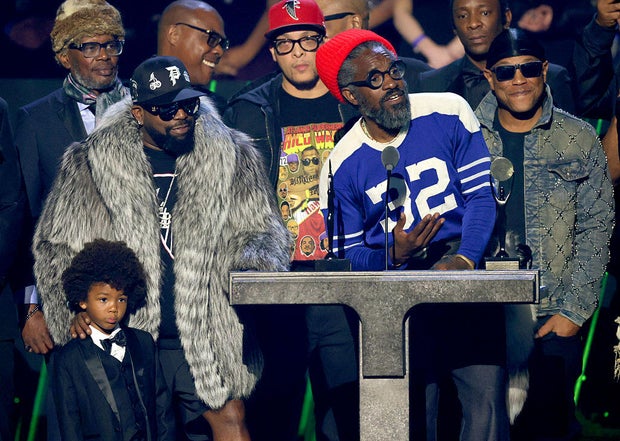
Outkast

Inductees Big Boi and André 3000 of Outkast speak onstage during the 2025 Rock & Roll Hall of Fame Induction Ceremony at Peacock Theater on Nov. 8, 2025, in Los Angeles, California.

Kevin Kane/Getty Images


Meg White not in attendance for induction of The White Stripes

The White Stripes reunion that some fans had hoped for didn’t happen. Their induction was among the highlights of the night anyway. Twenty One Pilots brought the house down with a version of the duo’s stadium-shaking anthem “Seven Nation Army” and Olivia Rodrigo and Feist doing a mid-audience acoustic version of “We’re Gonna Be Friends.”

Jack White

Inductee Jack White of The White Stripes speaks onstage during the 2025 Rock & Roll Hall of Fame Induction Ceremony at Peacock Theater on Nov. 8, 2025, in Los Angeles, California.

Theo Wargo/Getty Images


Their fellow Detroit rock legend Iggy Pop began his induction speech by leading the crowd in a chorus of “Seven Nation Army” then remembered his thoughts on meeting them.

“Cute kids, they’re gonna go places,” Pop said. “And they did.”

Drummer Meg White, who has led an almost entirely private life since the band broke up in 2011, did not show up for the ceremony, but Jack White said Meg, his ex-wife, helped him write the speech he delivered while wearing the band’s signature red and white.

Jack White shouted out several great duos from across culture and said that kind of one-on-one collaboration is “the most beautiful thing you can have as an artist and musician.”

He nearly cried several times as he told an Adam-and-Eve-like tale of “the boy and the girl” who made magic together, “knowing that they have shared and made another person feel something.”

Stevie Wonder pays tribute to Sly Stone

Stevie Wonder led a funky and flashy tribute to the late Sly Stone to open the show that’s streaming live on Disney+, will be available on Hulu Sunday and will air in an edited version on ABC on Jan 1.

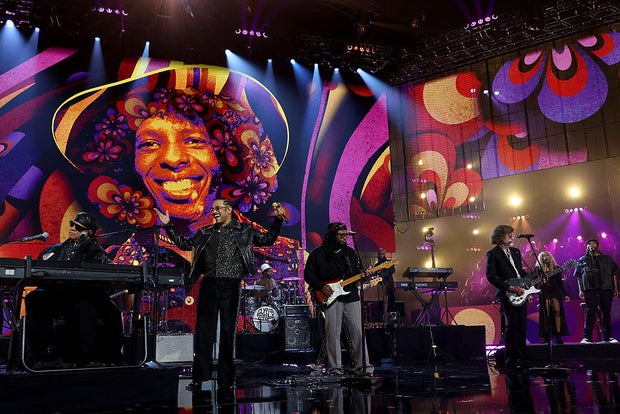
Stevie Wonder

(L-R) Stevie Wonder, Maxwell, Leon Thomas III, and Beck perform onstage during the 2025 Rock & Roll Hall of Fame Induction Ceremony at Peacock Theater on Nov. 8, 2025, in Los Angeles, California.

Kevin Mazur/Getty Images


Wonder was joined Saturday night by Questlove, Leon Thomas, Maxwell, Beck, Flea from the Red Hot Chili Peppers for rousing renditions of Sly and the Family Stone hits “Dance to the Music,” “Everyday People” and “Thank You.” Jennifer Hudson joined them to wail through “Higher.”

Stone, who was inducted into the hall in 1993, died in June. Brian Wilson, who died two days later, will also get a tribute from Elton John.

Mick Fleetwood opens ceremony, inducts Bad Company

Mick Fleetwood of Fleetwood Mac began the ceremony proper by inducting Bad Company. He called the British group founded by Paul Rodgers and Mick Ralphs in 1973 “classic rock legends” and “one of the first super groups,” but said that, more importantly, “they were four great musicians who came together for the love of music.”

Rodgers had to skip the ceremony because of health issues and Ralphs died earlier this year, so drummer Simon Kirke was the only member who took the stage.

He was joined by an ad hoc super group that blasted through a few of the super group’s biggest hits.

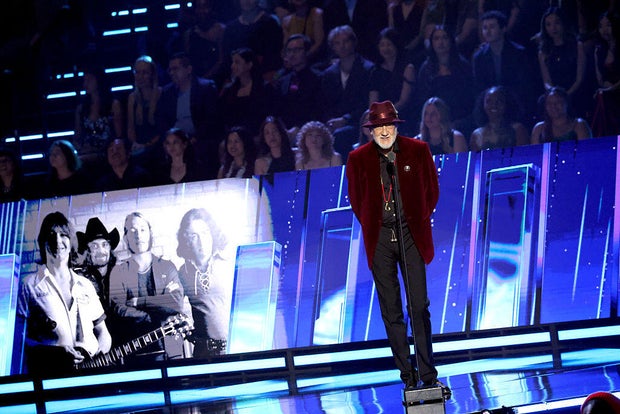
Mick Fleetwood

Mick Fleetwood speaks onstage during the 2025 Rock & Roll Hall of Fame Induction Ceremony at Peacock Theater on Nov. 8, 2025, in Los Angeles, California.

Amy Sussman/WireImage/Getty Images


Black Crowes singer Chris Robinson took lead vocals on their hit “Feel Like Makin’ Love,” with Nancy Wilson of Heart and Joe Perry of Aerosmith on guitars. Bryan Adams took the stage to sing “Can’t Get Enough.”

“I’ve never played in a tuxedo before” said Kirke as he accepted the honor for the group.

He got emotional as he thanked Ralphs’ wife Susie for taking care of him.

David Letterman inducts the late Warren Zevon

The late singer-songwriter Warren Zevon was inducted by David Letterman, a friend and superfan who made Zevon a regular on his NBC late-night show.

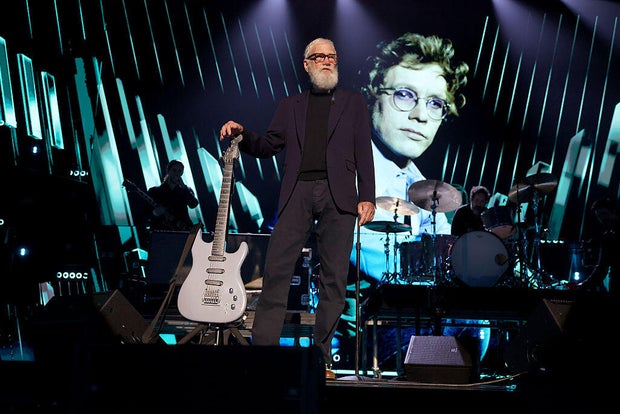
2025 Rock & Roll Hall Of Fame Induction Ceremony - Inside

David Letterman speaks onstage during the 2025 Rock & Roll Hall of Fame Induction Ceremony at Peacock Theater on Nov. 8, 2025, in Los Angeles, California.

Kevin Mazur/Kevin Mazur


“Warren Zevon is in my Rock & Roll Hall of Fame,” Letterman said. “Actually his own wing.”

A clip was shown from Zevon’s final appearance on the show in 2002, when he was dying of cancer. “Enjoy every sandwich,” Zevon said when Letterman asked what he’d learned about mortality.

Letterman was tearful as he showed the crowd a guitar that Zevon gave him later that night.

“He’s never going away,” Bruce Springsteen said in a recorded tribute. “He’s got a body of work that’s as good as anybody’s.”

Letterman outlined several categories of Zevon’s cleverly emotional tunes, the final one being “songs about werewolves” to a big laugh from the crowd. 1978’s “Werewolves of London” was Zevon’s biggest, and most unlikely, hit.

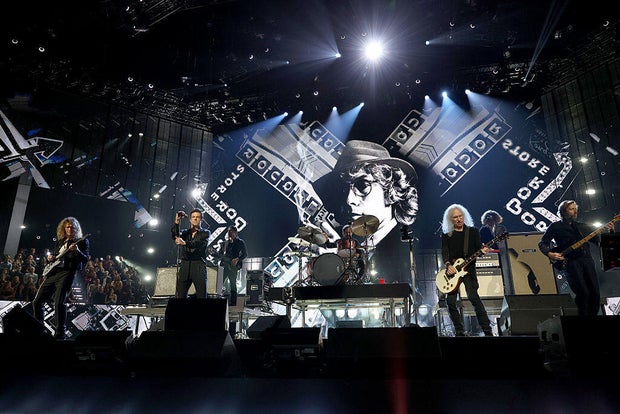
The Killers then played Zevon’s second-biggest hit, “Lawyers, Guns and Money.”

The Killers

(L-R) Dave Keuning, Brandon Flowers, Waddy Wachtel and Mark Stoermer of The Killers perform onstage during the 2025 Rock & Roll Hall of Fame Induction Ceremony at Peacock Theater on Nov. 8, 2025, in Los Angeles, California.

Kevin Mazur/Getty Images


Source link

Continue Reading
Click to comment

Leave a Reply

Your email address will not be published. Required fields are marked *

Entertainment

Reclaiming Jinnah’s Pakistan

Published

on

Reclaiming Jinnah’s Pakistan


Quaid-i-Azam Muhammad Ali Jinnah addressing the nation. — The News/File

When ruling elites are no longer willing to commit to constitutional values, we can no longer guarantee the constitutionally promised dignified life that Jinnah’s Pakistan promised.

The impact of the 26th and 27th amendments has led to the resignation of two Supreme Court judges and one Lahore High Court judge, who protested the erosion of fundamental rights protections for citizens, which has effectively disfigured the social contract between citizens and the state. The resignation letters are more instructive when read as part of a wider critique of government policy and the Judiciary itself. Public debate is required to reverse a course that has left state and society institutionally and normatively adrift. But what has brought us to this sorry situation?

Although we continue to revere Quaid-i-Azam Mohammad Ali Jinnah as the founder and great leader of Pakistan, we have conveniently ditched a critical feature of his thinking: his concept of Pakistan as a moral or dignified state with defining features of the rule of law, fairness, liberty of conscience and representative democracy. 

Jinnah’s speeches and letters set out the founding narrative and include ideals that address various aspects of state design, governance and foreign policy. Instead of a “living” source of inspiration, the Quaid has been consigned to history with the salutary portrait hanging in our hallowed corridors of power and drawing rooms.

What defines a dignified or moral state are the generally accepted moral standards and aspirations that both society and state commit to, which are usually contained in the constitution. On this, Jinnah held, “Islam and its idealism have taught us democracy. It has taught equality of man, justice, and fair play”.

The judiciary has had a vital role in institutionalising the separation between Pakistan as a mere fact and the state as a moral entity. In KB Ali v State (1975), the Supreme Court rejected “standards of reason or morality” as defining valid law. Although foundational for ensuring social cohesion, providing good governance and guaranteeing a dignified life for all, it held that valid law is whatever is commanded by “a competent lawgiver”. After granting near-unbridled powers to the legislature and executive, it has been very difficult for the judiciary to rein in governance within constitutional constraints.

Such judicial reasoning has reduced Jinnah to a historical figure whose task was completed by the administrative-legal recognition of a formal state — a historical fact. By doing this, we have effectively removed Jinnah’s moral ideals from the state’s practices, policy and legal thinking.

Although the judiciary is constitutionally mandated to protect and interpret constitutional norms and values, it has now diverted the course of the state towards secular power-based statecraft. 

Not only has this jurisprudence eroded the moral basis of policy, legislation and interpretation, but it has also predisposed Pakistan towards authoritarianism. An “empowered” legislature and executive have variously encroached on the judiciary’s independence. The result: a grotesque performance of elite interests and power politics that exposes the state for what it has become: an oligarchy.

Against the backdrop of a fractured judiciary (by virtue of the 26th Amendment) and weak democratic norms, the recent amendments were passed without rigorous public scrutiny and without consensus on their expected moral and strategic advantages. According to the ICJ, “It is alarming [that] a constitutional amendment of great significance and public interest was passed in such a secretive manner and in less than 24 hours”.

The amendments were also passed while sidelining the founding narrative and two substantive tests that protect the moral content of the Constitution. One that laws inconsistent with or in derogation of fundamental rights are to be void (Article 8) and second that no law shall be enacted which is repugnant to the injunctions of Islam (Article 227).

Our rule of law is thus a fine mix of secular and Islamic protections, which has not been elaborated jurisprudentially, nor enforced by the judiciary to test and inform the design and quality of the constitutional order and governance.

Islamic scholar Mufti Taqi Usmani criticised the 27th Amendment, insisting that absolute or lifetime immunity from prosecution for any person is in violation of Islam and the Constitution (Article 25). The International Commission of Jurists have criticised both the 26th Amendment as a “blow to judicial independence” and the 27th Amendment as a “flagrant attack on the independence of the judiciary and the rule of law”.

Wider implications for the salient features of the constitution and system of governance also need to be examined through the basic structure (of the constitution) doctrine. In the 2015 Supreme Court case, District Bar Association Rawalpindi v Federation of Pakistan, Justice Sheikh Azmat Saeed held, “[A]s long as the amendment has the effect of correcting or improving the constitution and not of repealing or abrogating the constitution or any of its salient feature or substantively altering the same, it cannot be called into question”. 

Arguably, with the reconfiguration of judicial appointments, reduced powers of judicial review, transfers and postings, the establishment of a new superior court and related measures, salient features have been altered significantly and warrant rigorous examination.

While Jinnah insisted on justice and complete impartiality as a “guiding principle”, Pakistan ranked a low 129 (out of 142) on the World Justice Project’s Rule of Law Index 2024, reflecting further erosion of an impartial rule of law that ensures equality for all (Article 25).

Commenting on the 26th Amendment, the International Commission of Jurists (ICJ) noted the “extraordinary political influence” and observed that “they [the amendments] erode the judiciary’s capacity to independently and effectively function as a check against excesses by other branches of the state and protect human rights”. 

Referring to the 27th Amendment, the ICJ observed, “They will significantly impair the judiciary’s ability to hold the executive accountable and protect the fundamental human rights of the people of Pakistan”. The change in the balance of power needs to be constitutionally justified.

This whole unfortunate constitutional amendment saga betrays the intellectual and moral bankruptcy of our institutions of governance — civil and military bureaucracies and the judiciary. Despite Jinnah insisting that looking after the poor is our “sacred duty”, public welfare is a low-ranking consideration: constitutional social and economic rights, set out in the Principles of Policy, are not even enforceable by the courts. 

Instead of a constitutional amendment to make such rights directly enforceable like the fundamental rights, the 26th and 27th amendments arguably erode what little we had of constitutional governance. What is lost in this Faustian bargain is public welfare and dignity — Jinnah’s Pakistan.

A superficial appreciation of the constitution has hollowed out state institutions and society normatively.

Our institutions, intellectuals and constitutionalists have failed to elaborate and hold to Jinnah’s founding narrative and “[t]he great ideals of human progress, of social justice, of equality and of fraternity” to inform policy and legislation, guide future generations and ensure that we stay focused on the original mission.

Not only is this a gross disservice to the ordinary Pakistani who holds Jinnah’s promise dear, but it is also a disservice to Jinnah by not appreciating him in an appropriate intellectual-moral context.

Consequently, and arguably, we are witnessing the resurgence of an executive state that Jinnah battled ferociously for much of his life. We need a new, clear jurisprudence to provide for a morally dignified state. Without rediscovering Jinnah intellectually and morally, we will never realise Jinnah’s Pakistan. Who can the citizens of Pakistan now trust?


The writer is a former secretary of the Law & Justice Commission of Pakistan.


Disclaimer: The viewpoints expressed in this piece are the writer’s own and don’t necessarily reflect Geo.tv’s editorial policy.


Originally published in The News


Source link

Continue Reading

Entertainment

Royal fans note emotional detail in Princess Kate, Charlotte surprise

Published

on

Royal fans note emotional detail in Princess Kate, Charlotte surprise


Royal fans note emotional detail in Princess Kate, Charlotte surprise

Kate Middleton made sure that the fifth annual carol service was something that marked an important milestone for the royal family and especially her young daughter.

Royal fans were left in awe of the young Princess Charlotte as he made her debut performance for her mother’s big annual event ‘Together at Christmas’ Carol Service held earlier this month.

The young princess had joined her mother to play the song Holm Sound composed by pianist Erland Cooper in a pre-recorded piece, shot at Windsor Castle.

Kensington Palace released the delightful clip, which also had a voiceover from the Princess of Wales, taking about “love and connection through music”.

The fans noted a key emotional detail in the mother-daughter interaction that melted their hearts. The two share a very close bond and trust for each other. Kate appears proud to pass on her musical talent to her daughter and Charlotte seems brimming with the joy of accomplishment.

“Such a beautiful mother daughter moment,” one fan wrote. “The love and trust they have for each other in so evident!”

Another one gushed, “So precious! So lovely to see Charlotte enjoying the gift of music with her mum.”

“Wow I am speechless, how beautiful,” a comment read. “How beautiful can a mother-daughter bond be.. Wishing you all a very Merry Christmas”.

“I was expecting the duo mom and daughter will be playing, it’s so beautiful! Merry Christmas to their Royal Highnesses, the beautiful Wales’s family.”

“What a lovely surprise. Love all the Christmas posts.”

Some fans couldn’t help but get tearful over the moment.

“Magical & what a lovely way to remind us all that we are united and to be there for each other. Brought a tear or 3 to my eyes.”

“Now that I have wiped my eyes from tears of this beautiful@moment- I hear your sentiments and see the reaction of love between peoples. Thank you for reminding us all of the love and closeness of the Season. Blessing to your family.”

“Who is cutting onions?” a user on IG quipped. “Merry Christmas [heart emojis]”.

The Prince and Princess of Wales along with their three children are anticipated to make the Christmas Walk at Sandringham estate, another annual tradition that fans eagerly wait for.


Source link

Continue Reading

Entertainment

Kennedy Center Christmas Eve jazz concert canceled after Trump name added to building

Published

on

Kennedy Center Christmas Eve jazz concert canceled after Trump name added to building


A planned Christmas Eve jazz concert at the Kennedy Center, a holiday tradition at the Washington, D.C., performing arts center dating back more than 20 years, has been canceled. 

The show’s host, musician Chuck Redd, told The Associated Press he called off the performance after the White House announced last week that President Trump’s name would be added to the facility — drawing pushback from Democratic lawmakers and some scholars, who say the change violates the law. According to the White House, the president’s handpicked board approved the decision to rename the institution the Trump-Kennedy Center. The revised name later appeared on the building’s facade.

“When I saw the name change on the Kennedy Center website and then hours later on the building, I chose to cancel our concert,” Redd told The Associated Press in an email Wednesday. Redd, a drummer and vibraphone player who has toured with everyone from Dizzy Gillespie to Ray Brown, has been presiding over holiday “Jazz Jams” at the Kennedy Center since 2006, succeeding bassist William “Keter” Betts.

The Kennedy Center did not immediately respond to an email seeking comment. The center’s website lists the show as canceled.

President John F. Kennedy was assassinated in 1963, and Congress passed a law naming the center as a living memorial to him. The law explicitly prohibits the board of trustees adding any additional memorials to the site.

The decision to rename the center has drawn steep criticism from congressional Democrats and some members of Kennedy’s family. Democratic Rep. Joyce Beatty of Ohio sued over the renaming Monday, calling it a “flagrant violation of the rule of law” and noting that the name can’t be changed without an act of Congress.

The center’s president, Richard Grenell, who was appointed by Mr. Trump, has argued that the center’s status as a memorial to Kennedy wasn’t changed.

Mr. Trump, a Republican, has been deeply involved with the center named for an iconic Democrat after mostly ignoring it during his first term. He has forced out its leadership, overhauled the board while arranging for himself to head it and personally hosted this year’s Kennedy Center honors, breaking a long tradition of presidents mostly serving as spectators.

Numerous artists have called off Kennedy Center performances since Mr. Trump returned to office, including Issa Rae and Peter Wolf. Lin-Manuel Miranda canceled a planned production of “Hamilton.”


Source link

Continue Reading

Trending