

Sports
‘Save Women’s Sports’ 2025 culture war timeline — the year the tides turned

NEWYou can now listen to Fox News articles!
Someway, somehow, “What is a woman?” became one of this decade’s defining cultural questions. And now, the nation is in a full-scale legislative war over the argument of whether males should be allowed to play women’s and girls’ sports.
In 2025, that war escalated to historic heights.
President Donald Trump returned to office and unleashed a volley of countermeasures to “save women’s sports.” But many Democrats fought back, even as a majority of their base sided with Trump on the issue, per multiple polls.
CLICK HERE FOR MORE SPORTS COVERAGE ON FOXNEWS.COM
And on the front lines, activists, athletes, celebrities and journalists dug a deepening cultural divide. Emotional arguments made their way to school board meetings, live interviews, the chambers of the capitol building, and plenty of social media threads.
January
Weeks before Trump’s inauguration, The New York Times put out a poll that found the vast majority of Americans, including a majority of Democrats, don’t think transgender athletes should be permitted to compete in women’s sports.
“Thinking about transgender female athletes — meaning athletes who were male at birth but who currently identify as female — do you think they should or should not be allowed to compete in women’s sports?” the survey asked. Of the 2,128 people who participated, 79% said biological males who identify as women should not be allowed to participate in women’s sports.
Of the 1,025 people who identified as Democrats or leaning Democrat, 67% said transgender athletes should not be allowed to compete with women.
HOW TRANSGENDERISM IN SPORTS SHIFTED THE 2024 ELECTION AND IGNITED A NATIONAL COUNTERCULTURE
It was seen as one of the scapegoat issues highlighted for the Democrats’ sweeping 2024 election defeat.
One of the first bills the GOP-controlled House of Representatives passed in the new year was the “Protection of Women and Girls in Sports Act” on Jan. 14, which sought to establish a national policy that only females could compete in women’s and girls’ sports at tax-payer-funded institutions.
The bill passed the House with the support of two Democrat representatives. But party leaders, including House Minority Leader Hakeem Jeffries and Rep. Alexandria Ocasio-Cortez were hard nos, making unsubstantiated arguments that the bill would somehow enable sexual predators to give genital exams to children. No language in the bill included any mention of genital exams.
The argument proved to alienate some Democrat voters, as the party saw waning public support and net losses in voter registration throughout the first month of the year.
February
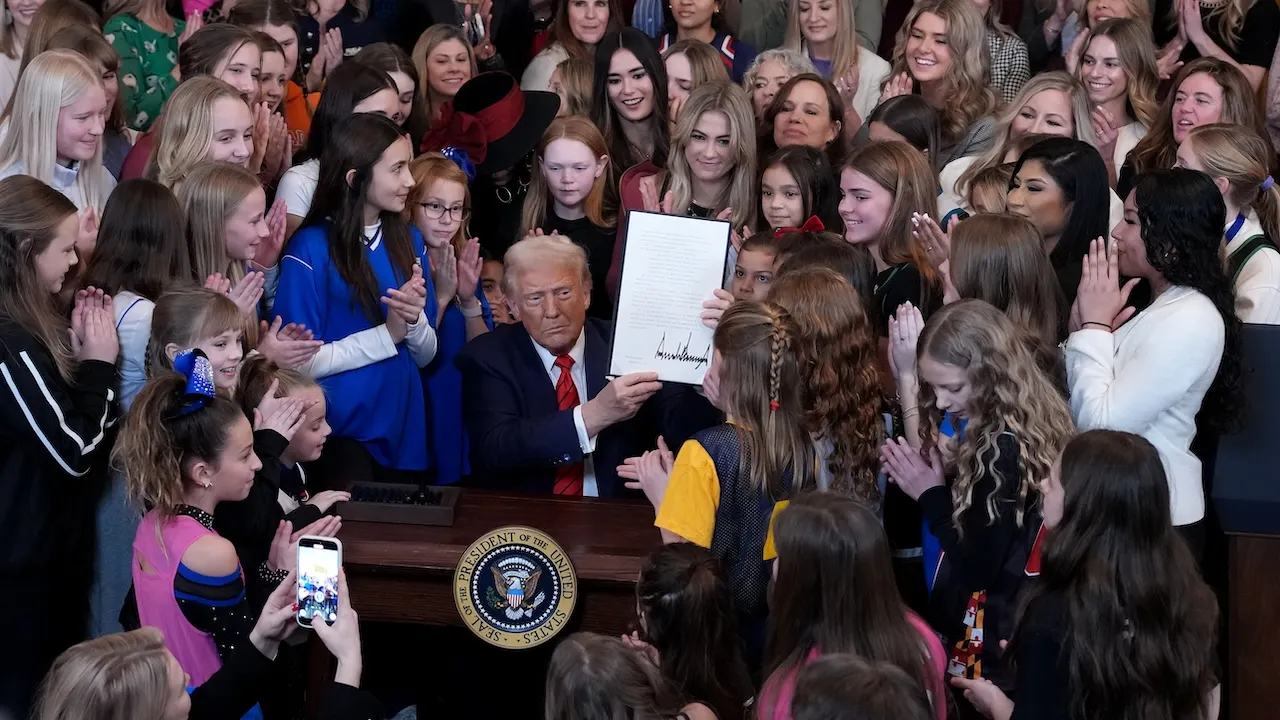
Trump signed the “Keeping Men Out of Women’s Sports” executive order on Feb. 5 to tackle the issue, as the bill wouldn’t reach the Senate for another month and a half.
The NCAA complied the very next day, changing its policy to only allow biological females to compete in women’s sports across the college sports landscape.
But a handful of Democrat-controlled states did not comply, and instructed their public schools to continue following state policy that allows males in girls’ sports. California, Maine, Minnesota and Illinois were among those states.
Maine’s defiance of the order allowed for almost immediate consequences, when a trans athlete won an indoor girls’ track and field state championship. The incident ignited attention from the Trump administration and a heated political feud within the state.
Maine lawmaker Laurel Libby was censured by the Democrat-controlled state legislature, and quickly became a symbol for conservative resistance in the state.
Trump engaged in an in-person spat with Gov. Janet Mills during a bipartisan meeting of governors at the White House on Feb. 21 after threatening to cut funding from the state. There, Mills defied Trump’s order to enforce the executive order right to his face, so the president threatened to cut federal funding to Maine right to her face. Trump’s department of Education launched a Title IX investigation into the state later that day.
But some Democrat-controlled states, including Pennsylvania and Wisconsin, complied with the order, passing reforms to their high school policies that complied to only allow females in girls’ sports.
March
Senate Democrats united to block the “Protection of Women and Girls in Sports Act” on March 3, via the filibuster. It left the floodgates open for states to defy Trump’s executive order, and ensured thousands of American public schools continued to let males in girls’ sports.
Minnesota’s legislature blocked a similar bill that would have protected girls’ sports on the state level that same week.
Later that week, at Trump’s Joint Address to Congress, former girls’ high school volleyball player Payton McNabb was a guest attendant, sitting right next to second lady Usha Vance. When Trump introduced McNabb and her story of suffering permanent brain damage when she was spiked in the face by a transgender opponent, only the GOP side of the room applauded her. The Democrats remained seated and silent.
It was one of the many controversial points of etiquette exhibited by Democrats during the speech, alongside not applauding childhood cancer patient DJ Daniels, and Rep. Al Green, D-Tex., being escorted out for shouting and pointing his cane at Trump early in the speech.
Just days after that, California Gov. Gavin Newsom threw a wrench into the debate when he, as one of the top figures within the Democrat party, hosted Charlie Kirk on his podcast and admitted to believing trans athletes in women’s sports was “deeply unfair.”
The comments pushed the conversation around the
Meanwhile, the feud within Maine had only just begun.
Libby filed a lawsuit seeking to overturn her censure on March 11. It would eventually go all the way up to the U.S. Supreme Court.
The Trump administration made a series of unmet ultimatums with Maine’s educational agencies. Behind the scenes, Maine’s Department of Education was actively instructing schools not to follow Trump’s executive order, as seen in public records obtained by Fox News Digital. By the end of the month, the state had been referred to the Department of Justice after noncompliance.
The March exchanges between Trump and Maine even included a temporary funding freeze to the Maine University System, before the system proved that it hadn’t been allowing males in women’s sports, and wouldn’t be going forward in compliance with the NCAA’s new policy.
But another institution got a much more consequential funding freeze.
The University of Pennsylvania saw $175 million in federal funds frozen as part of an investigation into the state’s handling of infamous trans swimmer Lia Thomas in 2022. It would be one big domino in reaching a historic resolution, which came later in the year.
April
On the first day of April, California’s Democrat-controlled state legislature blocked two bills that would have banned males from girls’ sports in the state.
Every Democrat voted against it, with Assembly member Rick Chavez Zbur arguing that one of the bills “is really reminiscent to me of what happened in Nazi Germany in the 1930s.” Zbur said this while in the presence of a descendant of a holocaust survivor, who had to excuse herself from the chamber, according to GOP Assembly member Kate Sanchez.
Newsom, who had admitted he didn’t think males in girls’ sports was fair the previous month, told reporters he “didn’t pay any attention” to the bills the following day.
“Well, I didn’t pay any attention to the committee yesterday. I was, literally, spent most of the day talking about LA fire recovery with our teams. And progress is being made there, by the way, but we’re starting to run up into some of those ‘abundance’ conversations around permitting that’s already starting to take shape, where most of my focus was yesterday,” Newsom said.
Meanwhile, April 1 also saw the neighboring state of Nevada’s high school sports league take action to change its policies to ban trans athletes from high school sports, complying with Trump’s
On the second day of April, a budding hero was born when footage of fencer Stephanie Turner kneeling to protest a trans opponent at a USA Fencing event went viral. Turner was penalized and disqualified for refusing to face the trans athlete, and became a sudden martyr at the heart of the national “save women’s sports” movement.
Turner’s protest became a global news story that ignited widespread backlash against USA Fencing and the U.S. Olympic and Paralympic Committee (USOPC). It would eventually culminate in a federal investigation and hearing the following month.
And on that same day, Trump’s administration cut USDA funding directly to Maine, escalating the ongoing feud with the state.
Just two days after that, the Department of Education and Department of Justice announced it would be jointly launching a Title IX task forced dedicated to protection of women’s and girls’ sports and private spaces across the country. The move sent a message that the Trump administration was doubling-down on addressing the issue, as states continued to defy the White House.
On April 16, the Trump DOJ announced it was suing Maine for refusing to comply with Trump’s executive order. Turner was present at the press conference to announce the lawsuit. The suit is set for its first hearing in January.
Later that month, Minnesota attorney general Keith Ellison went on the offensive, announcing he was suing Trump and the DOJ in order to protect the state’s policies that allow males in girls’ sports.
May
On May 7, the House Subcommittee on Delivering on Government Efficiency (DOGE) brought the legislative war to the halls of congress with a hearing titled “Unfair Play: Keeping Men Out of Women’s Sports.” Marjorie Taylor Greene used the platform to hammer national governing bodies, specifically subpoenaing USA Fencing Board Chair Damien Lehfeldt.
Lehfeldt, who had previously avoided voluntary testimony, was forced to defend his organization’s inclusion policies while sitting just feet away from fencer Stephanie Turner and former volleyball player Payton McNabb.
The hearing put the growing partisan rift on display. Republicans tore into Lehfeldt’s social media history and the organization’s policy, while lauding McNabb and Turner as heroes for their activism. Democrats didn’t direct any questions toward Turner or McNabb, and instead only made exchanges with other witnesses in defense of policies that enable trans inclusion, while also criticizing Trump on other issues.
On May 20, the Supreme Court ruled in the legal battle between Libby and Maine’s Democrat-controlled legislature. In a 7-2 emergency ruling, the High Court ordered the Maine House to immediately restore Libby’s voting rights, which had been stripped since February after she refused to issue a “forced apology” for a social media post identifying a transgender athlete.
Libby, who had been silenced for over 80 days and missed hundreds of legislative votes, including on the state budget, hailed the decision in an interview with Fox News Digital as a “civil rights win” for both her constituents and for women’s sports advocates nationwide.
On the high school front, the spring sports season saw multiple controversies garner national attention as trans athletes advanced to state championships in multiple girls’ sports.
In Minnesota, a trans softball pitcher garnered national notoriety amid dominant performances throughout the season and going into the playoffs, and prompted a lawsuit by three anonymous female players.
In California, a trans track and field athlete’s dominance caused postseason meets to devolve into political rallies. As the athlete progressed through the postseason, and close to a championship, the situation eventually caught Trump’s attention.
On May 27, Trump escalated the situation with a Truth Social, writing a “transitioned male athlete” was “practically unbeatable” and called the situation “NOT FAIR, AND TOTALLY DEMEANING TO WOMEN AND GIRLS.” He even wrote that he was “ordering local authorities, if necessary, to not allow” the athlete to compete and threatened to cut off California’s federal funding “maybe permanently” if the state didn’t fall in line.
Within hours of Trump’s post, the California Interscholastic Federation (CIF) buckled under the pressure, announcing a desperate “pilot entry process” for the state championships. The new rule dictated that any “biological female” who narrowly missed qualifying because of a transgender competitor would be allowed to compete anyway. Furthermore, the CIF declared that if a trans athlete won a medal, the highest-finishing biological girl would also receive a gold medal.
The rule change would result in shared podium finishes when the athlete ultimately won two gold medals and one silver at the state championships in Clovis on the final day of May, capping off a championship meet that featured multiple competing protests, an airplane banner that advocated for the protection of girls’ sports, and even the arrest of a pro-trans protester for alleged assault of an opposing protester.
June
In the aftermath of the track championships, on June 2, Assistant Attorney General Harmeet Dhillon, head of the Trump DOJ’s Civil Rights Division, issued a hard June 9 deadline for every public school district in California to “certify in writing” that they would not follow the state’s gender identity rules.
Meanwhile in Minnesota, the transgender pitcher was leading a dominant postseason run, securing their school’s first-ever state tournament berth with a shutout victory in the sectional final.
The trans athlete would go on to lead their team to the state title, and the online reaction would domino into a much larger cultural event.
On June 9, Olympic gymnastics legend Simone Biles ignited a viral social media feud with Riley Gaines. Reacting to the Minnesota controversy and Gaines’s advocacy, Biles posted a scathing message on X, calling Gaines “truly sick” and suggesting she “bully someone your own size, which would ironically be a male.”
The post backfired on Biles, drawing a mountain of backlash from conservative athletes and fans who accused Biles of abandoning the very women she inspired. Biles’ own former Olympic teammate, MyKayla Skinner, even publicly condemned Biles as a “bully.”
Biles ultimately settled for apologizing to Gaines.
Amid the chaos of the feud, it was revealed that USA Gymnastics deleted its transgender participation policy. It foreshadowed a much larger change that would come to USA Gymnastics the following month.
July
On July 1, the University of Pennsylvania reached a resolution agreement with the Trump administration’s Department of Education after a Title IX compliance battle rooted in the Lia Thomas controversy. UPenn agreed to bar transgender athletes from women’s teams and to revise its women’s swimming record books, erasing Thomas’s marks from the program’s history.
The settlement carried a blunt political message: if an elite university could be forced to retroactively “correct” what the government said was a Title IX violation, any school in the country could be next.
San Jose State University, which was embroiled in a similar national controversy in 2024 over Blaire Fleming, has also been under investigation since February. SJSU came under heavy scrutiny in July amid Fox News Digital reporting of how an investigation into misconduct allegations was carried out.
The White House, Department of Justice and multiple members of congress condemned the handlers that enabled the situation at SJSU.
On July 3, the U.S. Supreme Court of the United States agreed to take up multiple high-profile cases involving state bans on transgender athletes. The cases — Little v. Hecox from Idaho and West Virginia v. B.P.J. from West Virginia — asked the justices to decide whether laws prohibiting transgender girls and women from competing in girls’ and women’s sports violate the Constitution’s Equal Protection Clause and federal civil rights law, Title IX.
On July 9, just like it had against Maine in April, the DOJ filed a lawsuit against the California Department of Education (CDE) and the CIF, alleging that the state’s policies allowing transgender girls to compete in girls’ sports violated Title IX.
The lawsuit also clarified what the Trump administration wanted the fight to be about: not just “sports fairness,” but civil rights enforcement.
Arguably the biggest quake of the year on the issue happened on July 21. That day, the USOPC updated its athlete safety policies to comply with Trump’s “Keeping Men Out of Women’s Sports” executive order.
USA Fencing, the subject of widespread criticism after Turner’s protest, was one of the first US Olympic organizations to publicly announce it had updated its gender eligibility policy to comply with the USOPC’s new guidance.
By the end of July, the movement to “save women’s sports” had all the momentum. But resistance remained.
August
On Aug. 1, Wagner College quietly reached a resolution with the Trump administration to address the fact that the school rostered the transgender fencer that Turner protested earlier in the year. The private Staten Island school agreed to revise its athletic policies to comply with the administration’s interpretation of Title IX, barring males from women’s teams and aligning itself with the NCAA’s updated standards, similar to the resolution with UPenn.
The Wagner resolution was notable not because of the school’s size or athletic profile, but because it reinforced a growing pattern: universities were increasingly choosing settlement over resistance.
But resistance came via the trans athletes themselves.
A pair of trans athletes began to file their own lawsuits against institutions in response to allegedly being kept out of women’s events. Trans athlete Evelyn Parts sued Swarthmore College for alleged removal from the women’s track and field team, but the lawsuit also claimed Parts was added back onto the team later in the season, despite the NCAA’s new guidelines.
Another trans athlete sued a smaller school that was not part of the NCAA, Westcliff University and the National Association of Intercollegiate Athletes (NAIA), alleging removal from the women’s volleyball team.
Later in the month, Trump suggested that the U.S would push for mandatory gender testing at the 2028 Los Angeles Olympics, framing the move as a necessary safeguard to protect women’s sports on the world stage.
The statement marked the administration’s clearest signal yet that its definition of sex would not stop at American schools or governing bodies, but would be carried into global competition.
That philosophy went into effect on the global level that same month. World Boxing, the international governing body for the sport of boxing, announced a new policy mandating sex testing to ensure only females compete in the women’s category.
The change came a year after the world watched Imane Khelif and Lin Yu-ting, two boxers who previously failed sex tests, win women’s Olympic boxing gold medals in Paris, prompting global backlash.
September
Two girls’ high school volleyball players in California thrust their school district into a national spotlight when they stepped away from their team in protest of a trans athlete, and later filed a lawsuit against the school district over their alleged experience with the trans athlete over the previous three years.
One of the girls, a Muslim American, added a new layer to the debate by pointing out that sharing a locker room with, and changing in front of, a male was a violation of her religious beliefs. Many critics on social media pointed out how the Democrats’ ongoing support of trans athletes in girls’ sports was now also compromising a person who belonged to a group they also claimed to champion in recent years.
Newsom’s office ultimately addressed the situation and suggested the state’s growing wave of trans athletes competing in girls’ sports, and opposition to it, was not his responsibility.
“CIF is an independent nonprofit that governs high school sports. The California Department of Education is a separate constitutional office. Neither is under the Governor’s authority. CIF and the CDE have stated they follow existing state law — a law that was passed in 2013 and signed by Governor Jerry Brown (not Newsom) and in line with 21 other states. For the law to change, the legislature would need to send the Governor a bill. They have not,” Newsom’s office told Fox News Digital.
Another high-profile Democrat distanced themselves from the topic that same month. Former Vice President Kamala Harris, in her book “107 Days” set the record straight on her stance on the issue.
“I agree with the concerns expressed by parents and players that we have to take into account biological factors such as muscle mass and unfair student athletic advantage when we determine who plays on which teams, especially in contact sports,” Harris wrote.
Toward the end of the month, a lawsuit brought by Gaines and a group of other current and former female college athletes against the NCAA over their experience competing against Thomas and other trans athletes reached a crucial procedural turning point.
U.S. District Judge Tiffany R. Johnson issued a ruling on Sept. 25 that dismissed most of the plaintiffs’ claims against the NCAA and other defendants, but allowed a central Title IX claim against the NCAA to proceed to the next phase of litigation.
Gaines’ attorney Bill Bock told Fox News Digital that a key condition to settle the lawsuit would be the NCAA agreeing to a consent decree.
October
In early October, a coalition of Minnesota school board members launched a formal appeal to state authorities to bar transgender athletes assigned male at birth from competing in girls’ sports, urging compliance with a recent federal Title IX finding that the state’s inclusive policy violated federal nondiscrimination standards.
Signers — representing roughly 40 school districts across the state — sent a letter to the Minnesota Department of Education, the Minnesota State High School League, the state attorney general, and the governor calling for state policies to align with the federal government’s position and avoid the loss of education funding.
Minnesota had been one of the states most resistant to complying with Trump on the issue, and dying on that hill was starting to garner backlash from educators within the state, just as it had in Maine and California.
Weeks later, the Supreme Court cases set to define the future of transgender athlete bans continued moving forward. In Little v. Hecox, a federal judge rejected an attempt by transgender plaintiff Lindsay Hecox to dismiss the case before the justices could rule, despite arguments that the dispute was moot. The decision ensured Idaho’s Fairness in Women’s Sports Act would remain before the Supreme Court alongside West Virginia v. B.P.J.
Culturally, the movement to “save women’s sports” gained another high-profile ally. Olympic gymnast MyKayla Skinner announced she had joined XX-XY Athletics, a brand and advocacy group dedicated to protecting women’s sports based on biological sex.
In late October, USOPC leadership publicly acknowledged that sex-testing policies used internationally were being discussed at the highest levels, while stopping short of endorsing mandatory testing in the U.S. The comments signaled that even as the administration pushed for harder biological standards ahead of the 2028 Olympics, Olympic leadership remained cautious — aware the global and legal stakes were only rising.
Then, in the final days of the month, seemingly out of nowhere, Ocasio-Cortez went after Gaines, who had just given birth, in a series of disparaging social media posts.
Gaines initially posted a photo featuring Ocasio-Cortez, Sen. Bernie Sanders, I-Vermont, and New York City mayoral candidate Zohran Mamdani. Gaines wrote, “We’re being destroyed from within.”
Ocasio-Cortez responded, “Maybe if you channeled all this anger into swimming faster you wouldn’t have come in fifth,” referencing Gaines’ fifth-place tie with Thomas at the 2022 NCAA championships.
Ocasio-Cortez later suggested Gaines should “get a real job.”
Gaines challenged the congresswoman to a debate on the subject, to which Ocasio-Cortez never accepted.
November
Early in November, reports indicated the International Olympic Committee (IOC) was actively considering changes to its transgender eligibility framework, moving away from its long-standing hands-off approach that left decisions to individual sports.
The shift came amid growing pressure from international federations that had already adopted sex-based eligibility rules, and with the 2028 Los Angeles Olympics looming.
On Capitol Hill, 130 congressional Democrats filed an amicus brief at the Supreme Court urging justices to strike down state laws barring transgender athletes from women’s sports. The brief argued such bans violated Title IX and equal protection, formally aligning Democratic leadership with the legal effort to preserve trans inclusion as the high court prepared to hear the lawsuits of Idaho and West Virginia.
The list of signees included Ocasio-Cortez, Jeffries, Nancy Pelosi and other members of the Democrat party’s left wing like Ilhan Omar and Jasmine Crockett.
The Democrats who had suffered so much scrutiny for dying on the hill of trans athletes in women’s sports dating back to the last election cycle weren’t backing down. They doubled-down.
At a World’s Strongest Woman–affiliated competition, backlash erupted after a transgender athlete competed in the women’s division. Texas Attorney General Ken Paxton announced an investigation into the event, examining whether allowing a male athlete to compete violated state law.
Meanwhile, USA Fencing, which had been the target of months-long backlash following the Turner incident, put out a statement suggesting it was looking to turn the page after a change to its gender eligibility policy and leadership.
“We recognize the challenges of the past several months and are focused on moving forward with integrity, transparency, and a clear vision for the future,” read a statement provided to Fox News Digital
December
As 2025 came to a close, December proved to be a quieter month on the culture war’s front lines.
The Supreme Court cases remained center stage in the conflict, and saw a handful of famed athletes jump into the fight.
Super Bowl-winning head coach Barry Switzer and 31 Olympians signed an amicus brief in support of the legal defense to “save women’s sports.” The signees also include 12 Olympic medalists, including eight gold medalists.
CLICK HERE TO DOWNLOAD THE FOX NEWS APP
The brief has a total of 124 signatures, which also includes the family members of athletes who signed.
The cases are set for oral arguments on Jan. 13, 2026, and could prove to be the most consequential turning point to date in the nation’s new obsession over who gets to compete in women’s sports.
Follow Fox News Digital’s sports coverage on X, and subscribe to the Fox News Sports Huddle newsletter.










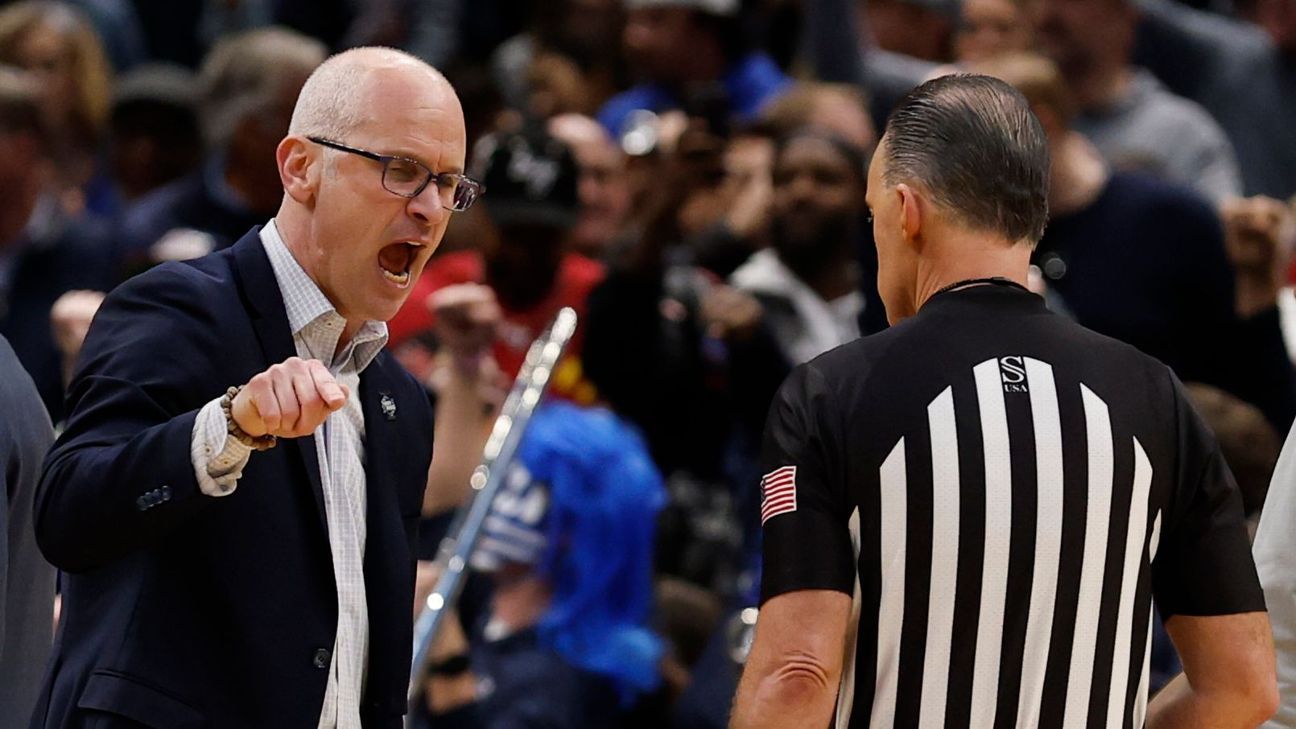
UConn coach Dan Hurley downplayed his bizarre interaction with an official at the end of Sunday’s historic NCAA tournament victory against Duke, saying he thought the veteran referee was looking to “chest-bump me to celebrate.”
UConn completed one of the biggest comebacks in NCAA tournament history when freshman Braylon Mullins drained a 35-foot 3-point attempt to give the Huskies a 73-72 lead with 0.4 seconds remaining in their Elite Eight game against the Blue Devils.
In the immediate aftermath of Mullins’ shot, cameras showed an elated Hurley walking away from the UConn bench area and appearing to bump heads for a few seconds with official Roger Ayers, before both men continued to walk in opposite directions.
Hurley, addressing the now-viral incident during an interview this week with the “Triple Option” podcast, said Ayers is an “easy guy to work with” and denied that there was any animosity between the two of them during the game.
“Really, at that point in the game, we had it won,” Hurley said. “And [Ayers is] such an easy guy to work with during the game, that I thought he was coming over to chest-bump me to celebrate the shot.”
Hurley was not called for a technical foul, and UConn ultimately won after Duke’s desperation inbounds attempt was denied, securing the Huskies’ eighth Final Four trip and their third in four years under Hurley.
The NCAA announced its 11 officials for the Final Four on Monday, one day after UConn rallied from a 19-point deficit to beat Duke in the tournament’s East Regional final. Specific game assignments were not included in the NCAA’s announcement, but the list of officials did not include Ayers, who has officiated seven Final Fours, including last year’s.
Hurley referred to Ayers as a “cool-ass ref,” adding that they had positive interactions throughout the game.
“It’s not like that for me with him,” Hurley said. “My experience with him has been — we haven’t won every game, I haven’t agreed with every call. But in no way was that me and a ref that I had been at their throat the whole game.
“There were other points in the game where I had my arm around him, walking out of a timeout, we were cracking jokes and laughing.”
ESPN’s Seth Greenberg said on “SportsCenter” that he spoke Monday with Ayers, who told Greenberg that “nothing happened” with Hurley. Greenberg, a former longtime college basketball coach, added that Ayers “literally didn’t know what I was talking about” and said the interaction with Hurley was “absolutely nothing.”
Hurley told the “Triple Option” podcast that Ayers was approaching him to inform him how much time remained on the clock after Mullins’ miracle shot.
“He was just coming up to tell me there was 0.3 [seconds] — ‘I think there’s going to be 0.3 or 0.4 on the clock’ is what he was saying to me,” Hurley said. “And I was still so hyped from the shot going in.”
Hurley, who has a combative history with officials, was ejected from a regular-season game earlier this month against Marquette after making contact with referee John Gaffney in the closing seconds.
UConn will play Illinois in the first Final Four game Saturday in Indianapolis, followed by the other national semifinal between Michigan and Arizona.
Last week, after Michigan became one of four Big Ten teams to reach the men’s Elite Eight, coach Dusty May was asked how recent rule changes around compensation in college athletics had helped league teams have such success.
“You’d have to catch me off the record to answer that question,” May said with a smile.
The implication was clear: Now that every school can pay players — either through direct revenue share or via name, image and likeness dollars — Big Ten schools are no longer disadvantaged in recruiting by everything from booster bag men to shoe company AAU connections.
This narrative, of course, ignores many past scandals in the league, let alone that the Big Ten has produced plenty of contenders through the years. It just hasn’t won it all since Michigan State in 2000.
The overall sentiment is somewhat fair, however. While violations certainly occurred in the Big Ten, they generally weren’t as extreme as in other places.
Now though, it’s an open game and an open checkbook. That means game on.
Big Ten schools have already won the past three national titles in football (Michigan, Ohio State and Indiana), and with two teams in the men’s Final Four — Illinois joins Michigan — it has a chance to break that 26-year hoops title drought.
“I think now that the playing field has been leveled out as far as finances and things like that, the environments in the Big Ten are second to none,” May said.
It’s more than just legalized cheating, if you will.
The money allows Big Ten programs to take different strategies to construct rosters.
For decades, league schools seemed to battle each other over many of the same Midwestern recruits — effectively kneecapping each other over a point guard from Flint or a swingman from Indiana. In the end, many of the very best went to other conferences, anyway: Anthony Davis, Derrick Rose, Shane Battier, Antoine Walker, Jalen Brunson, Dwyane Wade and so on.
Last year, the two best high school recruits with Midwestern hometowns were Darryn Peterson (Canton, Ohio) and Darius Acuff Jr. (Detroit). They chose Kansas and Arkansas, respectively.
No matter. May, for example, has constructed arguably the best team in Michigan history without a roster full of area high school stars.
Instead, armed with exceptional scouting and plenty of money, he hit the transfer portal and brought in Yaxel Lendeborg (UAB), Aday Mara (UCLA), Morez Johnson Jr. (Illinois) and Elliot Cadeau (North Carolina).
Those four alone make up 65% of the Wolverines’ scoring, 66.2% of their rebounding and 74.2% of their assists. U of M is 35-3 and won each of its tournament games by double digits.
Then there is Illinois coach Brad Underwood, whose program, based on proximity to Chicago, St. Louis and Indianapolis, should be a historic powerhouse. Yet the Illini have only occasionally gotten the best local recruits.
That’s one reason Underwood has put an emphasis on targeting European talent by using newly legal money to sign players who would have otherwise chosen to play professionally over there.
Illinois is powered by David Mirkovic of Montenegro, twin brothers Tomislav and Zvonimir Ivisic of Croatia, and Andrej Stojakovic, who spent part of his childhood in Thessaloniki, Greece, before moving to California where his father, Peja, played in the NBA.
Add in some Americans, including unheralded-recruit-turned-superstar Keaton Wagler, and the Illini are making their first Final Four appearance since 2005.
“NIL has opened it up so we can actually get the really, really good [European players],” Underwood said. “Dribble, pass, shoot guys. They’ve been extremely well coached. They are fundamentally very sound.
“We’ve had ones before, but maybe not the top-quality guys,” he continued.
Maybe under the old rules, May is two years into building a program and still trying to make recruiting connections while Illinois is stuck in its good but rarely great history.
Not anymore. The entire league is awash with talent, with six teams reaching the Sweet 16. And while Nebraska basketball couldn’t do the impossible that Indiana football pulled off, the Cornhuskers’ first ever NCAA tournament victory (and then a second) is proof enough that a new day is here.
Even a title this weekend wouldn’t give the Big Ten basketball dominance to go with the football variety, but here in the new era of college sports, it would suggest another step in its revival, if not arrival, as a true behemoth.
- Sahibzada Farhan declared Player of the Match.
- Kingsmen post 225/5, with Sadaqat’s 62 and Sharjeel’s 51.
- Multan Sultans will now face Lahore Qalandars on April 3.
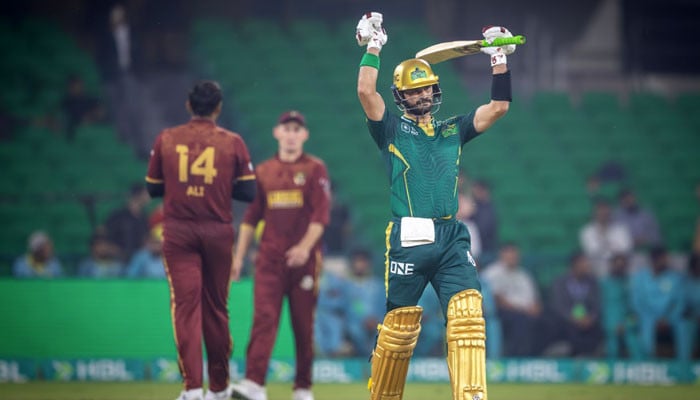
Sahibzada Farhan’s brilliant century powered Multan Sultans to a successful 226-run chase against Hyderabad Kingsmen in the eighth match of the Pakistan Super League (PSL) 11 at Gaddafi Stadium, Lahore, on Wednesday.
Set to chase a daunting 226-run target, the 2021 champions knocked the winning runs for the loss of four wickets and eight balls to spare, courtesy of Farhan.
The right-handed opener oversaw the Sultans’ pursuit with an unbeaten century and top-scored with 106 off just 57 deliveries, studded with eight sixes and seven fours.
Farhan received ample support from his opening partner, Steve Smith, and vice-captain Shan Masood, who made 46 and 29, respectively, before knitting an unbeaten 37-run partnership with Arafat Minhas, who chipped in with a brisk 26 off 11 deliveries.
Saim Ayub was the pick of the bowlers for the Kingsmen, taking two wickets for 43 runs in his four overs, while Maheesh Theekshana and Hassan Khan could pick up one apiece.
Farhan was declared Player of the Match.
Kingsmen captain Marnus Labuschagne’s decision to bat first paid dividends as the tournament debutants piled up 225/5 in their 20 overs.
The Kingsmen got off to a spirited start to their innings as their opening pair of Saim Ayub and Maaz put together 59 runs in five overs until the former was caught and bowled by Peter Siddle and consequently walked back after scoring a 20-ball 27, laced with three fours and a six.
Maaz was then involved in brief partnerships with captain Labuschagne and wicketkeeper batter Usman Khan until eventually falling victim to Mohammad Nawaz in the 10th over.
The 20-year-old remained the top-scorer for the Kingsmen with a 26-ball 62, studded with five sixes and as many fours.
Usman followed suit 10 balls later as he was caught at the deep fine leg by Shehzad Gull of Mohammad Wasim Jr, resulting in the Kingsmen slipping to 127/4 in 11.2 overs.
Following the flurry of wickets, experienced Sharjeel Khan took the reins of Kingsmen’s batting charge and smashed an unbeaten half-century, making 51 off 26 deliveries with the help of four sixes and three fours.
Sharjeel shared crucial partnerships with Syed Saad Ali and Muhammad Irfan Khan at the backend, who contributed with handy cameos of 23 and 22 not out, respectively.
Mohammad Wasim Jr was the standout bowler for the Sultans, taking two wickets for 37 runs in his four overs, while Nawaz, Siddle and captain Ashton Turner made one scalp apiece.


Artemis II crew member had heartbreaking talk with daughters before launch

Samsung’s Best OLED From Last Year Is Priced as Low as I’ve Seen It on Amazon

US VP Vance tells Pakistani intermediaries Trump open to ceasefire: source

-

 Politics1 week ago
Afghanistan announces release of detained US citizen
-

 Entertainment1 week ago
UN warns migratory freshwater fish numbers are spiralling
-

 Tech1 week ago
Can a Home Appliance Fix the Problem of Soft-Plastic Waste?
-

 Sports1 week ago
Broadcast industry CEO says consolidation is ‘essential’ to compete for NFL soaring media rights prices
-
 Business1 week ago
Property Play: Home flippers see smallest profits since the Great Recession, real estate data firm says
-
 Business1 week ago
Gold prices soar in Pakistan – SUCH TV
-

 Fashion1 week ago
ICE cotton slips on weaker crude, profit booking
-
 Business1 week ago
More women are entering wealth management, but few are in advisory roles, study finds