Business
Stock market today: Nifty50 opens above 25,550; BSE Sensex up over 200 points – The Times of India
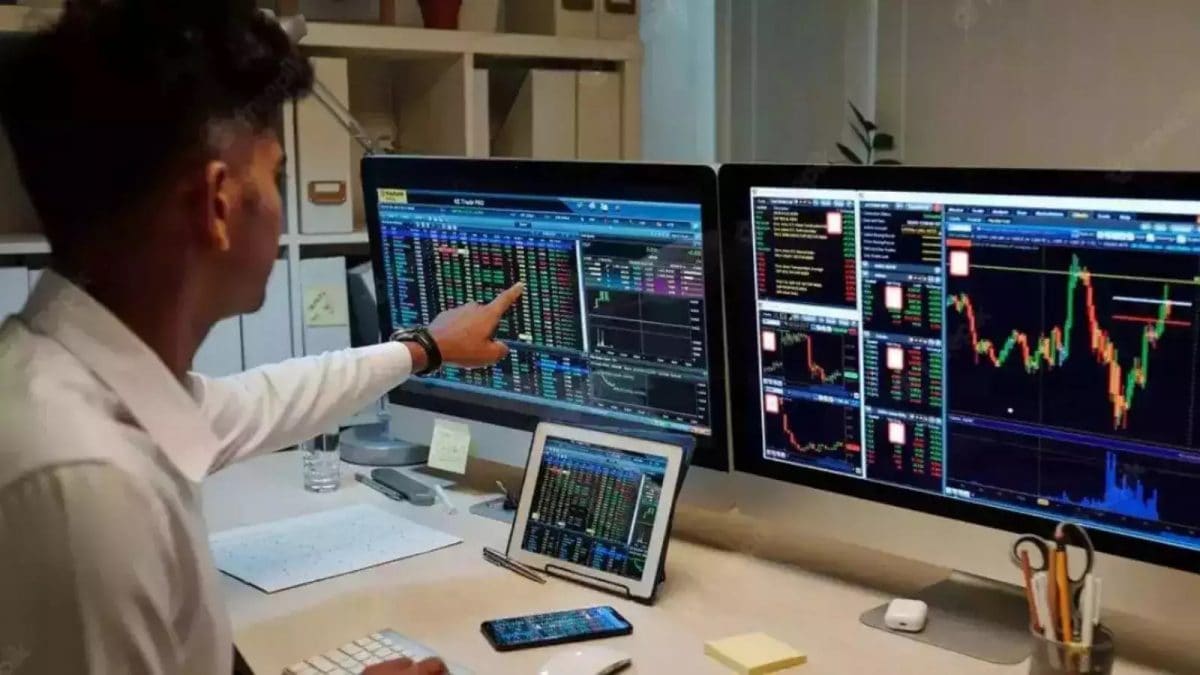
Stock market today: Nifty50 and BSE Sensex, the Indian equity benchmark indices, opened in green on Monday. While Nifty50 was above 25,550, BSE Sensex was up over 200 points. At 9:16 AM, Nifty50 was trading at 25,567.90, up 76 points or 0.30%. BSE Sensex was at 83,426.94, up 211 points or 0.25%.For the week ahead, market experts expect range-bound movement influenced by mixed global factors, while potential positive corporate earnings and developments in India-US trade discussions could provide support.Dr. VK Vijayakumar, Chief Investment Strategist, Geojit Investments Limited says, “The dominant trend in global trade this year has been the AI trade, which has pushed up AI stock valuations to elevated valuations, though not yet in bubble territory. The strong earnings growth in the US has been a fundamental support to this AI trade. Countries regarded as AI winners like China, South Korea and Taiwan also have benefited from this AI rally. Now, there are signs of this AI trade losing steam as evidenced by the 3 % decline in Nasdaq last week. This is a healthy trend. If this trend persists without high volatility, that would make the US market healthy, preempting a bubble formation and its eventual burst. Investors have to watch how this trend plays out.”“This emerging trend, it persists, would be particularly favourable for the Indian market which didn’t participate in the AI trade. FIIs, particularly the hedge funds, who have been consistently selling in India and taking money out for playing the AI trade, are now likely to pause and slowly reverse the AI trade in favour for non-AI trade in countries like India. Fortunately, the earnings growth currently happening in India and expected to gather momentum, going forward, can provide the fundamental support for a rally. Watch out for the leading names in banking and finance, telecom, capital goods, defence and automobiles.”Friday saw Nasdaq close slightly lower, marking its sharpest weekly fall since early April, as investors expressed concerns about sustainability of recent gains in artificial intelligence shares. US Treasury yields showed marginal decline.Asian trading witnessed a surge in US stock-index futures, as expectations grew for a resolution to the prolonged US government shutdown.Foreign portfolio investors conducted net sales of shares valued at Rs 4,581 crore on Thursday. In contrast, domestic institutional investors were net purchasers, investing Rs 6,675 crore.(Disclaimer: Recommendations and views on the stock market, other asset classes or personal finance management tips given by experts are their own. These opinions do not represent the views of The Times of India)

Business
New BIS standard for incense sticks: Govt bans certain substances; flags ‘potential impact on human health’ – The Times of India
NEW DELHI: The government issued a notification announcing a new Indian Standard for incense sticks (agarbatti), laying down quality norms and specifying a list of substances prohibited for use in their manufacture.The standard has been developed by the Bureau of Indian Standards (BIS) to ensure safer products and promote responsible and sustainable practices in the incense stick industry, the minister for consumer affairs said in a statement released on National Consumer Day 2025.The ministry released a list of harmful substances. “This includes certain insecticidal chemicals such as alethrin, permethrin, cypermethrin, deltamethrin, and fipronil, as well as synthetic fragrance intermediates like benzyl cyanide, ethyl acrylate, and diphenylamine. Many of these substances are restricted or banned internationally due to their potential impact on human health, indoor air quality, and ecological safety,” it said.According to the notification, the standard classifies agarbattis into machine-made, hand-made, and traditional masala agarbattis, and prescribes norms for raw materials, burning quality, fragrance performance and chemical parameters. This, the ministry said, will ensure safer products and consistent quality for consumers.Agarbattis are deeply embedded in India’s cultural and religious life and are widely used in homes, places of worship, meditation centres.With rising global demand for incense products growing steadily in India and overseas, the international studies and regulatory developments, “particularly in Europe have raised concerns over the use of certain synthetic chemicals in fragranced products, including incense sticks,” the release stated.Some of these substances have been linked to respiratory irritation, allergic reactions, neurological effects and environmental harm when used repeatedly in indoor environments, it added.The standard has been developed by the Fragrance and Flavour Sectional Committee (PCD 18) of BIS after extensive consultations with stakeholders.India is the world’s largest producer and exporter of agarbattis. The industry is estimated at around Rs 8,000 crore annually, with exports worth nearly Rs 1,200 crore to over 150 countries, including the US, Malaysia, Nigeria, Brazil and Mexico.The sector supports a large network of artisans, micro-entrepreneurs and MSMEs, especially in rural and semi-urban areas, and plays a key role in generating employment, particularly for women.The government said the new standard is “expected to enhance consumer confidence, promote ethical and sustainable manufacturing practices, support traditional artisans, and improve access to global markets. The standard reinforces India’s commitment to protecting its cultural heritage while aligning indigenous industries with modern quality and safety expectations. Products complying with this standard can also carry the BIS Standard Mark, helping consumers make informed choices with confidence.“
Business
Ask Dhirendra: ‘If I know markets go up in the long run, why do short-term losses bother me so much?’ – The Times of India
“‘If I know markets go up in the long run, why do short-term losses bother me so much?’This is one of the most honest questions an investor can ask.On paper, you know the logic. You’ve seen all the charts: “Sensex 100 to 70,000”, “Nifty over 20–25 years”, “equity beats inflation in the long run”. You nod wisely when someone says, “Equity is for the long term.”And then one fine day, you open your app, see your portfolio down 8–10 per cent, and your stomach drops.The mind says, “Long term”.The heart says, “Bas, ab yeh band karo.”Let’s start with some sympathy: there is nothing wrong with you. Your brain is not designed for SIPs; it is designed for survival.When our ancestors saw red (blood, fire, and danger) the correct response was to panic and run. Today, your app shows red numbers, and your brain uses the same wiring: “Danger, danger, get out.” The problem is that the stock market is the only place where running at the wrong time converts a temporary fall into a permanent loss.It helps to see what “short term” and “long term” actually look like in numbers.
The market tests patience before it rewards it
When we look at this kind of data at Value Research, the pattern is always similar. Over the course of a year, losses are frequent. Over ten-year periods, they shrink dramatically. So the market is not misbehaving when it falls in a single year. It’s behaving exactly like a market. It is unrealistic to expect a smooth, linear upward graph.There’s another uncomfortable truth. You don’t look at your portfolio like a long-term investor; you look at it like a daily scorecard. Every time you open the app, the number on top becomes a verdict on your intelligence. Up means “I am smart”; down means “I am stupid.” Of course, you don’t want to feel stupid for three months in a row.Now we put some more structure on this feeling.Imagine you start a ₹10,000 monthly SIP in a good, diversified equity fund for 15–20 years. Somewhere along the way, there is a year when the market is down 20 per cent.There are only three things that can happen in that year:
- You panic and stop your SIP or redeem.
- You grit your teeth and do nothing.
- You not only continue but increase your investments.
The cost of doing the wrong thing at the wrong time
When we run such scenarios at Value Research, the surprising part is this: the investor who simply does nothing in bad years often beats the one who keeps jumping around trying to avoid pain.So why can’t we “do nothing” easily?Partly because we confuse volatility with failure, a minus 10 per cent year feels like a verdict on our choice rather than a normal part of the journey. And partly because we mix up time horizons. We say, “This is for my retirement in 2045,” and then behave as if the performance over the last 45 days is all that matters.One practical way to calm yourself is to separate money by purpose. If you put all your money into the market and then need some of it next year, of course, every fall will feel catastrophic. But if you’ve done the boring work—kept an emergency fund, kept short-term money in safer avenues—then the equity money is truly long-term. You’re not going to need it next Diwali, so you don’t have to judge it every Diwali.Another trick is to change what you watch.Instead of staring at the absolute value, look at two different things:
- How much time do you have left before you actually need this money?
- How much of your target have you already accumulated?
At Value Research, our planning tools and advice try to shift people from “portfolio value today” to “probability of meeting your goal over time”. It’s much easier to tolerate a bad year in the market if you see that you’re still broadly on track for your long-term destination.And finally, accept this: you don’t have to enjoy seeing losses. You just have to not overreact to them. The test of a good investment is not whether it goes up every quarter; it’s whether it helps you reach your goals over ten or twenty years, without making you do something foolish in between.So if you know markets go up in the long run but short-term losses still bother you, that just means you’re human. Good. Stay human. Just put a system around your humanity:
- Keep your emergency and near-term money out of harm’s way.
- Use equity only for genuinely long-term goals.
- Decide your SIPs when you are calm, and refuse to renegotiate them with your panicked future self.
Red numbers on a screen are not a verdict on your intelligence. Most of the time, they’re just the market’s way of asking, “Did you really mean it when you said long term?”If the answer is yes, close the app and let time do the arguing for you.If you have any queries for Dhirendra Kumar you can drop us an email at: toi.business@timesinternet.in(Dhirendra Kumar is Founder and CEO of Value Research)
Business
Shyam Dhani Industries IPO Allotment Today: GMP At 100%; A Step-By-Step Guide To Check Status
Last Updated:
Unlisted shares of Shyam Dhani Industries are trading at Rs 140 apiece in the grey market, indicating 100% grey market premium (GMP) against the IPO issue price of Rs 70.
Shyam Dhani Industries IPO.
Shyam Dhani Industries IPO Allotment Date & Latest GMP: The allotment of the Shyam Dhani Industries IPO, which closed on Wednesday with a whopping 988.29x subscription, is scheduled to be finalised today, December 26. Investors will receive a bank debit or an unblock message once the allotment is finalised in the evening. They can also check the allotment status on the websites of the BSE, the NSE, and registrar Bigshare Services Pvt Ltd.
The Shyam Dhani Industries IPO received a blockbuster 988.29x subscription, garnering bids for 3,61,51,72,000 shares as against the 36,58,000 shares on offer. Its retail category got a 1,137.92x subscription, while its non-institutional investor (NII) quota got a 1,612.65x subscription. The QIB category received a 256.24x subscription.
Shyam Dhani Industries IPO GMP Today
According to market observers, unlisted shares of Shyam Dhani Industries Ltd are currently trading at Rs 140 apiece in the grey market, against the upper IPO price of Rs 70. It means 100% grey market premium (GMP), indicating blockbuster listing potential. Its listing will take place on December 30.
The GMP is based on market sentiments and keeps changing. ‘Grey market premium’ indicates investors’ readiness to pay more than the issue price.
Shyam Dhani Industries IPO Allotment Today: A Step-By-Step Guide To Check Status Online
The Shyam Dhani Industries IPO allotment is expected to be finalised today, December 26, in the evening. The allotment status can be checked online by following these steps:
1) Visit registrar Bigshare Services’ portal – https://ipo.bigshareonline.com/ipo_status.html.
2) Under ‘Select Company’, select ‘Shyam Dhani Industries Ltd’ from the drop-box.
3) Enter your application number, demat account, or permanent account number (PAN).
4) Enter Captcha
5) Then, click on the ‘Search’ button.
Your share application status will appear on your screen.
Via the BSE
1) Go to the official BSE website via the URL — https://www.bseindia.com/investors/appli_check.aspx.
2) Under ‘Issue Type’, select ‘Equity’.
3) Under ‘Issue Name’, select ‘Shyam Dhani Industries Ltd’ in the drop box.
4) Enter your application number, or the Permanent Account Number (PAN). Those who want to check their allotment status via PAN can select the ‘Permanent Account Number’ option.
5) Then, click on the ‘I am not a robot’ to verify yourself and hit the ‘Search’ option.
Your share application status will appear on your screen.
Via NSE’s Website
The allotment status can also be checked on the NSE’s website at https://www.nseindia.com/invest/check-trades-bids-verify-ipo-bids.
Shyam Dhani Industries IPO: More Details
Shyam Dhani Industries aimed to raise Rs 38.49 crore through a book-built IPO, comprising a fresh issue of 0.55 crore equity shares. The public issue opened for subscription on December 22, 2025, and closed on December 24, 2025, with allotment likely to be finalised on December 26. The company is scheduled to debut on the NSE SME platform, with a tentative listing date of December 30, 2025.
The IPO was priced in the range of Rs 65–70 per share.
Founded in 1995, Shyam Dhani Industries Limited is an ISO-certified company engaged in the manufacturing, exporting, wholesale trading, and supply of premium spices. Its product portfolio includes spice powders and whole spices, along with grocery items such as black salt, rock salt, rice, poha and kasuri methi. The company also deals in herbs and seasonings like oregano, peri peri, chilli flakes, mixed herbs, onion flakes and tomato powder.
Financially, the company reported a 16 per cent rise in revenue and a 28 per cent increase in profit after tax in FY25 compared with the previous financial year.
Holani Consultants Pvt. Ltd. is acting as the book running lead manager as well as the market maker for the issue, while Bigshare Services Pvt. Ltd. has been appointed as the registrar.
December 26, 2025, 11:22 IST
Read More
-
Fashion1 week agoIndonesia’s thrift surge fuels waste and textile industry woes
-
Business1 week agoBP names new boss as current CEO leaves after less than two years
-
Tech1 week agoT-Mobile Business Internet and Phone Deals
-
Sports1 week agoPKF summons meeting after Pakistani player represents India in kabaddi tournament
-
Entertainment1 week agoIndia streamlines visa rules in boost for Chinese professionals
-
Sports1 week agoUWCL grades for all 18 teams: Leuven get A+; Barça an A-, PSG fail
-
Sports6 days ago
Alabama turned Oklahoma’s College Football Playoff dream into a nightmare
-
Entertainment1 week agoRadiation fears rise after cracks found in $2 billion Chernobyl shield