Tech
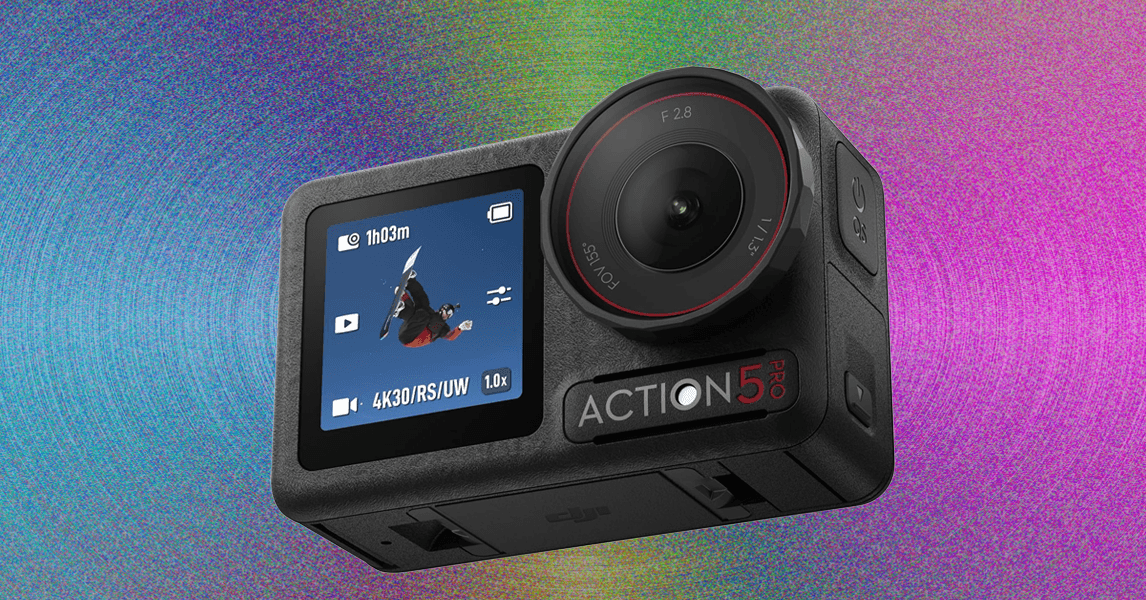
Strap One of Our Favorite Action Cameras to Your Helmet or a Floaty
Compare Our Top Pick Action Cameras
The B-Roll
All those cheap cameras on Amazon: Readers often ask, why spend $400 on a GoPro when they can get a camera with 4K video for $100? It’s a fair question, and the answer comes down to software, primarily image stabilization. Action cameras are designed to be strapped to helmets or clipped to your chest while you skydive, rock climb, and race through the city on a scooter. Without stabilization, the results are something even your closest friends won’t sit through. So yes, you’ll get 4K footage with the cheaper cams, but it’ll be footage no one wants to see. In our view, you’re better off spending another $100 for an older GoPro (Hero 11 or 12) on sale.
Best Accessories to Trick Out Your Camera
Photograph: Scott Gilbertson
Once you have an action camera, you’re good to go for most use cases. GoPro, Insta360, and DJI all provide helmet mounts and other ways to stick your camera where you want it. But there are some nice extras that can make getting that shot you’re dreaming of even easier. Here are a few:
A good microSD card: You may get an SD card with your camera. Insta360’s SD cards are pretty good actually, but I tend to use SanDisk’s Extreme cards because they’re fast and, as a bonus, waterproof. You can pick up a 512-GB card for around $70. I also like Samsung’s Pro Plus microSD cards, which are a little faster in my tests. You can grab a 256-GB for around $96. DJI has some specific recommendations for microSD cards to use with the Action 6. Of their list the one I recommend is the Lexar Professional Silver Plus ($24).
GoPro Media Mod for $79: GoPro’s sound is OK out of the box, but if you want higher-quality audio, this is where you start. Not because the Media Mod produces great sound—it’s better than the camera, but still not great. What it offers is a microphone jack. Plug in a high-quality microphone and you’ll finally have awesome sound. (Not recommended while skydiving.)
Handlebar/seatpost/pole mount for $40: This is my favorite mount for mountain biking, but it’ll also work on ski poles and any other round object you want to clamp it to.
Motorcycle accessory bundle for $50: If you ride, this mount for Insta360 cameras (Ace Pro, X5, etc.) is a must-have. It’s one of the most secure clamps I’ve ever used, almost as good as a bench vice.
Yallsame tripod mount for $10: Action cameras offer many ways to mount them, but one that’s curiously missing is the traditional quarter-inch tripod screw mount. The GoPro Hero 13 has one, but this three-pack of adapters solves the problem for the others.
Polarizer and ND filters: If you shoot around water, through glass, or in any other high-glare situation, a polarizing filter will help cut that glare. Neutral density (ND) filters hold back light to let you shoot at a wider aperture in bright light, helping to increase the amount of motion blur. Both are great additions to your action camera kit. If you have the Hero 13 Black you can get the new GoPro ND filter Four-Pack ($90), which automatically adjusts the camera settings when attached. This is huge since getting the shutter speed right with ND filters can take some trial and error. The GoPro ND filters handle all that for you. If you don’t have a HEro 13, I’ve tested and like DJI’s ND filter set for the Action 6 ($79). For older GoPros, I like Freewell’s polarizing and ND filters ($20). I suggest starting with an 8-stop ND or combo ND and polarizing filter.
Floaty for $35: Another one for the water shooters, but well worth the money since it’ll keep your GoPro from ending up at the bottom of the sea. I haven’t tried it, but here’s one for the Insta360 Ace Pro 2 ($20), and at the time of updating the Action 6 is so new there doesn’t see to be a case. I can confirm that the older case will work, but the buttons don’t quite line up and it’s a pain to use. Hopefully DJI will get out an updated version soon.
Selfie stick for $25: I’ve tested a lot of selfie sticks and they’re almost all fine, but I keep grabbing this Insta360 version when I head out the door. It’s lightweight, small enough to fit at the bottom of my bag, and it’s affordable. If you want to go big, this Insta360 Extended Edition Selfie Stick ($100) can imitate a low-flying drone, perfect for use in national parks and other places where drones are forbidden.

Tech
No, the Freecash App Won’t Pay You to Scroll TikTok
I first encountered the Freecash app after clicking on a sponsored TikTok video with dubious claims. The advertisement didn’t promote this app by name, rather it showed a young woman expressing her excitement about seemingly getting hired by TikTok at $35 an hour to watch videos on her “For You” page.
When I tapped the link to “order now,” it sent me to a website with TikTok and Freecash logos, featuring a download link for the Freecash app. “Get paid to scroll,” read the site. “Join thousands earning daily by watching TikTok videos and cashing out instantly.”
In the first month of 2026, Freecash has rocketed to popularity among US users. This week it reached the number two position on Apple’s free iOS download charts, nestled between ChatGPT and Gemini. The bump in downloads coincides with a spree of ads promoting the Freecash app.
The app appears to utilize the familiar strategy of offering rewards to users who share their information or complete online tasks. As a child, I remember entering my dad’s email and address into some pop-ups for a free iTunes giftcard, which never shipped us the promised $20 in downloads and likely just clogged his inbox with spam. (Please forgive me.)
While Freecash does actually pay out money to users, it’s not for scrolling social media. The app’s business model is centered around getting new users to play mobile games and then providing the players with monetary rewards. Those promises of direct payments to scroll aimlessly on TikTok sound too good to be true, because they are.
Ben Rathe, a spokesperson for TikTok, says the Freecash ads violate TikTok’s rules barring financial misrepresentation. Rathe says the ads in question were removed, after WIRED reached out, for what the company deemed as deceptive marketing. The social media platform forbids ads designed “to scam individuals out of money or personal data,” according to TikTok’s advertising policies.
The company behind Freecash claims that it did not directly produce the ads that I encountered on TikTok. Rather, the marketing was “generated by third-party affiliate partners,” says Elizaveta Shulyndina, a spokesperson for Freecash’s parent company. “We’re reviewing activity with relevant partners and tightening monitoring.”
Back on my TikTok feed, after I tapped on that first sponsored post, the barrage of boosted videos promoting Freecash grew incessant. A post with over 150,000 likes showed a mom and her young son traveling to the store together, because she could buy her “son whatever he wants now that I’m paid to watch TikTok.” Other sponsored videos showed more people enthusiastic about the amount of cash they are getting paid to scroll TikTok.
It’s not clear if the women and children appearing in the TikTok ads are actually the people promoting Freecash. Many of the ads originated from TikTok accounts with minuscule followings or accounts with zero other publicly viewable videos.
When I finally downloaded the app, rather than immediately finding ways to receive some kind of kickback for scrolling on TikTok, I was directed to download multiple mobile games, like Monopoly Go and Disney Solitaire.
Then, I was finally given the option to complete challenges in a limited amount of time to earn money. The Monopoly Go challenges included cash rewards ranging from $0.01, for playing the game for two minutes each day, to $123, for reaching level 300 in less than three months.
The company behind Freecash, called Almedia, is based in Berlin. Almedia operates the Freecash app as an advertising platform that matches mobile game developers with new users who not only install the apps but will also spend money.
Tech
Inside the trend of tech ‘spinouts’ solving real-world problems | Computer Weekly
Silicon Valley has created the impression of the archetypal technology company as founded by smart, young guns in a garage who tinker around to find a product that can make them, and their investors, a fortune. When things fail to work out, it is often down to the fact their creation failed to address a real-world problem.
The opposite of such a scenario is when a business finds itself with a problem and, failing to identify an offering in the marketplace, develops one itself. The retail and hospitality industries have been hotbeds for such activity in recent years, no doubt driven by the exponential increase in technology use since the advent of the pandemic.
The best products have then been “spun out” of the original operator businesses to then sell their capabilities to others in the sector who are encountering the same issues. Joel Robinson, founder of Openr, says that before it was a tech company, the firm started as a solution to a problem faced by the Azzurri Group, a leading hospitality operator with Zizzi, Ask Italian and Coco di Mama among its brands.
Having joined Azzurri Group in 2019 from the retail sector, working latterly at Sainsbury’s, Robinson encountered a growing digital landscape in hospitality involving a fragmented mess of scattered data, manual processes and inflexible systems.
“We were experiencing the pain,” he says. “In 2017/18, [hospitality] was a simple business involving configuring tills in restaurants and ‘off you go’. But post-pandemic, it was about order at the table, click and collect, website ordering and catering platforms. Managing identical data across these platforms was proving inefficient.”
Having failed to find a market offering that could truly solve its unique needs of handling this data, Robinson decided to build one. “If we felt we needed something then we’d build it ourselves,” he says. “We also spoke to peers to see if it was a sector-wide problem. Pubs, quick service restaurants and cafés all had the same [data-related] problem, so we knew there was external consumption for the solution.”
Openr was built as a business to ultimately spin out, and obviously had the benefit of being prototyped within the Azzurri Group. This gave the product credibility and authenticity in the sector. “We could speak with empathy to others,” says Robinson. “There are huge upsides to being a genuine solution for operators … and it opens doors.”
Development team
Although Robinson had built up some decent tech chops, and his team had built its own click and collect – as well as pay-at-table – services, the Openr data platform required bringing in a development team with the capabilities to scale and bring to market. The company has since gone on to supply its offering to the likes of Stonegate, Caffé Nero and Burger King.
It has been a similar story for Andrew Xeni, co-founder of Nobody’s Child and Fabacus, who gained experience in the retail and manufacturing sectors from working at his family’s business, Europride Ltd, producing and supplying value womenswear to big high street retailers. During this time, he discovered the opportunities to create both the fashion brand Nobody’s Child and tech business Fabacus.
He describes the latter as a trusted system of record for the products of large brands and retailers. It comprises all the product data to meet companies’ ESG reporting needs, and provides the infrastructure for implementing digital product passports.
“I did a lot of the ground work early on, speaking with most of our then retail customers – including New Look and Asos – to build a product lifecycle management [platform] for the family business, but the data aggregation platform – Fabacus – was always intended for go-to-market [spin-out], as I realised it was solving a common problem,” says Xeni.
Having scanned the landscape, he discovered that no-one was addressing the fundamental challenge of siloed and fragmented data across products. With his fashion experience, he says: “The main ingredient I brought to the table was the business logic and understanding of the problem and the solution needed. Anyone can build technology, but it’s like letting an architect build and decorate your home, expecting it to meet your needs.”
Xeni says Fabacus was initially a passion project that he self-funded, but as he discovered the common challenges across the clothing sector, he needed to source external capital and sell the product to third parties.
“It’s tough, so make sure you’re addressing a real problem,” he says. “We developed a solution architectured by a team of experienced execs that understood the problem intimately, and knew how to articulate the solution and plan an implementation succinctly. Nothing we have built to date is a challenge I haven’t operationally faced in to personally.”
Fabacus is currently working with a myriad of brands and retailers, including Nobody’s Child, Paramount, NBC Universal, Hasbro, Fanatics and Tesco. Across brand licensing, Xeni says the business has reached a critical mass of customers, while in the retail sector, there is “very exciting early engagement”.
Like Xeni and Robinson, there was recognition by JP Then, founder of Crosstown Doughnuts and Slerp, that fundamental change was happening to his business through structural change in the wider sector. As a very early user of Deliveroo and UberEats, he found a need for an e-commerce platform to host the growing volumes of online orders for his doughnuts.
“I had 10 locations with click and collect and on-demand delivery, but they all had different attributes (such as opening times),” he says. “I did not want to build a platform – I wanted to find something, but there was nothing out there. Slerp was born out of my need to solve a problem.”
Separate business
During conversations with other operators in the sector, Then found they were also experiencing online sales growth, so there was recognition of the opportunity to ultimately sell his offering to others in the industry. He incorporated the business in 2016 because he understood being separate was important: “A bakery running a tech company did not make sense!
“By 2020, there was enough proof from Crosstown that it could be important enough for other companies [to use],” he says. “By then there was also more sophistication in last mile logistics so Slerp could work with various delivery providers.”
The product gives hospitality companies greater control over their margins for delivery orders and ensures they have a direct relationship with the customer. This enables them to avoid having to rely wholly on the delivery marketplaces – Deliveroo, Just Eat and Uber Eats.
As the delivery marketplace model has developed, the Slerp platform has ultimately been able to plug into the network of delivery riders at these companies while still owning the customer relationships and the associated data.
Being an operator has been massively important for the development of Slerp, according to Then, who says: “Having operator domain knowledge has been pivotal to building out an operator-first view. Slerp solved a genuine operator problem.”
He believes this is in contrast to the technology firms that find there is not a market for their products and make radical changes to their propositions – hence the frequent use of the term “pivot” in the tech world.
Although Then left Crosstown in 2020, amid the tough times of Covid-19, he continues to run Slerp, which has gone on to work with many hospitality companies, including Nell’s, Zia Lucia, Dom’s Subs, Sourdough Sophia, Chicken Cottage and Chopstix.
Enterprise resource planing
Ed Brown, co-founder of Double Puc and Percy Labs, is also aware of the tough nature of the hospitality industry. He co-founded healthy food chain Friska, which reached eight sites before it hit difficulties in 2021 and changed hands. During his time at Friska, he had created a dedicated enterprise resource planing system for hospitality – to handle the likes of purchasing, supply chain and ingredients – that was not tied into a point-of-sale system.
This became RocketOS, and was an early product in the field as a software as-a-service offering for the hospitality industry. Brown now acknowledges it would have been a better business decision at the time to have focused on this technology and spun it out to sell to other operators rather than put more money into Friska.
Armed with this experience, he now operates Double Puc Café & Catering – with four units in the Bristol area – along with the fledgling Percy Labs, an artificial intelligence-powered purchasing platform that consolidates baskets of product orders across wholesalers to save on the purchase cost, built with a view to spinning it out and selling it to other hospitality businesses.
Although there are third-party group purchasing organisations acting as middlemen, Brown believes they do not benefit the hospitality companies nor the wholesalers. The advent of ChatGPT and its ability to accurately match food product data has enabled the creation of Percy Labs to provide a more efficient service that he says could save businesses 10% on their ingredients costs.
“We know it is a challenge to build a product, but we’ve done similar with RocketOS and Friska,” he says. “We know that these solutions will be easy for operators to use. Every feature we build, we can see it’s useful.”
Building it from within Double Puc means the product can be prototyped very quickly. “We know how it needs to work. It’s all customer-centric. Everything has been tested in a real environment,” says Brown, adding that building the service in-house also helps with conversations with wholesalers and operators. “Coming from us builds trust and confidence,” he adds.
As technology becomes an ever more important part of the operations of retail and hospitality businesses – and they have increasingly tech-literate workforces – the appetite for implementing real problem-solving products is likely to grow, thereby providing a fertile ground for in-house developments and potential spinouts.
Tech
Expanding sensory experiences in virtual environments | Computer Weekly
Human understanding and interactions lean heavily on our experiences with the real world that we are most used to and perfectly suited for. However, skill levels in interacting with digital information are a different issue, and various segments of the population feature widely different degrees of knowledge of how to use digital devices and content.
Comprehensively multisensory engagements marry extended reality (XR) and in real life (IRL) to create genuinely immersive experiences that allow us to perceive them as a true amalgamation of virtual and real worlds. They can also find use to create inclusive interactions for users whose disabilities can make it difficult to access commonplace computing technologies.
Truly multisensory environments require comprehensive technology approaches to address a variety of senses. This requirement creates new opportunities for developers of devices and applications, but also faces substantial hurdles for technological reasons, cost considerations and consumers’ readiness to engage with such environments. Many researchers and developers are taking up the challenge, and are working on a wide range of offerings to address human senses in more comprehensive ways than current applications allow for.
Multisensory technologies are under investigation to expand the ways individuals can interact with digital and virtual applications. Multisensory interfaces and environments have been research and development topics for a long time. Olfactory, haptics and tactile interfaces are available, and even wind- and temperature-interface efforts exist.
Currently, these types of interfaces are relegated to niche applications or small market pockets. But virtual environments and novel technology approaches could result in diffusion of such applications to a wider range of users. Technological, cost and adoption issues exist, but first steps in creating multisensory engagements are under way.
Multisensory environments serve users by connecting in natural ways with virtual information and elements. But companies also can leverage multisensory approaches to create more meaningful – and impactful – connections with consumers and customers.
Paul Silcox, executive creative director at FutureBrand, a brand strategy and design company, believes that from gesture control to in-store design, and mixed, virtual and extended reality, “multisensory marketing is here to stay”. And a crucial aspect of multisensory engagement is the opportunity to make brands and products stand out in a world of visual overload.
Sound and scents for brands
Sonic branding has been around for some time. After more than a quarter-century in use, Intel’s sound logo – the “Intel Inside” musical notes – is perhaps the example that comes to mind most readily. The logo manages to reach consumers if their eyes are focused somewhere else, or even if they are in a different room when watching TV, for example.
Sonic engagement is not new, but there are many more approaches emerging. Recently, a number of experimental sound applications have been launched, and there are many more senses brands – and applications – can make use of.
Smell is another sense that brands frequently leverage. Hotels, shops and entire franchises use scents to evoke a branded experience. Mood Media, an experiential media company, for example, helps clients to create emotional connections with scent marketing. The company is also working with immersive audiovisual solutions, “connecting physical and digital with integrated media for a seamless customer journey”.
For some showings of the movie Heretic, entertainment company A24 partnered with Joya Studio, which researches, develops and produces fragrances and scented objects. During a pivotal scene in the film, selected screenings featured scents that were pumped into the auditorium.
Silcox highlights super-additivity as an important aspect of multisensory branding. Engaging multiple senses simultaneously “is exponentially more powerful than the sum of their individual effects”.
Despite clear benefits, he also points to challenges – challenges that will apply to the entire category of XR-enhanced environments as they become more common. Just randomly embedding sensory effects will not result in desired outcomes – instead, developers will need to focus on “defining individual sensorial assets and bringing them together as a powerful suite for a clear purpose”.
Excitement about multisensory engagements will inevitably lead to designers bundling a smorgasbord of technologies simply because they can. But “it’s important to show restraint and use these tools in deliberate ways in order to avoid an empty, gimmick effect”.
Venues as experiential landscapes
Perhaps expectedly, music venues and events are exploring the use of multisensory sensations to increase the entertainment value. Since the autumn of 2023, the Sphere close to Las Vegas, Nevada, has established a showcase in modern entertainment.
The giant spherical venue features advanced sound systems such as directional sound and virtual acoustic environments, as well as many motion and environmental technologies. The costs were also tremendous, with a price sticker of more than $2bn, providing an understanding of how high the hurdles for wide diffusion are.
However, according to Brian Mirakian, senior principal at Populous, a design firm that focuses on the creation of experiential environments: “Tomorrow’s concerts are more than just performances; they are moments that immerse audiences in environments that engage all five senses, transforming live shows into unforgettable, multi-sensory journeys.”
He adds that “advancements in technology are enabling venues to integrate sensory elements” that require a design and planning process that can be challenging to translate to the many types of venues artists perform in.
Mirakian also cautions that the introduction of advanced technologies, including scents, motion and wind, comes with additional considerations. Creating immersive experiences “necessitates fine-tuning, a process that requires the expertise of those who know the venue to meld the artist’s vision with the venue’s specifications”.
Touch and go on haptics
There exist a wide range of interface technologies, such haptics and selected interfaces, and an obvious market exists for gaming applications, but there are challenges to expanding the use of haptic sensations to create immersive environments in real-world locations that add digital experiences. Marrying haptic sensations of digital interfaces meaningfully with real-world situations and activities is not a trivial task. Nevertheless, new applications are slowly emerging.
“As digital devices evolve, we’re at an exciting inflection point, with the likes of gaming consoles, headphones, smartwatches, fitness trackers and headsets incorporating more features, which will allow brands to develop truly immersive experiences,” says FutureBrand’s Silcox.
FutureBrand created a haptic logo for Mastercard, which uses distinctive haptic vibrations combined with a sonic logo to let customers feel their smartphones when shopping online or paying at shops’ payment terminals with the firm’s credit cards.
Meanwhile, researchers at Northwestern University developed a wearable device to create a “sophisticated variety of haptic sensations”. The device connects wirelessly to VR headsets or smartphones and offers the sensations of “vibrations, stretching, pressure, sliding and twisting”.
The device has a small form factor, attaches to the skin, and can easily be worn on the move. The researchers “envision their device eventually could enhance virtual experiences, help individuals with visual impairments navigate their surroundings, reproduce the feeling of different textures on flat screens for online shopping, provide tactile feedback for remote health care visits, and even enable people with hearing impairments to ‘feel’ music”.
The researchers also mention the use in applications where touch supports users with visual or hearing impairments, and other companies are focusing on related applications. OneCourt has developed a device that enables tactile sports broadcasts. The device resembles a tablet that outlines the game courts, and is described as “transforming gameplay into trackable vibrations”. The entrepreneurs created the offering to help visually impaired sports fans experience games.
Jerred Mace, the CEO and founder of OneCourt, says: “We’ve essentially developed a laptop-sized haptic display that’s capable of communicating dynamic information like sporting events through touch.”
The device is focused on sporting events, but similar services may find use in many more commercial applications to enhance immersive environments – and could support individuals with and without visual impairments.
The long way for puzzle pieces to fall into place
New interface technologies can enable multisensory sensations that will elevate metaverse environments. Initial use cases exist in industrial, healthcare and entertainment markets, for instance. However, truly immersive environments will remain elusive in consumer markets for quite some time.
The long-term prospects look better. Touchscreens, app-supported stores and public venues also required time to diffuse, and are now almost ubiquitous.
For companies trying to leverage these new opportunities, the question remains what sensory technologies to bundle in what form factor. What is the right breadth and depth of multisensory sensations for what kind of applications, and for which consumer segments? Possible combinations are virtually limitless.
A better understanding of human interactions with virtual environments and digital objects will be crucial to drive commercial applications. As Silcox advises, “we need to ask what our end desired purpose or reaction is that we are looking to provoke”.
Martin Schwirn is a strategy and innovation consultant for Global 2000 companies, and the author of Small data, big disruptions: How to spot signals of change and manage uncertainty (ISBN 9781632651921).
-
Politics6 days agoSaudi King Salman leaves hospital after medical tests
-
Sports1 week agoPak-Australia T20 series tickets sale to begin tomorrow – SUCH TV
-
Business1 week agoTrump’s proposed ban on buying single-family homes introduces uncertainty for family offices
-
Fashion6 days agoBangladesh, Nepal agree to fast-track proposed PTA
-
Tech1 week agoTwo Thinking Machines Lab Cofounders Are Leaving to Rejoin OpenAI
-
Tech6 days agoPetlibro Offers: Cat Automatic Feeders, Water Fountains and Smart Pet Care Deals
-
Tech1 week agoMeta’s Layoffs Leave Supernatural Fitness Users in Mourning
-
Fashion6 days agoWhoop and Samuel Ross MBE unveil multiyear design partnership