

Sports
Supporters’ group files lawsuit against ‘excessive’ Fifa World Cup ticket prices

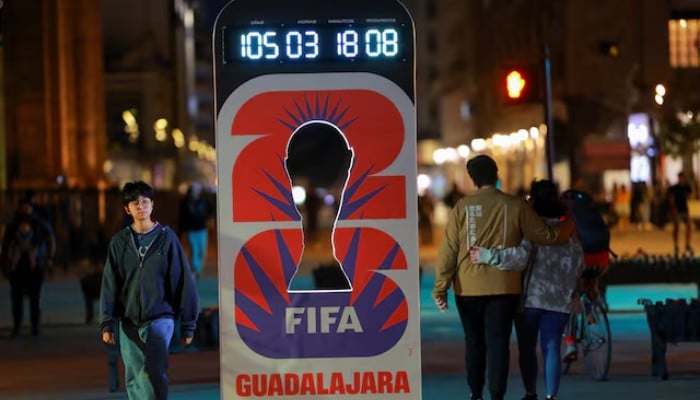
The Football Supporters Europe (FSE) group filed a lawsuit on Tuesday with the European Commission targeting football’s world governing body Fifa over “excessive ticket prices” for this year’s World Cup finals.
The FSE and the Euroconsumers organisation said the tickets for the June 11-July 19 tournament in the US, Canada and Mexico were overpriced and complained that Fifa has a monopoly over the sales.
“Euroconsumers and Football Supporters Europe (FSE) have filed a formal complaint with the European Commission against Fifa, alleging that the football body has abused its monopoly position to impose excessive ticket prices and opaque and unfair purchasing conditions and processes on European fans ahead of the 2026 World Cup,” the FSE said in a statement.
“Fifa holds a monopoly over ticket sales for the 2026 World Cup and has used that power to impose conditions on fans that would never be acceptable in a competitive market,” the group added.
The FSE said the prices for the final were way above those for the 2022 final in Qatar.
“The cheapest openly available final tickets now start at $4,185 — more than seven times the cost of the cheapest 2022 World Cup final ticket,” they said.
By contrast, it said the cheapest Euro 2024 final tickets were 95 euros ($100).
A European Commission spokesperson told AFP they would be “examining” the complaint but Fifa said they had yet to receive it.
The Fifa spokesperson told AFP: “Fifa is focused on ensuring fair access to our game for existing and prospective fans.”
According to Fifa, almost seven million tickets have been made available.
Each person can buy a maximum of four tickets per match and a total of 40 for the whole competition.
There will be a total of 104 matches played at this expanded World Cup, the first ever to feature 48 teams, and ticket prices have soared for the most in-demand games.
FSE said the North American bid team had initially promised tickets would be available from as little as $21, but instead the cheapest tickets to go on sale have been for $60, for example for the Group J opener between Austria and Jordan at the Levi’s Stadium in California.
Most tickets cost at least $200 for matches involving leading nations.
‘Dynamic pricing’
Fifa president Gianni Infantino insists ticket prices are simply a consequence of the huge demand.
“In the US in particular there is this thing called dynamic pricing, meaning the prices will go up or down”, depending on the match in question, Infantino has said.
FSE said the problem with ‘dynamic pricing’ was there was no limit to how high the prices can go.
“Fifa used ‘variable pricing’, or dynamic pricing, with no cap and no transparency on how prices are set,” it said in the statement.
“Some tickets rose 25% between sales phases. Fans had no clear way of knowing the final price before joining the queue.”
Having faced sustained criticism over prices, Fifa announced a cheaper category of tickets priced at $60, but they were reserved for fans of qualified teams and would make up just 10% of each national federation’s allotment.
“Fifa repeatedly advertised $60 group-stage tickets,” FSE said.
“In practice they were so scarce that the entire Category 4 inventory was practically sold out before general public sales opened.”
Fifa is keeping aside an unspecified number of tickets which it will make available from April until the end of the tournament “on a first come, first served basis”.
Then there are the resale platforms, including Fifa’s own official site. But this controversial fan-to-fan market allows resellers to determine prices themselves, hence the huge price advertised for a final ticket.
The resale market is unregulated in the United States and Canada. In Mexico, reselling a ticket above face value is prohibited, but only when the ticket is purchased in Mexico using the local currency.
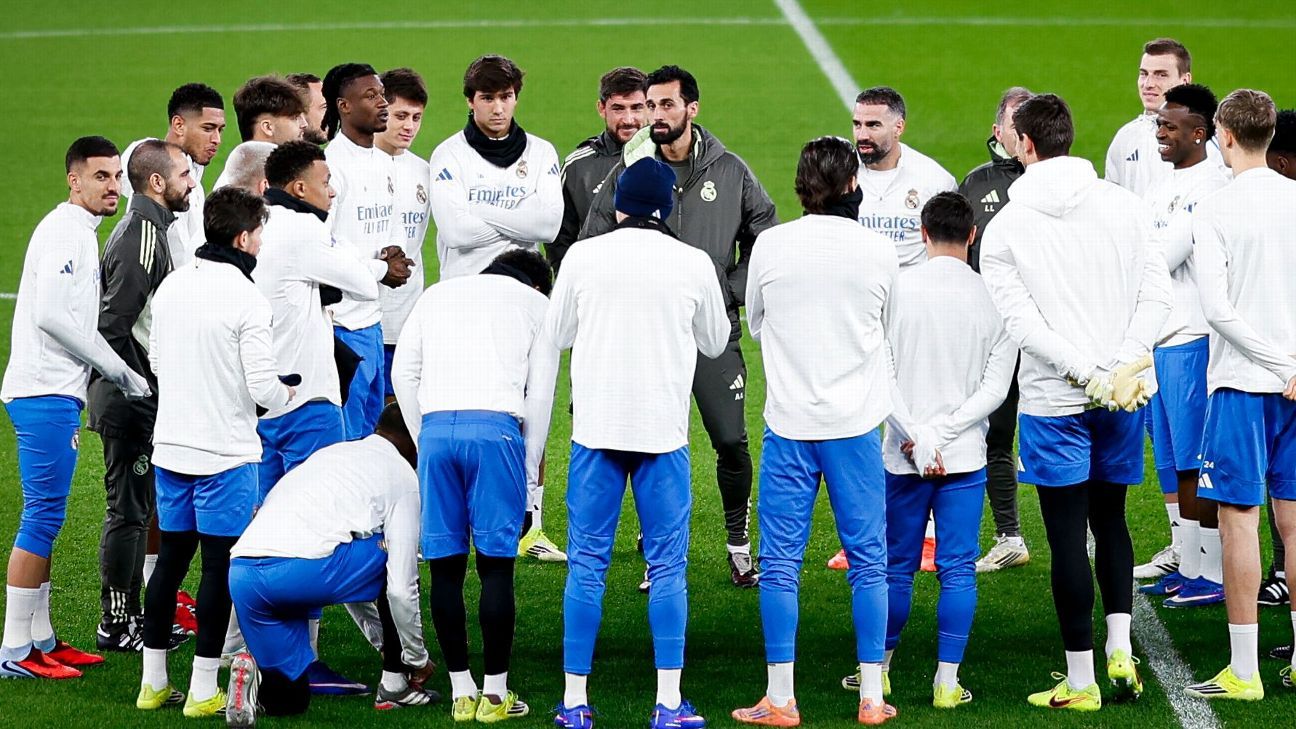
At the end of Álvaro Arbeloa’s news conference following Real Madrid‘s gutsy, gripping 3-2 win over Atlético Madrid in Sunday’s LaLiga derby, there was time for one last question.
It was a simple one. What would you say to those who doubted you? “That they didn’t know the players I had,” Arbeloa replied.
Since taking over from Xabi Alonso in January, Arbeloa has relentlessly shifted the focus on to the players, praising them, and deflecting any credit for Madrid’s turnaround in their general direction.
“I’m lucky to have him,” has been a constant refrain when the coach has been asked about Vinícius Júnior, Federico Valverde, Kylian Mbappé and others. “I’d make a statue of him and put it in my garden,” he said before the derby, when asked about defender Antonio Rüdiger.
– Stream every LaLiga match LIVE all season long on ESPN+ (U.S.)
– LaLiga Confidential: Spain’s soccer stars take ESPN’s player survey
– Sevilla, fighting relegation, are a shambles. Can Sergio Ramos save them?
Whether it’s the coach, the players, or both, Madrid have improved since Arbeloa took charge on Jan. 12. Since then, they’ve won 17 of their 21 games in all competitions, losing the other four.
In LaLiga, they’re four points behind leaders Barcelona — the same deficit as when Alonso was sacked — with a potentially decisive Clásico on May 10. In the UEFA Champions League, they will face Bayern Munich in the quarterfinals after eliminating Manchester City 5-1 on aggregate.
In just a few weeks, Arbeloa’s Madrid have beaten three teams coached by managerial greats: José Mourinho’s Benfica, Pep Guardiola’s City and Diego Simeone’s Atlético
It hasn’t all been plain sailing. Arbeloa’s debut as first-team coach saw Madrid knocked out of the Copa del Rey by Albacete. After back-to-back LaLiga defeats to Osasuna and Getafe, club sources told ESPN that barring “a miracle” or winning the Champions League — which at the time, felt like the same thing — Arbeloa would be replaced in the summer.
But results show the coach has, unquestionably, got a number of key things right, starting with his management of one of the team’s biggest — and previously most underperforming — stars.
2:00
Will Real Madrid’s comeback spark a LaLiga title push?
Luis Garcia reacts to Real Madrid’s comeback win over rivals Atletico Madrid in LaLiga.
Vinícius Júnior, back in form
Vinícius became the public face of dressing-room opposition to Alonso with his petulant on-field reaction to being substituted by the coach during last October’s Clásico.
Alonso’s doubts about the Brazil forward had been evident since last summer — ESPN reported that he considered dropping Vinícius during the FIFA Club World Cup — and the coach left him out of the team in both LaLiga and the Champions League, despite being fully fit. The result: Vinícius lost confidence, went three months without scoring, and was loudly whistled by home fans at the Bernabéu,
Negotiations over a new contract — with his current deal up in 2027 — were at a standstill. ESPN reported that Alonso was a major, perhaps insurmountable, obstacle in Vinícius’s contract renewal.
Arbeloa’s top priority after taking over was to get the former Ballon d’Or runner-up back on side. He has praised and defended Vinícius at every opportunity, making him a fixture in the starting XI again.
“I’m going to work to get the best out of Vinícius,” the coach said in January. “I’m going to demand that [the other] players look for him [with the ball]. He’s fearless. He’s one of the most dangerous players, if not the most dangerous, in the world. He embodies what a Real Madrid player is.”
Arbeloa’s faith and patience were rewarded when Vinícius scored in five consecutive games in February — matching his career-best run — and then scored back-to-back braces against City and Atlético Madrid. When he was substituted late on against Atlético, Arbeloa was waiting with a bear hug on the touchline.
“I don’t know if [Vinícius] is in the best form of his career, but he’s not far off,” the coach said on Sunday.
Speaking while on international duty with Brazil this week, Vinícius said he now wishes to stay at Madrid “for a long time.”
A new role for Valverde
If Vinícius’ transformation has been the most eye-catching of Arbeloa’s tenure, Valverde’s metamorphosis hasn’t been far behind. Valverde was another of the senior players, alongside Vinícius and Jude Bellingham, who — sources close to the dressing room told ESPN — were unconvinced by Alonso.
TV images showed the midfielder unenthusiastically warming up on the sidelines after being left out of the XI for a trip to Kairat Almaty in September, and he was frequently picked at right-back — a position he said he “wasn’t born to play” — in the absence of Trent Alexander-Arnold and Dani Carvajal.
Valverde hadn’t scored this season until January’s Spanish Supercopa. Now, under Arbeloa — and after being restored to the marauding right-wing position he thrived in under Carlo Ancelotti — he has scored six goals in a month, including a hat trick against City that made headlines around the world, and the crucial second goal against Atlético.
“Fede is everything a Real Madrid player should be,” Arbeloa said after Valverde scored a 94th-minute winner at Celta Vigo on March 6. “He has the spirit of [1980s club legend] Juanito. He has that quality which the great players in our history have had, and today he carried the team on his back.”
Liberated from right-back, and shifted out wide from a deep-lying central position which looked ill-suited to his skillset, Valverde is thriving. This is no reinvention from Arbeloa. Instead, as with Vinícius, it’s been about giving a talented player confidence, and putting them in a position to flourish.
1:31
Burley: Man City were taught a lesson by Real Madrid in UCL
Craig Burley reacts to Manchester City’s Champions League exit against Real Madrid.
Pitarch and homegrown talent
As the former coach of Madrid’s reserve side, Castilla — and before that, with the club’s youth teams — Arbeloa’s first-hand knowledge of the academy was signalled as a positive before his appointment. But the opportunities he has given to young players have been more frequent and more extensive than anybody could have predicted.
In Madrid’s 4-1 win over Elche at the Bernabéu on March 14, Madrid kicked off with one young homegrown talent, midfielder Thiago Pitarch, in the starting eleven, before Arbeloa introduced another five — Gonzalo García, Daniel Yañez, Diego Aguado, Manuel Ángel and César Palacios — off the bench. Madrid were only 2-0 up at the time, the outcome far from certain.
“I can die in peace after a night like this,” Arbeloa said, with a touch of hyperbole, afterward. “For someone who came up through the youth ranks and made it to the first team, this is a day of immense happiness and pride … It reminded me of the Madrid of the [famous 1980s homegrown team] Quinta del Buitre era.”
Arbeloa’s belief in youth has been justified. The energetic, fearless 18-year-old Thiago Pitarch has excelled, starting the team’s last six games, bringing dynamism and movement to a previously static midfield. Yañez contributed an assist against Elche.
Arbeloa has shown that he wasn’t just talking up the academy; he meant it. Sources told ESPN that senior club executives are delighted with his focus on the cantera, conscious of the resulting soaring valuations for homegrown players like Pitarch.
A compact 4-4-2 and a ‘false No. 9’
Pitarch has slotted into an athletic midfield quartet alongside Aurélien Tchouaméni — the team’s other outstanding player in recent weeks — Valverde, and Arda Güler. Vinícius has formed part of Arbeloa’s front two, starting on the left but with the freedom to step inside and take up dangerous, goal-scoring positions inside the box.
Partnering him, in the absence of Mbappé — who has been recovering from a knee sprain — has been Brahim Díaz. Díaz has often underwhelmed since joining Madrid, and made just one start in Arbeloa’s first two months in charge after returning from the Africa Cup of Nations a week into his new coach’s reign. But he has now started Madrid’s last five games, including both legs against City, playing an unshowy, hard-working ‘false No. 9’ role, and growing in stature.
“[Díaz] is understanding well what I want from him,” Arbeloa said on Sunday. “When opponents sit deep, he has a lot of freedom to move between the lines. He wanted opportunities, and just not making mistakes wasn’t enough. He’s a player who should take chances, have one-on-ones, get shots on goal and win penalties like today. That’s the Brahim we need.”
Winning over the doubters
Multiple sources close to the first-team squad have told ESPN that there is a notable improvement in the atmosphere around the Valdebebas training complex — and inside the dressing room — since Arbeloa’s arrival, a welcome sight following the fraught end to Alonso’s reign. Club executives are aware of this change, sources said, and point to it as proof that they made the right decision in removing Alonso when they did. The former coach had been focused almost exclusively on tactical solutions to the team’s problems, sources said, while Arbeloa is less concerned with on-field coaching, and more with supporting the players emotionally and putting them in a position to perform.
However, it must also be said that when results were bad — after the LaLiga losses to Osasuna and Getafe — the picture painted of Arbeloa’s management by sources close to the dressing room was much less positive. Then, some players were critical of Arbeloa’s approach and messaging, while executives said that he was almost certain to lose his job in the summer.
1:53
How will the return of Mbappé & Bellingham affect Real Madrid?
Alex Kirkland questions how Real Madrid will adapt following Kylian Mbappé and Jude Bellingham’s return from injury.
What about Mbappé and Bellingham?
The recoveries from injury of Mbappé — who made his return as a substitute against City — and Bellingham — who came off the bench against Atlético — present an opportunity, but also a significant challenge for Arbeloa. Two of the world’s best players are back and available for selection; but their inclusion risks breaking up the cohesive team unit that the coach has been able to build in their absence.
There is no doubt that top scorer Mbappé will replace Díaz, who has been an important part of the team’s success in recent weeks, while Bellingham will come in for either Pitarch or Güler. But while the two superstars possess many qualities, they may find it difficult to emulate those that their lower-profile teammates brought to the side: selfless work-rate and an acceptance of a specific, defined role to benefit the team as a whole.
After the international break, Madrid travel to Mallorca in LaLiga, before hosting Bayern Munich, one of the best teams in Europe, in the Champions League quarterfinals. Despite Arbeloa’s successes in recent weeks, club sources are still reluctant to state that he would remain in charge next season if his Madrid aren’t able to win either trophy.
“I’m not Gandalf,” Arbeloa said last month in another idiosyncratic news conference diversion, when asked about changing the team’s fortunes. “What I’m getting is what I wanted from my players: commitment and effort.”
That back-to-basics approach has worked its magic so far. Eliminating Bayern would be Arbeloa’s greatest trick yet.
MADRID — The first of three Clásicos in eight days felt like it was over almost before it began.
Real Madrid went into this latest meeting with Barcelona — the first of two UEFA Women’s Champions League quarterfinal legs, with a Liga F game sandwiched in between — determined to show they were getting ever closer to competing on level terms with their rivals, an emerging power catching up with the dominant force in Spain and Europe.
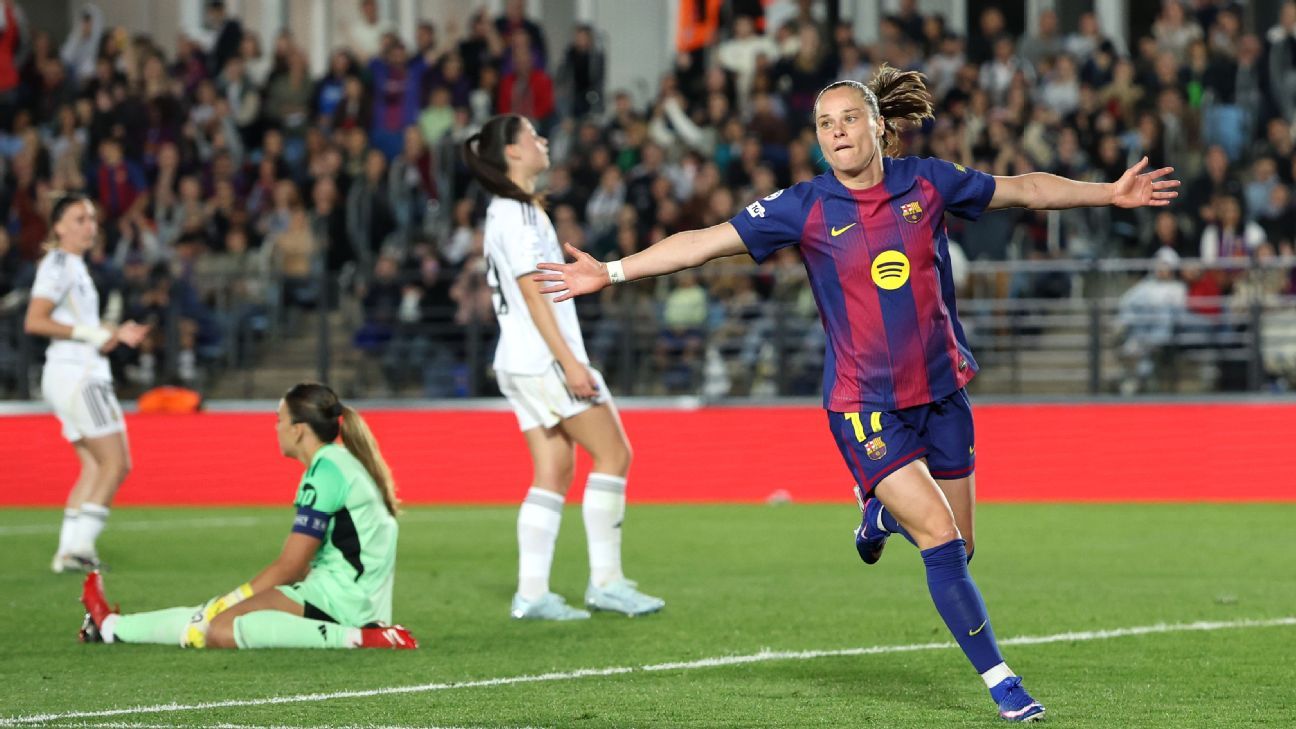
That hope lasted just six minutes, when Ewa Pajor put Barça ahead. Seven minutes later, Esmee Brugts made it 2-0 and silenced the excited crowd at the Alfredo Di Stéfano stadium, as Barça went on to win 6-2.
“In the last three Clásicos, we’ve had chances to go ahead and we haven’t been clinical,” Madrid coach Pau Quesada said prematch. “We’ll look for 90 minutes of perfection, because 70 aren’t enough in these games.”
It proved to be an overly ambitious aim. Barcelona’s record in this fixture is near flawless — with 21 wins and just one defeat going into Wednesday’s meeting at Valdebebas — and based on this contest, there’ll be no change in that balance any time soon.
Only the supremely talented Linda Caicedo put up much resistance, her two beautifully taken goals keeping Madrid just barely in the tie. Her second-half strike, arrowed into the top corner, drew gasps and then cheers from the crowd, hopeful that there was still some life in this quarterfinal.
Overall, though, this was an often deflating experience for a Madrid side that is starting to finally feel comfortable at this level, reaching the UWCL quarterfinals for the second season in a row. But they are nowhere near matching Barcelona’s overwhelming European pedigree, perennial semifinalists and beyond.
Barça’s early opening goal came far too easily, though the final ball, Barça midfielder Patri Guijarro‘s deftly scooped assist over the defense, was expertly delivered. Pajor, a familiar nemesis for Madrid, did the rest. Their second goal was bizarre, goalkeeper Misa’s save from Brugt’s header only serving to send the ball looping high up in the air, and into the net at the far post.
Misa made up for the error four minutes later, denying Pajor in a one-on-one, and there was some hope for Madrid when Caicedo made it 2-1 with her first goal against Barcelona. Caicedo’s run was perfectly timed, and she held off the challenge of Irene Paredes, before dribbling around keeper Cata Coll, who stayed on her feet as long as she could. Caicedo waited even longer.
At last, there was some noise from the crowd at the Di Stéfano, but it was short-lived. Just two minutes later, Paredes’ unstoppable header from Clàudia Pina‘s corner made it 3-1 and effectively ended the contest.
Despite their superiority in this contest, Barcelona had only once scored five or more goals away at Madrid, in the Copa de la Reina semifinals in 2025. In the second half, when they extended their lead with another cool finish from Pajor and then another from Vicky López on 64 minutes, some of the home fans got to their feet and started heading for the exits.
Those who did missed Caicedo’s goal-of-the-week contender, but there was still time for Alexia Putellas to convert an 89th-minute penalty, putting the game — and probably the tie — well beyond Madrid’s reach at 6-2. Madrid’s progress in this fixture is undeniable. That long-awaited first win over Barça came, almost unexpectedly, in March 2025. But on nights like this, the gulf between the two still feels significant and difficult to bridge.
The 6-2 Clásico scoreline is a famous one from the men’s game. Seventeen years ago, in May 2009, Pep Guardiola’s Barça won 6-2 at the Bernabéu. Here, the women’s side had delivered their own piece of history.
“We’re happy,” Guijarro said postmatch. “It’s the first leg. We’ll go at 200% in the second leg too. I think we deserved the result.
“With this result it might seem like we’ll relax on Sunday, and that in the next game, with a four-goal lead, we’ll relax in the second leg. But quite the opposite. You know us.”
Madrid were outplayed in midfield, where Caroline Weir was unable to exert her usual influence and substituted after 65 minutes. Only Caicedo’s individual quality could compete, and that alone wasn’t enough.
At full time, Quesada gathered his players in a circle on the pitch, looking to lift his players’ spirits ahead of the two upcoming Clásicos. Madrid can’t afford to dwell on this loss, or on conceding six goals at home. They must find a way to pick themselves up and keep believing that a different outcome is possible, this weekend and next Thursday.
ATLANTA — Florida freshman Ahmed Jaouadi broke the NCAA record in the 1,650-yard freestyle, and the Gators shared the Day 1 lead with Indiana at the Division I swimming and diving championships on Wednesday.
Jaouadi denied Indiana senior Zalán Sárkány a three-peat with a time of 14:10.03 to break former Gator Bobby Finke’s longstanding NCAA record. Sárkány recorded the fastest 1,000 freestyle in collegiate swimming history, splitting an 8:33.10 during a runner-up performance.
Florida and Indiana are tied atop the team standing with 86 points, followed by Texas with 72.
Jonny Kulow brought home the title for Arizona State in the 200-medley relay with a time of 1:20.07. Florida, after setting an NCAA record at the SEC championships, was runner-up, and the Longhorns took third.
Texas won the 800 freestyle relay after Rafael Fente-Damers, Camden Taylor, Rex Maurer and Baylor Nelson touched first in 6:05.82.
The four-day event at the McAuley Aquatic Center continues Thursday with the 100 butterfly, 400 individual medley, 200 freestyle, 100 breaststroke, 1-meter diving and the 200 freestyle relay.

Co-op boss quits after ‘toxic culture’ claims reported by BBC

‘She’s Never Going to Age’: Porn Stars Are Embracing AI Clones to Stay Forever Young

How Arbeloa has won over doubters and given Real Madrid hope

-

 Fashion1 week ago
Sales at US apparel, clothing accessories stores up 4% YoY in Jan 2026
-

 Tech1 week ago
Justice Department Says Anthropic Can’t Be Trusted With Warfighting Systems
-

 Entertainment1 week ago
Val Kilmer revived 1 year after death through AI
-

 Sports1 week ago
March Madness 2026 – How to watch in SA, start time, schedule, TV channel for NCAA championship basketball tournament
-
 Business1 week ago
Stocks and pound rise as US rate call approaches
-
 Business1 week ago
Brits cashing in jewellery as gold price hits record high
-

 Politics1 week ago
Iran strikes Tel Aviv with cluster-warhead missiles in retaliation of Larijani’s martyrdom
-

 Fashion1 week ago
Spain’s Inditex FY25 sales rise 3.2% to $46.28 bn amid strong demand