

Sports
T20 World Cup: Aleem Dar ‘expressed reservations’ over inclusion of Babar, Shadab

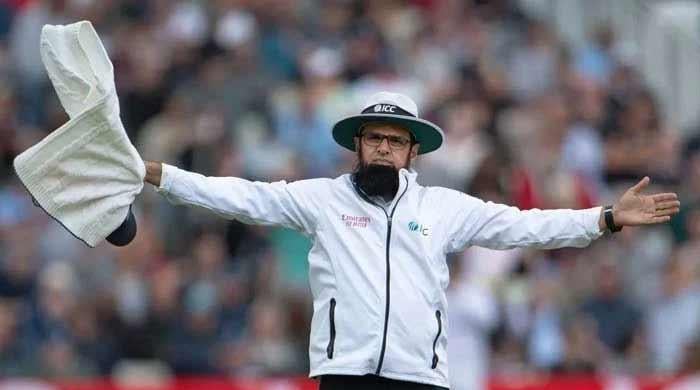
- Coach Hesson, Aqib Javed interfered in selection matters: sources.
- Dar complains 20 players selected, but captain, coach chose wrong 15.
- Salman Agha showed no resistance on selection matter, says Dar
KARACHI: Following Pakistan’s poor performance in the Super Four stage of the ICC Men’s T20 World Cup and the team’s exit from the event, a member of the national selection committee, Aleem Dar, has decided to resign.
According to highly reliable sources, the ICC Elite Panel umpire stepped down due to extraordinary interference in selection matters by head coach Mike Hesson and the silence of the influential selection committee member Aaqib Javed.
Aleem Dar complains that selectors had announced Pakistan’s best 20 players, but then the captain and coach chose the wrong 15, followed by incorrect selections in the playing XI. As a result, selectors are left only to face criticism.
During the ICC Men’s T20 World Cup, Aleem Dar had expressed reservations over the inclusion of former captain Babar Azam and all-rounder Shadab Khan in the squad despite their lack of performance. However, Captain Salman Ali Agha, who, according to Aleem Dar, did not even merit a place in the squad as captain along with Aaqib Javed, showed no resistance. Coach Mike Hesson openly had the final say in selection matters.
Aleem Dar had also proposed that experienced wicketkeeper Mohammad Rizwan should be played at number six instead of wicketkeeper Usman Khan. His stance was that if Shadab and Babar could be part of the team despite their underperformance, then Mohammad Rizwan also deserved another opportunity.
In the current circumstances, Aleem Dar’s resignation is being viewed as a principled decision. He believes that Allah has granted him great respect through cricket, and he does not wish to work as a puppet; therefore, it is better for him to step down.
Premier League soccer is stuck.
The last time the league felt stuck like this was about a decade ago. Despite TV revenues that were lapping the rest of Europe, the best Premier League teams — how can I put this? — stunk.
The league offered nothing unique from a tactical or talent perspective. The best soccer was being played in Germany, Spain, and even Italy. The likes of Bayern Munich, Real Madrid, Barcelona, and Juventus were, inarguably, better than anyone in England. As if to prove the point, Leicester City went out and won the Premier League in 2016.
The following season was the first with Jürgen Klopp and Pep Guardiola in England, and all the problems were almost immediately solved. Liverpool and Manchester City quickly became two of the best teams in the world, and they both did it through compelling risk-forward soccer: Man City by attempting to dominate possession to a degree we’d never seen outside of continental Europe, Liverpool through their vertical, high-pressing “heavy metal football.”
Everyone else was forced to adapt or die, and the next 10 years may have been the peak of English soccer: an era that married technical and physical skill with on-field results. The teams were great — and they were great to watch.
The solution to the Premier League’s rut isn’t as clear this time around, though. Back then, Premier League teams were rich, and all they had to do was hire the guys who built the better soccer that was being played elsewhere in Europe. Now, though, the Premier League teams are rich — and, as we’ve seen in the Champions League, they’re better than everyone else in Europe. And the game has been overwhelmed with set plays in a way I didn’t envision happening — even when I warned about it back in October.
Through 28 weeks, Premier League teams have combined for 505 open-play goals — the fewest since the 2020-21 pandemic season. And if we remove that one season in the history of England’s top flight when there were no fans in the stands, then this is the lowest-scoring season from open play since 2009-10.
Teams have only put 1,659 open-play shots on target so far this season — by far the lowest in Opta’s 17-season dataset, and 300-plus shots fewer than in either of the past two seasons.
Prefer pretty passing to goalmouth action? Well, you’ve been bored to death this year, too: teams have completed 48,248 open-play passes in the attacking third. That’s the lowest since 2011-12 and nearly 10,000 fewer than we saw either last year or the year before.
The best soccer teams in the world have landed on a style of soccer that eschews most of the things most people love about the sport: risky, intricate passing patterns and shots on goal.
Fixing this — and it needs to be fixed, unless you think soccer is the most popular sport in the world because “watching a lot of corner kicks” is our universal language — will require rule changes and new modes of on-field enforcement. But it will also require a coach or a club willing to do something that might break the sport free of its current stalemate.
To any prospective trailblazer out there, I have a suggestion: Do something no one else is doing right now and fully embrace the back three.
– Top 50 USMNT players of 2026, ranked by club form
– Do Premier League summer transfers need more patience?
– Premier League Power Rankings: Chelsea up, Liverpool down
Why nobody plays a back three
Wait, wait — where are you going?
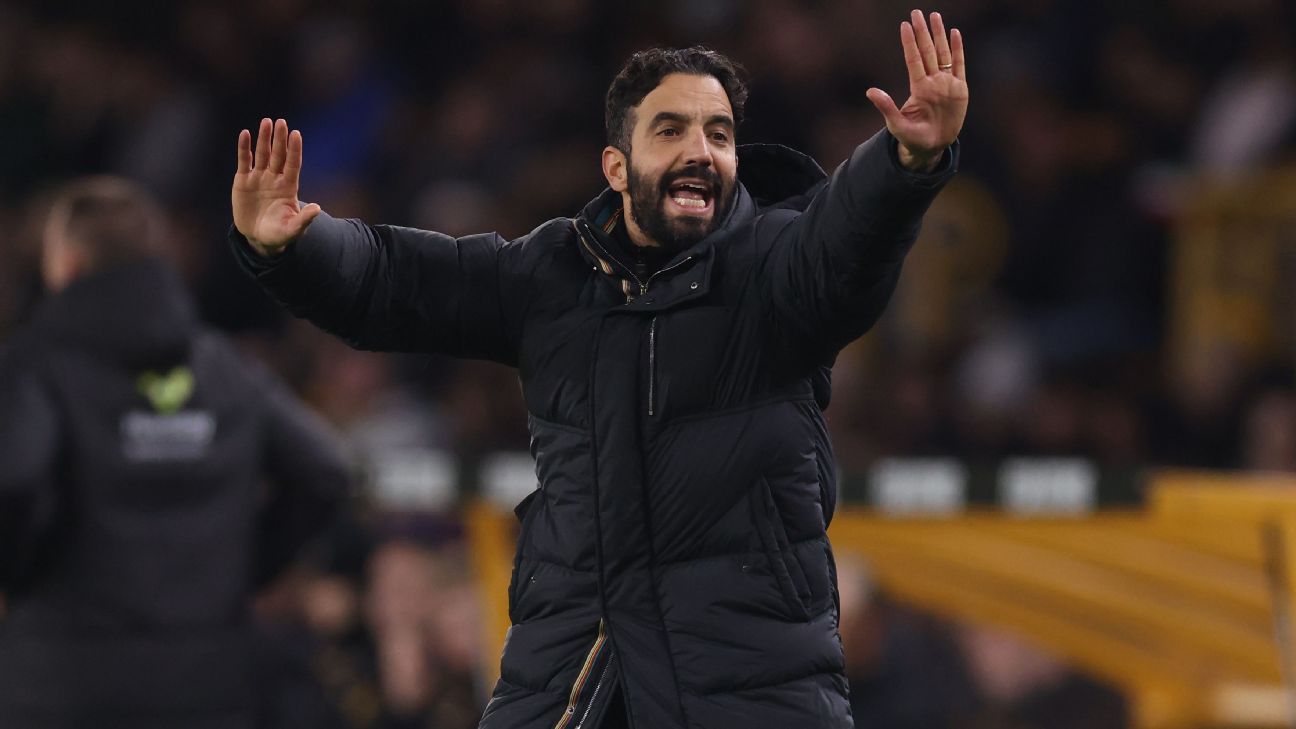
“Um, your big idea is that more coaches and clubs should do what, uh, Ruben Amorim was doing before he got fired? Have you seen Manchester United’s record since they stopped playing with a back three?”
First off, Amorim had the team in sixth place when he got fired. Plus, I’d argue that Manchester United were the one team in the league that was actually playing risk-taking, wide-open soccer. Their matches featured a ton of shots — at both ends of the field. It’s not like he got fired because the team wasn’t doing well. He got fired because he was a pain to work with, as his pre-firing news conference made clear.
“Well, he was a pain to work with because he refused to play anything other than his stupid back three!”
That brings us to the main problem with quantifying the effect of playing with a back three: so many people have given it a bad reputation.
Back in 2022, soccer data analysts Pascal Bauer, Gabriel Anzer, and Laurie Shaw wrote a fantastic paper titled “Putting team formations in association football into context” for the Journal of Sports Analytics. Bauer works for the German FA, Anzer with RB Leipzig, and Shaw recently joined Liverpool after leaving City. These are three of the more accomplished and refined analysts in the sport, and it’s obvious in the paper.
Formation notations, of course, are largely meaningless. Games are dynamic, player movement is fluid and unpredictable. “No 4-4-2s are created equal” and all that. So, to define a team’s formation, the trio looked at how a team positioned their players in the buildup phase — once they’ve settled possession, the opposition has settled into its defensive shape, and the challenge becomes: “How do we move the ball up the field?”
By using tracking data from seven Bundesliga seasons, they identified that most teams tend to build up with either two or three defenders as the deepest line of players — the former indicating a back four, the latter indicating a back three. Most teams also defended the buildup phase with either a back four or a back three. They compared the success of the various formations against each other by looking at the average expected goals created in each matchup.
“The conclusion is that the three-defender build-up formation appears to be more easily countered than the two-defender formation while showing less of an upside benefit against other formations,” they wrote. “Building up with two defenders is significantly more popular amongst Bundesliga teams than building with three defenders; our results indicate that the latter does indeed appear to be a weaker option.”
The one caveat to their findings, the authors note, is that if there were a preference among stronger or weaker teams to favor a certain buildup structure. The paper was published in March 2023, and the back four was the formation of choice at Bayern Munich, who would win their 11th-straight title just a few months later.
And a year after that, the Bundesliga winner could go undefeated for the first time ever — except, this time, it wasn’t Bayern Munich. It was Xabi Alonso’s Bayer Leverkusen, and they played with a back three.
Want to overachieve? Play a back three
Over the past 10 or 15 years, if a team has overachieved, they were probably playing back three.
Who has been the biggest overachiever in the Champions League over the past five years? Inter Milan’s annual revenues usually make them the 13th or 14th richest team in the world, and they’ve made it to two of the past three finals in the European cup — something no other team in the world can say.
The most surprising Champions League winner of the past 10 years? Frankly, the only surprising Champions League winner of the past 10 years? That would be Chelsea in 2021 — the same season they fired Frank Lampard and finished in fourth place in the Premier League. When Thomas Tuchel was brought in to replace Lampard midseason, what did he do? He switched to a back three. Oh, and the last time Chelsea won the Premier League, in 2017? They played a back three.
When RB Leipzig made a run to the Champions League semifinals in 2020, they were playing a back three. Remember how Atalanta used to flirt with Serie A titles every season? For most of that time, they played a back three.
How about when Sheffield United finished in ninth place a season after being promoted? A back three. Heck, remember when Tottenham Hotspur used to challenge for Champions League places instead of fending off a place in the Championship? The last time they finished top four, they were playing a back three.
But it’s not only upstarts catching everyone else off guard. Juventus used to win Serie A every year and make deep runs in the Champions League. And while their recent decline has much more to do with blatant corruption and club mismanagement than the formation they play, they’ve also moved away from the back three that brought them so much success.
And what about maybe the best team we’ve ever seen, the 2022-23 Manchester City side that won the treble? They caught Arsenal and everyone else once Guardiola shifted into something like a back three, where they’d play four defenders — Rúben Dias, Nathan Aké, one of Manuel Akanji and Kyle Walker, and John Stones — and then Stones would step into the midfield in possession. The outside backs would then pinch in, rather than running forward.
Here’s what their pass map looked like in the first half of the Champions League final against Inter Milan:
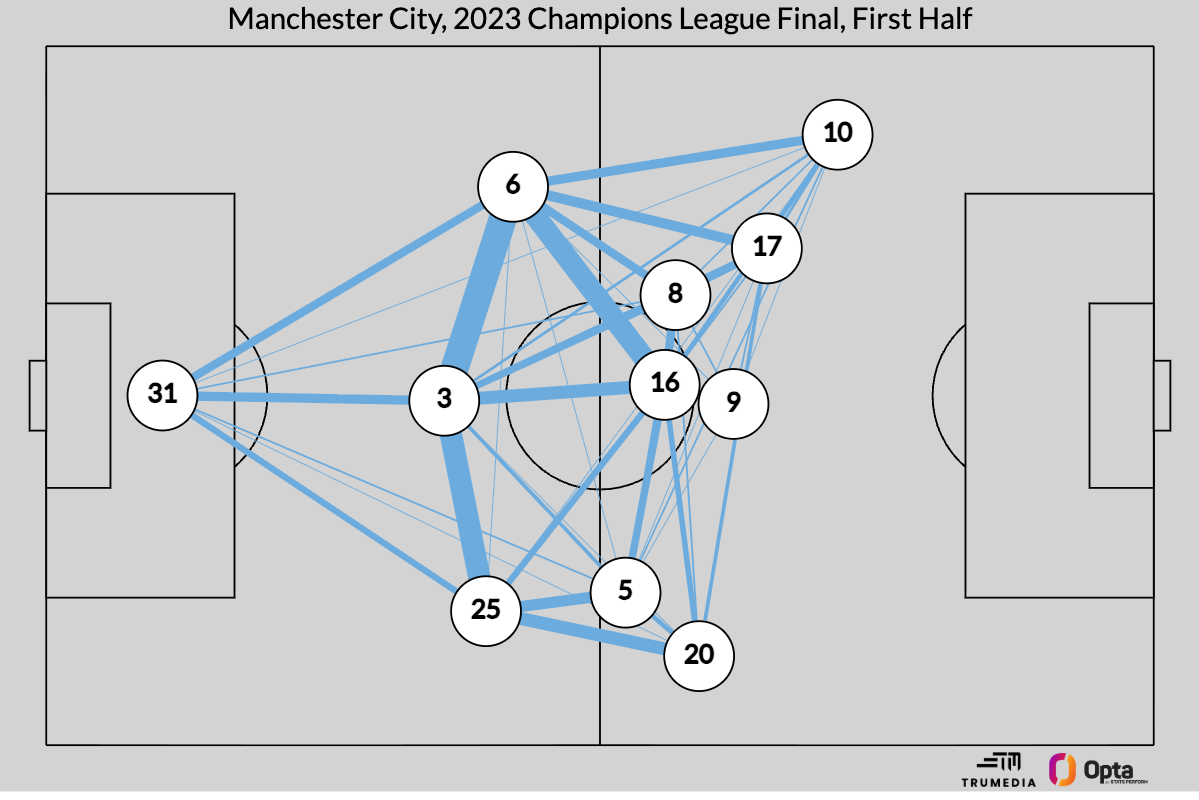
It’s been good enough to win the treble, make multiple Champions League finals, and go undefeated in the Bundesliga, but it’s still not good enough for anyone in the Premier League … yet.
Why it’s time for the Premier League to embrace the back three
Per Opta’s designations, here’s the frequency with which every formation has been used in the league since 2009:
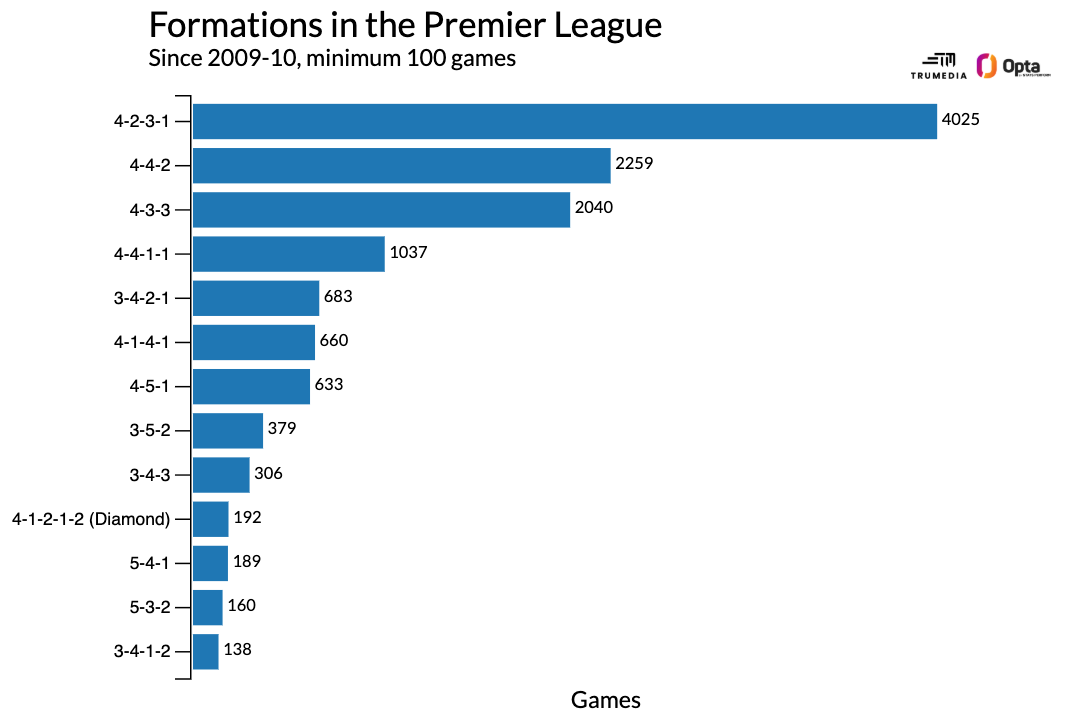
Formations are fluid and not all built the same, so plenty of caveats apply, but it’s clear that the back four, in its three different guises — first the 4-4-2, then the 4-2-3-1, followed by the 4-3-3, and now back to the 4-2-3-1 — is king.
And, well, the results would seem to support these choices. Here’s the collective goal differentials of all of those formations:
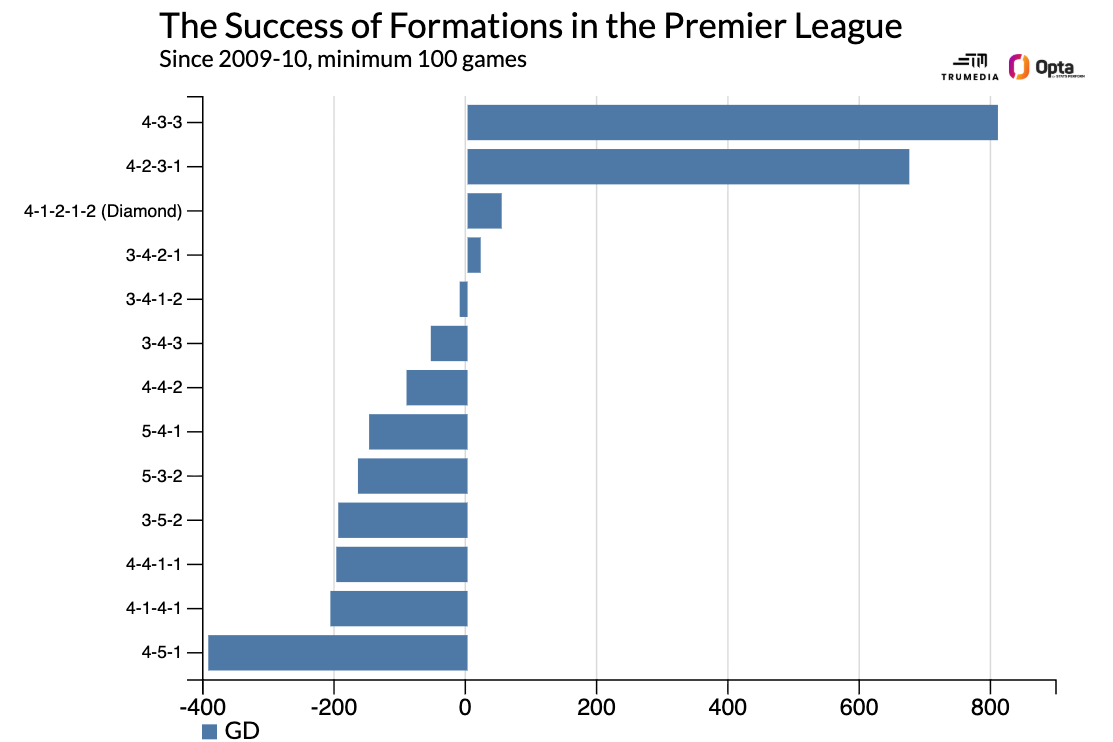
But as the authors of the Bundesliga study asked, how much of that is because of the true efficacy of the back four and how much of that is simply because the best teams in the Premier League happen to play with a back four?
Now, I think we should give the likes of Guardiola and Klopp some credit — that they, and other top managers, favored back fours because it was a more effective base arrangement to build from. And I think it probably was. If you were able to pin the ball high up the field, circulate possession up, back, around, and through your opponent, and only have to occasionally snuff out counter-attacks, then it made sense for you to only have two nominal centerbacks on the field.
To be an utterly dominant team like Manchester City and Liverpool were — or Bayern Munich are — then the back four is probably the optimal arrangement. Why? Simply because it puts more attack-first players on the field and asks fewer players to cover the areas you’ll occasionally need to defend.
But the Premier League has changed. Guardiola complains about it every week: everyone is more athletic and everyone can man-to-man mark your players now. The best clubs don’t necessarily have more elite talent than they had five or seven years ago, but the rest of the Premier League is gobbling up the types of players who would’ve played for Borussia Dortmund and AC Milan back then.
As such, these teams can’t be pressed off the field as easily as they were in the past. (Plus, the top teams are playing so many games that Klopp-style gegenpressing might be a physical impossibility anyway.) And when they do get pinned back, the quality of the players who are “parking the bus” is way higher than it used to be, as is the quality of the players who will launch the occasional counter-attack out of the deep block.
That all leads to where we are now: the ball rarely ends up near the goal, and the only way you can consistently score goals is from set pieces. Liverpool’s season was on the brink of falling apart, then they fired their set piece coach, scored seven set piece goals in a row, and now they’re three points back of third. This is just how it works right now — and it’s not fun.
The game is screaming out for someone to try something different — and to me, that’s where the value of a top team switching to a back three lies: it’s different. It may not have been the optimal approach when you needed 90 points to win the league, but it seems clear that the league has figured out how to negate the front-foot 4-3-3 or 4-2-3-1 style that the best teams in the Premier League have favored over the past decade. At the very least, the back-three base would create new angles that the rest of the league isn’t used to seeing.
Doing something different, too, would create all kinds of advantages in team-building.
These are the four hardest roles to fill in the sport: (1) a ball-playing centerback who is athletic enough to play in a high line but also big enough to dominate in the air, (2) a technically skilled fullback with the physical capacity to cover an entire sideline, (3) a defensive midfielder who can cover all the space behind the attackers and help progress the ball up the field, (4) and a goal-scoring, ball-dominant winger. They’re cheat codes for a back-four system. And at a given moment, there might be five of each of these players in the world.
To acquire one of these guys, you have to get really lucky and, say, happen to have a stadium in the same town that Trent Alexander-Arnold was born in, or you have to spend hundreds of millions of dollars in transfer fees just for the chance of acquiring one of them.
But what if you could play in a way where you didn’t have to chase any of those player types? Wouldn’t that be a massive advantage on the transfer market?
In, say, a base 3-5-2 system, none of those roles are really necessary. With three center backs, you’re not asking one or two guys to cover an entire half of the field by themselves. The wingbacks don’t have quite the same defensive responsibilities as top-level fullbacks. The midfielders need not be as rangy since there’s more defensive support behind them. And the attacking onus shifts more toward strikers and attacking midfielders, rather than wide forwards.
(In case you’re wondering: yes, Liverpool’s current and future personnel feel particularly suited for this approach.)
While Amorim’s devotion to the back three made it seem like the least flexible formation in the world, it should be way more flexible than the way we’re used to seeing top teams play. When you have those skeleton-key type roles, then you need to have those players on the field, playing those roles. But the 3-5-2 should be infinitely customizable, and it seems like it would better fit the new mold of front-office-driven team building, where some clubs try to identify undervalued players and then task the manager with figuring out how to piece it all together.
If you’re playing a top team, then maybe one of the front two is an attacking midfielder, and that allows you to clog the middle of the field and control the ball. Against lesser opposition, you can drop the midfielder into the midfield three and play with two actual strikers. The same goes for wingbacks. If you’re chasing the game or are expected to have lots of possession, you can just play an actual winger in that role.
Need more solidity? Then throw in a more traditional fullback. It’s true with the center backs, too. Three bigger center backs can solidify the defense, but you can play around by dropping a midfielder or a fullback into one of the outside centre-back slots. Different players will interpret the roles differently and change the overall dynamic.
Formations are just telephone numbers, as Guardiola has said. Picking your starting formation isn’t coaching or tactics — developing a style of approach, a relationship between your players, and an overall appetite for risk is what matters. Regardless of the formation you play, soccer will always be about creating space, controlling space, and exploiting space.
At least for now, though, there just isn’t much space in the Premier League, save for the moments when a guy can launch a long throw-in with his hands from the sideline or whip in a cross from the corner flag. It won’t last forever, but if it’s going to change, somebody is going to have to start doing something different.
Somebody, please, try winning some games by playing a back three.

The Pakistan Super League (PSL) franchise formerly known as Sialkot Stallionz has been renamed Multan Sultans following a majority acquisition by CD Ventures, PSL Chief Executive Salman Naseer said on Tuesday.
He made the announcement at a joint news conference alongside franchise owner Hamza Majeed and CD Ventures chief Gohar Shah.
Naseer said CD Ventures has taken a majority stake in the team, which was initially bought by OZ Developers for Rs1.85 billion at the PSL auction held in January.
Naseer revealed that, following the latest developments, the franchise’s valuation has risen to Rs2 billion annually.
“Gohar Shah requested to change the franchise’s name after becoming CEO, and that request has been accepted,” Naseer said.
“Sialkot Stallionz will now compete as Multan Sultans.”
Majeed described the arrangement as a strategic partnership approved by both the Pakistan Cricket Board (PCB) and the PSL.
“With PCB and PSL approval, this strategic partnership has been finalised,” Majeed said. “CD Ventures’ Gohar Shah is now our strategic partner and will serve as the franchise’s CEO going forward.”
He praised Shah’s enthusiasm, adding: “Gohar Shah’s passion and drive are even greater than mine. Seeing his energy makes me happy, and I welcome him to our league.”
Speculation had surrounded the Sialkot franchise in recent weeks amid reports that OZ Developers had offloaded a significant portion of their shares after one of their partners withdrew shortly after the PSL auction.
There were also unverified claims of financial difficulties within the parent company, which Majeed publicly denied last week, confirming only that discussions with CD Ventures were ongoing.
Speaking at the press conference, Gohar Shah confirmed he has officially joined the franchise as CEO and expressed his desire to restore South Punjab’s representation in the league.
“A stallion alone cannot win the PSL. To move forward, a stallion needs a sultan, and we have come as Sultans,” he remarked.
He added that retaining the Multan identity was important to him.
“It was my wish that the name Multan Sultans remain, and for me it was essential,” he said.
Shah also outlined his broader cricketing vision, which he has termed “Total Cricket”.
“Cricket should be played in a way that serves Pakistan cricket’s needs. In my opinion, the squad selected is correct. Final decisions on the playing XI and other matters will be taken once the camp begins,” he added.
Despite the name change, Majeed assured Sialkot supporters that their backing would not be overlooked.
“We are grateful to Sialkot Stallionz fans for their encouragement,” he said. “There will still be an element of the Stallionz identity visible in our campaign.”
He also confirmed that transport arrangements would be made for Sialkot supporters to attend Multan Sultans matches during the season.
The rebranding marks a significant shift ahead of PSL season 11, which is scheduled to commence on 26 March across five venues in the country.
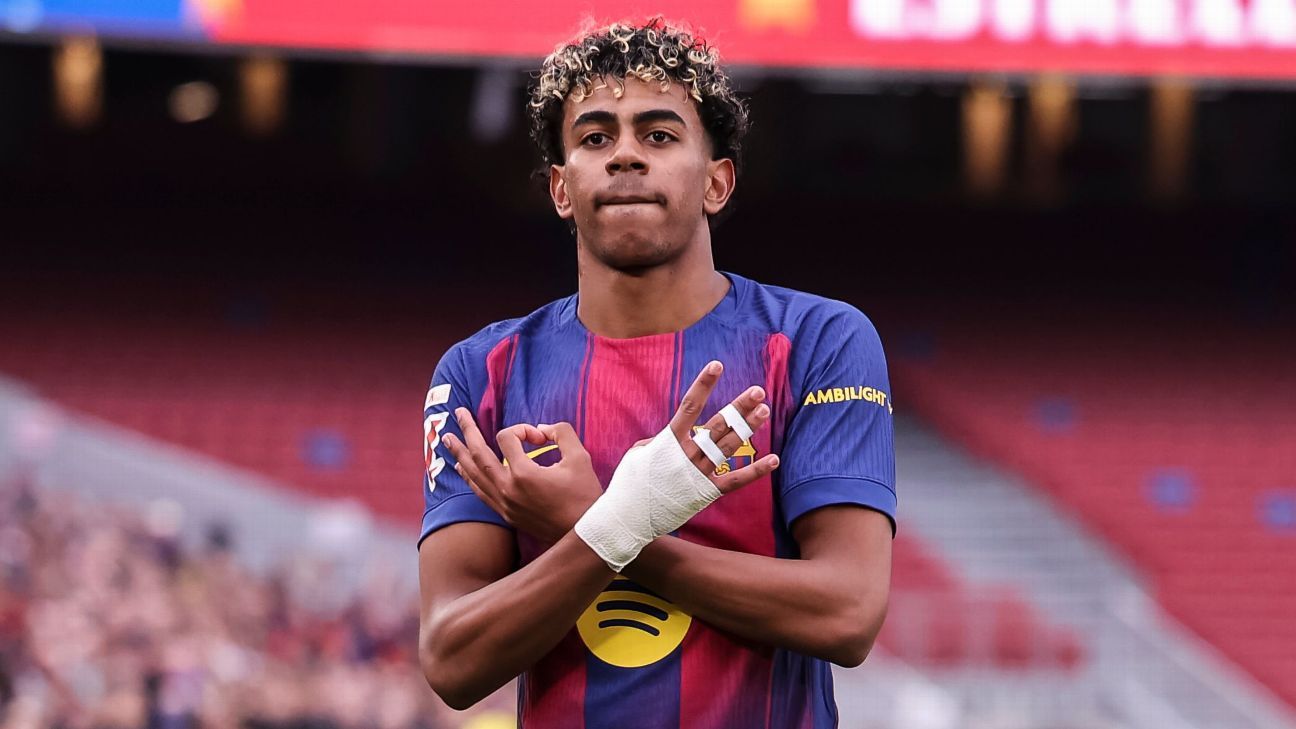
The fact that Barcelona and Spain forward Lamine Yamal has 100 combined goals and assists for club and country as a teenager is, without using any kind of hyperbole, a little footballing miracle.
At the identical age (18 years and seven months), the two great modern players (one of whom is arguably the best in history), Lionel Messi and Cristiano Ronaldo, respectively had only five and four goal contributions for club and country. Meanwhile, Yamal is 60 ahead of where Real Madrid and France forward Kylian Mbappé was at the same age.
Just think about that for a second.
This inventive, daring, creative, technically exquisite young lad, from a working-class background, is at least 95 goal contributions ahead of the game’s two behemoths, Messi and Ronaldo, and is increasing the like-for-like gap with each passing week. And he’s doing so while suffering painfully for months from the type of groin injury which should either be drastically restricting his development, or leaving him on the sidelines — as it has done with Nico Williams at Athletic Club.
But, no, right now Yamal is proving immune to pain, immune to Messi/Ronaldo comparisons, immune to the potentially corruptive impact of huge wealth and trophy success as a teenager.
Even if you set the stats aside, we’ve learned several inarguable things about Yamal already; firstly, that he possesses the same inherent, ferocious, indomitable competitive aggression which fed, and still feeds, Messi.
Without in any way deprecating Ronaldo — because his will to win and competitive aggression are both elite — there is something in his personality, something about his ego, which means he wants to be regarded individually as the best. I’ve been in his presence when he has said exactly that.
But neither Messi nor Yamal are as driven by that individualistic, egotistic compartment of human nature. For them, the constant demand is: “Give me the ball, give me an opponent, let me thrill, let me beat him, let me score or assist and let us win.”
“Us” … that’s the key.
That we are watching a close facsimile of Messi, who is already outstripping pound-for-pound comparative numbers, is, legitimately something of a miracle. You don’t have to be a Barcelona fan or follow Spanish football in order to feel genuinely touched by the privilege of witnessing another genius emerge so soon after Messi.
Indisputably, we live in a world of strife, jeopardy and uncertainty. It’s not an opiate to look for something that is joyous, something that is natural, pure, inspirational and which gives us a dose of happiness even if it’s only for 90 minutes each time he plays. It’s human nature.
The dazzling hat trick Yamal scored on Saturday at home to Villarreal, the first of his career, again highlights the chasm between him and his two almighty forebears at the same age. Yamal is over a year younger than when Messi achieved the same feat against Real Madrid in March 2007 and over four years quicker than Ronaldo when he registered his aged nearly 23 for Manchester United against Newcastle in 2008.
But this wasn’t just his debut treble, these were three goals of increasingly astonishing wonder.
For many, the pick of them was the second, where Yamal started in a position of apparently no threat and danced like a footballing Rudolf Nureyev past all his opponents before his left foot thrashed the ball beyond goalkeeper Luis Reis Junior. But for my taste, the third goal was the most eye-catching one; the timing of his run, his decision-making and his cleverness in finishing, not just through power alone, stood out.
Yamal’s “street-football” style of dribbling, playing “inside” and not on the touchline, while also acting like an outright striker, are some of the things which will elevate him onto the all-time pantheon of greats if he continues to develop this way. If he can add top-level acuity in the penalty box — showing more of a finisher’s touch — then we potentially have another all-time great on our hands.
But of course there are obstacles to overcome.
If he is a little footballing miracle, as I swear to you he is, then that’s precisely what Barcelona require on Tuesday to somehow overturn a four-goal deficit in the second leg of the Copa del Rey semifinal at Camp Nou.
Yes, we all know that Barcelona have the most astonishing result in European football history — having been 4-0 down to Paris before coming back to win 6-1 in the Champions League in 2017 — and maybe it’s coincidence that the heroes of that night were Yamal’s two all-time heroes, Messi and Neymar. But that was an historic achievement that stood out so much because these things do not happen often.
The last time Barcelona and Atleti met in the Catalan capital in the Copa del Rey, Barcelona scored four times alright … but they also conceded four.
So far, Yamal’s record against Atleti is good, without being scintillating: Seven matches, five wins, one draw, one defeat, but only one goal.
The glaringly obvious truth is that while they will need to be a team performance of extraordinary power and discipline in order even to force their way back into the tie on Tuesday, Barça will undoubtedly require some miraculous provision of manna from heaven.
And while midfielder Pedri has some of that in his mind, and his boots, the main provider is Yamal.
2:39
Is there too much pressure on Lamine Yamal?
The ‘FC TV’ crew debate if there’s too much pressure on Lamine Yamal at 18 years of age.
But his club asks a monstrous amount of him. Despite this being a season where he has had to cope with an injury, and where rivals have double- and triple-marked him, his contribution across all competitions has been 32 goals or assists in 34 matches.
That is simply astonishing.
But after the match against Villarreal he admitted: “Over the last few months I haven’t been enjoying myself as much, the groin pain was part of that, I think all that was pretty evident. But for about a week now there’s been a click — things feel better and I’ve got the urge to smile again while I’m playing, which is something I’d lost for a while!”
By now I’ve interviewed Yamal five or six times — on two occasions good, lengthy, interesting conversations — and this is what those meetings taught me:
In general, he’s tough-minded, extremely smart and aware of the talent, responsibility and opportunity which has landed on his doorstep. I honestly think that a large part of his extraordinary makeup is how well his sharp, well-ordered mind — which is mature beyond his age in footballing terms — intersects with his natural talent.
But, in some matters he’s still a kid who dotes on his younger brother and who went to be smothered by hugs and kisses from his mum on the touchline postmatch against Villarreal.
One of the first things he revealed to me two years ago was that when he was four or five and put in goal by his dad and uncles during their Rocafonda park games, he felt that they deliberately treated him like an equal and unforgivingly booted shots which hit him in the face. He said that, there and then, he resolved to speed up his development and ability to play outfield so that the next sucker who joined their regular game would have to go in goal instead.
Flinty tough: don’t complain, win.
The fact that Barcelona depend on him to play miraculously on Tuesday against Atletico is fine: he’s ready, willing and able. The fact that Barça have needed him to carry them every week since August to the point that, at 18, he wasn’t happy, or taking joy in his job, isn’t.
I hope someone in their system was taking note: Yamal isn’t theirs alone, he belongs to everyone around the world who looks to football to inspire them. He gives us thrills, joy and hope. And that is a precious thing indeed.


ICE cotton drops 1% on Middle East war, stronger US dollar

US stock market: Wall street crashes amid Iran tension; Dow jones slips over 900 points, Nasdaq dips by 2% – The Times of India

PM invites lawmakers, party chiefs for in-camera briefing on regional conflict

-

 Politics5 days ago
What are Iran’s ballistic missile capabilities?
-
 Business7 days ago
Households set for lower energy bills amid price cap shake-up
-

 Politics5 days ago
US arrests ex-Air Force pilot for ‘training’ Chinese military
-

 Sports5 days ago
Sri Lanka’s Shanaka says constant criticism has affected players’ mental health
-

 Sports1 week ago
Top 50 USMNT players of 2026, ranked by club form: USMNT Player Performance Index returns
-
 Business7 days ago
Lucid widely misses earnings expectations, forecasts continued EV growth in 2026
-
 Business5 days ago
Attock Cement’s acquisition approved | The Express Tribune
-

 Fashion1 week ago
OECD GDP growth slows to 0.3% in Q4 amid mixed trends