Politics
Tajik forces ‘kill three terrorists’ after border infiltration from Afghanistan

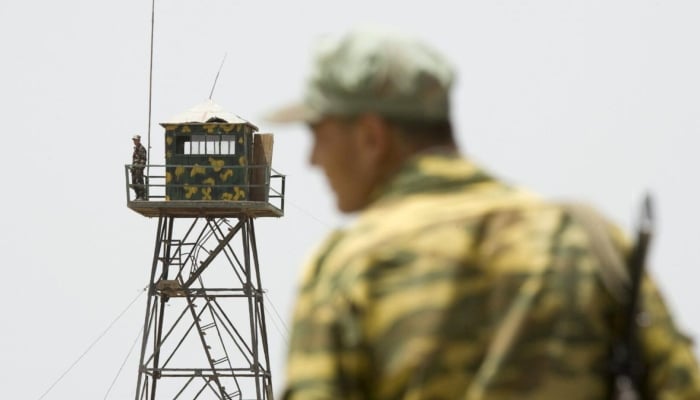
- Militants crossed from Afghanistan, resisted orders.
- Weapons, explosives, recovered from attackers.
- Two Tajik border personnel also killed in operation.
Tajik security forces killed three armed militants who crossed into the country from Afghanistan and refused to lay down their weapons.
In a statement, Tajikistan’s Press Centre of the Border Troops of the State Committee for National Security said that the incident took place on December 23.
“They intended to carry out an armed attack on one of the border outposts of the Border Troops of the State Committee for National Security of the Republic of Tajikistan,” it added.
Tajik security forces swiftly identified the militants’ location and ordered them to surrender. However, they offered armed resistance, leading the forces to kill all three militants in a combat operation, read the statement.
Tajik forces also recovered firearms, including an M-16 rifle, a Kalashnikov assault rifle and three foreign-made pistols equipped with suppressors, ten hand grenades, one night-vision device, explosives, and other military equipment, from the killed militants.
During the fire exchange, two Border Troops personnel were also killed.
The Press Centre of the Border Troops noted that it was the third incident involving an armed attack following illegal border-crossing from Afghanistan into Tajikistan over the past month.
The Central Asian country assailed the Afghan Taliban regime’s failure to prevent terrorist outfits from using its soil for launching terrorist attacks into its neighbouring countries.
The incident comes weeks after five Chinese nationals were killed and five more injured in attacks launched from Afghanistan.
Tajik authorities and China’s embassy in the country said that the Chinese citizens were targeted in armed and drone attacks.
Following the deadly attacks, China’s embassy in Dushanbe, the capital, advised Chinese companies and personnel to urgently evacuate the border area.
Pakistan has repeatedly invited global attention to increased terrorist safe havens in Afghanistan since the Afghan Taliban returned to power in 2021.
Islamabad has lost nearly 1,200 lives this year alone in terrorism linked to networks based in Afghanistan, Pakistan’s permanent representative to the UN, Ambassador Asim Iftikhar Ahmad, said earlier this month.
Pak-Afghan tensions
The issue of cross-border terrorism escalated after the Afghan Taliban and militants launched unprovoked attacks against Pakistan’s border posts on the night between October 11 and 12.
The clashes led to the killing of over 200 Taliban and affiliated militants, while 23 Pakistani soldiers laid down their lives defending the motherland.
Pakistan also conducted “precision strikes” deep inside Afghanistan, targeting terrorist safe havens in Kandahar province and Kabul.
A temporary 48-hour ceasefire was announced on October 15 at Afghanistan’s request, with the two sides eventually reaching an official ceasefire agreement on October 19 in Qatar in talks mediated by Doha and Turkiye.
Under the deal, terrorism from Afghanistan on Pakistani soil should have stopped immediately, with Islamabad and Kabul agreeing to establish mechanisms to consolidate lasting peace and stability between the two countries.
However, the following talks in Turkiye collapsed after Islamabad refused to accept the Afghan Taliban delegation’s “illogical” arguments and refusal to address Islamabad’s concerns regarding cross-border terrorism.
However, mediators persuaded Pakistan to give the talks another chance, which ultimately resulted in an agreement to uphold the ceasefire.