

Business
Taylor Swift’s ‘The Life of a Showgirl’ album release party snares $34 million domestically


A person wearing an outfit inspired by The Eras Tour poses in front of “The Official Release Party of a Showgirl” posters at an AMC theater to celebrate the release of Taylor Swift’s new album “The Life of a Showgirl” in New York City, U.S., Oct. 3, 2025.
Kylie Cooper | Reuters
Taylor Swift gave the box office a boost this weekend.
In partnership with AMC, the singer-songwriter brought a 90-minute movie to cinemas for one weekend only to celebrate the release of her 12th album, “The Life of a Showgirl.”
The three-day event tallied $34 million domestically, the biggest album debut event in cinema history. Internationally, the film snared $16 million, bringing the global box office total to $50 million for the weekend. Previously, AMC had estimated a $33 million domestic haul and $13 million internationally.
“On behalf of AMC Theatres and the entire theatrical exhibition industry, I extend our sincerest appreciation to the iconic Taylor Swift for bringing her brilliance and magic to movie theatres this weekend,” AMC’s CEO Adam Aron said in a statement Sunday. “Her vision to add a cinematic element to her incredible album debut was nothing less than a triumph.”
Swift’s “The Official Release Party of a Showgirl” featured a music video for the song “The Fate of Ophelia,” as well as behind-the-scenes footage from the music video shoot, lyric videos for other songs on the album and personal reflections from the singer.
This is the second collaboration between Swift and AMC. In 2023, the theater chain secured the rights to distribute a filmed version of Swift’s Eras Tour concert. The concert film generated more than $261 million at the global box office. It is currently the highest-grossing concert film of all time.






Stock markets are as turbulent as they have ever been. Those not used to seeing their wealth jump and plunge from day to day might well be wary of trying them out for the first time.
But by investing for the longer term, investors who pick a stocks and sharesISA will almost certainly do better than those who play it safe by holding savings in cash – and they will never pay tax on any earnings.
The average stocks and sharesISA account is worth over £65,000, significantly higher than the typical cash ISA, which holds less than £13,500.
“With UK inflation elevated at around 3 per cent over the past year, it’s not a great time to be sitting on cash, especially given that over the past 12 months, the average stocks and sharesISA grew around 11 per cent, compared to an average return of 3.48 per cent for cash ISAs,” explained Dan Moczulski, eToro UK’s managing director.
With the new tax year’s allowance now in effect – worth £20,000 per person – we asked five experts to pick one fund they would be willing to buy into themselves.
While not recommendations for everybody, they offer food for thought, as well as better diversification and lower risk than buying individual company shares.
Scottish Mortgage FTSE 100
Annabel Brodie-Smith, communications director of the Association of Investment Companies (AIC)
Brodie-Smith is going for the Scottish Mortgage FTSE 100 investment trust managed by Baillie Gifford.
This company invests around the world in exciting private companies like SpaceX and Revolut, as well as public-listed companies like Meta, Nvidia and ASML.
Get a free fractional share worth up to £100.
Capital at risk.
Terms and conditions apply.
ADVERTISEMENT

Get a free fractional share worth up to £100.
Capital at risk.
Terms and conditions apply.
ADVERTISEMENT
They are aiming to invest in the companies shaping the future – a mix of technology, healthcare, consumer services and more. The trust currently trades on a 5 per cent discount and has low charges of 0.31 per cent. This is an investment trust for long-term investors with a high appetite for risk.
This fund went up 27 per cent in the last year and is up 68 per cent over five years.

iShares Over 15 Years Gilts Index Fund (UK)
Alan Miller, CIO at SCM Direct
This fund tracks the FTSE Actuaries UK Conventional Gilts Over 15 Years Index and is therefore a fund investing solely in sterling-denominated UK government bonds, with a minimum remaining maturity of 15 years. It holds 27 gilts, has net assets of £2.95bn, and carries a Morningstar Gold medal.
There are no performance fees and a charge of just 0.1 per cent a year.
Miller says: “One of the most compelling opportunities in the market is hiding in plain sight: UK government bonds.
“Here’s the number that stops people in their tracks: 4.95 per cent compounded over 10 years is a 62 per cent return before charges, backed entirely by the UK government and sheltered from tax inside an ISA.”
Gilt yields are close to multi-decade highs. Locking in a yield to maturity of nearly 5 per cent inside an ISA wrapper, where all income and gains are tax-free, is exceptional by historical standards, and at an ongoing charge of just 0.1 per cent per annum, virtually nothing is lost to fees.
He adds: “Boring has rarely looked this good. It’s the kind of deal most active fund managers can only dream of offering.”
This fund is basically flat over the last year and up 9 per cent over five years. That’s because interest rates have been very low – as they are now higher, it should fare better from here.
Man Income
Paul Agnell, head of investment research, AJ Bell
Of the Man Income fund, Agnell says: “The fund’s pragmatic and analytical managers, Henry Dixon and Jack Barrat, invest in undervalued UK companies across the market cap spectrum, which are paying a yield at least in line with the market. In order to avoid value traps, the managers also look at a firm’s cashflow and assets.”
So, the team seek out undervalued and unloved companies, of which the UK market continues to present opportunities.
Their investment process centres on identifying two types of stocks: those trading below their replacement cost (what it would cost today to replace a company’s assets and operations) that are also cash generative, and those where the market appears to be undervaluing profit streams.
The fund has made an excellent start to 2026, up over 10 per cent in the first two months alone and was up 28 per cent over 2025. Banks were a key contributor over 2025, led by Lloyds, but with strong contributions also coming from Barclays and Standard Chartered.
The charge on the Man Income fund is 0.9 per cent.
Murray International
Philippa Maffioli, Blyth-Richmond Investment Managers
Murray International aims to blend global diversification with a solid income stream. The yield is around 3.5 per cent.
Maffioli says: “I like Murray International’s focus on dependable cashflows and sensible valuations, rather than chasing the highest yield. It also isn’t tied to the UK market, so you’re spreading risk across regions and currencies.”

Day-to-day decisions now sit with Martin Connaghan and Samantha Fitzpatrick, but the approach remains consistent: sustainable income with long-term growth potential. If you reinvest the dividends, it can be a strong compounding option over time.
It charges fees of 0.5 per cent. It is up 36 per cent in the last year and up 60 per cent over five years.
Pantheon Infrastructure Plc
Jonathan Moyes, head of investment research, Wealth Club
Pantheon Infrastructure Plc aims to provide investors with some diversification away from global stock markets while providing the potential for attractive equity-like returns over the longer term.
The FTSE 250 trust co-invests alongside some of the world’s leading infrastructure managers. Its portfolio includes large-scale data centres, gas distribution networks, US renewable energy and storage developers, as well as one of Europe’s leading temperature-controlled logistics and transport businesses.
Moyes says: “These assets are prized for their mission-critical nature and long-term contracted revenue streams. Nonetheless, shares in Pantheon Infrastructure change hands at an attractive 13 per cent discount to net asset value.”
That means the shares in the fund are valued more highly than the actual fund, which means easy wins – if that discount narrows. Trusts’ valuations do not always do so, while others might trade at a premium – in other words, more than the sum of their parts.
Investors should note this is a high-risk investment and should form part of a diversified portfolio. The trust has total ongoing charges of 1.29 per cent. The fund is up 30 per cent in the last year, but is too new for a five-year view.
Depending on which investment platform you use, and like any other fund, there may also be share dealing costs, so look to minimise those where you can so they don’t eat into your long-term returns.
When investing, your capital is at risk and you may get back less than invested. Past performance doesn’t guarantee future results.
Trump says US begins the process of clearing the Strait of Hormuz as a favour to countries around the world
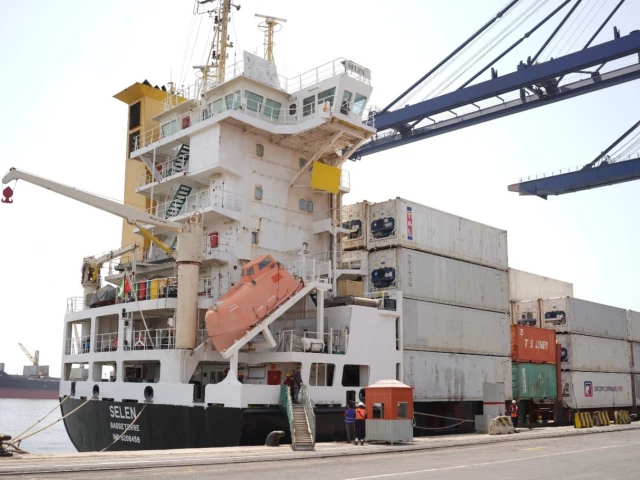
First container vessel, MV SELEN, arrives at Karachi Port after reopening of the Strait of Hormuz. Photo: Express
The vessel MV SELEN arrived at Karachi Port on Saturday, becoming the first Pakistan-bound vessel to do so following the reopening of the Strait of Hormuz after more than a month of disruption caused by conflict in the Middle East.
In a statement, the Karachi Port Trust (KPT) said: “MV SELEN, operated by NLC (AP Line), has berthed at Karachi Port, marking the first Pakistan-bound container vessel arrival following recent disruptions in the Strait of Hormuz.”
It added that the vessel, arriving from Jebel Ali, signalled the resumption of containerised trade and reinforced confidence in maritime supply chains.
Read: First Pakistani vessel carrying oil shipment arrives via Strait of Hormuz
The KPT said the development reflected effective coordination among port, shipping and logistics stakeholders to sustain cargo operations.
Although the Strait of Hormuz had remained disrupted since the United States and Israel attacked Iran on February 28, Pakistan continued to receive oil shipments, the first of which arrived on March 18. It also facilitated the passage of other shipments, with its flagged carriers operating under arrangements with Iran, allowing containers to transit through the strait.
Meanwhile, as talks between Iran and the US began in Islamabad under Pakistan’s mediation, President Donald Trump said US forces had begun clearing the Strait of Hormuz.
“We’re now starting the process of clearing out the Strait of Hormuz as a favour to Countries all over the World,” Trump posted on social media, saying 28 Iranian mine-dropping vessels had been sunk.
Separately, US Central Command said that two US Navy warships transited the Strait of Hormuz at the start of an operation to clear the strategic waterway of mines laid by Iran.
Also Read: Trump says US will have Strait of Hormuz ‘open fairly soon’
“Today, we began the process of establishing a new passage and we will share this safe pathway with the maritime industry soon to encourage the free flow of commerce,” said Centcom commander Admiral Brad Cooper.
Amid conflicting reports from the field, Iranian state TV said no US ships had crossed the strait, a crucial transit point for global energy supplies that Tehran has effectively blocked but Trump has vowed to reopen.
The waterway, which lies on Iran’s southern coast, was one of the main points on the agenda in Islamabad for the first direct U.S.-Iranian talks in more than a decade and the highest-level discussions since the 1979 Islamic Revolution.

On Jim Continenza’s first day on the job as Eastman Kodak executive chairman in 2019, he got a call from a star Hollywood filmmaker telling him the company was making a big mistake.
The photography technology company was in the process of shutting down its acetate factory, which makes one of the key ingredients used in film. Christopher Nolan, the director behind major movies like “Inception” and “Oppenheimer,” urged Continenza to stop the process.
“He goes, ‘Do not turn this off. Please take a look.’ And I did,” Continenza, now CEO, told CNBC. “He was right. I started looking at it because I shoot 35 millimeter [film], and I’m like, ‘Why would one of the greatest directors of all time even have this conversation?'”
Continenza, a self-proclaimed “turnaround specialist,” said he quickly realized how central film was to Kodak’s roots, and how it could be one of its biggest strengths as he fought to bring the company back from teetering on the edge of bankruptcy.
Fast forward roughly seven years, and multiple 2026 Oscar-winning movies, including “One Battle After Another” and “Sinners,” were shot on Kodak film. It’s part of a bigger trend as the category sees a resurgence fueled by both a nostalgia for film in Hollywood and by younger consumers.
That road wasn’t smooth, though. The company declared bankruptcy in 2012 and reemerged a year later. Then it cautioned last year that its financial conditions “raise substantial doubt about Kodak’s ability to continue as a going concern.”
In the second-quarter earnings where it made that going concern statement, Kodak posted a 12% decrease in gross profit, with millions in debt obligations.
But Continenza said it was one step in a longer process toward rebuilding the company to its former success.
CEO of Kodak Jim Continenza speaks onstage during Kodak’s Film Awards at ASC Clubhouse on March 2, 2026 in Los Angeles, California.
Rodin Eckenroth | Getty Images
Last month, the company’s earnings report looked different. Its fourth-quarter gross profit reached $67 million, a 31% increase from the year prior. Kodak also said it had reduced its annual interest expense by roughly $40 million.
Continenza said at the time that the results were signs of the long-term plan he began executing in 2019. He told CNBC that he chose Kodak as his final company to revive before closing his chapter as a C-suite executive, having previously served in leadership roles at communication companies including AT&T and Lucent.
“Here’s what our goal is: We’re going to create jobs for the next generation. Make no mistake, we’re going to fix this company and put it on a stable foundation and put building blocks to grow all the systems,” Continenza said. “We didn’t put in what we need, we put in what we want, and that’s a difference.”
Troubled waters
In a digitally evolving society, Kodak has been fighting to keep its place and relevancy.
The company’s 2012 bankruptcy protection came after it failed to improve its finances as digital photography took off and revolutionized the industry. When it reemerged the following year as a smaller company, it shifted its primary focus to commercial printing.
Though it’s not a company that is largely covered by investors anymore, Melius Research analyst Ben Reitzes wrote in a note last year that the onset of digital technology posed a significant setback for Kodak.
“At the time, Kodak management told us that film would co-exist with digital cameras and more photos would be taken — and more would need to be printed by Kodak,” he wrote.
Still, Kodak faced its struggles. Its stock sank more than 35% in 2014, continuing to gradually fall over the next few years and hitting an all-time low of $1.55 per share during the onset of the pandemic in March 2020.
Last August, the more than 100-year-old photography company said it had roughly $155 million in cash and nearly $600 million in loans.
A Kodak spokesperson said at the time that the going concern language had to be included because Kodak did not have enough available liquidity to pay off its debt, due within 12 months. Still, the company said it was confident it would pay off a significant portion of that loan before it became due by terminating its pension plan and said the disclosure was just a required technical report.
Wall Street investors didn’t like what they heard. The stock plunged from a price of roughly $7 per share a few days prior to just over $5 per share on the day of earnings.
“We could have done a better job on it, because to us, it wasn’t as dire straits, it was more of a GAAP accounting coincidence by dates,” Continenza said, adding that it was a “timing issue” for the loans.
Rolls of Kodak Gold film hang on a shelf at the Precision Camera & Video store on Aug. 12, 2025 in Austin, Texas.
Brandon Bell | Getty Images
Continenza said Kodak’s main challenges were in its “huge tranches” of debt and a lack of communication with its shareholders and customers.
The CEO said he’s never sold a share of Kodak and instead bought stock after the company issued its going concern disclosure.
“You’ve got to put the work in and the long-term investments, and you’ve got to be methodical, but you’ve got to fix your operations, and I’ve spent seven years of doing it,” he said. “[It’s] a 130-plus year old company, right? You can imagine what’s in the attic.”
Defining success
Continenza said he’s been intentional about instituting long-term changes since he took over the company. He’s changed about 90% of the company’s leadership, paid off more than $400 million in debt and reorganized the company’s priorities to focus on print and advanced materials and chemicals.
He said it was also important to be “transparent” with his team and acknowledged that turning around the company would mean layoffs and staffing changes.
“First thing I always do is go out and get people who want to hold the company and buy them out, and that’s what we did,” he said. “I got a board and investors who love what we’re doing — we keep them informed, and they help guide us.”
As he examined what worked for the company, Continenza said he saw an opportunity with Generation Z and the resurgence of the film aesthetic. The look of photos and videos shot on film captures something that “penetrates your heart and soul,” he said.
Kodak leaned into the analog and authenticity trend, investing its resources in its film capacities and creating products that consumers, directors and filmmakers alike were interested in.
Continenza said he also refinanced the company three times and rightsized its balance sheet.
It seems to have hit the right note on Wall Street. Over the past year, Kodak’s stock has shot up nearly 100%.

Kodak 1-year chart
“We’re doing our job. The stock’s not supposed to spike, it’s supposed to crawl, because that’s how we grow,” he said. “I don’t look at our stock price. I don’t care. I couldn’t tell you what it is today. I’m a long-term investor.”
Continenza said success to him will mean continuing to improve finances and ensuring Kodak has a solid succession plan in place to continue its growth.
Though the company is well over 100 years old, he said he likes to treat Kodak as a startup, where all of the debt is paid off, the brand is well-loved and only Kodak itself could, at this point, “screw it up.”
“We don’t need to be a $5 billion or $20 billion or $80 billion company,” Continenza said. “We’re a billion-dollar global company, but one thing we have going for us is our brand recognition. And make no mistake, around the globe, it is endeared and loved, and it’ll continue to be.”


2026 Masters: Best shots, moments and more from the third round

NBA sees 168 players sit out of games due to illness, injury as playoffs approach

Cal G Justin Pippen returning to Big Ten, commits to Ohio State

-

 Entertainment1 week ago
Joe Jonas shares candid glimpse into parenthood with Sophie Turner
-

 Tech1 week ago
Our Favorite iPad Is $50 Off
-

 Sports1 week ago
UConn Final Four run could trigger a $50M furniture giveaway for Massachusetts-based Jordan’s Furniture
-

 Entertainment1 week ago
Blake Lively reacts to harassment claims dismissal against Justin Baldoni
-
 Business1 week ago
Gold prices in Pakistan Today – April 3, 2026 | The Express Tribune
-
 Business1 week ago
Video: Why Is the Labor Market Stuck?
-

 Politics1 week ago
Iran can sustain Strait of Hormuz closure for years, will cut US military logistics: Official
-

 Entertainment1 week ago
Barbie Ferreira reveals where she stands with ‘Euphoria’ girls after exit