Politics
Thailand’s airstrikes against Cambodia reignite border tensions

- Thai army says one soldier killed in border clashes.
- Military facilities targeted in air strikes: Thai Air Force
- Ex-Cambodian leader urges forces to exercise restraint.
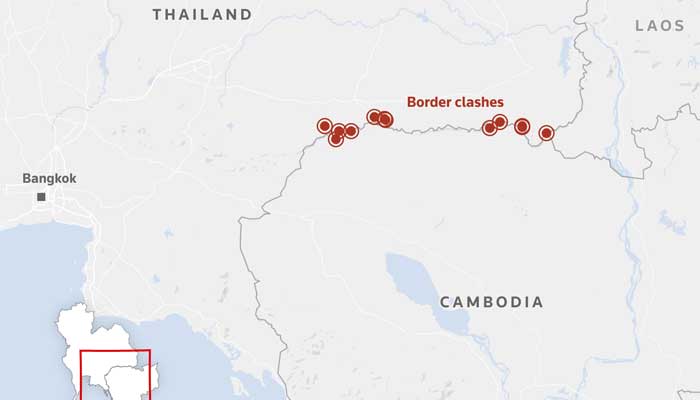
BANGKOK/PHNOM PENH Thailand said it launched airstrikes into Cambodia on Monday as fighting broke out in multiple areas along their disputed border, after both countries accused the other of breaching a ceasefire brokered by US President Donald Trump.
At least one Thai soldier had been killed and eight were wounded in the fresh clashes that intensified around 5am local time (2200 GMT), a Thai army spokesperson said, adding that air support was called in to hit Cambodian military targets.
Thailand’s Air Force said that Cambodia mobilised heavy weaponry, repositioned combat units and prepared support elements that could escalate military operations.
“These developments prompted the use of air power to deter and reduce Cambodia’s military capabilities,” it said in a statement.
Cambodia’s defence ministry said in a statement that the Thai military had launched dawn attacks on its forces at two locations, following days of provocative actions, and added that Cambodian troops had not responded.
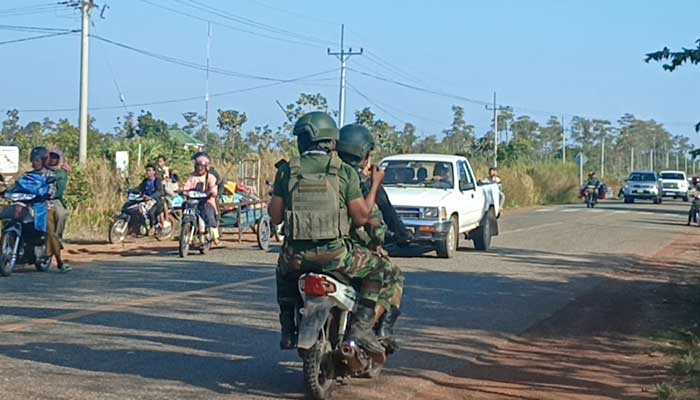
Cambodia’s influential former longtime leader Hun Sen, father of current premier Hun Manet, said Thailand’s military was “aggressors” seeking to provoke a retaliatory response and urged Cambodian forces to exercise restraint.
“The red line for responding has already been set,” Hun Sen said on Facebook, without elaborating. “I urge commanders at all levels to educate all officers and soldiers accordingly”.
Three Cambodian civilians have been seriously injured in the fighting so far, according to a senior provincial official. Cambodia’s defence ministry said its forces had not retaliated.
A simmering border dispute between the countries erupted into a five-day conflict in July, before a ceasefire deal brokered by Malaysian Prime Minister Anwar Ibrahim and Trump, who also witnessed the signing of an expanded peace agreement between the two countries in Kuala Lumpur in October.
Renewed fighting and risks
Anwar, chair of the Association of Southeast Asian Nations bloc, urged both sides to exercise maximum restraint and maintain open channels of communication.
“The renewed fighting risks unravelling the careful work that has gone into stabilising relations between the two neighbours,” Anwar said in a post on X.
Southeast Asian countries have rarely engaged in military clashes among themselves in recent decades, with the use of cross-border air strikes even rarer.
Phichet Pholkoet, a resident of Thailand’s Ban Kruat district which adjoins Cambodia, said he has heard gunfire since early Monday morning.
“It startled me. The explosions were very clear. Boom boom!” he said via telephone. “I could hear everything clearly. Some are heavy artillery, some are small arms.”
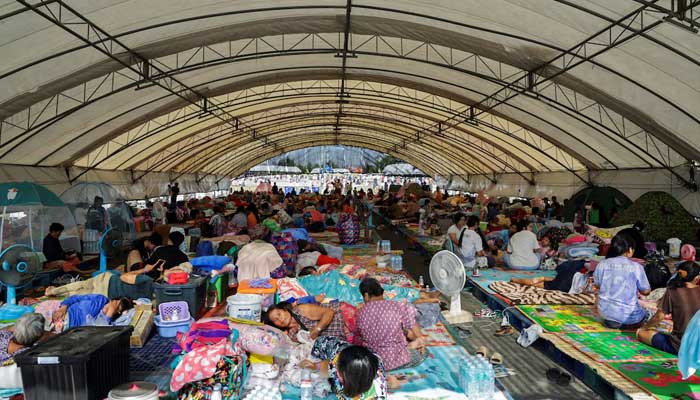
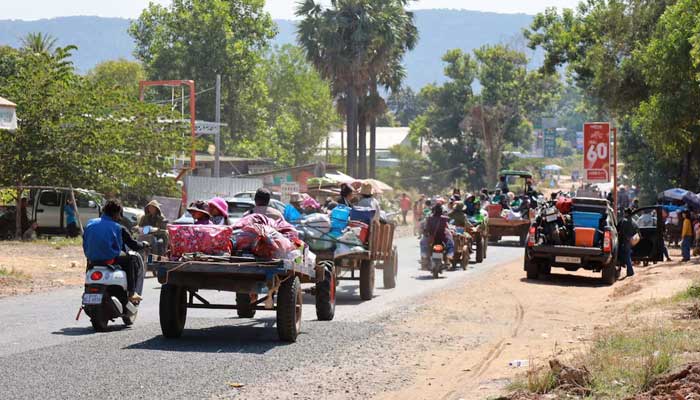
In Thailand, more than 385,000 civilians across four border districts were being evacuated, with more than 35,000 already housed in temporary shelters, the Thai military said.
Across the border in Cambodia, opposition politician Meach Sovannara said civilians were also moving away from the fighting along the frontier.
“I heard the artillery shelling,” he told Reuters in an audio message from Samroang town, the capital of Oddar Meanchey Province, which abuts Thailand.
More than 1,100 families in Oddar Meanchey had been evacuated, authorities there said.
At least 48 people were killed and an estimated 300,000 temporarily displaced during the July clashes, with the neighbours exchanging rockets and heavy artillery fire for five days.
Un-demarcated points along border
Thailand and Cambodia have for more than a century contested sovereignty at un-demarcated points along their 817-km (508-mile) land border, first mapped in 1907 by France when it ruled Cambodia as a colony.
The long-standing dispute has occasionally exploded into skirmishes, such as a weeklong artillery exchange in 2011, despite attempts to peacefully resolve overlapping claims.
Tensions began rising in May this year, following the killing of a Cambodian soldier during a brief exchange of gunfire, and steadily escalated into diplomatic spats and armed clashes.
Although Anwar and Trump were able to halt the fighting within days and then cemented a ceasefire agreement at a regional summit in October.
Thailand said it was halting the implementation of the truce with Cambodia last month, following a landmine blast that maimed one of its soldiers.
Thailand has repeatedly accused Cambodia of planting fresh landmines along parts of their disputed border, which have seriously injured at least seven Thai soldiers since July. Phnom Penh denies the charge.
Some of the mines found along the frontier were likely newly laid, Reuters reported in October, based on expert analysis of material shared by Thailand’s military.