

Business
The Manchester community shop selling groceries at huge discounts

Kelly Foranand
Jonny Humphries,North West
 Kelly Foran/BBC
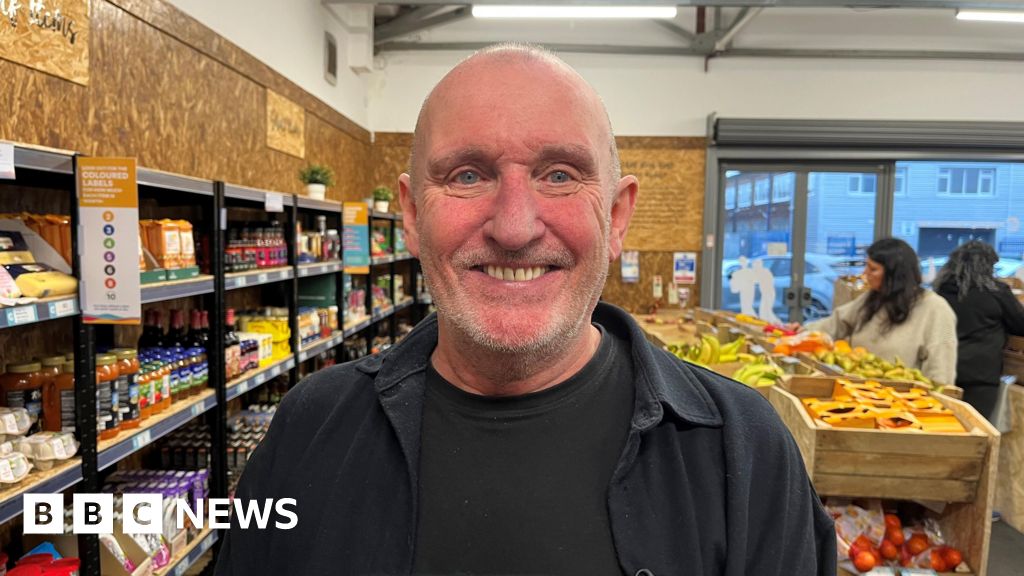
A charity boss who founded a community shop selling groceries at a fraction of the price of supermarkets said the concept was so successful “it had gone a bit nuts”.
Andy Hawthorne is chief executive of The Message Trust, a Christian charity which also aims to provide access to affordable groceries to combat food insecurity.
The trust runs a community members-only store in Wythenshawe, Greater Manchester, which sells food donated by supermarkets, or that would otherwise go to landfill, at heavily discounted rate.
Hawthorne told the BBC: “People often walk in this place in despair, we see it in their eyes and their demeanour and they sniff hope.”
He said the idea was formed during the coronavirus pandemic when the trust was delivering food to vulnerable people.
“We saw desperate need,” Hawthorne said.

 Kelly Foran/BBC
“So we came up with this dream: let’s start a shop, let’s stop food going into landfill, let’s get lots of donations and let’s buy some choice items.
“We’ll make sure it’s well stocked and let’s try and provide food for families at a fraction of the cost for a supermarket.
“And it’s gone a bit nuts to be honest.”
The result was the trust’s flagship shop in Sharston.
Shopper Beatrice Zulu told the BBC it had been “absolutely amazing” at helping keep her bills down.
“Especially with the days like now after Christmas, where you’re probably thinking everything’s gone but if you come in here and it’s a fiver you can get your veg, you get your fruit, you can get your meat, you can get your bread, It’s really, really good and really, really useful,” she said.
 Kelly Foran/BBC
Hawthorne said since then demand has rocketed and the charity now runs 34 similar shops across the country, with around 100,000 members.
A food shop costs around 25% less than in regular supermarkets, and the charity also provides “wraparound support” with courses on debt or managing mental health.
The food on the shelves is a combination of “perfectly good” stock which is closer to its sell by date, food donated to the charity and stock the charity has bought out of its own funds.
Sharston shop member Kathleen Roper added: “What you’d spend say £20 in the shops, you can get here for £5.
“So it’s a massive, massive difference and it’s always full. The fresh veg especially in the shops is so dear and you can’t afford to live.
“I really can’t afford to live if I shop outside.”
Business
Education Budget 2026 Live Updates: What Will The Education Sector Get From FM Nirmala Sitharaman?
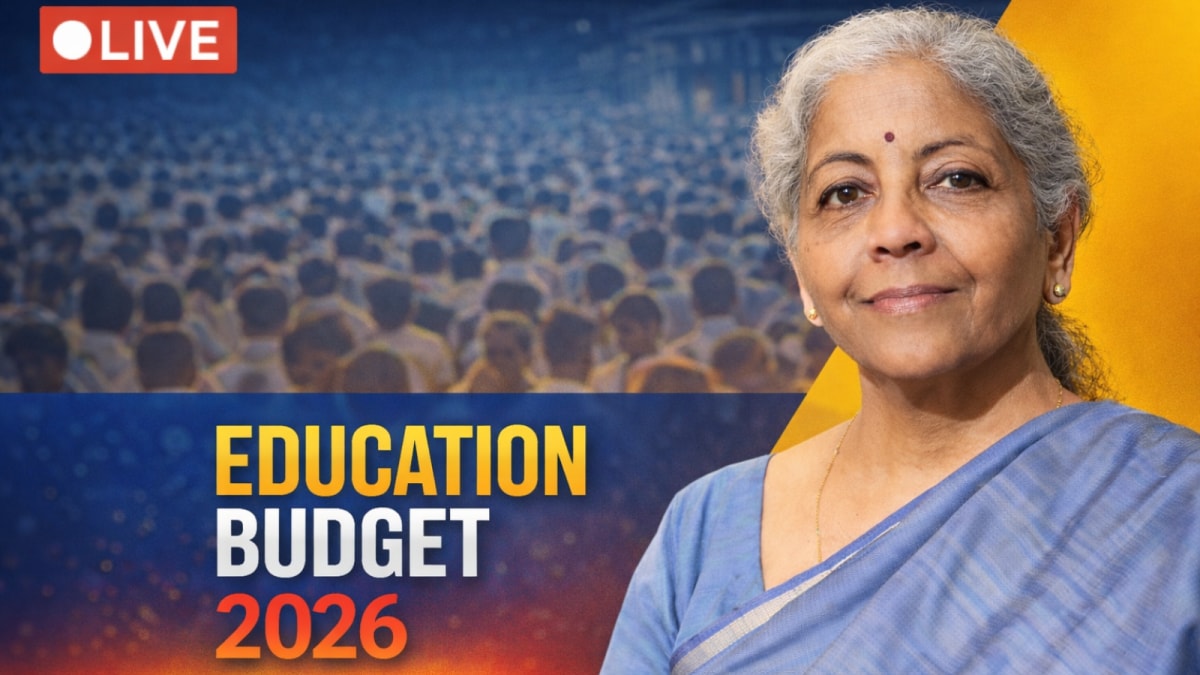
Union Education Budget 2026 Live Updates: Union Finance Minister Nirmala Sitharaman will present the Union Budget 2026–27 on February 1, with a strong focus expected on the Education Budget 2026, a key area of interest for students, teachers, and institutions across the country.
In the previous budget, the Bharatiya Janata Party government announced plans to add 75,000 medical seats over five years and strengthen infrastructure at IITs established after 2014. For 2025, the Centre had earmarked Rs 1,28,650.05 crore for education, a 6.65 percent rise compared to the previous year.
Meanwhile, the Economic Survey 2025–26, tabled in the Parliament of India, points to persistent challenges in school education. While enrolment at the school level is close to universal, this has not translated into consistent learning outcomes, especially beyond elementary classes. The net enrolment rate drops sharply at the secondary level, standing at just over 52 per cent.
The survey also flags concerns over student retention after Class 8, particularly in rural areas. It notes an uneven spread of schools, with a majority offering only foundational and preparatory education, while far fewer institutions provide secondary-level schooling. This gap, the survey suggests, is a key reason behind low enrolment in higher classes.
Stay tuned to this LIVE blog for all the latest updates on the Education Budget 2026 LIVE.

The Oil and Gas Regulatory Authority (Ogra) has increased the price of liquefied petroleum gas (LPG). According to a notification, the price of LPG has risen by Rs6.37 per kilogram. Following the increase, the price of a domestic LPG cylinder has gone up by Rs75.21. The revised prices have come into effect immediately.
The rise in LPG prices has added to the inflationary burden on household consumers.
Business
Budget 2026: Fiscal deficit, capex, borrowing and debt roadmap among key numbers to track – The Times of India
Finance Minister Nirmala Sitharaman is set to present her record ninth straight Union Budget, with markets closely tracking headline numbers ranging from the fiscal deficit and capital expenditure to borrowing and tax revenue projections, as India charts its course as the world’s fastest-growing major economy.The Budget will be presented in a paperless format, continuing the practice of recent years. Sitharaman had, in her maiden Budget in 2019, replaced the traditional leather briefcase with a red cloth–wrapped bahi-khata, marking a symbolic shift in presentation.Here are the key numbers and signals that investors, economists and policymakers will be watching in the Union Budget for 2025-26 and beyond:
Fiscal deficit
The fiscal deficit for the current financial year (FY26) is budgeted at 4.4 per cent of GDP, as reported PTI. With the government having achieved its consolidation goal of keeping the deficit below 4.5 per cent, attention will turn to guidance for FY27. Markets expect the government to indicate a deficit closer to 4 per cent of GDP next year, alongside clarity on the medium-term debt reduction path.
Capital expenditure
Capital spending remains a central pillar of the government’s growth strategy. Capex for FY26 is pegged at Rs 11.2 lakh crore. In the upcoming Budget, the government is expected to continue prioritising infrastructure outlays, with a possible 10–15 per cent increase that could take capex beyond Rs 12 lakh crore, especially as private investment sentiment remains cautious.
Debt roadmap
In her previous Budget speech, the finance minister had said fiscal policy from 2026-27 onwards would aim to keep central government debt on a declining trajectory as a share of GDP. Markets will look for a clearer timeline on when general government debt-to-GDP could move towards the 60 per cent target. General government debt stood at about 85 per cent of GDP in 2024, including central government debt of around 57 per cent.
Borrowing programme
Gross market borrowing for FY26 is estimated at Rs 14.80 lakh crore. The borrowing number announced in the Budget will be closely scrutinised, as it signals the government’s funding needs, fiscal discipline and potential impact on bond yields.
Tax revenue
Gross tax revenue for 2025-26 has been estimated at Rs 42.70 lakh crore, implying an 11 per cent growth over FY25. This includes Rs 25.20 lakh crore from direct taxes—personal income tax and corporate tax—and Rs 17.5 lakh crore from indirect taxes such as customs, excise duty and GST.
GST collections
Goods and Services Tax collections for FY26 are projected to rise 11 per cent to Rs 11.78 lakh crore. Projections for FY27 will be keenly watched, especially as GST revenue growth is expected to gather pace following rate rationalisation measures implemented since September 2025.
Nominal GDP growth
Nominal GDP growth for FY26 was initially estimated at 10.1 per cent but has since been revised down to about 8 per cent due to lower-than-expected inflation, even as real GDP growth is pegged at 7.4 per cent by the National Statistics Office. The FY27 nominal GDP assumption—likely in the 10.5–11 per cent range—will offer clues on the government’s inflation and growth outlook.
Spending priorities
Beyond the headline aggregates, the Budget will also be scanned for allocations to key social and development schemes, as well as spending on priority sectors such as health and education.Together, these numbers will shape expectations on fiscal discipline, growth momentum and policy support as India navigates a complex global economic environment.

Education Budget 2026 Live Updates: What Will The Education Sector Get From FM Nirmala Sitharaman?

Currency shift drives Australian wool fall despite firm exports

Historic recording by “Sly and the Family Stone” released after gathering dust: “Sheer magic”

-
 Business1 week ago
Success Story: This IITian Failed 17 Times Before Building A ₹40,000 Crore Giant
-
 Business1 week ago
Silver ETFs Jump Up To 10%, Gold ETFs Gain Over 3% On Record Bullion Prices
-

 Tech1 week ago
Ruckus gears up for networking partnership with TGR Haas F1 Team | Computer Weekly
-

 Fashion1 week ago
South Korea tilts sourcing towards China as apparel imports shift
-

 Sports1 week ago
Transfer rumors, news: Saudi league eyes Salah, Vinícius Jr. plus 50 more
-

 Entertainment1 week ago
Trump touts ‘total access’ Greenland deal as Nato asks allies to step up
-

 Entertainment1 week ago
TikTok seals deal for new US joint venture to avoid American ban
-

 Sports5 days ago
PSL 11: Local players’ category renewals unveiled ahead of auction