

Sports
Top 50 USMNT players, ranked by club form: A new No. 1 leads the American pool


The U.S. men’s national team, it seems, is back to a good place.
The Nations League and Gold Cup eliminations for the U.S. have faded into the past. There’s no more feuding between the team’s best players and the manager. The Americans are undefeated in five matches, all against World Cup-qualified opposition. They’ve outscored those opponents 12-4, and there finally seems to be a plan: either a clear back three or a back four that morphs into a back three because one of the fullbacks is more of a center back. It’s similar to what Mauricio Pochettino did in his one year at Chelsea, and it has coincided in an uptick in both performances and results for the World Cup co-hosts.
But what about the broader player pool? Pochettino has done a fantastic job of expanding it — there’s a much bigger collection of players who seem capable of contributing than there was a year ago. But a national team manager can only have a minor impact on the true quality of the players at his disposal. We learn a lot more about them when they’re at their day jobs: playing for club teams.
So with the European season fast approaching its midway point and MLS just recently wrapped, it’s time for one last edition of the USMNT Player Performance Index before the end of 2025.
What is the USMNT PPI and how does this ranking work?
For the unfamiliar or forgetful, this is our way of trying to rank the performance of every American professional soccer player in the world. I use the word “trying” because it’s not perfect — ranking soccer players, especially across multiple competitive contexts, is impossible — but it’s useful.
To come up with the rankings, we use a combination of talent, playing time, team quality and … that’s it. Simple, but effective.
For talent: The metric is Transfermarkt’s estimated market value for every player. This isn’t a one-to-one match for talent, but it’s close enough, and having it as part of the input ensures that the rankings don’t stray too far from what the world thinks of a given player.
For playing time: We simply take the percentage of available minutes each player has played for his team in their domestic league.
For team quality: We use Opta’s power rankings, which rate every professional club team in the world. These ratings aren’t perfect either — MLS teams are ranked a little too highly, for one — but they offer a uniform way of assessing the quality of the teams every American plays for.
And so, the rankings work off a simple premise: if you’re playing a lot of minutes and your team has a high rating, then you’re likely contributing valuable performance to your team.
For the current edition, the market value makes up 15% of the rating, minutes played makes up 20%, and team quality makes up the remaining 65%. I’ve also added a 10%-of-minutes threshold, and that means Cole Campbell (1.8% of minutes for Borussia Dortmund) and Antonee Robinson (4.5% of minutes for Fulham) both miss out.
Some other notable absences: Norwich City’s Josh Sargent, Orlando City’s Alex Freeman, and Real Salt Lake’s Diego Luna didn’t make the top 50. Were I doing this more subjectively, Luna still wouldn’t be in the top 50, I don’t think — he’s been way better for the USMNT than in MLS over the past year. Freeman, however, would easily be top 50 because he was probably the best fullback in MLS. And Sargent also would be somewhere on the list. But none of their club teams were good enough for them to make the cut in this edition of the USMNT PPI.
Now, to the list …
– O’Hanlon: Why Christian Pulisic is having his best season ever
– Predicting the USMNT’s starting lineup at the World Cup
– How Roldan went from USMNT afterthought to Pochettino fave
 1. Chris Richards, center back, Crystal Palace
Ten years ago, Richards would’ve been playing for a Champions League team in Italy, Spain or Germany. Instead, he’s playing 99.5% of the minutes for, well, the fourth-place team in England.
Even if you don’t think Crystal Palace will be there come season’s end, the team is currently rated as the 12th best in the world by Opta. Such is the financial might of the Premier League that Palace, according to these ratings, would be the second-best team in France, Italy, and Germany, while they’d be behind only Barcelona and Real Madrid in Spain.
More simply, Palace is the best team any American is currently playing for, and Richards is playing every minute of every game.
 2. Malik Tillman, attacking midfielder, Bayer Leverkusen
After a nightmare start that got Erik ten Hag fired as manager before the transfer window had even closed, Leverkusen has stabilized. After Bayern Munich, Leverkusen is battling it out with RB Leipzig and Borussia Dortmund to be the second-best team in Germany. And outside of his injuries, Tillman has been close to an automatic first-choice starter under both of his managers.
There’s not really much in the way of notable statistical production on the ball — he’s making a lot of defensive plays, playing a lot of passes, completing a lot of passes, and not doing much else. But he moved for a major transfer fee over the summer, and he’s starting for a Champions League-quality side. That’s enough to get him to No. 2.
Unfortunately, Pulisic no longer qualifies for FBref’s leaderboards after dipping slightly below the one-third-of-the-minutes threshold. But after his two goals earlier this week, he’s now averaging 1.82 non-penalty goals+assists per 90 minutes. That’s almost half a goal/assist more than Harry Kane, who leads Europe’s Big Five top leagues (among qualified players) with 1.36 per 90.
 4. Tyler Adams, defensive midfielder, AFC Bournemouth
He’s sort of the “is the dress blue or gold?” of U.S. fandom.
If I told you that Adams had played nearly 90% of the minutes for a good Premier League team so far this season, you probably would have one of two reactions: (1) Wow, that’s such good news for the World Cup! Or (2) Oh my god, no, he’s going to get hurt before the World Cup.
He’s first in progressive passes and second in progressive carries for a team that has beaten the defending English and Italian champs by a combined 10-3. Given Antonee Robinson’s injury problems and Weston McKennie’s inconsistent call-ups, it seems as if there’s now a core four of close-to-irreplaceable players for the USMNT ahead of next summer: Richards, Pulisic, Adams and Dest.
 6. Johnny Cardoso, central midfielder, Atletico Madrid
It started off well — kind of. He played a lot for Atletico at the beginning of the season, but Atletico was bad to start the season. Then he stopped playing, and now Atletico is pretty much as good as it always is, again.
Since the end of August, Cardoso has played only 71 minutes for Atletico across all competitions. If you thought this move seemed like too big of a jump for a player with a solid season and a half in Spain, then nothing about the first few months of this season will have convinced you otherwise.
 7. Weston McKennie, central midfielder, Juventus
It happened again. McKennie wasn’t playing for Juventus to start the season and everyone freaked out. And then his new manager eventually realized his team is better when McKennie is on the field. Despite the slow start, McKennie has played nearly two-thirds of the Serie A minutes for Igor Tudor. And as always, he’s just doing a little bit of everything, everywhere:
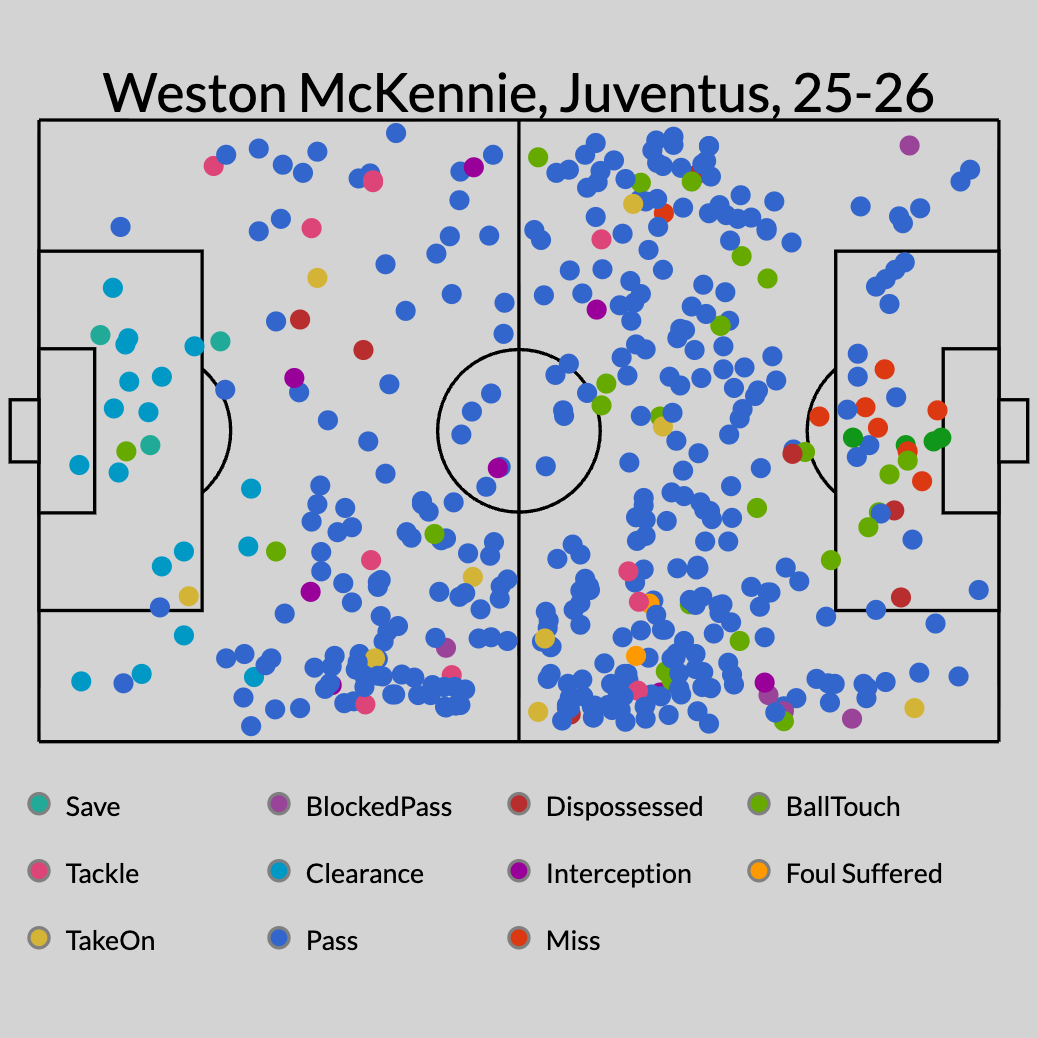
Juventus is in seventh in Serie A — that’s why he’s not higher here — but the team’s expected-goal differential is second-best in Italy after Inter Milan. I’d expect Juventus to gradually rise up the table over the next few months, and the same thing should happen to McKennie the next time we do these rankings.
 8. Timothy Weah, winger, Olympique Marseille
What Weah is getting on loan at Marseille: more minutes than he got at Juventus.
What Weah is not getting on loan at Marseille: any minutes at his preferred position of wing.
Marseille could give Paris Saint-Germain a genuine title challenge this season — its expected-goal differential is not far behind the European champs — and that’s happening mostly with a lineup in which Weah plays either as a fullback or a wingback. But that might not be as big of a problem for the U.S. as it once seemed.
No one in Europe thinks Weah is a top-class winger even though he mostly has been one of the starting wingers for the U.S. over the past half-decade. But with this new system, Pochettino has leaned more toward inside-forward types rather than pure wingers as the two players next to his striker. That doesn’t suit Weah at all, so his path to a starting spot with the U.S. might be as a wingback after all.
He’s no longer putting up Messi-like per-minute numbers for PSV anymore — and that’s a good thing. Why? Because it means he’s no longer just coming in during garbage time and pummeling Eredivisie clubs that are way worse than PSV.
Pepi still isn’t first choice at PSV, but he already has 515 minutes in the league this season. Last season, he finished just south of 700.
 10. Tanner Tessmann, defensive midfield, Olympique Lyonnais
I don’t think Tessmann is a future star or anything — he’s already 24 — but he is a solid starting midfielder for a fringe Champions League team in France. Here’s how he fares compared to his peers in Ligue 1, per the various grades from Gradient Sports:
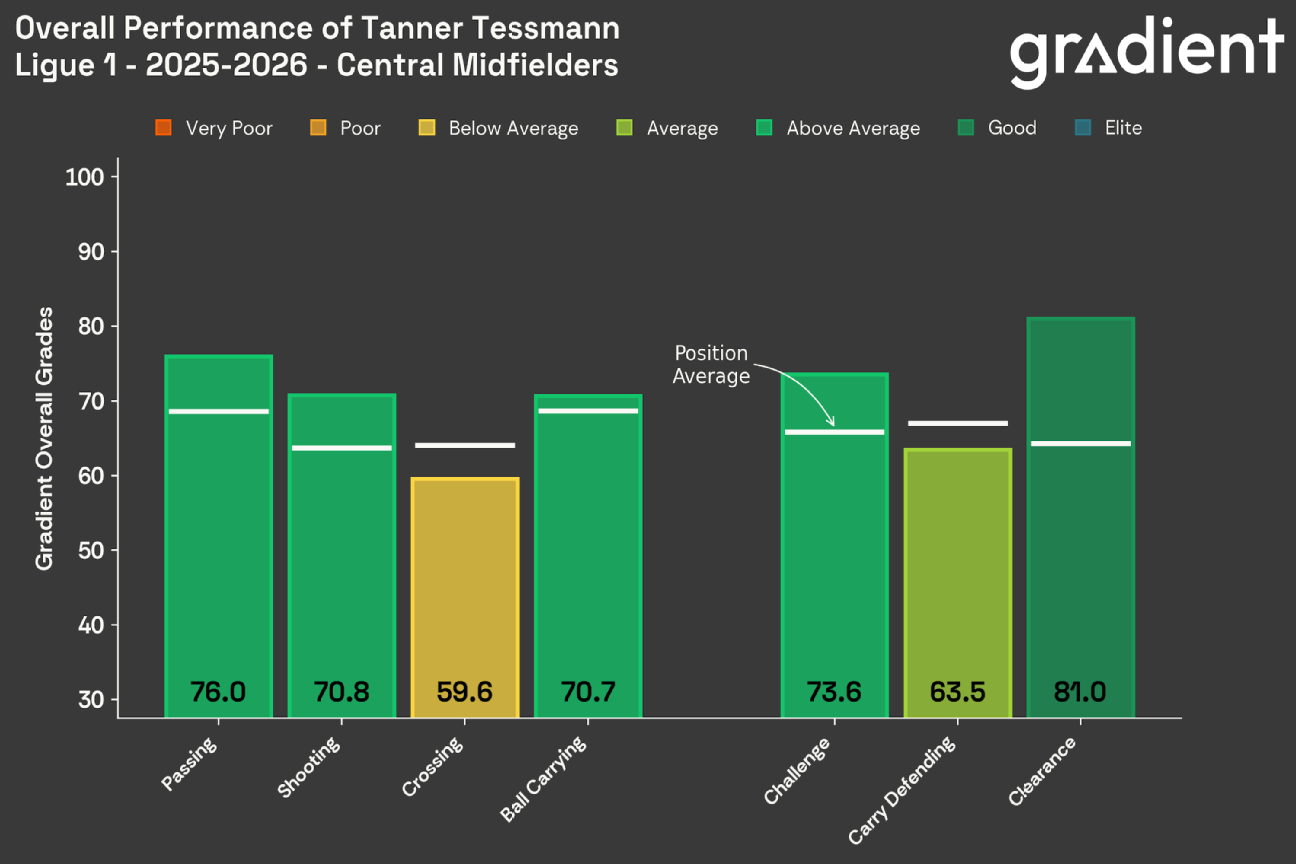
With that level of play, he should be in the mix for the starting spot in the midfield next to Adams next summer.
 11. Yunus Musah, central midfielder, Atalanta
It has been a terrible season for the two young American midfielders on Champions League clubs and Pochettino doesn’t seem to like them. Musah even made this list only because he’d played 90 minutes in a match for Milan before moving to Atalanta. With his new club, he has played 60 total minutes and hasn’t appeared in a league match since before Halloween.
0:38
Folarin Balogun scores in 3rd straight UCL game
Jeff Carlisle recaps Folarin Balogun’s big night for Monaco in the Champions League.
 13. Brenden Aaronson, attacking midfielder, Leeds United
 14. Mark McKenzie, center back, Toulouse
 15. Haji Wright, forward, Coventry City
 16. Joe Scally, fullback, Borussia Monchengladbach
 17. Cristian Roldan, central midfielder, Seattle Sounders
I like how such a simple rating system can discover the same thing Pochettino has found out over the past couple of months: Roldan is very good at soccer.
 18. Mark Delgado, central midfield, LAFC
 19. Sebastian Berhalter, central midfield, Vancouver Whitecaps
22. Jesús Ferreira, forward, Seattle Sounders
 23. Justin Haak, center back, New York City FC
Delgado, a midfielder, and Haak, a midfielder-turned-defender, haven’t been called up by Pochettino and probably won’t be any time soon, but they’ve both played a ton of minutes for two of the better teams in MLS. In the past, they’d probably be in the mix for one of the final few roster spots, but now this pool has guys who play for Champions League clubs such as Atletico Madrid and Atalanta and probably won’t even make next summer’s roster, either.
25. Tristan Blackmon, center back, Vancouver Whitecaps
26. Paul Rothrock, winger, Seattle Sounders
28. Jackson Ragen, center back, Seattle Sounders
29. Matt Freese, goalkeeper, New York City FC
30. Emmanuel Sabbi, winger, Vancouver Whitecaps
31. Tate Johnson, fullback, Vancouver Whitecaps
 33. Brian White, forward, Vancouver Whitecaps
It’s funny that perhaps one of the best MLS teams of all time that relied heavily on Americans is also the one that plays its home games in Canada. White, Sabbi, Berhalter and Blackmon combined to play all but one minute of the 3-1 MLS Cup loss to Inter Miami.
 34. Max Arfsten, wingback, Columbus Crew
 37. Noahkai Banks, center back, Augsburg
I don’t want to alarm anyone, but Banks was 18 at the beginning of the season, and he’s now just a full-time starter for a team in the Bundesliga at a position that peaks later than average and typically favors older players. The main problem is that Augsburg isn’t very good. In fact, the team is very bad: a minus-9.2 expected goal differential, worst in the Bundesliga. But Augsburg has been a lot better — a roughly average side — in the minutes when Banks has played.
It’s all really promising, and if you were going to pick one out-of-nowhere player to not only make the World Cup roster, but start next summer, then Banks would be your guy. As long as he keeps playing, I’d be very surprised if he doesn’t get a call-up to the next full camp.
 38. Roman Celentano, goalkeeper, FC Cincinnati
 39. Aidan Morris, central midfield, Middlesbrough
40. Sean Zawadzki, central midfield, Columbus Crew
 41. Luca Bombino, fullback, San Diego FC
42. Patrick Schulte, goalkeeper, Columbus Crew
43. Danny Musovski, forward, Seattle Sounders
44. Luca de la Torre, central midfield, San Diego FC
It feels as if he moved to Manchester City just last year, but he’s somehow already 28 years old.
Palmer-Brown never lived up to the hype after he debuted for Sporting Kansas City as a teen, starred at the 2017 under-20 World Cup, and signed with the best club team in the world. But now he’s quietly just a starter for one of the biggest clubs in Greece, where he’s managed by … (cleans off glasses in a theatrical fashion that suggests I am familiar with the meme of Tobey Maguire in “Spider-Man”) … Rafa Benitez.
46. Miles Robinson, center back, FC Cincinnati
 47. Aziel Jackson, attacking midfield, Jagiellonia Bialystok
 48. Lennard Maloney, defensive midfield, Mainz
 49. James Sands, defensive midfielder, St. Pauli
A quick shoutout to Sands, who recovered from a gruesome ankle break earlier in February to become one of St. Pauli’s most reliable ball-winners this season.
50. Giovanni Reyna, attacking midfielder, Borussia Monchengladbach
Though he hasn’t played particularly well, at least he’s playing — sometimes. Reyna has zero goals or assists through 255 league minutes for Gladbach, but he’s already fewer than 100 minutes shy of his entire minutes haul with Dortmund last season.
The question for the rest of this season: Can he start playing more often? And a not-unrelated question to that: Can he start having more of an impact when he gets out there?
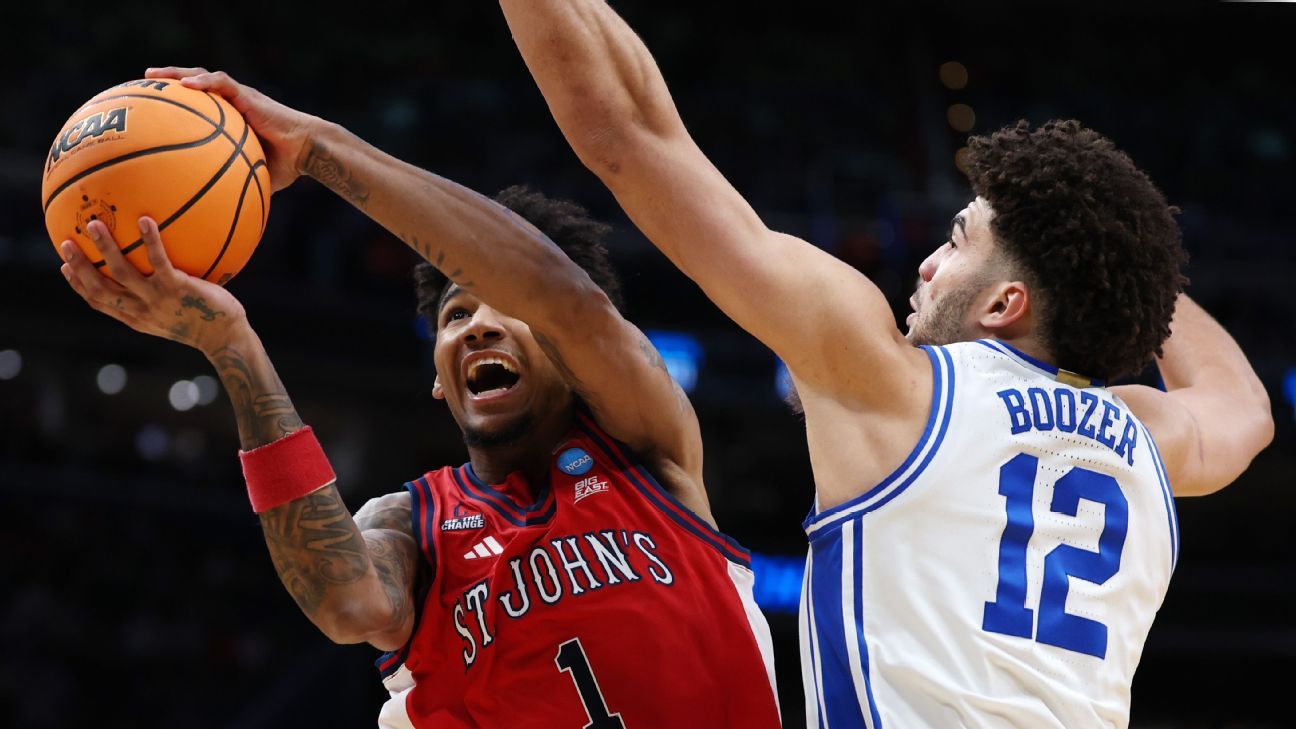
The first half of the Elite Eight is set with Arizona, Illinois, Purdue and Iowa punching their tickets Thursday. Who could join them in the regional finals of the 2026 men’s NCAA tournament?
ESPN reporters on-site in Chicago and Washington, D.C. tracking Friday’s Sweet 16 action in real-time.
Jump to: Game previews, predictions
SWEET 16 LIVE TRACKER

SWEET 16 PREVIEWS
All times Eastern.
9:45 p.m., CBS
Borzello’s prediction: UConn 68-64
Medcalf’s prediction: UConn 70-65
How Michigan State can advance to Elite Eight: Personnel matchups generate the most headlines during the NCAA tournament, but coaching matchups are equally — if not more — impactful. During a tenure that began in 1995, Tom Izzo has developed an uncanny ability to zero in on an opposing team’s top players and create problems for them. That’s the Spartans’ ticket to another Elite Eight.
Izzo’s primary mission against UConn is to limit Tarris Reed Jr.’s impact on the game. The Huskies are a different team when he’s a dominant presence in the post. If Reed is grabbing offensive rebounds and giving them an abundance of second-chance opportunities, Michigan State will be in a tough spot. The good news for the Spartans is that they are connecting on 35.9% of their 3-point attempts and capitalizing on second-chance opportunities with a No. 10 national ranking in offensive rebounding rate. It will be key for them to hit more 3s, extend UConn’s defense and create more paths to the basket for Jeremy Fears Jr. & Co. They have to give UConn a reason to guard on the perimeter — if the Spartans just allow the Huskies to sit in the lane, challenge shots around the rim and grab rebounds, Michigan State could lose.
Izzo has been in this position before — against better teams — and won. His experience will matter in a matchup against Dan Hurley.
How UConn can advance to the Elite Eight: To beat Izzo, UConn will have to show up as the top-notch defensive outfit that held UCLA to just a 39% clip inside the arc in the second round. The Huskies’ win over the Bruins served as a reminder that they can be a great defensive team when they want to be. In the Big Ten tournament, UCLA had produced 132 points per 100 possessions in a win over Michigan State. In the round of 32, the Bruins — who played without leading scorer Tyler Bilodeau (knee) — scored only 57 points, their second-lowest total of the season. UCLA star Donovan Dent had nine assists but also finished 2-for-9 shooting with a pair of turnovers. That’s the same attention UConn will need to give Fears. When he’s comfortable, Michigan State’s offense soars. The Huskies can’t let that happen.
On offense, Braylon Mullins could be an X factor. Reed had a double-double against UCLA but not the historic numbers he put up against Furman in the first round (31 points, 27 rebounds). Alex Karaban recorded a career-high 27 points against the Bruins, with Solo Ball and Silas Demary Jr. scoring two points combined. If Reed and Karaban can create a balanced inside-outside attack, Michigan State will have to find a way to disrupt that, which could give Mullins — who is averaging 14.5 points in two NCAA tournament games — more freedom and opportunities to make plays and create off the dribble or on off-ball screens.
The Huskies have a multitude of options to score, and as long as most of them are effective, they can get back to the Elite Eight. — Medcalf
10:10 p.m., TBS/truTV
Borzello’s prediction: Iowa State 67-65
Medcalf’s prediction: Iowa State 74-68
How Tennessee can advance to the Elite Eight: To beat Iowa State, Tennessee will have to play the same disciplined defense that stopped Virginia in the final minutes of Sunday’s second-round game. That task begins with Felix Okpara, who had four blocks against the Cavaliers and altered other shots, including a late drive by Thijs De Ridder that Okpara blocked during Virginia’s comeback attempt. Opposing players had made only 30% of their shots around the rim against Okpara entering Sunday’s game, per Synergy Sports data. He’ll have to protect the rim against Iowa State, which had a significant advantage in paint points against Kentucky (34-20) — but he won’t have to do it alone.
Tennessee has the personnel to handle every one-on-one matchup defensively. The Vols can guard at every spot. They will have to put pressure on Tamin Lipsey, sharpshooter Milan Momcilovic and Joshua Jefferson, if he plays, to win. That defensive effort coupled with standout performances from Ja’Kobi Gillespie and Nate Ament would be the formula for a Tennessee trip to the Elite Eight.
How Iowa State can advance to the Elite Eight: With or without Jefferson, Iowa State will have the same blueprint against Tennessee: Move the ball to find the best shot on offense, force turnovers with defensive pressure and score on fast breaks. Although they didn’t have Jefferson, who is a game-time decision because of an ankle injury, the Cyclones forced 20 turnovers in their second-round win over Kentucky. Playing through Lipsey — who finished with 26 points, 10 assists and only three turnovers against Kentucky — the Cyclones registered 150 points per 100 possessions and made 63% of their shots after halftime. They are 18-2 when Lipsey’s assist-to-turnover ratio is 3-to-1 or better.
Gillespie and Ament combined for five turnovers in Tennessee’s second-round win over Virginia. Iowa State can pressure that duo into the same mistakes Otega Oweh and Denzel Aberdeen (eight turnovers combined) made for Kentucky, even if Jefferson sits out another game. That’s how the Cyclones can advance. — Medcalf
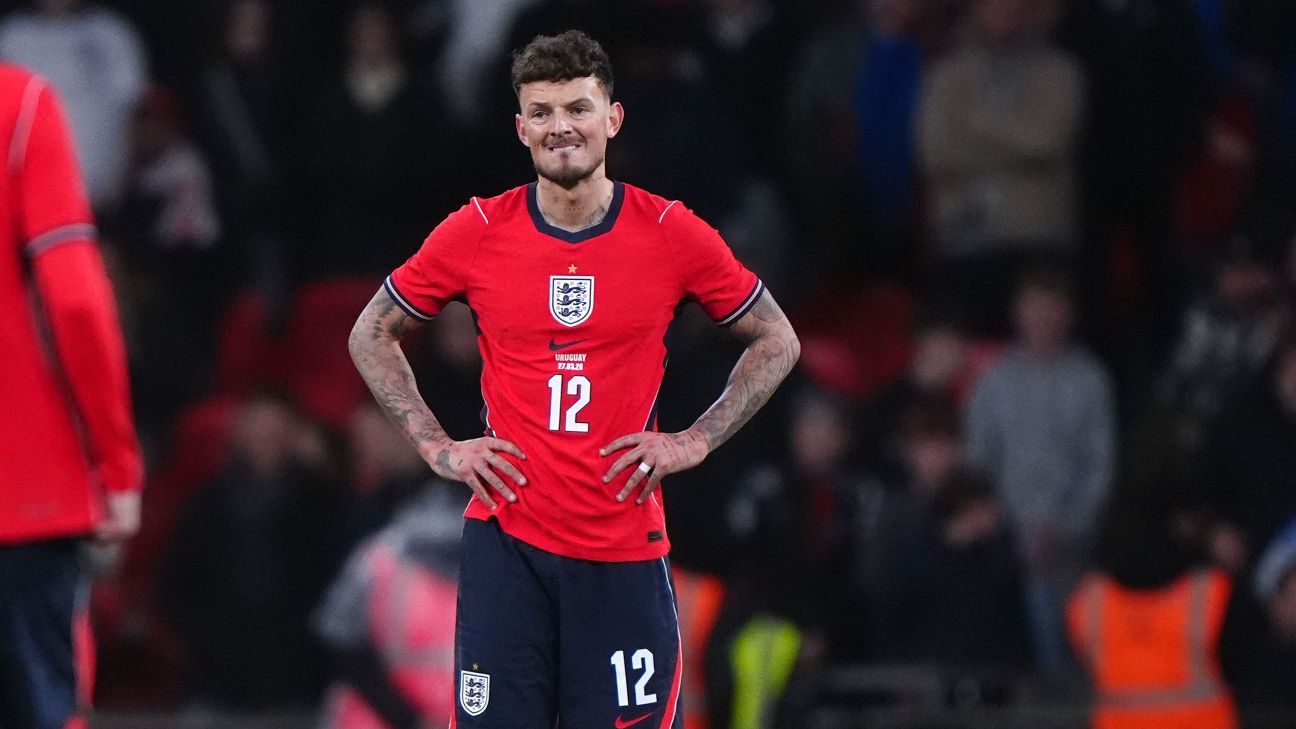
LONDON — However Ben White imagined his return to the England setup would play out, not once could he have pictured this.
Booed by some supporters when introduced as a 69th-minute substitute, he then marked his comeback after a four-year absence with his first international goal — only to be booed even more.
And just when it looked as though his efforts had salvaged victory from a thoroughly abject collective display, White conceded a stoppage-time penalty, which Federico Valverde converted to give Uruguay a 1-1 draw at Wembley Stadium.
Even before White stepped onto the field, his presence in the England squad for this window was not without controversy.
He declined to play for England ever since leaving the 2022 World Cup early for what the Football Association described at the time as “personal reasons.” Various outlets, including ESPN, reported at the time that White had in fact fallen out with a member of the coaching staff, and although Gareth Southgate later publicly denied any bust-up, the Arsenal defender subsequently refused a call-up and did not play for England again.
That was, until Friday.
England manager Thomas Tuchel did not select White in his initial expanded 35-man squad for this camp, but Jarell Quansah‘s injury triggered a surprise late inclusion. Tuchel justified the decision by saying “everybody deserves a second chance” following talks with White in recent months, but there were many among the 80,581 crowd who clearly did not agree.
“I [was told] that he was booed,” Tuchel said. “I didn’t hear it on the field because I was involved in the changes and instructions. It cannot be the majority. There were some boos and some mixed reception for him, which I am disappointed about because, of course, protect our players.
“He was excellent in camp. He deserved to come on. He deserved also to start and got us almost the winner. But I also understood that it happened to other players before here.
“He needs to take it on the chin,” Tuchel said. “We will always protect him, and hopefully we can put it behind [us] because he is ready to write some new chapters. We are ready to give him the chance, so hopefully everyone can move on and accept it.”
White’s roller-coaster cameo contrasted markedly with England’s flat-line performance that preceded it.
Tuchel had talked up the merits of his split-squad idea — 11 players were given this week to rest and occupied a Wembley box together here before resuming training ahead of Tuesday’s friendly against Japan — by framing this as a key audition for a “plane ticket” to the World Cup.
1:44
Burley slams ‘awful’ England after draw with Uruguay
Craig Burley reacts to England’s 1-1 draw with Uruguay at Wembley.
What greeted the players instead were paper planes. In many ways, this was a throwback to the dark days of years gone by: desperately uninspired football and fans expressing their discontent by throwing folded paper at the pitch, waving phone lights like they’re at a Coldplay gig and booing whichever player they had in their crosshairs.
Southgate worked exceptionally hard to move England on from nights like this, and although there were the occasional nonevents, by and large he achieved it.
And Tuchel will hope White is a unique case. Perhaps part of it was that his selection came at the expense of Trent Alexander-Arnold, a popular and decorated player for Liverpool and Real Madrid yet one who has never fully been trusted by Southgate and now Tuchel.
But more likely, it is White’s perceived indifference in playing for his country. The accusation of insouciance is difficult to shake, and these supporters, many of whom are facing bills running into the tens of thousands to follow England at this summer’s World Cup, do not take kindly to any ambiguous loyalty.
2:09
Tuchel: Trent must accept England squad decision
Thomas Tuchel explained why he left Real Madrid defender Trent Alexander-Arnold out of the latest England squad.
The team’s overall level of performance did not help the mood, either. Phil Foden was given a chance — perhaps his final chance — to stake a claim for the No. 10 role, but he could not get England playing. What he got for his trouble was an appalling tackle early in the second half from Ronald Araújo that left Tuchel incensed but somehow went entirely unpunished. Foden was subsequently substituted due to injury.
England were equally irate at the decision to award a spot kick after VAR review for White’s challenge on substitute Federico Viñas, a decision Harry Maguire branded a “ridiculous penalty.”
German referee Sven Jablonski appeared to give Manuel Ugarte two yellow cards but not send the Manchester United midfielder off, with the officials later saying the second one was in fact rescinded.
“I think it was not a good performance [from the referee] at all throughout the match,” Tuchel said.
“And I cannot understand that the tackle like this [on Foden] is not even checked. I think the penalty in the end was very, very soft and then there were like debates that a player got two yellow cards in the match and not being sent off. OK, bad day at the office.”
But once the refereeing row subsides, England will reflect on an evening when few individuals pressed their claims. James Trafford and James Garner made their debuts. Fikayo Tomori appeared for the first time in 2½ years, Maguire for the first time in 18 months, Dominic Calvert-Lewin as a substitute for the first time in almost five years.
Garner and Maguire were probably the standouts on a very ordinary night. Tuchel has vowed to harness the Premier League trend of set-piece prowess, and so in that context, England’s goal coming from a corner will be a source of encouragement.
He was, in fact, quite upbeat about the performance as a whole, aside from Foden and Noni Madueke both leaving the field prematurely, the latter seen wearing a knee brace as he departed the stadium.
“I learned a lot because it was a tough opponent — you just see it in the details, you learn a lot and you see the level,” Tuchel said. “We knew it would be a difficult opponent, and we needed this kind of test.”
It might have been one Tuchel anticipated but White, for certain, did not.
-
Jordan Reid
Close
Jordan Reid
NFL draft analyst
- Jordan Reid is an NFL draft analyst for ESPN, providing in-depth scouting on the nation’s top pro prospects. Jordan joined ESPN in 2021 and also contributes to SportsCenter and ESPN Radio. He played quarterback at North Carolina Central University and then went on to coach there from 2014-18.
-
Field Yates
Close
Field Yates
ESPN NFL Insider
- Field Yates is a fantasy football expert and NFL draft analyst for ESPN. You can find him on Fantasy Football Now on Sunday mornings and regularly on NFL Live throughout the week, as well as the Fantasy Focus and First Draft podcasts. A graduate of Wesleyan University (CT) and native of Weston, Mass., Yates has previous experience interning with the New England Patriots on both their coaching and scouting staffs.
Multiple Authors
Pro days are underway across the country, as we’re less than a month away from the 2026 NFL draft on April 23. Amid a ton of buzz about early picks and the quarterback class, we asked NFL draft analysts Matt Miller, Jordan Reid and Field Yates to break down the latest intel from around the league.
How likely is Alabama quarterback Ty Simpson to go in Round 1? Does Notre Dame running back Jeremiyah Love make sense for the Titans at No. 4? Who could rise into the top 10 picks by April, and which underrated prospects could be available late? We get into all that and then let Miller, Reid and Yates predict the best first rounds for teams with multiple Day 1 picks. How can the Browns, Chiefs, Cowboys, Dolphins and Jets win the day?
Finally, our experts empty their scouting notebooks with what they’re hearing, seeing and thinking ahead of April. Let’s start with the latest on Simpson, who said he’s “absolutely” a first-round pick at Alabama’s pro day.
Jump to a section:
Ty Simpson | Jeremiyah Love
Who will move into top 10?
Day 3 sleepers | First-round mocks
Emptying our notebook: What we’re hearing


What percentage chance would you put on Ty Simpson going in Round 1?
Miller: 25%. As the draft order stands right now, no team in Round 1 makes sense to me as a Simpson landing spot. No team in the top 10 that needs a quarterback is likely to reach for him, nor should they. Even the Rams are drafting too early at No. 13 overall. Maybe a team trades back into the first round for him, but that’s a risky proposition to give up draft capital — especially if it includes 2027 picks.
Reid: 75%. Considering the lack of QB talent at the top of the draft, I’d be surprised if Simpson wasn’t selected in the first round. But I agree with Matt that there are no logical landing spots in the first 16 picks. One idea that I floated in my last mock draft was the Cardinals trading back into Round 1 at No. 28 for Simpson. With Jacoby Brissett and Gardner Minshew at the top of the depth chart, they are obviously in need of a young QB.
Yates: 90%. I borrowed from Jordan’s idea of the Cardinals trading up in my last mock draft, but I’m going a step further than him on the percentage. Simpson is the clear-cut second-best QB prospect, his first half of last season was far too strong and there are too many teams that need a QB in the first round for him to not be selected on Thusrday.

Could the Titans really take Jeremiyah Love at No. 4?
Reid: Love is my No. 1 prospect in this class, but I just don’t see it happening. General manager Mike Borgonzi joined Tennessee after 16 seasons in Kansas City, where the Chiefs always valued premium positions early. Don’t be surprised to see another defensive player added here for new coach Robert Saleh.
Yates: They absolutely could. Tennessee’s busy offseason has opened the board up, as it added all over its defense and signed wide receiver Wan’Dale Robinson to a four-year deal. Love is my No. 2 prospect, and many NFL executives and scouts believe he is Tennessee’s most likely pick. With that said, what other teams think the Titans are going to do doesn’t mean much. This will come down to whether Tennessee is confident in the rest of its roster.
Miller: Yes, they could and should take Love at No. 4. The Titans were aggressive enough in free agency to enter the draft without a must-pick position here. Love is the type of transcendent prospect who the Titans can build their offense around, giving quarterback Cam Ward a viable threat in the run and pass game. And from what I’ve heard, if Love falls past Tennessee, the Giants will likely take him at No. 5.
Who isn’t a consensus top-10 pick right now but could end up there by draft time?
Yates: Kadyn Proctor, OT, Alabama. Consensus is not easy to find right now, but one name that I haven’t seen linked to the top 10 as often is Proctor. He has incredible traits, led by his mammoth size at 6-foot-7 and 352 pounds with nifty athleticism. He could be in play for the Browns at No. 6 and the Chiefs at No. 9.

Miller: Monroe Freeling, OT, Georgia. He might rise into the top 10 based on positional value and need. The 6-foot-7, 315-pounder was just a one-year starter, but his athletic tools are that of a high-end NFL starter on the left side. Like Proctor, the Browns or Chiefs could take a chance on Freeling.

Reid: Keldric Faulk, DL, Auburn. He fits the exact archetype that teams covet near the top of the draft. At 6-foot-5, 276 pounds, Faulk’s pass-rush production took a step back in 2025, but he’s only 21 and one of the best run defenders in the class. When speaking to scouts, Greg Rousseau and Mykel Williams are two NFL comparisons for him. The Chiefs at No. 9 and the Bengals at No. 10 overall are two teams to watch here.
Who is your favorite Day 3 sleeper right now?

Miller: Will Lee III, CB, Texas A&M. Lee was a consistent performer throughout college and jumps off the tape in press coverage, where he played 240 of his snaps over three seasons. That talent was on display at the Senior Bowl, too. Lee’s 4.52-second time in the 40-yard dash at the combine didn’t help his draft stock, but he’s a potential NFL starter.

Reid: Adam Randall, RB, Clemson. He made a seamless transition from wide receiver to the backfield this past season. Because of that background, the 6-foot-3, 233-pounder could be a movable piece all over the field. Randall also has A+ value on special teams with experience as a return specialist. I have a strong Round 4 grade on him.

Yates: Dae’Quan Wright, TE, Ole Miss. Much like the running back position last year, there are going to be tight ends that drop because of the incredible depth of the position. Wright played an important role for Ole Miss this past season, hauling in five touchdowns on 39 catches. He’s a snappy route runner who’s comfortable hauling in catches outside of his frame.
The perfect first round for teams with multiple Day 1 picks

Reid’s ideal picks for the New York Jets
2. David Bailey, Edge, Texas Tech
16. Makai Lemon, WR, USC
The Jets should take two players who can be impactful right away. A highly productive player off the edge, Bailey’s explosive get-off is something this pass rush lacks. And for help opposite Garrett Wilson, Lemon is a steady option who could move inside to the slot. His sure hands, formational versatility and competitiveness after the catch make him an easy fit in new coordinator Frank Reich’s offense.

6. Carnell Tate, WR, Ohio State
24. Caleb Lomu, OT, Utah
In an unpredictable draft, Tate is one of the surer prospects. The field-stretching wideout is an excellent route runner who dropped just one pass in 2025. Simply put, the Browns need his offensive firepower. Cleveland will have a good debate about taking an OT or WR with the first pick, but they’d be excited to land Lomu in this perfect scenario. He surrendered six pressures and zero sacks at left tackle in 2025. Plus, he is nimble in space to get to the second level as a run blocker.

Miller’s ideal picks for the Miami Dolphins
11. Jermod McCoy, CB, Tennessee
30. Emmanuel McNeil-Warren, S, Toledo
The best route for the Dolphins would be a complete rebuild of the secondary after allowing the highest completion percentage in 2025 (72%) and trading safety Minkah Fitzpatrick again this offseason. McCoy, who sat out the 2025 season with an ACL injury, profiles as a true CB1 with shutdown ability. McNeil-Warren would give new coach Jeff Hafley a long, rangy safety who could play in the box or at free safety.

9. Mansoor Delane, CB, LSU
30. T.J. Parker, Edge, Clemson
After losing Trent McDuffie and Jaylen Watson to the Rams, cornerback is at the top of Kansas City’s needs. Delane blew scouts away with a 4.38 40-yard dash time at LSU’s pro day Monday and cemented his status as the top cornerback in the draft. And after an underwhelming season, Parker has had a strong predraft process. Dense and powerful rushers are prioritized in coordinator Steve Spagnuolo’s scheme, making Parker an ideal fit.

Miller’s ideal picks for the Dallas Cowboys
12. Rueben Bain Jr., Edge, Miami
20. Dillon Thieneman, S, Oregon
Dallas signed Sam Williams to a one-year deal and traded for Rashan Gary, but this is still a roster that needs another speed rusher. Bain would bring exactly that, as well as power to the position. At safety, Dallas signed Jalen Thompson and has Malik Hooker under contract for one more season. They could use another playmaker on the back end; Thieneman had eight interceptions and two forced fumbles in three seasons at Purdue and Oregon.
What else did you hear and see this week?
Yates’ notes:
-
LSU quarterback Garrett Nussmeier had his pro day Monday, which was an important showcase for him after a disappointing season. Nussmeier threw the football with the accuracy you would expect — the hallmark of his great 2024 season was excellent anticipation and accuracy — and observers noted how he looked healthy, which Nussmeier himself noted at the conclusion of the event. Health was an issue for him this past season, but seeing him look like this helped strengthen his case to be taken as QB3 in the upcoming draft.
-
A prospect who I’ll bang the drum for is Georgia Tech guard Keylan Rutledge, who is No. 48 on my board. Perhaps no player embodied the toughness and identity of the Georgia Tech program quite as well as Rutledge over the past two seasons. And he showed at the combine that he’s a quality athlete. Scouts I talk to believe he’s a strong bet to go in the second round.
Miller’s notes:
-
Arizona State wide receiver Jordyn Tyson opted to not work out at the combine and will not participate in Friday’s pro day, but a scout told me he will work out for teams on April 17. That’s just six days before the start of Round 1, and Field reported Wednesday that Tyson will do only positional work. A potential top-15 pick, Tyson has been plagued by hamstring injuries that limited his 2025 season to just nine games.
Reid’s notes:
-
Alabama’s pro day took place Wednesday and multiple scouts in attendance came away impressed with how the ball came off Simpson’s hand. “I thought his arm was a little above average on tape, but it’s much stronger than I anticipated after seeing him up close,” said an NFC executive.
-
After Faulk didn’t participate in the 40-yard dash at the combine, evaluators were eager to his true speed at Auburn’s pro day Tuesday. Scouts that I talked to had him timed in the range of 4.67 to 4.69 seconds. He also completed 17 reps on the bench press and participated in positional drills.
-
At Miami’s pro day Monday, edge rushers Rueben Bain Jr. and Akheem Mesidor took part only in positional drills, but offensive tackle Francis Mauigoa did run a 40-yard dash. Scouts that I talked to had him in the 5.10 to 5.12-second range on both runs. Mauigoa is my top-ranked offensive tackle and could go as high as No. 3 to the Cardinals.


Hainan free trade port crosses $11.6 bn trade in 100 days

Antonio Banderas opens up on ethnic stereotyping in Hollywood

Trump hints at future target, raises stakes after Iran, Venezuela moves

-
 Business1 week ago
Flipkart group CFO to leave co amid IPO plans – The Times of India
-
 Business1 week ago
Video: The Effects of High Oil Prices
-

 Fashion7 days ago
China’s textile & apparel exports surge 17% to $50 bn in Jan-Feb 2026
-

 Sports1 week ago
Rating Adidas’ 2026 World Cup away shirts: Argentina, Spain, Mexico and more
-

 Fashion1 week ago
The hidden $1.62 war tax now embedded in every garment you source
-

 Sports1 week ago
American Conference Commissioner Tim Pernetti thanks Trump for Army-Navy game executive order
-
Tech1 week ago
The Corsair 4000D RS PC Case Keeps Your System Cool
-

 Tech1 week ago
‘Uncanny Valley’: Nvidia’s ‘Super Bowl of AI,’ Tesla Disappoints, and Meta’s VR Metaverse ‘Shutdown’