Connect with us

Sports

Transfer rumors, news: Rodrygo lined up by Arsenal, Man City

Published

on

Transfer rumors, news: Rodrygo lined up by Arsenal, Man City
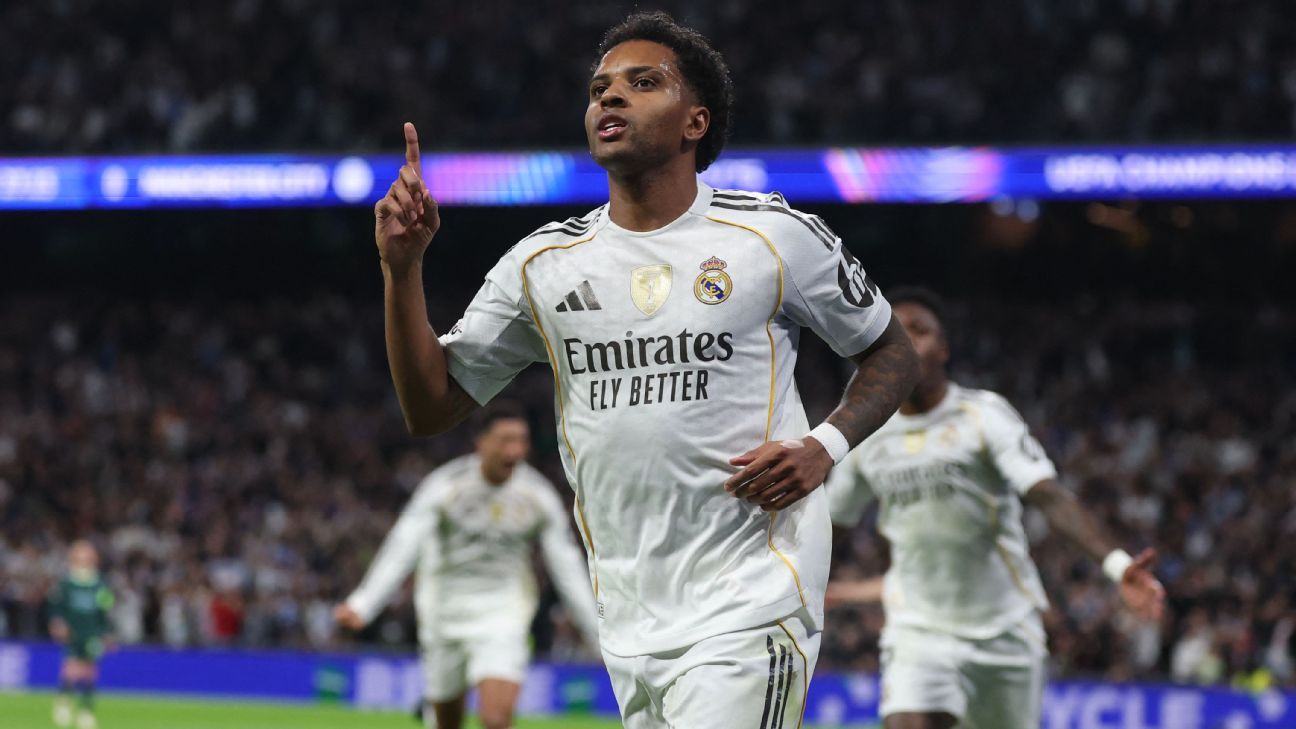

Premier League sides Arsenal, Liverpool and Manchester City are all potential destinations for Real Madrid‘s Rodrygo, while Club Brugge defender Joel Ordóñez nears a move to Anfield. Join us for the latest transfer news and rumors from around the globe.

Transfers home page | Men’s summer grades | Women’s grades

TOP STORIES

Sources: Rosenior frontrunner to replace Maresca at Chelsea
Everton keen on Blackburn, Nigeria RB Alebiosu – sources
Tottenham’s Johnson agrees £35m Palace move – sources

TRENDING RUMORS

– Real Madrid winger Rodrygo wants to leave Real Madrid this winter, according to Diario Sport. The 24-year-old is reported to have begun talks with “two top agents” amid hopes of accelerating his departure from the Bernabéu, but Los Blancos are unlikely to consider offers until the summer following the recent injury to striker Kylian Mbappé. Manchester City and Arsenal are said to be the two most likely destinations for Rodrygo, but Liverpool, who remain on the lookout for a long-term successor for Mohamed Salah, also can’t be ruled out.

– Liverpool are closing in on a move to sign Club Brugge defender Joel Ordóñez, the Daily Mirror reports. A deal worth £43 million has reportedly been agreed, and the Reds are expected to complete the signing of the 21-year-old in a matter of days. The report adds that the Premier League side are also exploring a potential approach for Borussia Dortmund winger Karim Adeyemi, 23, with belief that his versatility could help reinforce Arne Slot’s attacking options.

– Multiple clubs in Italy are tracking Liverpool winger Federico Chiesa, according to Calciomercato. Inter Milan are one of the latest clubs linked with interest in the 28-year-old, with the Nerazzurri said to have been “considering” an approach for some time. Chiesa, who played just 11 minutes in the 0-0 Premier League draw with Leeds on Thursday, continues his struggles to start regularly at Anfield. Italy national team manager Gennaro Gattuso is hopeful of him earning more regular minutes ahead of their FIFA World Cup playoff semifinal against Northern Ireland. Juventus and Atalanta are also reportedly pondering a potential swoop for him.

– Efforts to sign Bayern Munich defender Kim Min-Jae are set to be stepped up by AC Milan, Gazzetta dello Sport reports. The 29-year-old has been identified as one of the top names on the Serie A club’s shortlist amid plans to strengthen their defence, and they are exploring an initial loan move that would include an option to become permanent. Negotiations are set to continue between both clubs with the Bundesliga champions reluctant to accept the current proposal, while the Rossoneri could also struggle to meet his €12m salary in full.

– Real Madrid’s strategy of “patience” with Nico Paz has been rewarded, Marca reports, with the playmaker undergoing an “unparalleled explosion” in growth and profile in Serie A this season. Madrid “seriously considered” bringing Paz back to the Bernabéu last summer but opted to continue his development at Como, with a “clear plan” to re-sign him in 2026.

EXPERT TAKE

play

2:33

Do Vinicius Jr & Rodrygo play with more freedom for Brazil?

The ESPN FC crew debate if Vinicius Jr & Rodrygo play with more freedom for Brazil than Real Madrid.

OTHER RUMORS

– Negotiations between Real Madrid and winger Vinícius Júnior are set to continue over a new contract. (Diario AS)

– A battle between Manchester United and Tottenham Hotspur is set to take place for the signature of RB Leipzig winger Yan Diomande. (talkSPORT)

– Tottenham have moved ahead of Arsenal and Manchester United in the race for Bayern Munich midfielder Leon Goretzka. (Caught Offside)

– Chelsea winger Raheem Sterling is unlikely to consider a move to West Ham United. (Jacob Steinberg)

– Midfielder Kobbie Mainoo is “determined” to stay at Manchester United. (The Sun)

– Sporting CP are in advanced talks to sign West Ham’s Brazilian striker Luis Guilherme in a €17m transfer deal. (A Bola)

– Manchester City defender Jahmai Simpson-Pusey is attracting interest from Strasbourg, FC Koln, and clubs in the Championship. He is set to be recalled from his current loan at Celtic. (Daily Telegraph)

– Tottenham’s Israeli winger Manor Solomon has arrived in Florence ahead of completing his loan move to Fiorentina. (Ansa)

– Uncertainty is growing around the future of Napoli winger Noa Lang, who has caught the attention of Galatasaray. (Il Mattino)

– Manchester United have no plans to recall left-back Harry Amass from his loan spell at Sheffield Wednesday. (The Sun)

– Lazio have joined city rivals Roma in the race to sign Atlético Madrid forward Giacomo Raspadori. (Corriere dello Sport)

– A move for Toulouse defender Charlie Cresswell is being considered by West Ham. (TEAMtalk)

– Lazio are looking at Real Sociedad forward Mikel Oyarzabal. (Nicolo Schira)

– Roma remain interested in Manchester United striker Joshua Zirkzee. (Tuttosport)

– Fiorentina and Valencia are interested in Flamengo right-back Emerson Royal. (Ekrem Konur)

– Crystal Palace, Sunderland, and Fulham are keen on Paris FC winger Ilan Kebbal. (Football Insider)

– Toulouse defender Dayann Methalie is on the radar of Newcastle. (Daily Mail)

– Palmeiras are eyeing Orlando City midfielder Martin Ojeda as a potential reinforcement in January. (TNT Brasil)



Source link

Continue Reading
Click to comment

Leave a Reply

Your email address will not be published. Required fields are marked *

Sports

Messi will score his 900th career goal in 2026. Can he reach 1,000? Can he pass Ronaldo?

Published

on

Messi will score his 900th career goal in 2026. Can he reach 1,000? Can he pass Ronaldo?


Lionel Messi is never far from breaking his next record or hitting his next landmark, and he enters 2026 on the verge of yet another massive milestone in his incredible career: his 900th goal.

The eight-time Ballon d’Or winner is poised on 896 goals in his senior career for Argentina, Barcelona, Paris Saint-Germain and current club Inter Miami following his final match of 2025: Miami’s MLS Cup triumph over the Vancouver Whitecaps on Dec. 5.

The 2026 MLS season doesn’t kick off until Feb. 21, and Argentina are not in action again until they play Spain in the Finalissima in Doha on March 27. Therefore, we’ll have to wait a little while before Messi can get the four goals he needs to hit goal No. 900, but it is likely to come soon enough once the 38-year-old resumes competitive action.

Right now, Messi’s longtime rival Cristiano Ronaldo is the only active player to have scored over 900 professional career goals, having achieved the feat in September 2024. Given that the active player with the next-highest goal total is Robert Lewandowski with 685, it might be some while before the twin titans of modern football are joined in the 900 club by anyone else.

Miami’s maiden MLS title caps off long, ambitious Messi project
Camp Nou icon: The ultimate history of Messi’s Barcelona career
Messi tracker: Goals, assists, key moments for MLS champs Inter Miami

Messi’s goal-scoring odyssey began way back in May 2005, when the teenage sensation emerged from the bench for the final two minutes of Barcelona’s league game against Albacete and capped off a 2-0 victory with his first goal in professional football.

Even though expectations were high for Messi all the way through his development, no one could have predicted the incredible level of success that would follow that first goal at Camp Nou. Yet here we all are 21 years later, with Messi still scoring goals at such a rate that there is no telling how much more he could achieve.

Much has rightly been made about Ronaldo’s quest to reach an undisputed career tally of 1,000 goals, with the 40-year-old now within 50 strikes of that total. But as Messi nears 900, could he also have that four-figure total in his sights? And, being almost 2½ years younger than Ronaldo, could he yet retire with more goals to his name than the Portugal superstar?


Messi’s goals by team

It shouldn’t come as much surprise to learn that most of Messi’s goals were scored at the club where he enjoyed the majority of his career and his peak years: Barcelona. The 5-foot-7 forward scored 672 goals in 778 games for the Catalan giants across 17 seasons — which accounts for 75% of his career tally.

Messi then scored 32 goals in 75 games during his two-year stint with PSG before adding another 77 goals in 88 games to date for Inter Miami.

On the international front, Messi has a running tally of 115 goals in 196 games for Argentina. Though none were bigger than the two goals he scored (plus a penalty in the shootout) in the 2022 FIFA World Cup final victory over France.

Barcelona: 672 goals in 778 games
Paris Saint-Germain: 32 goals in 75 games
Inter Miami: 77 goals in 88 games
Argentina: 115 goals in 196 games
Total: 896 goals in 1,137 games

Messi’s goals per season

Aged 17, Messi debuted for the Barcelona senior side in 2004-05 under head coach Frank Rijkaard and scored just one goal in nine games in all competitions — his first professional career goal, when Ronaldinho set him up to open his account against Albacete in May 2005.

He followed up with his first senior international goal for Argentina in March 2006, in a friendly defeat to Croatia. And with goals for club and country combined, Messi reached double figures in his sophomore campaign (10 goals in 2005-06) and hasn’t looked back, having done likewise in each of the subsequent 20 seasons of his professional career.

Messi’s highest single-season return came in 2011-12, when he amassed a dizzying 82 goals for club and country. It was also the same season that Messi notched his 234th goal in 314 games for Barça to become the club’s top career goal scorer at the age of 24, seizing the mantle from César Rodriguez, hero of the side from the 1940s and ’50s. The decisive strike proved to be Messi’s second goal of a hat trick he scored in a 5-3 win over Granada in March 2012.

Messi had to wait until November of the 2014-15 campaign to become LaLiga‘s top career scorer when another hat trick, this time against Sevilla, saw him reach 253 goals in 289 Spanish league games. He overtook another Barça great, Telmo Zarra, whose individual record of 251 goals in LaLiga had stood since 1955. Messi went on to score 66 goals in total that season.

To sum up his ludicrously prolific goal-scoring consistency, during the 22 seasons that Messi has spent as a professional footballer he has passed the 80-goal mark once, the 60-goal mark three times, the 50-goal mark eight times and the 40-goal mark on 14 occasions. During his monumental heyday, he also scored at least 30 goals for club and country for 13 consecutive campaigns between 2008-09 and 2020-21, the end of which coincided with him leaving Barcelona for PSG.

Following that emotional exit, Messi’s goal return faltered in Paris, where his first season (2021-22) produced a “mere” 22 goals. That said, he did deliver 37 goals in his second term (2022-23). He didn’t spend too long in France, but he did manage to win two Ligue 1 titles and the Trophée des Champions, as well as surpassing Ronaldo’s tally of 701 goals to become the top career goal scorer in European club football with a goal against Nice in April 2023.

Messi’s many records and milestones

Messi refuses to hang around in his relentless pursuit of career milestones. He became Barcelona’s top career scorer in 2011-12, just eight seasons into his senior career, by rattling away 234 goals in his first 314 games for the club. He then quickly took the LaLiga record when he scored that 253rd goal in Spanish league appearances.

We shouldn’t gloss over the fact that he also holds a world record for most goals scored in a single calendar year, having stormed to 91 in 69 games in 2012. Messi scored 79 goals for Barça and 12 for Argentina to surpass the previous annual record of 85, which had been held by Bayern Munich legend Gerd Müller since 1972.

Messi scored the 500th goal of his club and international career in April 2016 in a shock 2-1 home defeat for Barcelona against Valencia. The forward did so in his 632nd game, having amassed 450 goals in 525 games for Barça and 50 goals in 107 caps for Argentina at the time.

He is also the fastest player on record to score 100 goals in the Champions League after taking just 123 games to do so, with the crucial strike coming against Chelsea in March 2018 — also making him the youngest player to reach a century in the competition at 30 years and 263 days.

In that same quarterfinal second leg, Messi also scored the quickest goal of his career, when he bagged his 99th UCL goal with 128 seconds on the clock at Camp Nou.

Even as he pushes on toward his 40s, Messi is still eating up milestones in MLS. After guiding Inter Miami to their first-ever trophy, the 2023 Leagues Cup, he then scored 23 goals in 25 games in 2024 to take over as Inter Miami’s top career scorer and drive them to claim the Supporters’ Shield.

The 2025 season saw Messi ramp it up again, scoring 29 goals in 28 regular-season games en route to winning the MLS Golden Boot. He also became the fastest player to reach 50 goals in MLS history, taking 53 games to beat the previous record shared by Zlatan Ibrahimovic and Josef Martínez (54 games). In all, Messi scored 43 goals in 49 games for Inter Miami in 2025.

play

1:09

How Cristiano Ronaldo and Lionel Messi could face off in WC quarterfinals

Take a look at the potential fixtures of the 2026 World Cup quarterfinals including Cristiano Ronaldo’s Portugal facing Lionel Messi’s Argentina.

When could Messi hit 1,000 goals?

He still has more than 100 goals to go until he reaches the 1,000 milestone, but there’s every chance Messi will get there.

At 38, he still has three years to run on his Inter Miami contract after signing an extension in October 2025 that is due to run until the conclusion of the 2028 MLS season, when Messi will be 41.

Messi has averaged 36 goals a season for club and country since moving to MLS in July 2023 (77 for Miami, 12 for Argentina). However, with uncertainty over how much longer he will continue to play for Argentina — speaking to ESPN last month, he would not confirm that he will play at the 2026 World Cup — that rate would likely drop if he is no longer playing international games.

Still, should he continue to average 36 goals per season for Miami beyond the World Cup next summer, Messi would be on course to score his 1,000th career goal at some point toward the end of the 2028 season, the final year of his current contract.

Of course, this is an incredibly basic calculation that doesn’t take into account any fluctuations in form or fitness — but we employed the same method to calculate if/when Ronaldo would reach his 1,000th career goal, and we haven’t been too wide of the mark regarding his progress toward that target thus far.

Could he retire with more goals than Ronaldo?

Ronaldo, who currently has 957 career goals in 1,298 games for club and country, turns 41 on Feb. 5.

Messi, who has 896 goals in 1,137 games at senior level, turns 39 on June 24.

If Ronaldo dramatically announced his retirement on New Year’s Day 2026 and Messi played on for two further seasons for club and country until the age of 40, while successfully maintaining his average goal return since moving to the U.S. of 36 goals per season, the latter would potentially surpass his rival’s tally of 957 in mid-2027.

In that scenario, Messi could end his career with a total of 968. Again, that’s a ballpark calculation, but it gives an indication of how time is very much on Messi’s side as the younger man of the two rivals.

Both players have unquestionably defined the era in which they have played, winning the Ballon d’Or a combined 13 times between Ronaldo’s first in 2008 and Messi’s eighth in 2023. But, even now, both are still strengthening their respective claims to be declared the greatest of all time.


Source link

Continue Reading

Sports

Smart: UGA 4th-down faux paw ‘on us as coaches’

Published

on

Smart: UGA 4th-down faux paw ‘on us as coaches’


NEW ORLEANS — Coach Kirby Smart wasn’t pointing fingers in the aftermath of a 39-34 loss to Ole Miss in the Sugar Bowl, but the play that may have ultimately doomed the Georgia season was never supposed to happen.

Facing a fourth-and-2 at its own 33, Georgia initially ran its punt team onto the field. But with an Ole Miss defender on the ground, the injury stoppage gave Smart a chance to reconsider. He put his offense back on the field, he said, with an option to either try to draw the Rebels offsides or take a delay of game penalty before a punt.

Instead, Georgia snapped the ball to a surprised Gunner Stockton, and Ole Miss linebacker Suntarine Perkins came unblocked off the edge for the sack.

“We had a misfire there,” Smart said afterward. “The ball was not supposed to be snapped in that situation. That’s on us as coaches.”

Ole Miss took over at the Georgia 23 and scored two plays later to extend its lead to 10 with 9:05 to go in the game.

Smart said Georgia’s analytics actually advised going for it on the fourth down, and after the Bulldogs had blown a 10-point second-half lead, he felt his team had “lost momentum” but the look from the Ole Miss defense meant the snap shouldn’t have happened.

“That’s their OC’s business,” Ole Miss defensive lineman Princewill Umanmielen said. “That ain’t my business. I see the ball, I go.”

Georgia had actually executed a flawless fake punt on fourth down earlier in the half, when Landon Roldan took a reverse and threw a 16-yard pass to Lawson Luckie for the first down. That, too, Smart said felt like a moment in which Georgia had lost momentum and needed a jolt. The drive ended with a field goal.

On the whole, Smart said, the well executed fake punt and the botched fourth-down play evened out.

Georgia still recovered from the miscue, and the Bulldogs tied the game at 34 with less than a minute to play. But a 40-yard completion from Trinidad Chambliss set up a game-winning field goal for the Rebels. In the game, Georgia’s defense allowed 473 yards — the Bulldogs’ second-highest total of the season.

“They made more plays than we did, and I’ve got to be honest, that’s part of football,” Smart said. “They made more [plays] and out-executed us, outcoached us, outplayed us.”

In an October matchup with Ole Miss, Georgia had trailed by 9 entering the fourth quarter, but a dominant final frame sparked a 43-35 win.

On Thursday, the opposite was true. The loss snapped a 75-game winning streak — the nation’s longest — for Georgia when leading at the start of the fourth quarter.

It marked the second straight year Georgia’s title hopes ended in the Super Dome. Last season’s loss came down to a lackluster offensive performance. Thursday was a mixed bag of miscues.

When it was over, however, Smart said he had plays he’d “love to go back and do differently,” but he wasn’t hanging his head. Instead, he gushed about the raucous Ole Miss crowd — “it felt like a road game” — Chambliss’ theatrics under pressure, and the defensive game plan from a team that Georgia had beaten two months earlier.

“That’s what the [playoff] was built for,” Smart said, “to have games like that.”


Source link

Continue Reading

Sports

The NHL is back at the Olympics! Everything you need to know about hockey in Milan-Cortina

Published

on

The NHL is back at the Olympics! Everything you need to know about hockey in Milan-Cortina


For the first time since 2014, NHL players will be competing in the Olympic Games — minus those who call Russia home.

On the women’s side, the best players have been participating without restriction this whole time.

You might have several questions based on those two sentences.

ESPN reporters Ryan S. Clark and Kristen Shilton are here with answers to those — and many more about the format, favorites, etc. — as the start of the Milan-Cortina Games approaches in early February.


When do the tournaments begin?

As pop poet laureate Taylor Swift would say: Baby, let the Games begin!

In this 25th iteration of the iconic winter sports showcase, hockey’s best will compete over 18 days. The women’s side kicks things off Feb. 5, with round-robin action extending to Feb. 10. The men get started Feb. 11 with their own round-robin going until Feb. 18.

Quarterfinals for the women will open Feb. 13, and the men will have qualification playoff games starting Feb. 17. Further quarterfinal and semifinal matchups will follow, leading into medal rounds slated for Feb. 19 (both bronze and gold on the women’s end) and then Feb. 21 (bronze) and Feb. 22 (gold) for the men. — Shilton


Which countries are competing?

Twelve nations will compete in the men’s division, while 10 nations will comprise the women’s division.

Men’s hockey was first introduced as an Olympic sport during the 1920 Summer Olympics, but was then made a permanent sport at the 1924 Winter Games.

Canada was the first nation to win gold in men’s hockey, winning four consecutively; in total, Canada has won gold nine times — the most of any nation. The U.S. is tied for third all time with two gold medals, while its eight silver medals are the most of any nation in men’s hockey.

Finland enters the tournament as the reigning men’s champion, with the nation winning its first-ever gold in 2022. The Finns are seeking to become the first country since Canada in 2010 and 2014 to win consecutive gold medals. It’ll try to pull off that achievement in a field that will also feature Canada, Czechia, Denmark, France, Germany, Italy, Latvia, Slovakia, Sweden, Switzerland and the U.S.

Women’s hockey was introduced at the 1998 Winter Games in Nagano, Japan.

The U.S. was the first country to win gold in women’s hockey when it defeated Canada. Since then, there has been just one Olympics (2006 Torino) in which the gold medal game hasn’t been played between the two North American rivals. The Canadians won their first gold in 2002, and kept those gold medals coming until they were defeated by the U.S. in 2018 in Pyeongchang, South Korea. Canada would strike back in 2022 to win its fifth gold medal in six tries.

Both Canada and the U.S., which are the only countries to win a gold medal in women’s hockey, are back in 2026. They’ll be joined by Czechia, Finland, France, Germany, Italy, Japan, Sweden and Switzerland. — Clark


Why is it a big deal that NHL players are participating on the men’s side?

The NHL is back competing at the Olympics for the first time since the 2014 event in Sochi. There had been league players participating at the Winter Olympics since 1998, but the NHL eventually had a change of heart about being involved. The NHL opted to stop taking Olympic breaks, disallowing its athletes from going to the 2018 showcase.

There were a number of reasons for that choice cited by NHL officials, ranging from pricing and cost issues with the International Olympic Committee and International Ice Hockey Federation (particularly when it came to insurance, travel and lodging). Furthermore, there was consideration for the impact of shutting down for a month on the NHL’s bottom line, not to mention the logistical gymnastics involved in a shortened season. Basically, the NHL owners didn’t think there was enough benefit to seeing their players suit up for their countries.

It wasn’t until the NHLPA pushed back at the collective bargaining table and worked Olympic participation back into the labor laws that it became an option once again. NHL players were slated to return for the 2022 Games, but because of widespread COVID-19 outbreaks at that time, the league stepped in and barred its players again — this time for health reasons — from heading to Beijing.

Those days are behind us now though. The NHL is all-in, and ready to build on the best-on-best momentum from last February’s 4 Nations Face-Off — Shilton


What is the format of the tournament, and what rules are different from the NHL’s?

The tournament is straightforward for the women: 10 countries will be represented, spread across two groups of five teams each. All teams will play each other once in preliminary action. From there, all five teams from Group A and the top three teams from Group B will advance to the quarterfinals. Standard knockout rules apply once the round-robin is done.

The men’s situation is a tad more complex.

We’ve already covered some of the basics: There are 12 teams competing, seeded across three groups of four. Each team will play three round-robin games. When that preliminary round ends, all 12 clubs will be reranked according to a specific system: Which team had the higher position in the group, which had more points, which had the better goal differential, which had the higher number of goals scored and which had a higher IIHF ranking in 2020.

At that point, teams rated 1-4 will have a bye into the quarterfinals. Teams 5-12 will participate in a qualifying round that pits 5 vs. 12, 6 vs. 11, 7 vs. 10 and 8 vs. 9. The four winners from that mini tournament will advance to the quarterfinals, where the matchup system (highest vs. lowest seed) will carry on. Ditto into the semifinals, and then the gold and bronze medal games will be played by the winners and losers of the semis. The team with the higher preliminary round ranking will be considered the home squad in each final round game.

There will also be some differences from what rules and procedures govern the NHL.

The Olympic event’s outcomes will be run by a points system: three for the winning team in regulation, zero for the losing team in regulation, two for the winning team in overtime or a shootout and one for the losing team in overtime or a shootout. During the preliminary action, overtime will last five minutes before the sides go to a shootout. At the Olympics, there will be five preliminary shooters per side instead of the NHL’s usual three. In qualifying, quarterfinal and semifinal games, there will be a 10-minute overtime followed by a shootout. In medal rounds, overtime periods will last 20 minutes until someone scores.

Intermissions will also be shorter — 15 minutes, as opposed to 18 in the NHL. Men’s teams can bring 25 skaters (including three goalies) and ice a game-day roster of 20 players.

Oh, and as always, there is no fighting allowed at the Olympics (or any IIHF hockey events). Sorry, Tkachuk brothers! — Shilton


What’s the latest on the construction of a new rink?

Creating the space where both male and female players will compete has been an arduous process ahead of these Games. Various delays put laborers behind schedule, and by mid-December — just seven weeks from when the women’s hockey teams are slated to start playing — the ice surface inside Milano Santagiulia Ice Hockey Arena had not been installed.

The IOC executive board has made assurances that the arena will be ready by February, even though previously planned pre-Olympic events to test out the pending ice surface had to be canceled. There are reported to be thousands of workers on site around the clock each day to ensure the final deadlines are made.

NHL commissioner Gary Bettman has repeatedly said the NHL had nothing to do with the arena construction process, and deputy commissioner Bill Daly reiterated recently that the safety of NHL players remains the league’s primary concern when it comes to any arena setbacks. — Shilton


What happens if the rink isn’t finished? Is there a deadline for a decision?

Officially, there is no Plan B if the Milano Santaguila rink isn’t finished in time and deemed safe for the athletes. In order for the NHL to make that designation, there has to be some kind of hockey played in the arena so that ice can be tested on its own and when the 16,000-person capacity venue has actual people inside. Bettman and Daly have both stated that if the league doesn’t feel the rink is adequately prepared and vetted they will not send players as planned.

NHL officials have been on the ground in Milan to see what progress there has been, and on one of those trips discovered the size of the ice surface will measure 196.85 feet by 85.3 feet, something the IIHF agreed upon but was a surprise to the league (which has its own standard rinks at 200 feet by 85 feet). International tournaments have been played on smaller ice surfaces than that in the past, but this will be shorter and wider than what athletes have experienced before. The IIHF defended itself against any backlash while moving ahead with their plans.

“While these dimensions differ slightly from a typical NHL rink, they are consistent with IIHF regulations, match the rink size used at the Beijing 2022 Olympic Winter Games and are fully consistent with the dimensions the NHL requires as part of its Global Series Game arena specifications,” the federation said in a statement. “All involved — the IIHF, the organizing committee, NHL, NHLPA, International Olympic Committee and the relevant venue authorities — agree that the differences in rink specifications are insignificant and should not impact either the safety or quality of game play.”

Still, it’s yet another wrench in an increasingly stressful situation for both Olympic organizers and men’s and women’s league executives who want to see their players properly showcased but without risking their health in the process.

“We have offered [to help with the construction] and they are utilizing our ice experts and technicians and outside providers,” Daly said. “We’re basically moving everybody there to try to help get this done in a way that is acceptable for NHL athletes.”

There has been no publicly announced cut-off date as of yet that would indicate how much runway the organizers have before the NHL or any of the women’s teams would drop out of the tournament. — Shilton


Who are some of the top women’s players who I need to know?

Canada is expected to be led by its established stars, and that starts with its captain Marie-Philip Poulin. She’s a three-time Olympic gold medalist, a four-time women’s world champion, the reigning IIHF Women’s Player of the Year, and is considered to be one of the greatest players of all time.

Poulin is just one of two Player of the Year recipients who are expected to play for Canada. Natalie Spooner won the award in 2024 and has won two Olympic golds and three world championships. Canada’s bid for a consecutive gold medal is also likely to be heavily bolstered by other stars such as Erin Ambrose, Renata Fast, Sarah Fillier, Brianne Jenner, Sarah Nurse and Blayre Turnbull.

The U.S. has its own collection of stars who will be led by captain Hilary Knight. She is a four-time Olympic medalist who was part of the U.S. team that won gold in 2018 and is also a 10-time world champion. Knight was the first recipient of the IIHF Women’s Player of the Year back in 2023.

America’s path for a gold is also expected to feature Alex Carpenter, Kendall Coyne Schofield, Britta Curl-Salemme, Aerin Frankel and Lee Stecklein. Laila Edwards and Caroline Harvey, teammates at the University of Wisconsin, are also expected to be on the roster.

Outside of the North American powers, there’s Finland duo Jenni Hiirikoski and Michelle Karvinen, who are considered to be two of the best players in the world. Switzerland’s Alina Muller might be a familiar name, with the forward winning a bronze medal when she was 15 at the 2014 Olympics.

Another country to watch is Czechia, which has been among the top four women’s teams over the past four years because of players such as Kristyna Kaltounkova, Natalie Mlynkova, Katerina Mrazova and Aneta Tejralova. — Clark


Who are the key non-NHL players to know on the men’s side?

The U.S., Canada, Finland and Sweden are expected to field rosters that exclusively feature NHL players. Although it’s possible Finland could have to rely on skaters playing elsewhere considering how many expected roster players are out because of injury, led by Florida Panthers star Aleksander Barkov.

Czechia, Germany and Switzerland will have NHL players on their respective rosters but will need players from leagues beyond the NHL in order to field a full team. Czechia is expected to rely on Ondrej Beranek, Roman Cervenka and Jakub Flek, along with other players who have previous NHL experience like Libor Hajek, Michal Kempny and Dominik Kubalik.

Switzerland could be an under-the-radar medal threat. In addition to NHL players like Nico Hischier and Timo Meier, it also has players who either have NHL experience or have played in North American leagues. It’s a group that consists of Sven Andrighetto, Dean Kukan and Denis Malgin. There are also players who’ve stayed in Europe for their whole careers such as Swiss goalie Leonardo Genoni, a veteran of nearly 90 games for his country at the senior level. — Clark


Who are the medal favorites?

Part of what made the 4 Nations Face-Off intriguing is that it was seen as a dress rehearsal for the Olympics. Canada and the U.S. were the heavy favorites and showed why with Canada winning in overtime in the final. The tight margins between those two teams is more evidence that either could win the men’s tournament. That narrative was enhanced by the U.S. winning its first men’s world championships gold medal since 1960 this past spring.

That said, Czechia, Finland and Sweden all have a strong history of finding cohesion at numerous international tournaments en route to either winning gold or being somewhere on the podium. And as noted above, Switzerland could build upon its consecutive second-place finishes at the two most recent men’s world championships and parlay that into a place on the medal stand.

On the women’s side, the U.S. and Canada are considered to be the two strongest nations when it comes to talent and infrastructure, and they enter the tournament as the favorites for gold.

That’s not to suggest that others won’t force the issue and give the Olympics its second-ever gold medal game that isn’t played between Canada and the U.S.; the two most likely candidates to do so appear to be Finland and Czechia.

Finland has won bronze in three of the four most recent Olympics. The Finns have also won bronze in the two most recent women’s world championships.

Both of those third-place finishes for Finland were against a surging Czechia. The 2022 Olympics was Czechia’s first time at the Games, and they finished seventh. They were the bronze medalists at the women’s world championships in 2022 and 2023, losing the bronze to Finland the past two years. — Clark


Why isn’t Russia in the tournament?

The IOC is continuing its ban on teams from Russia (and Belarus) competing in both men’s and women’s hockey at the 2026 Games. This will be the second straight Olympics where those countries won’t be represented in group sports, although certain individual athletes will be allowed to compete as Individual Neutral Athletes.

The IOC initially had its executive board call for sanctions against Russia in response to their invasion of Ukraine — with Belarus’ support — in 2022. Those recommendations were made in 2023, and consequently Russia and Belarus were barred from the summer 2024 Games in Paris. The IOC asked the IIHF for a projected schedule and groupings in May for the 2026 Games, making their decision to uphold the previous recommendations against Russia and Belarus at the end of that month.

This isn’t the first time the IOC has taken a stance against Russia. When a state-sponsored doping program was exposed there in 2016, the IOC and World Doping Agency determined as punishment that Russia’s name, flag and anthem be banned from all upcoming Games. As such, Russia’s last two Olympic teams competed as “Olympic Athletes from Russia” in 2018 and “Russia Olympic Committee” in 2022. — Shilton


Source link

Continue Reading

Trending