Politics
Trump 2.O and prospects of ending Russia-Ukraine War

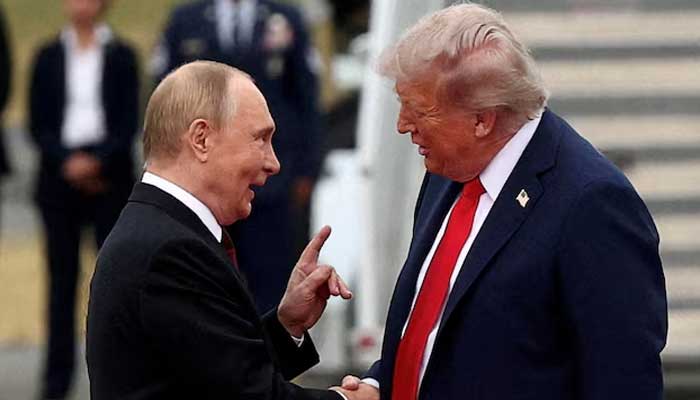
Russian President Vladimir Putin has endorsed his US counterpart Donald Trump for Nobel Peace Prize. It is despite the fact that President Trump has failed to end the Russia-Ukraine war till now.
As the year 2025 ends, it is interesting to look at why Russia is preferring Donald Trump over his predecessor Joe Biden? And, what are the chances that recent peace plan will come to fruition?
In an interview with the Russian Consul General in Karachi Andrey V. Fedorov, Geo.tv tried to understand who let President Trump down as ‘easy to solve’ war is still going on.
Q: How do you see US-Russia relations in the first year of Trump administration?
Andrey V. Fedorov: The new US administration began its work during one of the most strained periods in Russian-American relations since the end of the Cold War. Nevertheless, we note their desire to partially revise the policies of the previous US President and attempt to discuss the accumulated problems. As President Putin has repeatedly stated, we are committed to cooperation and the pursuit of dialogue. This is particularly important now that at least some opportunities for this have emerged.
Q: President Putin said that US-Russia trade is increasing and it is 20% higher. What are the areas where trade is increasing and is there any data for that?
Andrey V. Fedoro: Yes, indeed. We are witnessing an increase in trade volume by more than 20%. Those numbers, however, are still quite humble. Some economic ties have been preserved, but their further development is effectively constrained by the imposed sanctions. It is evident to everyone that without those restrictions, business and investment cooperation between Russia and the United States would have considerable prospects, notably in the energy sector, high technology, and digital solutions.
Q: What are the areas where US and Russia are still cooperating with each other despite bans imposed on Russian companies and individuals?
Andrey V. Fedoro: An indicative example could be our joint projects in space exploration. There is still some cooperation on the operation of the International Space Station and related research. Collaboration on the International Thermonuclear Experimental Reactor (ITER) and potential scientific projects in the Arctic also seem promising. Our country’s leadership has always advocated not politicising science and continuing cooperation in this area for the benefit of all humanity.
Nuclear weapons are another issue on which we need to maintain contact. On the one hand, the current US administration clearly has a better understanding of its responsibility as a nuclear power and is seeking dialogue. On the other hand, there are calls for new nuclear tests. President Putin has suggested an initiative to keep following the quantitative targets under the New START Treaty for another year after it expires in February 2026. Of course, this measure will only be justified if the United States agrees to take the same step. Efforts to normalise bilateral relations and resolve differences in approaches to global security are also necessary for the resumption of substantive strategic dialogue.
Q: What is the impact on the ground after the presidential summit in Alaska?
Andrey V. Fedoro: There have been no Russian-American summit meetings for more than four years. The last one was in Geneva, when President Putin met President Biden. Unfortunately, it did not yield any tangible results: the previous American administration continued its policy of confrontation. The bilateral relations reached their lowest point since the Cold War.
President Trump has demonstrated a willingness to shift away from this course, to attempt to resolve longstanding issues and, more importantly, to address their root causes. No one has any illusions that this process will be easy or swift, but the very possibility of a meeting is an important signal. The talks in Anchorage have certainly given impetus to further dialogue and created a foundation from which we can proceed. As you can see, contacts have continued at the level of foreign ministers, national security aides, special representatives of the two presidents and through other channels.
On December 2, President Putin received US Special Envoy Steve Witkoff and Jared Kushner at the Kremlin. The meeting lasted five hours and was very useful, constructive, and substantive.
Q: President Trump said: ‘’I will call up NATO in a little while. I will call up the various people that I think are appropriate, and I will, of course, call up President Zelensky and tell him about today’s meeting. It is ultimately up to them’’. So, who is calling the shots?
Andrey V. Fedoro: It is only natural that after such talks the presidents discussed the results with their administrations, key departments, and international partners who might be affected by the summit’s outcome. This is not a reason to speculate that other states will have the final say.
After the negotiations in Alaska, a delegation of leaders from European countries, the EU, NATO and Ukraine arrived in Washington. They made no secret of the fact that they wanted to undermine any constructive efforts to resolve the Ukrainian crisis and develop relations with Russia, and that they would like the US to adopt their confrontational logic, as was the case under Joe Biden. Despite these destructive efforts of Europeans, which, incidentally, President Putin assessed quite unequivocally during the last meeting in the Kremlin, the positions of Russia and the US have not grown any further apart. Judging by his subsequent steps and continued contacts with Russia, President Trump is taking a more constructive stance.
Q: What does it mean when President Putin said that ‘fair security balance must be restored in Europe and the rest of the world’?
Andrey V. Fedoro: President Putin has repeatedly stated that everything happening around Ukraine is inextricably linked to fundamental threats to our national security and that Russia is sincerely interested in ending the conflict. However, for a long-term settlement, we need to eliminate the root causes of the crisis, including threats to Russia, and, yes, restore a fair security balance in Europe and the world. For example, at some point Nato intended to include Ukraine in its membership and build bases in Crimea. This is, of course, absolutely unacceptable to Russia, as it violates all agreements on the indivisibility of security that were reached at the highest level in the OSCE. It was specified that no organisation or country in Europe would strengthen its security at the expense of the security of others.
Russia has attempted to put forward constructive initiatives to avert the conflict. For example, in December 2021, we prepared and submitted a draft treaty between the Russian Federation and the United States of America on security guarantees and an agreement on measures to ensure the security of the Russian Federation and member states of the North Atlantic Treaty Organisation (Nato). This was an attempt to confirm the political commitments and principles of the 1999 Charter on European Security, which, incidentally, were reiterated at the OSCE summit in Astana in 2010. Unfortunately, in 2021, President Putin’s initiative was rejected, even though it could have contributed to stabilising the security situation.
Of course, there are alternative paths. It has now become abundantly clear that the period of Western dominance is coming to an end, with the role of the countries of the Global South and East growing ever stronger. Russia supports the idea of transforming Eurasia into a zone of development, peace and stability, and establishing a new security architecture based on the principle of equal and indivisible security. A concrete example is the initiative put forward by Belarus, with Russia’s support, to develop a Eurasian Charter of Diversity and Multipolarity in the XXI Century.
Q: President Trump also said that, “We did not get here, but we have a very good chance of getting there”. And, “there is no deal until there is a deal’’. So, what is stopping both presidents making a deal?
Andrey V. Fedoro: First, it should be noted again that President Trump is inclined to understand the root causes of the conflict. The talks in Alaska were partially structured around this, as well as around taking into account Russia’s interests in ensuring its own security, especially given the Nato factor, and the people who decided to tie their fate to Russia after having been oppressed by the Ukrainian authorities. So now there are better chances than with the last US administration. However, a lot still needs to be clarified and discussed.
Moreover, the European countries are actively trying to undermine the joint efforts of Russia and the US and to compel Ukraine to continue fighting. If at the beginning of the special military operation, they declared that Russia must suffer a ‘strategic defeat’, now they are demanding an immediate ceasefire without preconditions. This implies that they will not stop supplying weapons to Ukraine, which they admit quite openly. Obviously, this will not contribute to the shaping of a new robust security architecture in the world. As stated earlier, resolving a conflict cannot be reduced to a simple ceasefire. There are no easy solutions here, nor will there ever be. That is why we are continuing our dialogue with the US through various channels, trying to reach agreements rather than formalities.
Q: It appears that Russia intends to take over the whole of Donbas and some other regions before agreeing to a ceasefire. And so, a possible meeting in Hungary couldn’t take place. By every passing day, with Russian advancement and Ukrainian actions, don’t you think Moscow is making it more difficult to achieve a ceasefire?
Andrey V. Fedoro: Both our president and the foreign minister have repeatedly stated that it is not the territories that are of fundamental importance, but the fate of the people living there who have expressed their desire to be with Russia. So, such statements in the media are not entirely accurate.
It is worth remembering that in April 2022, following the negotiations in Belarus and Turkey, Ukraine seriously considered accepting a document that could have put an end to the military confrontation. The opening provisions reiterated the fundamentals of Ukraine’s 1990 Declaration of Independence, namely that Ukraine would never become a member of Nato, would never possess nuclear weapons, and would remain neutral. These principles were the foundation of the country’s independence. Unfortunately, under pressure from Western countries, they did not sign the document.
Subsequently, some European countries, the EU, and Nato began to dictate completely opposite goals to Kyiv: to inflict a ‘strategic defeat’ on Russia and restore Ukraine’s sovereignty within the 1991 borders. They also completely forgot about the usual enforcement of democratisation, ignoring the oppression of the Russian-speaking population, the refusal to hold presidential elections, corruption scandals, and other manifestations of the Ukrainian government’s failure. Of course, there have been no attempts to resolve the root causes of the conflict. Through these attempts to disrupt any settlement, they have effectively deprived themselves of a place at the negotiating table. It was primarily because of their influence that a quick resolution of the conflict became impossible. Not to mention the issue of the legitimacy of Zelensky as president, with whom it will also be necessary to sign an agreement.
Q: EU has a slightly different stance. It says, ‘’Russia cannot have a veto against Ukraine’s pathway to the EU and Nato. International borders must not be changed by force’’. And, ‘’We are determined to do more to keep Ukraine strong’’. Don’t you think that Russia should first deal with the EU before making a deal with President Trump?
Andrey V. Fedoro: We have already discussed that the stance of European countries is less constructive. For now, we only see EU countries trying to block a possible agreement and disrupt the conflict resolution. You must have also seen statements by their authorities about the urgent need to revive the military industry and draft more citizens into the army. This hardly looks like an effort to achieve peace. And all this is happening while Russian officials openly declare having no intentions of invading Europe. Recently, President Putin has once again stated that there are no such plans, only determination to protect our country, should Europe attack first.
Russia’s contacts with the new American administration, on the contrary, have shown that President Trump bases his relations with other states on the priority of US national interests. At the same time, he understands that other countries, especially when it comes to great powers, have every right to assert their own national interests. Our country’s top officials know that some disagreements are inevitable, but they always try to find common ground and avoid even a ‘cold’ confrontation. So, it’s mostly about seeking dialogue.
Q: Till now, how far have the US and Russia worked to address the question of the security of Ukraine?
Andrey V. Fedoro: As you know, there is currently a lot of discussion in the media about a certain “leaked” peace plan, which includes a clause on security guarantees. Such “leaks” are almost always aimed at undermining the efforts of negotiators. The fact is that consultations are currently being held with the US through diplomatic channels, which require not only painstaking work on every aspect, but also trust. Therefore, I would like to refrain from any unnecessary speculations on any points of possible agreements.
During the latest meeting in Moscow, both sides had agreed not to disclose the substance of the negotiations. However, it is known that Russia has received a plan comprising 27 points and four other documents. Some of the proposals appear more or less acceptable, some are not. So, a compromise has not been reached yet. All five documents should be further discussed in detail, and the work will continue.