

Politics
UAE move to end medicine monopolies may lower drug prices, ease shortages



DUBAI: The United Arab Emirates (UAE) has introduced new rules aimed at preventing monopolies in the pharmaceutical sector, a move doctors say could help reduce medicine prices and prevent recurring drug shortages.
Under the new system, pharmaceutical companies will be required to appoint more than one authorised agent in the UAE for each medical product. The measure is designed to increase competition in distribution and strengthen supply chains.
Health experts say the change could have a direct impact on prices. When a single distributor controls the supply of a medicine, it can set prices with limited market pressure.
By allowing multiple agents to handle the same product, competition is expected to grow, which may gradually bring down costs for patients.
Doctors also note that reliance on one supplier has previously led to shortages when production delays or global disruptions occurred. In recent years, patients in the UAE faced difficulty obtaining certain diabetes, weight-loss and mental health medications due to high demand and supply chain problems.
With more than one authorised distributor, any logistical failure by one company would be less likely to disrupt patient treatment. Greater competition is also expected to improve service standards in storage and transportation.
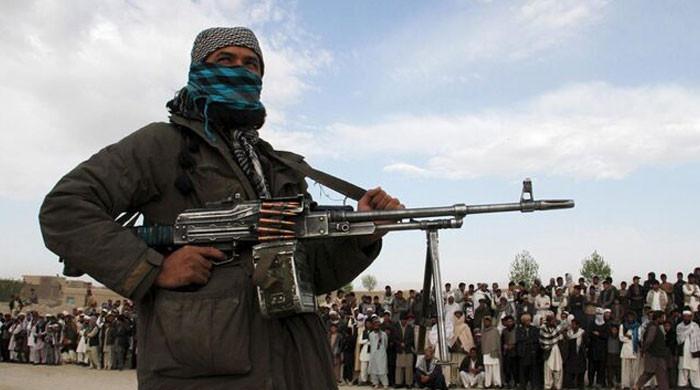
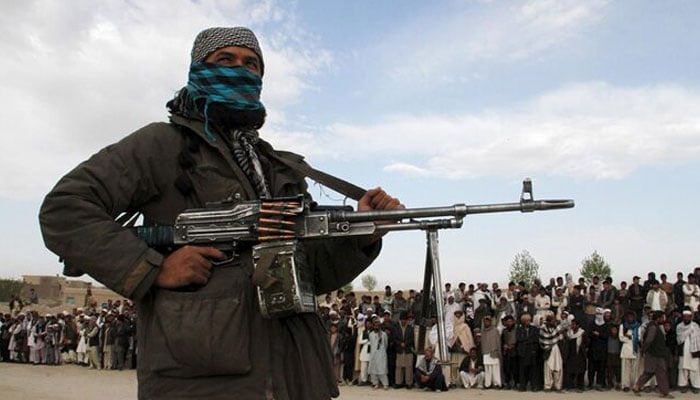
- Taliban decree expands death penalty, bans dissent. UN
- Decree not yet released; UN urges Taliban to rescind it.
- Turk likens Taliban system to gender apartheid.
A new decree from Afghanistan’s Taliban government is set to further crush rights and freedoms in the war-torn nation, especially for women, UN human rights chief Volker Turk said on Thursday.
The Taliban has restricted women’s movements and barred girls from education beyond primary school since coming to power in 2021, via a series of morality laws that also limit expression and employment.
Turk, the United Nations High Commissioner for Human Rights, said a decree signed by Taliban supreme leader Hibatullah Akhundzada last month “defines several crimes and punishments that contravene Afghanistan’s international legal obligations”.
“It provides for the use of corporal punishment for numerous offences, including in the home, legitimising violence against women and children,” he told a Human Rights Council meeting in Geneva.
“The decree, which is expected to come into effect soon, extends the number of offences that carry the death penalty.”
The decree also criminalises criticism of the de facto leadership and its policies, in violation of freedom of expression and assembly, he said.
Detailed provisions of the decree have not been officially published by the Taliban’s Ministry of Justice or Supreme Court, and Reuters has not been able to obtain the text from officials.
The Afghan administration did not respond to an immediate request for comment.
Turk urged the Taliban to rescind the decree, impose a moratorium on executions and end corporal punishment, saying women and girls face persecution under a system he likened to gender apartheid. The Taliban say women’s rights are internal matters and should be addressed locally.
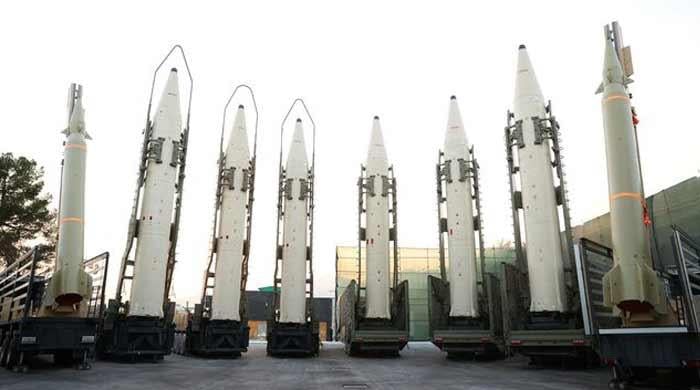
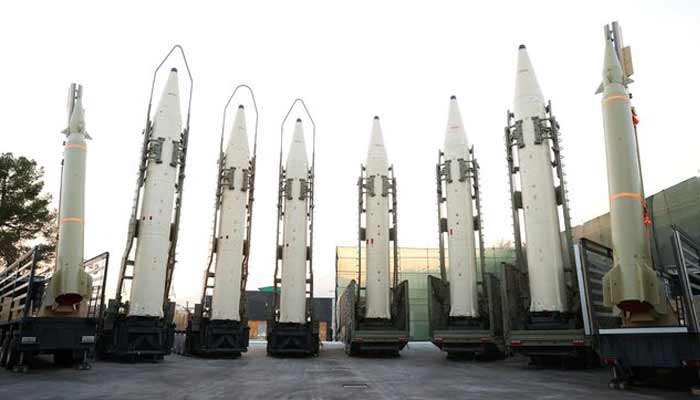
Iran holds a new round of nuclear talks with the United States on Thursday in Geneva. Its arsenal of missiles has been a sticking point in negotiations.
Here are some details about Iran’s missiles:
What are ballistic missiles?
A ballistic missile is a rocket-propelled weapon that is guided during its ascent but follows a free-fall trajectory for most of its flight. It delivers warheads — containing either conventional explosives or potentially biological, chemical or nuclear munitions — over varying distances.
Western powers regard Iran’s ballistic missile arsenal both as a conventional military threat to Middle East stability and a possible delivery mechanism for nuclear weapons, should Tehran develop them. Iran denies any intent to build atomic bombs.
Iranian missile types and ranges
Iran has the largest stockpile of ballistic missiles in the Middle East, according to the US Office of the Director of National Intelligence. They have a self-imposed range of 2,000 km (1,240 miles), which Iranian officials have said was enough to protect the country as they can reach Israel.
Many of Iran’s missile sites are in and around Tehran. There are at least five known underground “missile cities” in various provinces, including Kermanshah and Semnan, as well as near the Gulf region.
The arsenal encompasses multiple long-range missiles that can reach Israel, according to the Center for Strategic and International Studies. It says these include the Sejil, with a 2,000-km range; Emad, 1,700 km; Ghadr, 2,000 km; Shahab-3, 1,300 km; Khorramshahr, 2,000 km; and Hoveyzeh 1,350 km.
The semi-official Iranian news outlet ISNA published a graphic in April 2025 showing nine Iranian missiles it said could reach Israel, including the Sejil, which ISNA said was capable of flying at more than 17,000 km (10,500 miles) per hour and had a range of 2,500 km; the Kheibar, with a range of 2,000 km; and the Haj Qasem, 1,400 km.
Washington-based think tank, the Arms Control Association says Iran’s ballistic arsenal included the Shahab-1, with an estimated range of 300 km; the Zolfaghar, 700 km; Shahab-3, 800-1,000 km; Emad-1, under development, 2,000 km; and a Sejil model under development, 1,500-2,500 km.
When did Iran last use its missiles?
During the 12-day war with Israel in June 2025, Tehran fired ballistic missiles into Israel, killing dozens of people and destroying buildings.
The Institute for the Study of War (ISW) and AEI Critical Threats Project said Israel “likely destroyed around a third of the Iranian missile launchers” during the conflict. Iranian officials have said Tehran has recovered from the damage incurred during the war.
Iran also responded to US participation in Israel’s air war by firing missiles at the US Al Udeid air base in Qatar. Tehran gave advance warning and no one was hurt. Washington announced a ceasefire hours later.
Iran’s Revolutionary Guards used missiles in January 2024 when they said they had attacked Israel’s spy headquarters in Iraq’s semi-autonomous Kurdistan region, and that they had also fired at Daesh in Syria.
In 2020, Iran launched missiles at US-led forces in Iraq in retaliation for a US drone strike that killed Major General Qassem Soleimani of the Revolutionary Guards.
Missile strategy and development
Iran says its ballistic missiles provide a deterrent and retaliatory force against the United States, Israel and other potential regional targets.
According to a 2023 report by Behnam Ben Taleblu, a senior fellow at the US-based Foundation for Defense of Democracies, Iran continues to develop underground missile depots complete with transport and firing systems, as well as production and storage centres. In 2020, Iran fired a ballistic missile from underground for the first time, it said.
“Years of reverse-engineering missiles and producing various missile classes have also taught Iran about stretching airframes and building them with lighter composite materials to increase missile range,” the report said.
In June 2023, Iran presented what officials described as its first domestically made hypersonic ballistic missile, the official IRNA news agency reported. Hypersonic missiles can fly at least five times faster than the speed of sound on a complex trajectory, making them difficult to intercept.
The Arms Control Association says Iran’s missile programme is largely based on North Korean and Russian designs and has benefited from Chinese assistance.
Iran also has cruise missiles such as the Kh-55, an air-launched nuclear-capable weapon with a range up to 3,000 km.
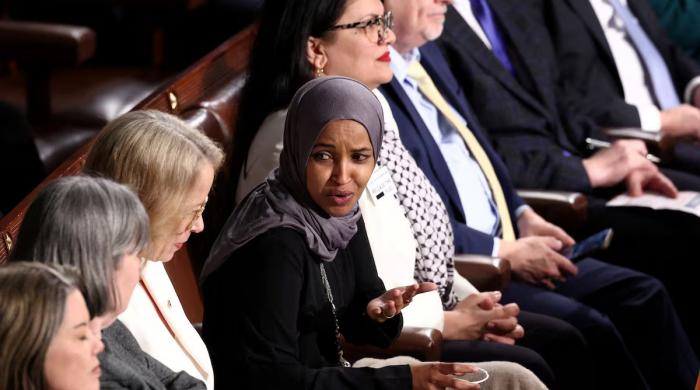
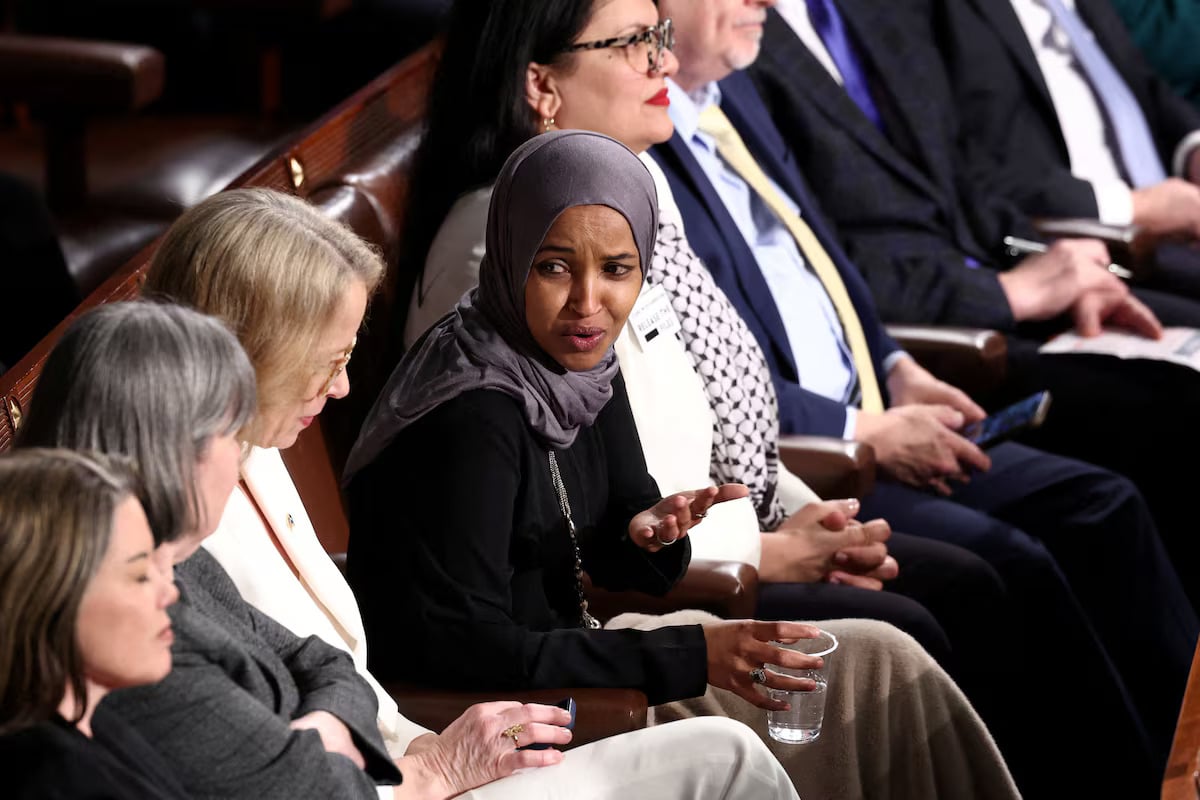
President Donald Trump said that two Muslim Democratic US Representatives, Ilhan Omar of Minnesota and Rashida Tlaib of Michigan, should be “institutionalised” and sent back to “where they came from,” a day after they had a heated exchange with him during his State of the Union address.
Both Omar and Tlaib shouted “you’re killing Americans” at Trump during his speech, with Omar also calling him a “liar.”
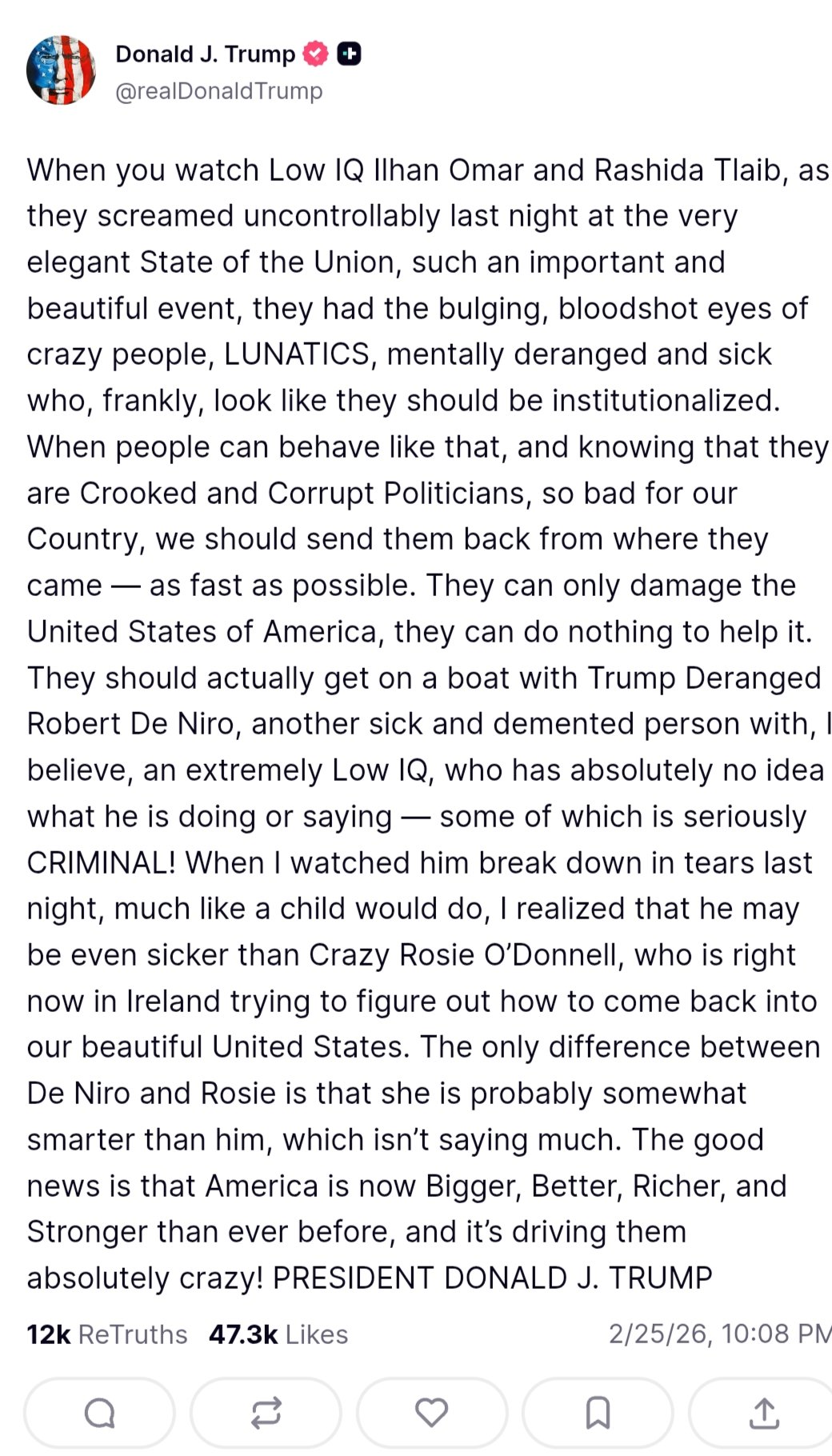
In a Truth Social post on Wednesday, Trump said the two lawmakers “had the bulging, bloodshot eyes of crazy people, LUNATICS, mentally deranged and sick who, frankly, look like they should be institutionalized.”
“We should send them back from where they came — as fast as possible,” Trump added. Both Omar and Tlaib are U.S. citizens.
House of Representatives Minority Leader Hakeem Jeffries cast Trump’s rhetoric against Tlaib and Omar as “xenophobic” and “disgraceful.” Tlaib said on X that Trump’s comments showed “he is crashing out.”
Muslim advocacy group Council on American-Islamic Relations also said Trump’s comments were racist.
“It’s racist and bigoted to say two Muslim US lawmakers should be sent to the country they were born in or where their ancestors came from based on their criticism of the gunning down of Americans by ICE,” CAIR National Deputy Director Edward Ahmed Mitchell said.
The White House did not immediately respond to a request for comment. White House press secretary Karoline Leavitt said last week that members of the media have “smeared” the president as a racist.
Trump’s immigration enforcement actions were criticised following two separate January fatal shootings of US citizens by federal agents in Minnesota. At least eight people have died in US Immigration and Customs Enforcement detention centres since the start of 2026, following at least 31 deaths last year.
During his Tuesday speech, Trump reiterated his accusation that Somali communities in the US have engaged in fraud and claimed that “Somali pirates” had ransacked Minnesota. His administration had used fraud allegations to deploy armed federal immigration agents in Minnesota.
Trump has cast his actions as aiming to tackle fraud and improve domestic security.
Rights groups say the crackdown has created a fearful environment and that Trump has used isolated fraud cases as an excuse to target immigrants. They also dismiss Trump’s ability to tackle fraud, citing pardons from him to those who have faced fraud convictions in the past.
Trump also recently faced criticism after his social media account posted a video that contained a racist depiction of former President Barack Obama and his wife Michelle Obama.


This AI Agent Is Designed to Not Go Rogue

What’s going on with Premier League’s 115 charges against Man City?

Policy easing drives Argentina’s garment import surge in 2025

-

 Tech7 days ago
A $10K Bounty Awaits Anyone Who Can Hack Ring Cameras to Stop Sharing Data With Amazon
-

 Fashion6 days ago
ICE cotton ticks higher on crude oil rally
-
 Business6 days ago
US Top Court Blocks Trump’s Tariff Orders: Does It Mean Zero Duties For Indian Goods?
-
 Business5 days ago
Eye-popping rise in one year: Betting on just gold and silver for long-term wealth creation? Think again! – The Times of India
-

 Entertainment5 days ago
Viral monkey Punch makes IKEA toy global sensation: Here’s what it costs
-

 Sports6 days ago
Brett Favre blasts NFL for no longer appealing to ‘true’ fans: ‘There’s been a slight shift’
-

 Entertainment6 days ago
The White Lotus” creator Mike White reflects on his time on “Survivor
-

 Sports5 days ago
Kansas’ Darryn Peterson misses most of 2nd half with cramping