

Politics
UK High Court orders Adil Raja to publicly apologise to Brig (retd) Rashid Naseer



LONDON: The UK High Court has ordered YouTuber Major (retired) Adil Raja to make a public apology and pay around £310,000 in damages and legal costs to Brigadier (retd) Rashid Naseer in relation to the defamation case that Adil Raja lost in October this year.
Judge Richard Spearman KC made the order after a hearing in the London High Court, where Raja had sought to make an appeal against the original judgment.
Naseer asked the court to proceed with making the order following the judgment he obtained in his favour in October this year.
After hearing the arguments of Raja’s lawyer Simon Harding, Judge Richard Spearman KC refused to entertain Raja’s application for permission to appeal before him. The Judge was critical of Raja’s lawyers, who did not engage with Naseer’s lawyers in dealing with consequential matters.
The Judge has made the following orders to Raja: he must make a public apology for his defamatory statements towards Brig (retired) Naseer; this apology is to be posted for 28 days on Raja’s Twitter, Facebook, YouTube accounts and the main page of his website; Raja has been ordered to pay £50,000 in damages and £260,000 costs upfront (and the rest to be assessed later) all to be paid by 22 December 2025; Raja has been issued an Injunction order not to repeat the defamatory statements; and permission to Appeal was not granted by the Judge.
In October this year, the UK High Court Judge ruled against Major (retd) Raja in the defamation case filed by Brigadier (retd) Naseer at the London High Court that Raja defamed Naseer, without any factual basis and evidence, made false allegations and therefore the court awarded £50,000 in damages to Naseer, an injunction restraining Raja from repeating his baseless and false allegations ever again and ordered Raja to publish a summary of the judgement confirming that Naseer had won the case and that the allegations were defamatory.
Brig (retd) Naseer attended the trial in July this year, he also attended the court when the judgment was delivered and he was also present in the court on Monday when the final orders were made. Raja attended the court remotely, and his lawyers attended the court during the trial. Raja was not present during the hearing on Monday.
Raja told Geo News in a statement: “We are appealing the judgement at the Court of Appeal.”
Naseer had started his defamation claim against Raja in August 2022 over ten publications — published between June 14 and 29, 2022, on Raja’s Twitter, YouTube and Facebook.
The court found that nine of these publications were seriously defamatory to Naseer and caused him serious harm.
The judge stated that he was not persuaded that the allegations that Raja published came from his “sources” because (i) when observing Raja give oral evidence, he was unable to determine whether Raja’s evidence was reliable or a case of mistaken recollection or exaggeration; and (ii) Raja produced no contemporary record of any kind which supported his evidence.
Raja was unable to satisfy the judge that his source(s) provided him with information to support the allegations that he made against Naseer; therefore, his public interest defence failed.
Naseer was represented by Barrister David Lemer of Doughty Street Chambers and Ushrat Sultana and Sadia Qureshi of Stone White Solicitors. Raja was represented by Barrister Simon Harding.


- Meteorological agency records two 40-centimetre tsunami waves.
- Tsunami expected to hit Japan’s Pacific coast, say meteorologists.
- Footage shows shattered glass fragments scattered across roads.
A major earthquake rocked Japan’s northern coast on Monday, with the country’s meteorological agency recording two 40-centimetre tsunami waves and local media reporting injuries.
The United States Geological Survey said the magnitude 7.6 quake struck at 1415 GMT off Misawa on Japan’s Pacific coast, at a depth of 53 kilometres (33 miles).
The Japan Meteorological Agency issued a tsunami warning, with a first wave hitting a port in the northern region of Aomori, where Misawa is located, at 11:43 (1443 GMT).
At 11:50 pm, another wave reached the town of Urakawa town in the Hokkaido region, the agency said.
Both waves measured 40 centimetres (16 inches), it added.
Public broadcaster NHK cited a hotel employee in the city of Hachinohe in Aomori as saying there had been some injuries, with live footage showing shattered glass fragments scattered across roads.
The quake was also felt in the northern hub of Sapporo, where alarms rang on smartphones to alert residents.
A reporter for NHK in Hokkaido described a horizontal shaking of around 30 seconds that made him unable to keep standing as the earthquake struck.
The meteorological agency earlier warned a tsunami of up to three metres (10 feet) was expected to hit Japan’s Pacific coast.
Japan sits on top of four major tectonic plates along the western edge of the Pacific “Ring of Fire” and is one of the world’s most tectonically active countries.
The archipelago, home to around 125 million people, experiences around 1,500 jolts every year.
The vast majority are mild, although the damage they cause varies according to their location and depth below the Earth’s surface.
- Thai army says one soldier killed in border clashes.
- Military facilities targeted in air strikes: Thai Air Force
- Ex-Cambodian leader urges forces to exercise restraint.
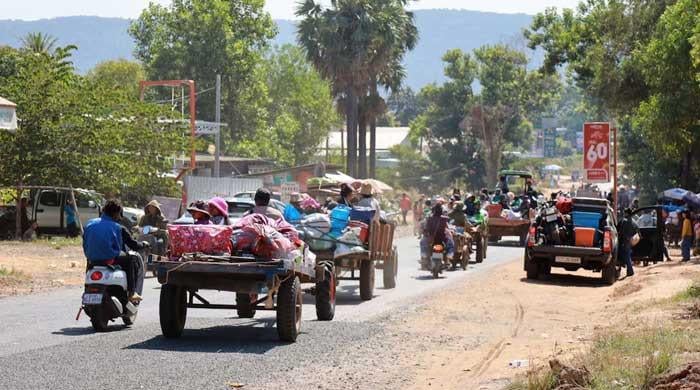
BANGKOK/PHNOM PENH Thailand said it launched airstrikes into Cambodia on Monday as fighting broke out in multiple areas along their disputed border, after both countries accused the other of breaching a ceasefire brokered by US President Donald Trump.
At least one Thai soldier had been killed and eight were wounded in the fresh clashes that intensified around 5am local time (2200 GMT), a Thai army spokesperson said, adding that air support was called in to hit Cambodian military targets.
Thailand’s Air Force said that Cambodia mobilised heavy weaponry, repositioned combat units and prepared support elements that could escalate military operations.
“These developments prompted the use of air power to deter and reduce Cambodia’s military capabilities,” it said in a statement.
Cambodia’s defence ministry said in a statement that the Thai military had launched dawn attacks on its forces at two locations, following days of provocative actions, and added that Cambodian troops had not responded.
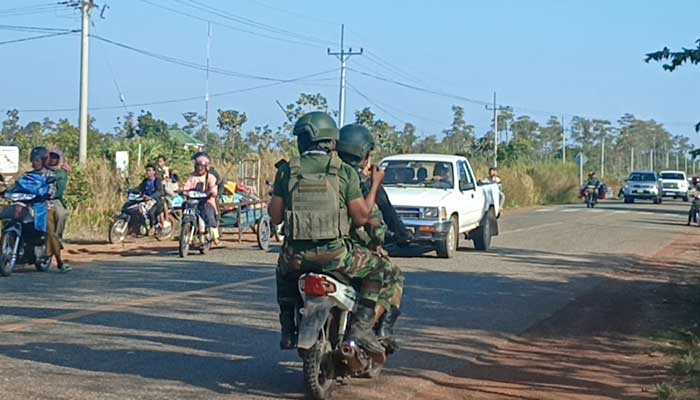
Cambodia’s influential former longtime leader Hun Sen, father of current premier Hun Manet, said Thailand’s military was “aggressors” seeking to provoke a retaliatory response and urged Cambodian forces to exercise restraint.
“The red line for responding has already been set,” Hun Sen said on Facebook, without elaborating. “I urge commanders at all levels to educate all officers and soldiers accordingly”.
Three Cambodian civilians have been seriously injured in the fighting so far, according to a senior provincial official. Cambodia’s defence ministry said its forces had not retaliated.
A simmering border dispute between the countries erupted into a five-day conflict in July, before a ceasefire deal brokered by Malaysian Prime Minister Anwar Ibrahim and Trump, who also witnessed the signing of an expanded peace agreement between the two countries in Kuala Lumpur in October.
Renewed fighting and risks
Anwar, chair of the Association of Southeast Asian Nations bloc, urged both sides to exercise maximum restraint and maintain open channels of communication.
“The renewed fighting risks unravelling the careful work that has gone into stabilising relations between the two neighbours,” Anwar said in a post on X.
Southeast Asian countries have rarely engaged in military clashes among themselves in recent decades, with the use of cross-border air strikes even rarer.
Phichet Pholkoet, a resident of Thailand’s Ban Kruat district which adjoins Cambodia, said he has heard gunfire since early Monday morning.
“It startled me. The explosions were very clear. Boom boom!” he said via telephone. “I could hear everything clearly. Some are heavy artillery, some are small arms.”
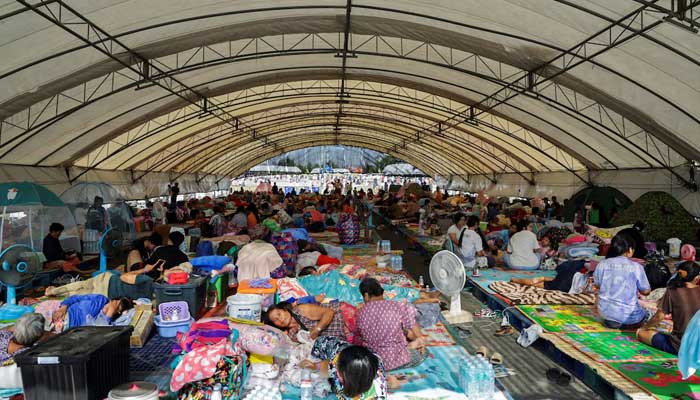
In Thailand, more than 385,000 civilians across four border districts were being evacuated, with more than 35,000 already housed in temporary shelters, the Thai military said.
Across the border in Cambodia, opposition politician Meach Sovannara said civilians were also moving away from the fighting along the frontier.
“I heard the artillery shelling,” he told Reuters in an audio message from Samroang town, the capital of Oddar Meanchey Province, which abuts Thailand.
More than 1,100 families in Oddar Meanchey had been evacuated, authorities there said.
At least 48 people were killed and an estimated 300,000 temporarily displaced during the July clashes, with the neighbours exchanging rockets and heavy artillery fire for five days.
Un-demarcated points along border
Thailand and Cambodia have for more than a century contested sovereignty at un-demarcated points along their 817-km (508-mile) land border, first mapped in 1907 by France when it ruled Cambodia as a colony.
The long-standing dispute has occasionally exploded into skirmishes, such as a weeklong artillery exchange in 2011, despite attempts to peacefully resolve overlapping claims.
Tensions began rising in May this year, following the killing of a Cambodian soldier during a brief exchange of gunfire, and steadily escalated into diplomatic spats and armed clashes.
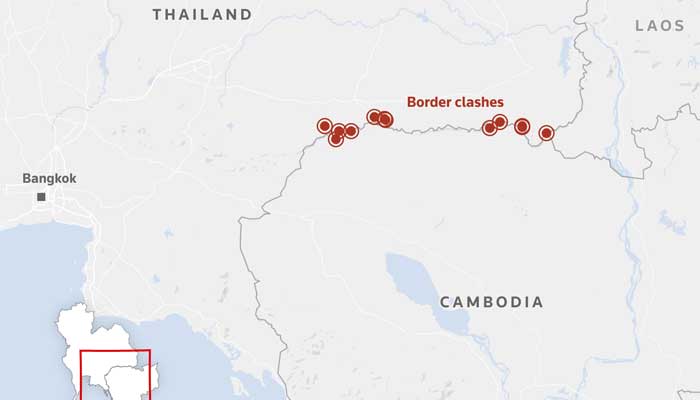
Although Anwar and Trump were able to halt the fighting within days and then cemented a ceasefire agreement at a regional summit in October.
Thailand said it was halting the implementation of the truce with Cambodia last month, following a landmine blast that maimed one of its soldiers.
Thailand has repeatedly accused Cambodia of planting fresh landmines along parts of their disputed border, which have seriously injured at least seven Thai soldiers since July. Phnom Penh denies the charge.
Some of the mines found along the frontier were likely newly laid, Reuters reported in October, based on expert analysis of material shared by Thailand’s military.
- UN funding falls to 10-year low, less than 1/3 of appeal met.
- Gaza, Syria and Sudan need most support for 2026.
- US remains top donor even after drastic aid cuts.
The United Nations on Monday appealed for an aid budget only half the size of what it had hoped for this year, acknowledging a plunge in donor funding at a time when humanitarian needs have never been greater.
By its own admission, the $23 billion UN appeal will shut out tens of millions of people in urgent need of help as falling support has forced it to prioritise only the most desperate.
The funding cuts come on top of other challenges for aid agencies that include security risks to staff in conflict zones and a lack of access.
“It’s the cuts ultimately that are forcing us into these tough, tough, brutal choices that we’re having to make,” UN aid chief Tom Fletcher told reporters.
“We are overstretched, underfunded, and under attack,” he said. “And we drive the ambulance towards the fire. On your behalf. But we are also now being asked to put the fire out. And there is not enough water in the tank. And we’re being shot at.”
A year ago, the UN sought some $47 billion for 2025 – a figure that was later pared back as the scale of aid cuts by US President Donald Trump, as well as other top Western donors such as Germany, began to emerge.
November figures showed it had received only $12 billion so far, the lowest in 10 years, covering just over a quarter of needs.
Next year’s $23 billion plan identifies 87 million people deemed as priority cases whose lives are on the line. Yet it says around a quarter of a billion need urgent assistance, and that it will aim to help 135 million of them at a cost of $33 billion – if it has the means.
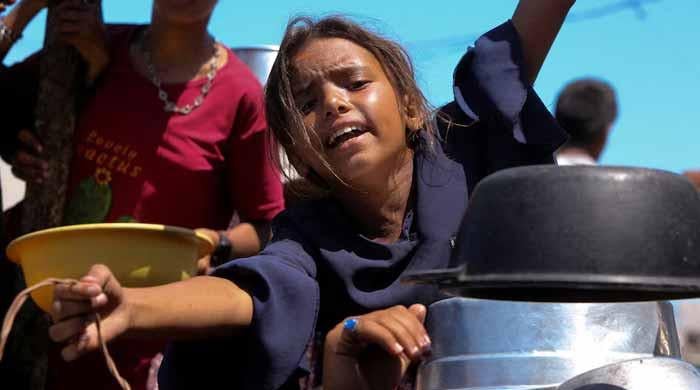
The biggest single appeal of $4 billion is for the occupied Palestinian territories. Most of that is for Gaza, devastated by the two-year Israel-Hamas conflict, which has left nearly all of its 2.3 million inhabitants homeless and dependent on aid.
Second is Sudan, followed by Syria.
Fletcher said humanitarian groups faced a bleak scenario of growing hunger, spreading disease and record violence.
“(The appeal) is laser-focused on saving lives where the shocks hit hardest: wars, climate disasters, earthquakes, epidemics, crop failures,” he said.
UN humanitarian agencies are overwhelmingly reliant on voluntary donations by Western donors, with the United States by far the top historical donor.
UN data showed it continued to hold the number one spot in 2025 despite Trump’s cuts but that its share had shrunk from over a third of the total to 15.6% this year.


German business sentiment stalls despite slight rise in expectations

The Last of the REI Cyber Week Outdoor Deals

Magnitude 7.6 quake strikes off Japan, triggering tsunami warning

-

 Tech1 week ago
Get Your Steps In From Your Home Office With This Walking Pad—On Sale This Week
-

 Sports1 week ago
India Triumphs Over South Africa in First ODI Thanks to Kohli’s Heroics – SUCH TV
-

 Entertainment1 week ago
Sadie Sink talks about the future of Max in ‘Stranger Things’
-

 Fashion1 week ago
Results are in: US Black Friday store visits down, e-visits up, apparel shines
-

 Politics1 week ago
Elon Musk reveals partner’s half-Indian roots, son’s middle name ‘Sekhar’
-

 Tech1 week ago
Prague’s City Center Sparkles, Buzzes, and Burns at the Signal Festival
-

 Sports1 week ago
Broncos secure thrilling OT victory over Commanders behind clutch performances
-

 Entertainment1 week ago
Natalia Dyer explains Nancy Wheeler’s key blunder in Stranger Things 5