

Fashion
UNIDO, Ghana to build Circular Econ Innovation, Textile Testing Centre

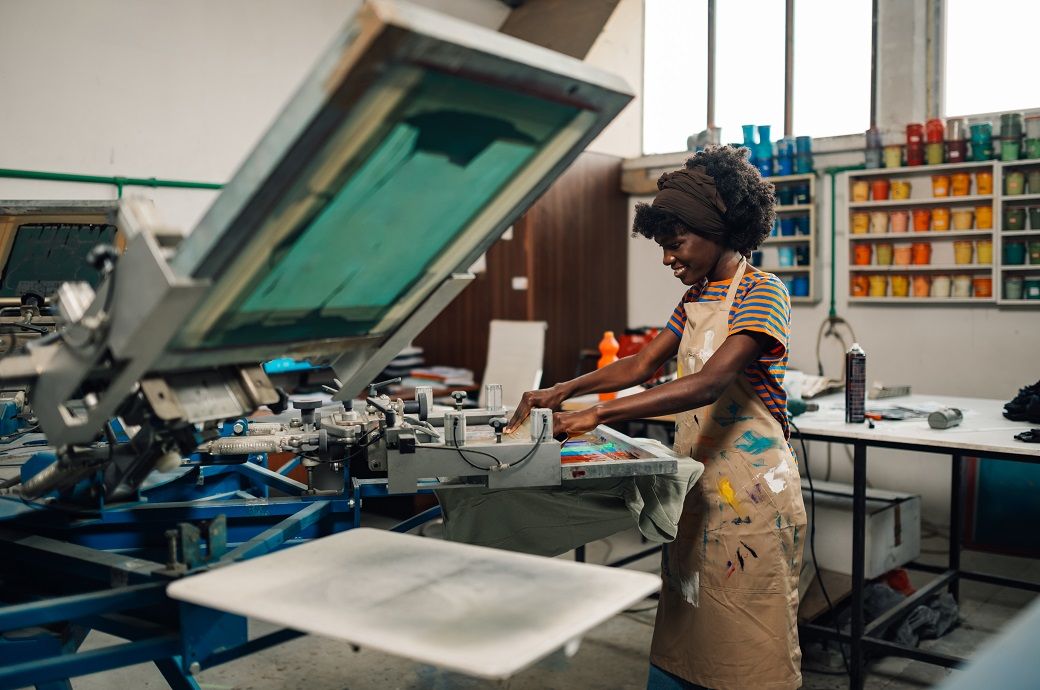
The initiative was discussed during a UNIDO courtesy call on Ghana’s Embassy in Rome.
UNIDO and Ghana are planning to set up a Circular Economy Innovation and Textile Testing Centre to tackle textile waste in the country while creating industrial development opportunities.
Ghana would provide laboratory testing and technical services to support textile sorting and classification, identify toxic components and enable second-life industrial applications.
The proposed centre represents a core component of an Italy-funded UNIDO project implemented with Ghana’s Ministry of Trade, Agribusiness and Industry.
It aims at strengthening circular economy solutions in the textile and second-hand clothing sector, according to a report in a Ghanaian media outlet.
The UNIDO Italian Investment and Technology Promotion Office (ITPO Italy) is implementing a project titled ‘Promoting business and technology development in Ghana’s circular textile sector’ funded by the Italian Agency for the Development Cooperation (AICS).
Ghana would provide laboratory testing and technical services to support textile sorting and classification, identify toxic components and enable second-life industrial applications, such as converting discarded textiles into inputs for furniture, insulation panels, automotive components, paper products and agricultural uses.
Nearly 15 million garment pieces arrive in Ghana every week, mostly at the Kantamanto Market in Accra, with about two-fifths ending up as waste, leading to choked drainage, and polluted lagoons and coastal zones.
Ghana last year launched the Ghana Circular Economy Centre—a 7.5-million Canadian dollar project implemented by UNIDO over a five-year period in coordination with the Ministry of Environment, Science, Technology and Innovation, with funding from Global Affairs Canada. Ho Technical University hosts the centre.
Fibre2Fashion (DS)












“For textiles exports, it opens up a $118 billion US global imports market of textiles, apparels and made-ups. With the US being India’s largest export destination of around $10.5 billion [in] exports, comprising around 70 per cent apparel and 15 per cent made ups, this is a major opportunity,” the ministry said in a statement.
Terming the India-US Trade Agreement ‘a major catalyst’ enhancing bilateral textile trade, the Indian textile industry expressed hope that this will be ‘a major economic game changer’ for the sector by generating additional employment and encouraging investments by US entities.
The agreement would also enable the industry to be cost competitive and diversify risks by sourcing intermediates from the US.
“The 18 per cent reciprocal tariffs on all the textiles products including apparel and made-ups will not only remove the disadvantage that Indian exporters had, but would place them in a better position than most competitors like Bangladesh (20 per cent), China (30 per cent), Pakistan (19 per cent) and Vietnam (20 per cent) who have higher reciprocal tariffs. This would alter the market dynamics as large buyers would surely relook at their sourcing in the light of this agreement,” it noted.
The agreement would also enable the textile industry to be cost competitive and diversify risks by sourcing intermediates from the United States, and that would facilitate manufacturing of value-added textiles in the country and diversify production and exports, it added.
Fibre2Fashion (DS)

Vietnam’s January export growth remained modest, but sharp gains in yarn exports and rising cotton, yarn and fabric imports point to production build-up.
Strong raw material inflows signal mills positioning for higher garment output in 2026.
Achieving VITAS’ $50 billion goal will hinge on sustained order recovery and stable global consumption.
Source link

The SRC, primarily governed by the Trade Union and Labour Relations (Consolidation) Act 1992 (as amended), allows independent trade unions to secure legal recognition for collective bargaining on pay, hours, and holidays when employers refuse voluntary agreement.
The UK Statutory Recognition Scheme will be reshaped from April 6 under the new Employment Rights Act, introducing several key changes.
The majority of the Trade Union Act 2016 will be repealed from February 18.
This change simplifies requirements on trade unions, including in relation to procedures around industrial action.
Employees will be protected from unfair dismissal for taking part in strikes.
Unions will no longer need to demonstrate that most workers in a proposed bargaining unit are likely to support recognition, removing the requirement for petitions or similar evidence.
When recognition is decided by ballot, unions will only need a simple majority of votes cast, with the former 40-per cent support requirement removed.
The majority of the Trade Union Act 2016 will be repealed from February 18.
The change simplifies requirements on trade unions, including in relation to procedures around industrial action.
Key changes include a 10-day notice period to inform employers of their intention to take industrial action (reduced from 14 days); a 12-month mandate (increased from 6 months) for ballots approving industrial action; no requirement for unions to reimburse employers for check-off administration in the public sector; and no need for unions to appoint a picket supervisor to monitor picket lines, according to a UK government release.
Employees will be protected from unfair dismissal for taking part in industrial action, whatever the length of the strike action (due to removal of the 12-week cap).
Unions will be required to include less information than previously in industrial action notices and industrial action ballot notices.
Public sector employers will no longer be required to publish facility time.
Fibre2Fashion (DS)


UNIDO, Ghana to build Circular Econ Innovation, Textile Testing Centre
Ice dance will incorporate queer culture unlike in any other Olympics

‘Flood’ of disinformation ahead of Bangladesh election

-

 Entertainment3 days ago
How a factory error in China created a viral “crying horse” Lunar New Year trend
-

 Tech1 week ago
How to Watch the 2026 Winter Olympics
-
 Business1 week ago
Post-Budget Session: Bulls Push Sensex Up By Over 900 Points, Nifty Reclaims 25,000
-

 Entertainment1 week ago
The Traitors’ winner Rachel Duffy breaks heart with touching tribute to mum Anne
-

 Tech1 week ago
I Tested 10 Popular Date-Night Boxes With My Hinge Dates
-
 Business7 days ago
New York AG issues warning around prediction markets ahead of Super Bowl
-

 Fashion7 days ago
Canada could lift GDP 7% by easing internal trade barriers
-
 Business1 week ago
Investors suffer a big blow, Bitcoin price suddenly drops – SUCH TV