

Politics
US officials, Vance urge Trump to try diplomacy before strikes on Iran: report

- JD Vance spox denies report pushing diplomacy over Iran strikes.
- Iran says nuclear talks with US ongoing despite rising tensions.
- Iranians use Starlink to bypass nationwide internet blackout.
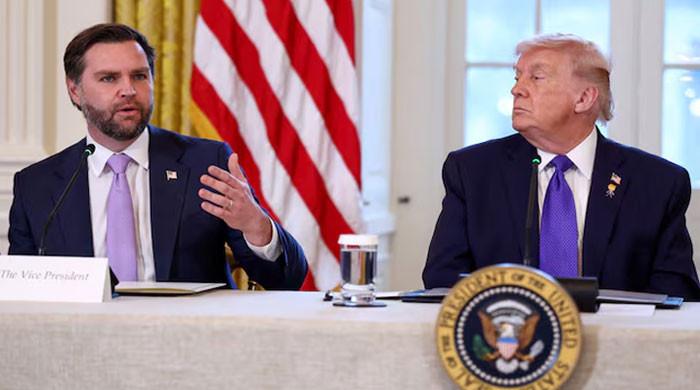
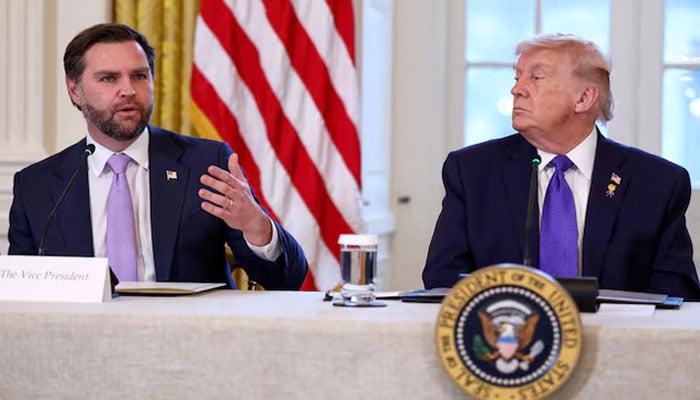
WASHINGTON: Some senior aides in President Donald Trump’s administration, led by Vice President JD Vance, are urging Trump to try diplomacy before strikes against Iran, the Wall Street Journal reported Monday, citing US officials.
The White House was weighing an offer from Tehran to engage in talks regarding its nuclear program as Trump seemed to eye authorising military action against Iran.
A spokesman for Vance said the Journal’s report was not accurate.
“Vice President Vance and Secretary of State Rubio together are presenting a suite of options to the president, ranging from a diplomatic approach to military actions,” said William Martin, Vance’s communications director. “They are presenting those options without bias or favour.”
The development came a day after Tehran said it was keeping communication channels with Washington open as US President Donald Trump considered how to respond to Iran’s tackling of nationwide protests.
Iranian Foreign Minister Abbas Araqchi said Tehran was studying ideas proposed by Washington, though these were “incompatible” with US threats.
“Communications between (US special envoy Steve) Witkoff and me continued before and after the protests and are still ongoing,” he told Al Jazeera.
Adding to threats of military action, Trump late on Monday announced that any country doing business with Iran, a major oil producer, will face a new tariff of 25% on its exports to the US.
“This Order is final and conclusive,” Trump said in a social media post, without providing further detail about the legal authority he would use to impose the tariffs, or whether they would be aimed at all of Iran’s trading partners.
The White House did not respond to a request for comment.
Iran’s mission to the United Nations in New York declined to comment on Trump’s tariff announcement. Iran, already under heavy US sanctions, exports much of its oil to China, with Turkiye, Iraq, the United Arab Emirates, and India among its other top trading partners.
Meanwhile, some Iranians are still using Elon Musk’s Starlink satellite internet service despite a nationwide communications blackout, three people inside the country said, the latest example of Starlink being used to counter internet shutdowns in geopolitical flashpoints.
But Starlink, which beams its service directly from thousands of low-earth orbit satellites, is still working in some places in Iran, despite being banned by authorities there, three people using Starlink in the country told Reuters. One of them, in Western Iran, said he knew dozens of people using Starlink and that users in border towns and cities were largely unaffected.
Alp Toker, founder of internet monitoring group NetBlocks, said he has heard from people in the region that there is still some Starlink access in Iran, though service appears reduced.
“It is patchy, but still there,” he said.
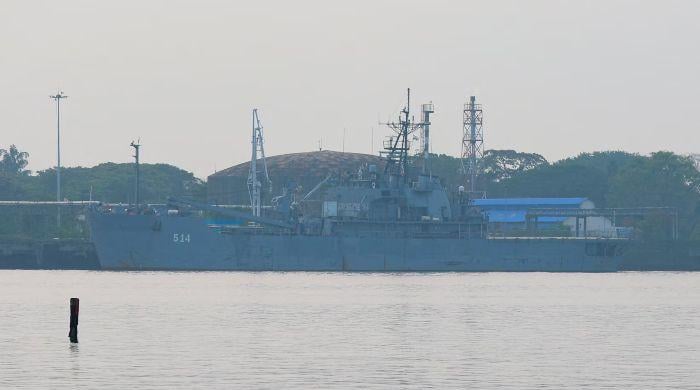
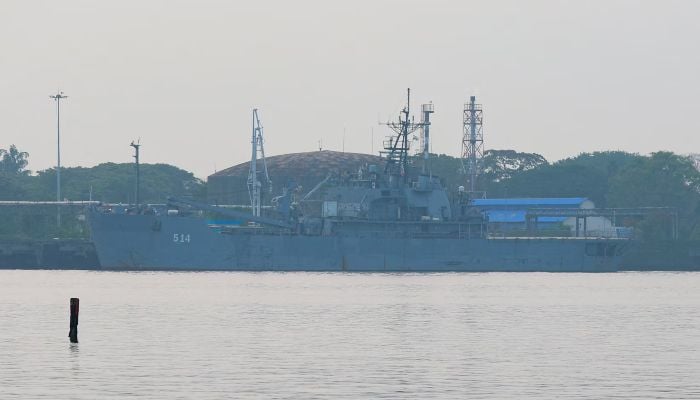
India has allowed an Iranian warship to dock as a humanitarian gesture, Foreign Minister Subrahmanyam Jaishankar said on Saturday, after the US sank another Iranian navy vessel off neighbouring Sri Lanka.
The Lavan docked at India’s southern port of Kochi on Wednesday, the same day the US submarine struck Iranian navy frigate Dena, after an urgent request from Tehran, an Indian government source told Reuters.
US President Donald Trump has said destroying the Iranian navy is one aim of the war he and Israel launched against the Islamic Republic a week ago.
The Lavan – an amphibious landing vessel, according to the US Naval Institute’s online news site – and two other ships “were coming in for a fleet review and then they got, in a way, caught on the wrong side of the events,” Jaishankar told the annual Raisina Dialogue event.
“I think we really approached it from the point of view of humanity, of other than whatever the legal issues were,” he said. “I think we did the right thing.”
At least 87 people were killed in the US attack on the Dena in Sri Lanka’s exclusive economic zone, 19 nautical miles off the coast, outside its maritime boundaries.
India received the docking request for the Lavan on February 28, the day the Iran war started, the source said late on Friday, adding that the request “was urgent as the vessel had developed technical issues”.
Its 183 crew members have been accommodated at naval facilities in Kochi, said the source, who asked not to be identified citing confidentiality.
The Dena was on its way back from a naval exercise organised by India, according to the drill’s website and Sri Lankan officials.
Sri Lankan authorities said on Friday that they were escorting the Iranian naval ship Booshehr to a harbour on the eastern coast and moving most of its crew to a navy camp near Colombo.
- Shah’s popularity driven by social media and youth connection.
- RSP party’s manifesto promises job creation and economic growth.
- Final results covering 165 seats decided by direct vote expected within days.
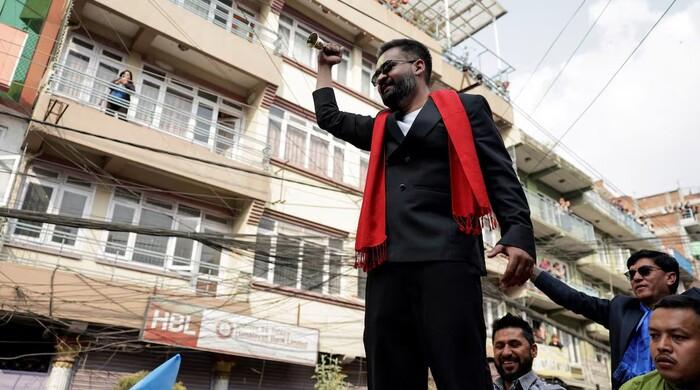
After Nepal’s historic youth-led uprising last September killed 77 people and forced then-Prime Minister KP Sharma Oli to resign, a 35-year-old rapper-turned-politician posted a typically terse message to millions of followers on social media.
“Dear Gen Z, the resignation of your killer has come,” Balendra Shah — popularly known only as Balen — wrote. “Now your generation will have to lead the country. Be prepared.”
Five months on, the musician who cut his political teeth in 2022 when he became the mayor of the capital Kathmandu, is poised to become Nepal’s next prime minister following the country’s first election since the September uprising.
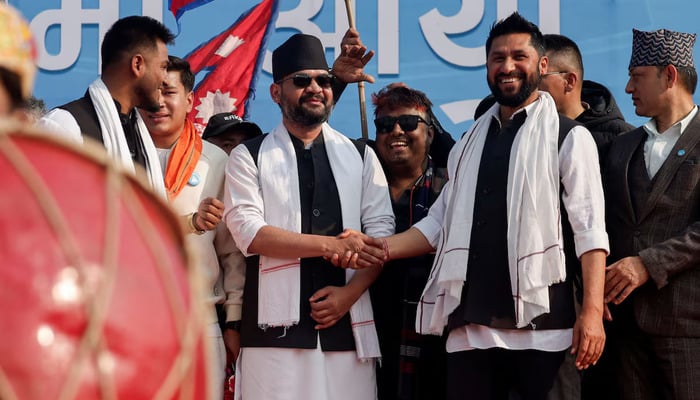
Shah’s Rastriya Swatantra Party (RSP) was leading in around 100 seats, far ahead of its main rivals, early counting trends from the election commission showed on Friday.
Final results, covering 165 seats decided by direct vote and 110 through proportional representation, are expected within days.
The Nepali Congress, currently in second place, has already conceded defeat, and analysts said the RSP’s dominant showing means it will likely form the next government.
“Balen Shah is so popular that now buses coming to Kathmandu have stickers on them saying, ‘Headed to Balen’s city'”, said Bipin Adhikari, a constitutional law expert who teaches at Kathmandu University.
If Shah is able to take power, it would cap a dramatic rise for a man who entered the public spotlight with rap music critical of the establishment and parleyed his popularity to ascend to high political office.
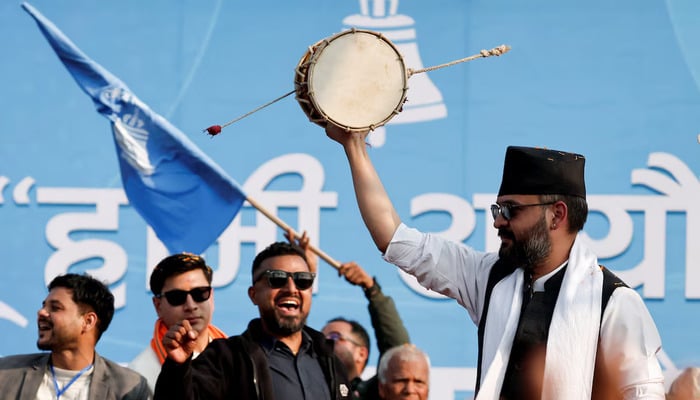
It would also potentially reshape the politics of Nepal, a small Himalayan nation wedged between China and India, that has long been dominated by a handful of established parties.
‘Not a cakewalk’
Some of Shah’s nationwide appeal is driven by the work he has done as the mayor of Kathmandu, where he focused on improving the urban infrastructure, such as waste management, and ensuring the delivery of services like healthcare.
He has also faced criticism, including from Human Rights Watch, for allegedly using police to seize the properties of street vendors and landless people.
Shah — who resigned as mayor in January to contest the general election — did not respond to requests for an interview and questions from Reuters sent via email.
Unlike much of Nepal’s political elite comprising veterans from older generations, Shah has made it a habit to largely shun the mainstream press.
Instead, it is his prolific social media presence, with over 3.5 million followers on platforms like Facebook, that enables him to connect directly with young Nepalis.
“What makes Balen special is that he stays connected with the youth through his short messages on social media, but it would not be a cakewalk for him after becoming prime minister,” said independent political analyst Puranjan Acharya.
‘Let me speak’
Born to a father who practiced traditional Ayurvedic medicine and a homemaker mother, Shah showed an early inclination towards poetry that evolved into a love of rap music, influenced by American artists including Tupac Shakur and Curtis “50 Cent” Jackson, according to an aide.
After securing an undergraduate degree in civil engineering in Nepal, Shah went on to study for a master’s degree in structural engineering in southern India — by which time he had already emerged as a rap star in his home country.
His songs, often taking on Nepal’s ruling class, struck a chord with many in a country where about 20% of the 30 million population live in grinding poverty.
Released in 2019, one of Shah’s best-known songs, “Balidan” — or sacrifice in the Nepali language — has over 12 million views on YouTube.
Its lyrics read:
“Let me speak, sir, it is not a crime,
Let me open the mind, I am not a curse to the palace,
My mind is not bad, it is not afraid to speak the truth.”
‘Wood attacked by termites’
Last December, Shah joined the RSP, led by former TV host-turned-politician Rabi Lamichhane, as its prime ministerial candidate.
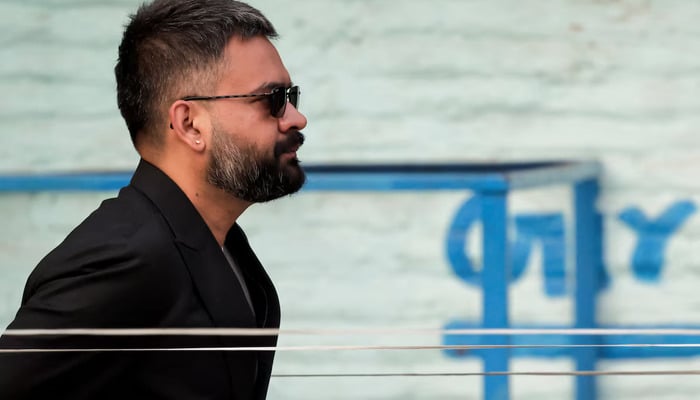
In its manifesto, Shah’s RSP has vowed to create 1.2 million jobs and reduce forced migration, in an effort to tap into frustration over unemployment and low wages that have pushed millions of Nepalis to search for work overseas.
The party has also pledged to raise Nepal’s per capita income from $1,447 to $3,000, more than double the nation’s economy to $100 billion GDP and provide safety nets such as healthcare insurance for the entire population — all within five years.
At the national level, analysts foresee that if he is elected, much of Shah’s success will depend on the talent he surrounds himself with to overhaul a moribund administrative system, riven by corruption.
“It needs a team, experts and support,” Acharya said, “Under the existing state apparatus, he can’t perform and he will be finished like wood attacked by termites.”
- US grants India 30-day Russian oil waiver.
- Congress says Washington dictates India’s oil choices.
- Tamil Nadu CM questions India seeking foreign approval.
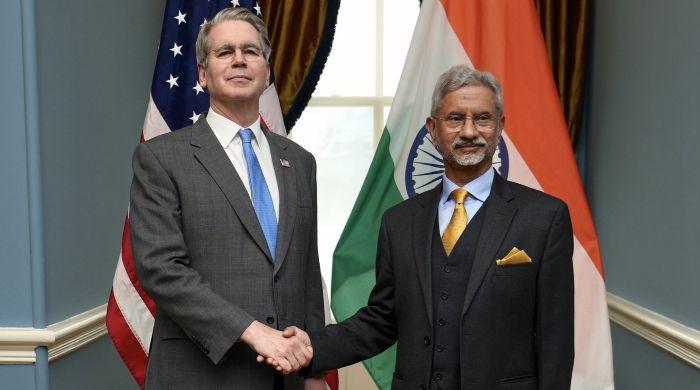
KARACHI: India’s Narendra Modi-led government has come under renewed criticism from opposition parties and sections of the public after the United States said it had temporarily allowed Indian refiners to buy Russian oil stranded at sea, The News reported.
The criticism centres on a statement by US Treasury Secretary Scott Bessent, who said in a post on X early Friday that the Treasury Department was issuing a 30-day waiver to allow Indian refiners to purchase Russian oil in order to keep oil flowing into the global market.
Opposition parties argued that the move made India appear dependent on Washington’s approval. In a post on X, the Congress party said the Modi government had led the country “to a situation where the United States is now deciding where India can buy oil from and where it cannot”.
The waiver, which the US Treasury Secretary Scott Bessent said was issued to “enable oil to keep flowing into the global market,” comes under heightened tensions in the Middle East following the US-Israeli attack on Iran, sparking uncertainty around oil.
It should be noted that India had earlier said it would stop purchasing Russian oil as part of a trade deal with the US.
MK Stalin, chief minister of the southern state of Tamil Nadu, questioned why India should appear to seek approval from any foreign government to meet its energy needs.
“Equally troubling is the sinking of the unarmed Iranian warship IRIS Dena by the United States soon after it participated in the International Fleet Review 2026 naval exercise hosted by India in Visakhapatnam. When a ship that came to India as part of a multinational exercise meets such a fate, India cannot appear silent or passive,” he added.
Bessent further added, “This deliberately short-term measure will not provide significant financial benefit to the Russian government as it only authorises transactions involving oil already stranded at sea. India is an essential partner of the United States, and we fully anticipate that New Delhi will ramp up purchases of US oil. This stop-gap measure will alleviate pressure caused by Iran’s attempt to take global energy hostage.”
Journalist Rana Ayyub added with America’s permission, “we now sound like an American colony”.
India was the top buyer of Russian seaborne crude after Moscow’s 2022 Ukraine invasion, but in January its refiners started to reduce purchases under pressure from Washington. Cutting Russian oil purchases helped New Delhi avoid 25 per cent tariffs and clinch an interim trade deal with the US.
India is vulnerable to energy supply shocks, with crude stocks covering only about 25 days of demand. India receives about 40% of its oil imports from the Middle East through the Strait of Hormuz.
According to The Guardian, which quoted Reuters, a source directly involved with the matter said India had approached Trump’s administration seeking approval to buy Russian crude imports because of the Iran conflict.


Inside the booming business of wellness third spaces and membership clubs

Harry Styles kicks off new era with ‘One Night Only’ comeback show

Eight Pakistanis Appointed to ITF and ATF Committees for 2026–2027 – SUCH TV

Attock Cement’s acquisition approved | The Express Tribune

India Us Trade Deal: Fresh look at India-US trade deal? May be ‘rebalanced’ if circumstances change, says Piyush Goyal – The Times of India

Policy easing drives Argentina’s garment import surge in 2025

-
Business1 week ago
Attock Cement’s acquisition approved | The Express Tribune
-
 Fashion1 week ago
Policy easing drives Argentina’s garment import surge in 2025
-
Business1 week ago
India Us Trade Deal: Fresh look at India-US trade deal? May be ‘rebalanced’ if circumstances change, says Piyush Goyal – The Times of India
-

 Sports1 week ago
LPGA legend shares her feelings about US women’s Olympic wins: ‘Gets me really emotional’
-

 Entertainment1 week ago
Bobby J. Brown, “The Wire” and “Law & Order: SUV” actor, dies of smoke inhalation after reported fire
-
 Fashion1 week ago
South Korea’s Misto Holdings completes planned leadership transition
-

 Entertainment1 week ago
Pakistan’s semi-final qualification scenario after England defeat New Zealand
-

 Fashion1 week ago
Texwin Spinning showcasing premium cotton yarn range at VIATT 2026