Sports
VAR review: Did Chelsea deserve a penalty in loss to Arsenal?

Video assistant referee causes controversy every week in the Premier League, but how are decisions made and are they correct?
This season, we take a look at the major incidents to examine and explain the process both in terms of VAR protocol and the Laws of the Game.
Andy Davies (@andydaviesref) is a former Select Group referee, with over 12 seasons on the elite list, working across the Premier League and Championship. With extensive experience at the elite level, he has operated within the VAR space in the Premier League and offers a unique insight into the processes, rationale and protocols that are delivered on a Premier League matchday.


Referee: Darren England
VAR: John Brooks
Time: 44th minute
Incident: Possible handball in the box worth a penalty kick
What happened: Chelsea whipped in a corner and Arsenal’s Declan Rice, while challenging to clear the ball, appeared to move his elbow towards and contacted with the ball as it dropped. Referee Darren England was unmoved and waved away any appeals.
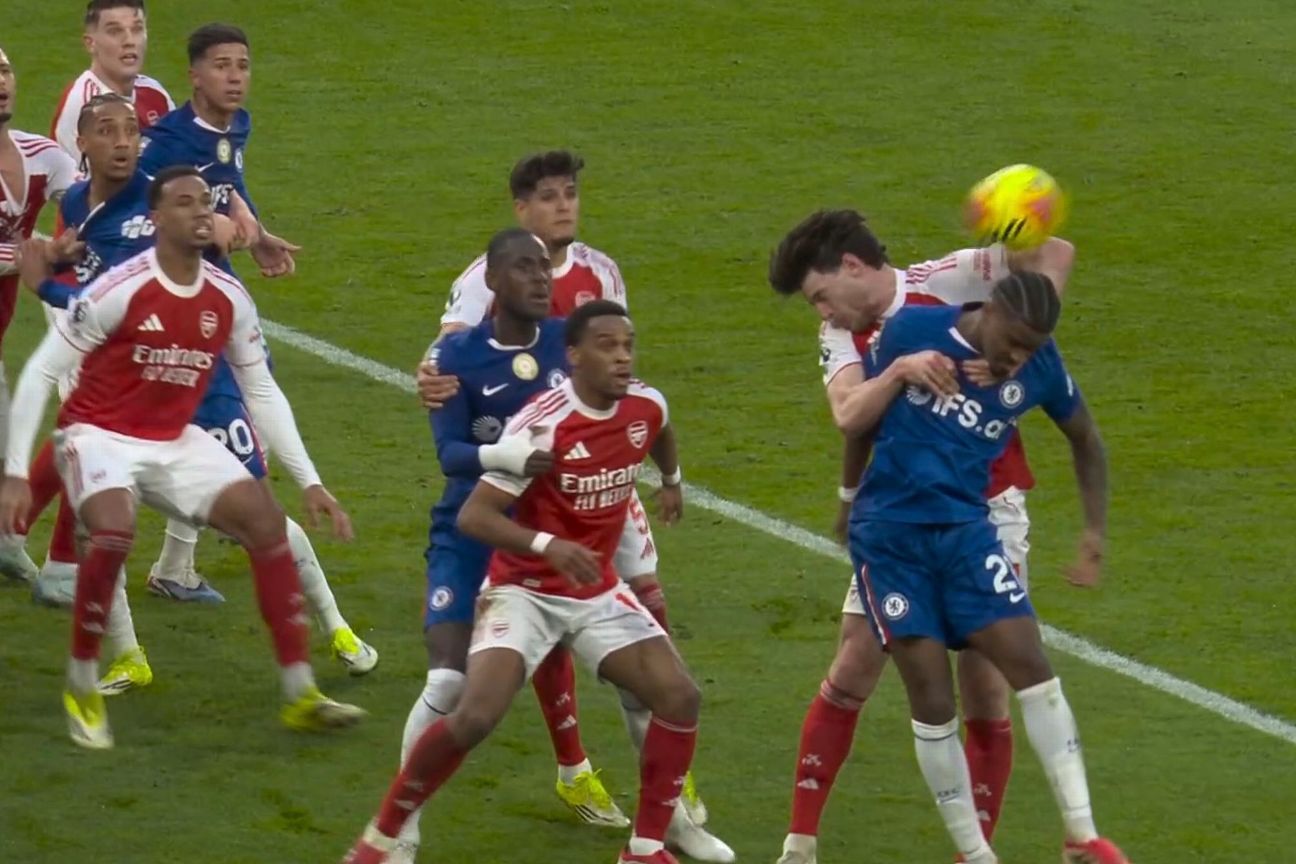

VAR decision: The referee’s call of no penalty was checked and confirmed by VAR, who deemed there was no punishable handball offence with Rice challenging an opponent as the ball hit his arm.
VAR review: As with all VAR reviews, the starting point is the on-field decision and referee live communication. Any VAR intervention is only triggered by clear video evidence that an error has been made.
Referee Darren England had a good view of this incident and would have communicated that Rice’s contact on the ball was within normal physical engagement with his opponent whilst jumping to head the ball, confirming that no clear handball offence had been committed. VAR John Brooks didn’t feel that the video evidence provided any detail that the referee had not described, nor did any act by Rice clearly met the criteria for a handball offence. He cleared the incident as a correct on-field call.
Verdict: The Premier League referees do set a high bar in relation to penalising handballs, which should be recognised.
Watching this live, I would have been surprised if this was awarded as a handball offence given the dynamics of which the contact with the arm occurred. However, a defender who moves their arm in these types of situations is running a risk of being penalised, for sure.
When processing a possible hand ball offence, considerations around what is a reasonable position and movement of arm in relation to the player’s action is important. Rice was jumping for a ball, with his arms naturally high and engaged with his opponent and, whilst there was some movement of the arm, it wasn’t an indisputable act to make himself bigger.
Handball continues to be the most difficult and at times contentious area of law to apply in live play. I believe the Premier League are in a good place currently with these situations, where only the very obvious standout situations are penalised.
Referee: Chris Kavanagh
VAR: Tony Harrington
Time: 52nd minute
Incident: Penalty and possible red card for denying a goal-scoring opportunity (DOGSO)
What happened: Manchester United captain Bruno Fernandes played a brilliant ball into attacker Matheus Cunha, who had turned Palace defender Maxence Lacroix and was heading toward goal. Lacroix — whose fourth-minute goal had given Palace the lead at Old Trafford — grabbed the shoulder of Cunha, who went to ground, and referee Chris Kavanagh quickly pointed to the spot. The VAR confirmed the penalty, but also recommended an on-field review for a possible red card to Lacroix for DOGSO.
VAR decision: After the VAR review, the referee overturned his original decision of no red card to Lacroix. Kavanagh announced to the crowd: “After review, Crystal Palace No. 5 commits a clear holding offense which denies a clear, obvious, goal-scoring opportunity. The final decision is a penalty and red card.”
A HUGE refereeing decision ends with a penalty to Man United and red card for Crystal Palace’s Maxence Lacroix. 👀 pic.twitter.com/k7064Skgu9
— NBC Sports Soccer (@NBCSportsSoccer) March 1, 2026
VAR review: The first check for the VAR was to confirm that a foul had been committed by the Palace defender and that its location was inside the penalty area. The pull was clear, starting outside the area and continuing into the box, meaning that the on-field decision of penalty was cleared. Secondly, the review focused on whether the foul stopped Cunha having a clear opportunity to score a goal. The VAR considerations in this situation would be:
– distance from goal
– direction of play
– attackers’ likelihood of retaining possession of the ball
The key to reviewing this type of incident is pausing the footage at the exact point the foul contact occurs. Sometimes allowing the footage to continue to run gives a false picture that the ball is out of playing distance for the attacker, which can alter a DOGSO judgement outcome.
Harrington felt these circumstances met all the criteria for a DOGSO and recommended an on-field review. Once at the screen, Kavanagh agreed with the VAR’s judgement of the incident and sent Lacroix off.
Fernandes converted the penalty, and eight minutes later, with Palace reduced to 10 men, Benjamin Sesko scored what proved to be the winning goal that sent United up to third in the Premier League table.
Verdict: Correct on-field decision by Kavanagh to award the penalty and good intervention from the VAR to recommend a red card for DOGSO. Once on the wrong side of the defender, Cunha has a clear path toward goal with his next touch likely to be a shot on goal.
The nature of the challenge by Lacroix was the determining factor in what sanction he received for committing the offense. An upper-body holding offense, with no attempt or opportunity to play or win the ball, is still a red card. However, an attempt to challenge for a ball, where there is an opportunity to be successful, would result in a yellow card only. Good decision and process from the referee and VAR.