

Tech
We Tried a Bunch of Karaoke Speakers to Find the Best

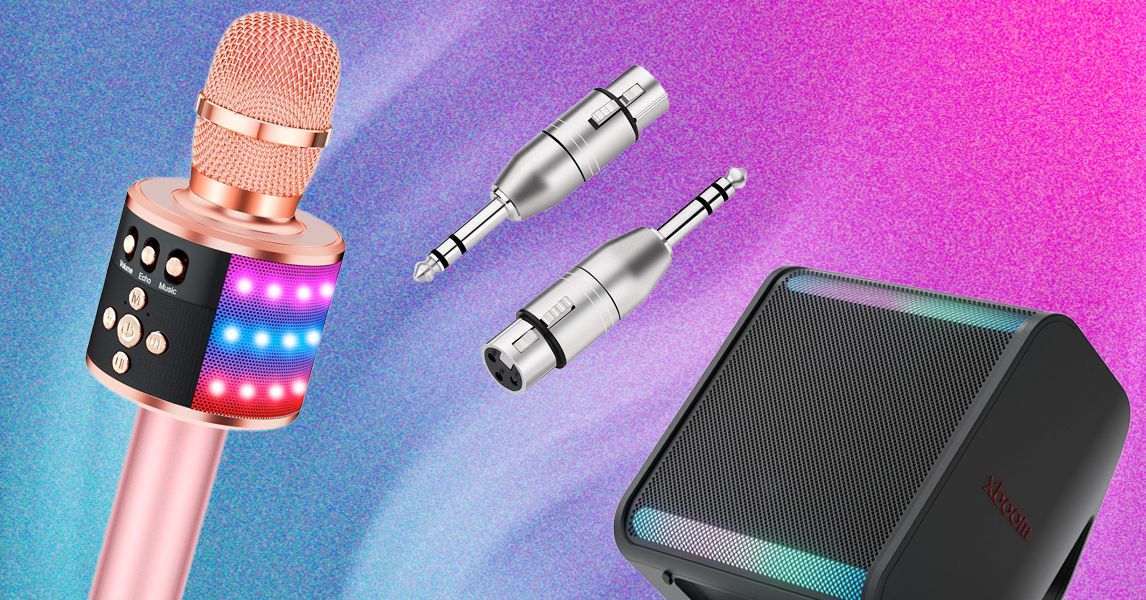
Awesome Accessories
Which karaoke accessories you need will depend on what kind of system you buy. For example, if you’re buying a portable Bluetooth speaker that doubles as a karaoke machine with traditional microphone inputs, the first thing you’ll need is a good microphone like the Shure SM58 and a cable (or two). If your device offers only quarter-inch inputs, you’ll want to add an XLR to quarter-inch cable or an XLR to quarter-inch adapter.
That’s a great start, but even if your machine comes with built-in wireless mics, there are some good accessories worth considering to raise the experience a notch or two.
Photograph: Parker Hall
A Mic, Stand, Cable (and Adapter)
The Shure SM58 ($109) is the most popular stage mic on Earth for a reason: they’re bulletproof and they sound great. If you need of a mic, we highly recommend picking up the SM58; they’re probably what you’ve used at your local juke joint.
Our favorite mic stands are from the German brand K&M ($83), but you can totally get away with an Amazon Basics Mic Stand ($23) at home. I like colorful microphone cables like these ($12). If you need one, snag a quarter-inch to XLR adapter ($10 for two) so that your mic can plug into every karaoke machine you find.

A Vocal Effects Box
If you want to mess with the way voices actually sound, or to create cool harmony lines with yourself on the fly, we highly recommend the new Antares Headrush VX5 pedal ($299). This thing can make you perfectly in tune, but it can also do things like stack layers of your own voice on top of or below each other. You can even hook up an instrument and play along with tunes and have it match the key of your axe.

Photograph: Parker Hall
A Portable Projector
If you’re not using a TV in your living room, it’s an awesome idea to grab a cheap but quality portable projector. We like the latest small model from Anker ($530), because it is relatively affordable and includes a decent pair of speakers for when you’re watching movies outside and don’t want to hook up a PA.
A Streaming Stick for Casting to Your TV
If you don’t already have a way to cast content from your phone to your TV or projector, we highly recommend any of the latest 4K streaming devices. These all have a way to share stuff from phones to screens, and you can download YouTube or other karaoke apps.
Cool Lights
Ambience is a key part of a good karaoke party. We really love this light from Soundboks ($299), who also make big party speakers. It can sync to your music and is USB-C rechargeable for off-grid vibes.

Photograph: Parker Hall









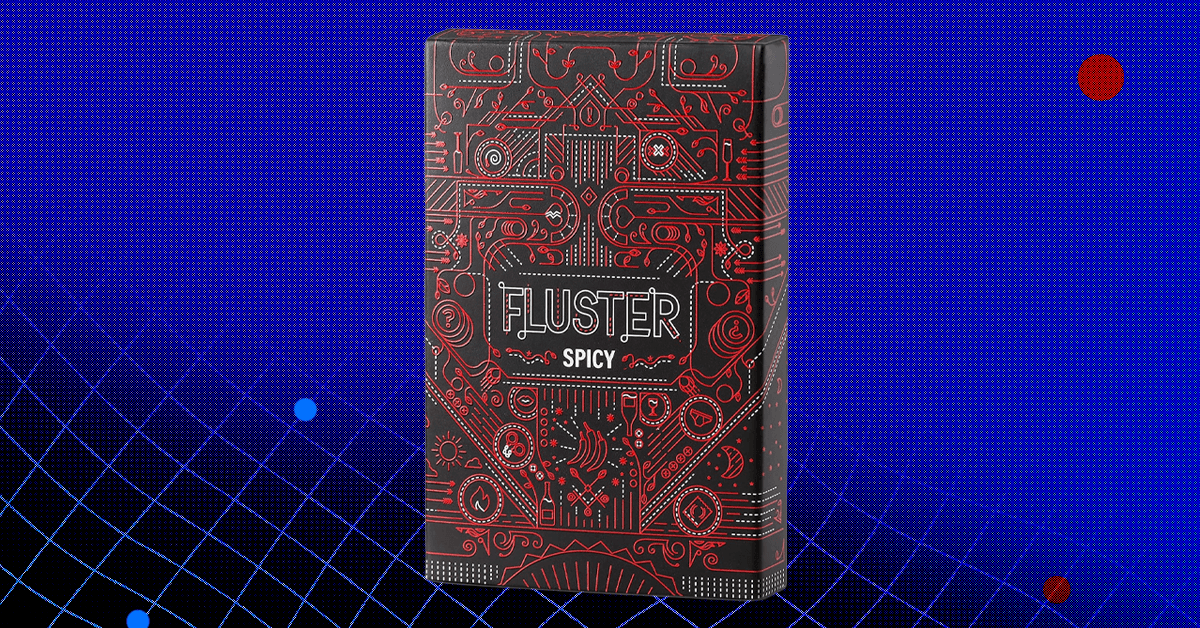
Same as the Five Senses deck above, this scratch-off card set happens in sequence, with optional “level up” cards to really push intimacy, and separate cards for each partner with secret directions. For this date, you’ll both bring a red item that you show at certain points to signify that you’re open to physical touch. Then you’ll go out to dinner and have intentional conversation, and every time a partner pulls out the red item, you’ll follow the prompts to initiate increasingly intimate physical acts, ranging from hand holding to neck kisses. So there we were, at Illegal Taqueria, edging each other over al pastor tacos (I kid).
Many of the cards urged a partner not to interrupt or solve problems, but ask questions and talk dirty. My date said, “I think this may be for couples who hate each other.” I had to agree. The second part of the date involved driving and stoplights, but since we were in Brooklyn, we walked down the trash-filled sidewalk and pretended to be a suburban couple on the fritz instead.
The rest of the date included buying things for sexy time, like whipped cream and blindfolds. I’m vegan and had no desire to lick cream from chest hair, so we came home, stripped, and did our best to keep our eyes closed (in lieu of a blindfold). It was overall a strange experience for us both, I think. If you and your partner need a lot of prompting to connect, compliment, and be physical, this set is for you.
Date: Greg, 10/10 (Note: I didn’t find this man on Hinge; I met him the old-fashioned way, in a bar at 2 am.)
Box: 6/10

Valentine’s Day is a sneaky one. It’s easy to let grabbing fun and unique Valentine’s Day gifts fall to the wayside while you recover from the Christmas holidays, but it’s not one to miss if you have a partner you want to shower with a little extra love.
If you’re feeling too wiped to shop, good news: I’ve got you covered. I’ve rounded up some of our favorite ideas for the year’s most romantic holiday, from Lego sets you can build as a date and date boxes filled with ideas to last you all year long to gorgeous flowers you can get delivered in a snap and cozy robes you’ll want to lounge in together. This guide all the Valentine’s Day gifts we’re excited to give this year.
Curious about what else we recommend? Don’t miss our Gifts for Lovers, Gifts for Moms, Gifts for Plant Lovers, Gifts for People Who Work from Home, and Best Blind Boxes for more gifts and shopping ideas.
Table of Contents
For a Gift That’s a Date
My husband and I are planning our fourth or fifth year of our favorite Valentine’s Day Date: building Lego sets together. We’ve done this for years, and then we get to enjoy the fruits (well, flowers) of our labor around the home forevermore. These sets serve as both the gift and the activity. Building the dried-flower centerpiece together was probably my all-time favorite, since you can each simultaneously work on one half and then click it together at the end, followed by each building a different-color bonsai tree.
For a Daytime Adventure


Retrospec
Weekender Crew Multi-Person Inflatable Paddle Board
Building on the idea of date activities that involve gifts, this multi-person paddleboard is a fun way to spend time outdoors while staying together the entire time. It’s massive, almost raftlike, so that it can support the weight of up to three adults, but once we got the hang of the size, it wasn’t hard to maneuver. Sometimes we’d both row together, sometimes I’d let my husband do all the work. It made for a lovely daytime adventure together, and I can’t wait for the next warm day for my husband and me to take this out on our local harbor again. It’s big enough that we could bring our son, though it’s much more peaceful as a date activity. It’s inflatable, and I’d recommend grabbing an electric filler since it takes a lot of manual pumping otherwise.
For Flowers on Demand

Photograph: Boutayna Chokrane
The classic go-to for Valentine’s Day is, of course, flowers. WIRED reviewer Boutayna Chokrane tested several flower delivery services to find the best one to get sent to your home, and her favorite is the Ode à la Rose, specifically the Edith arrangements. The business was created by two former French bankers, and the arrangements’ design choices feel distinctly chic in a way only French romance can. The Edith bouquet is entirely Columbus double tulips from Holland, and come hand-tied in a travel vase a fun pink box. The flowers ship nationwide, and there’s same-day shipping in New York, Chicago, Los Angeles, Austin, Miami, and Washington, DC.
For a Jewelry Upgrade
Maybe you’ve already exchanged rings, or maybe you’re looking for your first set without committing to I do. Either way, the most popular fitness tracker to get these days is a smart ring, and Oura is the ruler of the space. The latest model is the Ring 4, and it comes in both metallic and ceramic finishes. Many of my friends love theirs. I wish I had one, but they don’t make sense for my husband and me since we’re an aerialist and rock climber duo. Live my dreams for me and get this for your valentine (and yourself)!
For Your Fave Photographer
If your romantic partner loves to capture photos, a digital photo frame is the perfect gift (and you’ll benefit, too, as likely the number one fan of their photography!). I’m the photographer of our house, and our Aura frame is my husband’s favorite gadget because it showcases photos I’ve captured of our son and life together over the years. Our wedding photos can be found on there too, as well as the occasional good photo of me that he’s captured. It’s a monthly ritual for me to go through my camera roll and add my latest favorites. Aura’s my favorite because the range of frames is beautiful, and the storage is unlimited with no fees or subscriptions.
For the Cozy Couple
One of my favorite souvenirs I have around the house is a matching robe set that my husband and I bought on our honeymoon. Our all-cotton robes are from the Ten Thousand Waves Japanese spa in New Mexico (the final destination of a Southwestern US road trip) and are great for taking to the pool or using after a shower on a hot day. But I still love a good fluffy robe during the colder season, especially since it can double as a towel. Get your partner one of these cozy robes to give them something luxurious to use after their next everything shower or quick rinse-off. Cozy Earth’s robe is crazy-soft thanks to its blend of cotton and bamboo viscose, while this flannel robe from L.L.Bean is one of our favorites for anyone who works from home.
For Your Inner Theater Kids
If your partner loves to sing along to the Wicked soundtrack and is regularly suggesting karaoke as a group activity, then give them the gift of making karaoke happen anywhere with these gadgets. The Bonaok Karaoke Microphone is one of our favorite karaoke microphones, letting you sing anywhere without lugging bulky equipment. The Ikarao Shell S2 is a portable device with two mics, a built-in screen, and support for streaming services, so you can sing along to your favorite songs on Spotify.
For the Fitness Couple
After the Christmas season, I saw a video on my For You page that roasted how every mom had clearly gotten a matching workout outfit set for Christmas and was out wearing it on Boxing Day. As a mom myself, all I could think of was how much I would love another matching workout set. I’m serious. They’re great for workouts, quick errands, and day care or school drop-off. My latest favorite set is from Bombshell Sportswear. The set is both super soft and fits securely without any annoying squeezing. It’s getting the most compliments of all my sets. I wish I’d sized up with the bolero, but as an aerialist, my lat muscles are a little bulkier than an everyday person’s.
Have a partner who doesn’t need a matching set? Try some fantastic running shoes instead, which are even more useful for both workouts and daily life. WIRED reviewer Adrienne So says these R.A.D. shoes are fantastic for a range of uses, as they’re designed for gym, HIIT, CrossFit, and hybrid workouts and are soft enough for treadmill running. They look fantastic, too.
For the Beloved Bookworms
A Kindle is always a great gift for anyone who reads in any format. Funny enough, my siblings and I are about to buy one for my dad for his birthday (two weeks before Valentine’s Day), and I recommended my favorite pick, the Kindle Paperwhite, since the standard Kindle is a little too small for his 6-foot-4 frame to hunch down over, and he doesn’t read enough illustrated books to make the Colorsoft the right jump for him. If they already have a Kindle, I’m still in love with my matching PopSockets Kindle case and grip, and they’ve since launched a new Bookish collection with beautiful designs.
For Some Bedroom Spice
Looking to spice things up? These adventure boxes can add more fun to the bedroom without creating additional mental work for you and your partner. An offshoot from the Adventure Challenge, “The Adventure Challenge … In Bed” scratch-off date book has 50 date ideas designed specifically to help facilitate fun and connection in the bedroom. The dates are categorized by activity type in sections like food, dancing, “sexploration,” and more. Each date is covered by a black box, with only icons indicating required fields such as duration, cost, and more. Meanwhile, the Fantasy Box is a date-night box service offering a range of themes, from sexy wine tasting to a kinky poker night, all designed to help couples communicate and connect more intimately. Before opening the box, each partner will fill out a questionnaire of potential intimate acts, and this box comes with everything needed for a truly kinky night in: a satin blindfold, pleather paddle, lingerie, lube, massage gel, feather wand, mini vibrator, and silky wrist restraints. —Molly Higgins
Power up with unlimited access to WIRED. Get best-in-class reporting and exclusive subscriber content that’s too important to ignore. Subscribe Today.

In the early morning hours of Saturday, January 3, the roar of bombs dropping from the sky announced the US military attack on Venezuela, waking the sleeping residents of La Carlota, in Caracas, a neighborhood adjacent to the air base that was a target of Operation Absolute Resolve.
Marina G.’s first thought, as the floors, walls, and windows of her second-story apartment shook, was that it was an earthquake. Her cat scrambled and hid for hours, while the neighbors’ dogs began to bark incessantly. But the persistence of the strange hum of engines (military aircraft flying low over the city, she would later learn), as well as seeing a group of cadets in T-shirts and shorts fleeing the Army headquarters, were signs that this was not an earthquake.
Marina couldn’t rely on the typical media outlets that are easily accessible in most other countries to learn more. She didn’t bother to turn on the television or radio in search of information about the attacks that began simultaneously at 11 military installations in Caracas and three other states. The government-run television station Venezolana de Televisión (VTV) was broadcasting a report on the minister of culture’s visit to Russia as the attack was taking place. Her cell phone, however, still had a signal and she began to receive dozens of messages on WhatsApp: “They’re bombing Caracas!”
During the darkest moments of that confusing morning, there was no team of independent reporters able to go out and record what was happening on the streets. After years of harassment, censorship, and imprisonment of journalists by the government, there were instead only empty newsrooms, decimated resources, and a complete lack of security, which made it impossible to keep the public informed as the crisis was unfolding.
The fears felt by journalists were shared by many Venezuelans: the fears of arbitrary detention, of being imprisoned without cause, tortured, and extorted. These are fears that have led citizens in Venezuela to adopt some digital safeguards in order to survive. They have learned to restrict chats, move sensitive material to hidden folders, and automatically delete any “compromising” messages. Whenever possible, they leave their cell phones at home. If they have to take their phones with them, then before going out, they delete all photos, stickers, and memes that could possibly be interpreted as subversive. This state of collective paranoia has also, however, allowed Venezuelans to stay informed and not succumb to the dictatorship.
It is, largely, ordinary citizens who have created this information network. Soon after the bombs fell on January 3, the first videos began to circulate, recorded by people who had witnessed the explosions from their windows and balconies, or from the beach, where some were still celebrating the New Year. Even hikers camping at the summit of Cerro Ávila, in Waraira Repano National Park, managed to capture panoramic shots of the bombs exploding over the Caracas Valley. Shortly afterwards, international networks confirmed the news.
In the interior of the country, connectivity is even more complicated. In San Rafael de Mucuchíes, a peaceful village in the Andes in the state of Mérida, a group of hikers tried to keep up with the frantic pace of events with intermittent internet access at 10,300 feet above sea level. They learned the news from telephone calls via operators such as Movistar (Telefónica) and Digitel, not from the instant messaging app WhatsApp. They also overcame the challenges of the information desert they were in by using a portable Starlink satellite internet antenna that one of the travelers had in their luggage. During the crisis, the service developed by SpaceX was provided free to Venezuelans.


Netflix’s exciting February line up revealed

Netherlands’ goods exports to US fall 4.7% in Jan-Oct 2025

I Tested 10 Popular Date-Night Boxes With My Hinge Dates

-

 Sports5 days ago
PSL 11: Local players’ category renewals unveiled ahead of auction
-
 Tech1 week ago
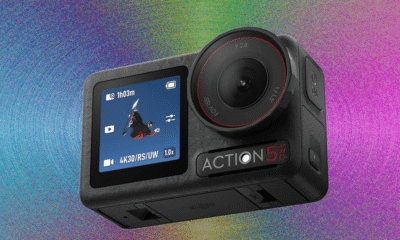
Strap One of Our Favorite Action Cameras to Your Helmet or a Floaty
-

 Sports1 week ago
Wanted Olympian-turned-fugitive Ryan Wedding in custody, sources say
-

 Entertainment1 week ago
Three dead after suicide blast targets peace committee leader’s home in DI Khan
-

 Tech1 week ago
This Mega Snowstorm Will Be a Test for the US Supply Chain
-

 Sports1 week ago
Storylines shaping the 2025-26 men’s college basketball season
-

 Fashion1 week ago
Spain’s apparel imports up 7.10% in Jan-Oct as sourcing realigns
-

 Entertainment1 week ago
UFC Head Dana White credits Trump for putting UFC ‘on the map’