

Politics
What are Iran’s ballistic missile capabilities?

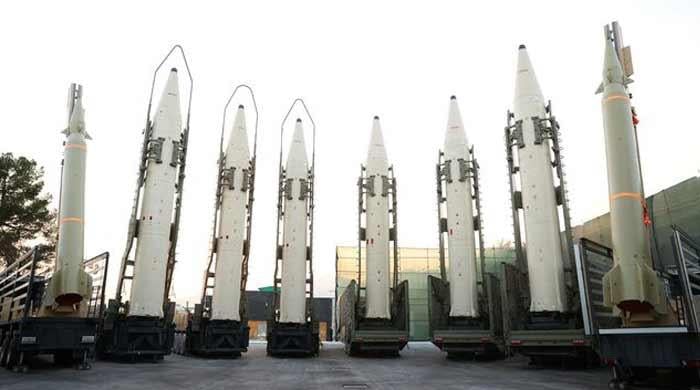
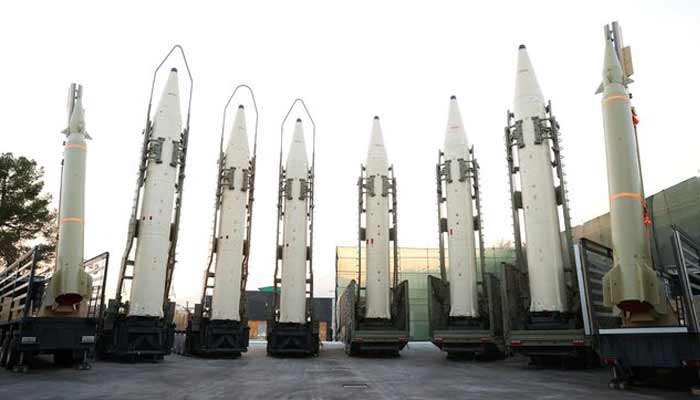
Iran holds a new round of nuclear talks with the United States on Thursday in Geneva. Its arsenal of missiles has been a sticking point in negotiations.
Here are some details about Iran’s missiles:
What are ballistic missiles?
A ballistic missile is a rocket-propelled weapon that is guided during its ascent but follows a free-fall trajectory for most of its flight. It delivers warheads — containing either conventional explosives or potentially biological, chemical or nuclear munitions — over varying distances.
Western powers regard Iran’s ballistic missile arsenal both as a conventional military threat to Middle East stability and a possible delivery mechanism for nuclear weapons, should Tehran develop them. Iran denies any intent to build atomic bombs.
Iranian missile types and ranges
Iran has the largest stockpile of ballistic missiles in the Middle East, according to the US Office of the Director of National Intelligence. They have a self-imposed range of 2,000 km (1,240 miles), which Iranian officials have said was enough to protect the country as they can reach Israel.
Many of Iran’s missile sites are in and around Tehran. There are at least five known underground “missile cities” in various provinces, including Kermanshah and Semnan, as well as near the Gulf region.
The arsenal encompasses multiple long-range missiles that can reach Israel, according to the Center for Strategic and International Studies. It says these include the Sejil, with a 2,000-km range; Emad, 1,700 km; Ghadr, 2,000 km; Shahab-3, 1,300 km; Khorramshahr, 2,000 km; and Hoveyzeh 1,350 km.
The semi-official Iranian news outlet ISNA published a graphic in April 2025 showing nine Iranian missiles it said could reach Israel, including the Sejil, which ISNA said was capable of flying at more than 17,000 km (10,500 miles) per hour and had a range of 2,500 km; the Kheibar, with a range of 2,000 km; and the Haj Qasem, 1,400 km.
Washington-based think tank, the Arms Control Association says Iran’s ballistic arsenal included the Shahab-1, with an estimated range of 300 km; the Zolfaghar, 700 km; Shahab-3, 800-1,000 km; Emad-1, under development, 2,000 km; and a Sejil model under development, 1,500-2,500 km.
When did Iran last use its missiles?
During the 12-day war with Israel in June 2025, Tehran fired ballistic missiles into Israel, killing dozens of people and destroying buildings.
The Institute for the Study of War (ISW) and AEI Critical Threats Project said Israel “likely destroyed around a third of the Iranian missile launchers” during the conflict. Iranian officials have said Tehran has recovered from the damage incurred during the war.
Iran also responded to US participation in Israel’s air war by firing missiles at the US Al Udeid air base in Qatar. Tehran gave advance warning and no one was hurt. Washington announced a ceasefire hours later.
Iran’s Revolutionary Guards used missiles in January 2024 when they said they had attacked Israel’s spy headquarters in Iraq’s semi-autonomous Kurdistan region, and that they had also fired at Daesh in Syria.
In 2020, Iran launched missiles at US-led forces in Iraq in retaliation for a US drone strike that killed Major General Qassem Soleimani of the Revolutionary Guards.
Missile strategy and development
Iran says its ballistic missiles provide a deterrent and retaliatory force against the United States, Israel and other potential regional targets.
According to a 2023 report by Behnam Ben Taleblu, a senior fellow at the US-based Foundation for Defense of Democracies, Iran continues to develop underground missile depots complete with transport and firing systems, as well as production and storage centres. In 2020, Iran fired a ballistic missile from underground for the first time, it said.
“Years of reverse-engineering missiles and producing various missile classes have also taught Iran about stretching airframes and building them with lighter composite materials to increase missile range,” the report said.
In June 2023, Iran presented what officials described as its first domestically made hypersonic ballistic missile, the official IRNA news agency reported. Hypersonic missiles can fly at least five times faster than the speed of sound on a complex trajectory, making them difficult to intercept.
The Arms Control Association says Iran’s missile programme is largely based on North Korean and Russian designs and has benefited from Chinese assistance.
Iran also has cruise missiles such as the Kh-55, an air-launched nuclear-capable weapon with a range up to 3,000 km.
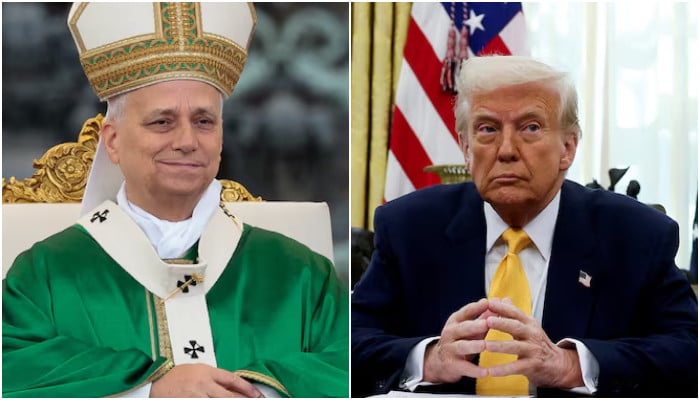
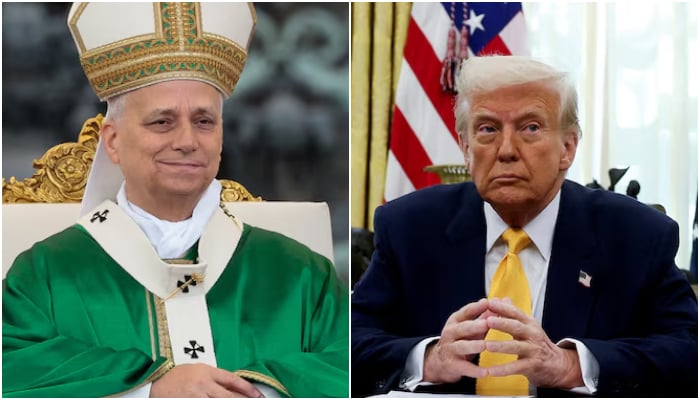
US President Donald Trump, whose war and immigration policies have been condemned by Pope Leo, reiterated his criticism of the religious leader on Tuesday night.
In a post on Truth Social, Trump urged that “someone please tell Pope Leo” about the killings of protesters by Iran and that “for Iran to have a Nuclear Bomb is absolutely unacceptable.”
The US and Israel attacked Iran on February 28. Iran responded with its own strikes on Israel and Gulf states with US bases.
US-Israeli strikes on Iran and Israeli attacks in Lebanon have killed thousands and displaced millions.
Iran does not have nuclear weapons while the US does. Israel is widely believed to be the only Middle Eastern country with nuclear weapons.
While Western countries have long believed that Iran wants a nuclear bomb — or at least the ability to make one very quickly — Tehran has always denied that, citing its membership of the Nuclear Non-Proliferation Treaty.
Trump’s comments come after Pope Leo warned earlier in the day of the risk of democracies sliding into “majoritarian tyranny”.
The first US pope, Leo wrote in a letter issued by the Vatican about the use of power in democratic societies, and said democracies remained healthy only when they were rooted in moral values.
The pope has criticised Trump’s decision to launch the war against Iran, saying God rejects the prayers of those who launch wars and have “hands full of blood”.
The pope termed Trump’s threat this month to destroy the Iranian civilisation as unacceptable and previously declined to join the US president’s so-called “Board of Peace” initiative for Gaza.
The religious leader has also urged a “deep reflection” on the way migrants are treated in the US while Trump has pursued a hardline immigration policy.
On Sunday, Trump called the pope “weak” and “terrible” on crime and foreign policy issues.


Italy’s Prime Minister Giorgia Meloni said on Tuesday her government had suspended a defence cooperation deal with Israel, reflecting frayed ties between previously close allies as the conflicts in the Middle East continue.
Meloni’s right-wing government has been one of Israel’s closest friends in Europe, but in recent weeks it has criticised its attacks on Lebanon, which have killed hundreds and injured thousands.
Israel also fired warning shots last week at Italian troops serving in Lebanon under a UN mandate, causing damage to a vehicle.
“In light of the current situation, the government has decided to suspend the automatic renewal of the defence agreement with Israel,” Meloni said during a visit to Verona, northern Italy.
A source close to the matter, who requested anonymity, said Meloni took the decision on Monday with her foreign and defence ministers, Antonio Tajani and Guido Crosetto, as well as Deputy Prime Minister Matteo Salvini.
A spokesperson for Israel’s foreign ministry declined to comment.
Opposition had called for the suspension
Meloni’s announcement was a surprise in that it marked a shift from a previously cautious stance on Israel. The opposition had asked the government to suspend the agreement.
“We had been calling for this for some time, along with other progressive forces,” the leader of the centre-left Democratic Party, Elly Schlein, said, adding Italy should also support the suspension of the EU-Israel Association Agreement.
Italy’s memorandum with Israel, signed in 2003 by the government of then Prime Minister Silvio Berlusconi, entered into force in 2006 and is subject to automatic renewals every five years unless one of the parties withdraws.
It foresees Israeli-Italian cooperation to “increase their respective defence capabilities” and spans fields including procurement, training and the “import, export and transit of defence and military equipment”.
As diplomatic tensions have risen, Rome last week summoned the Israeli ambassador to protest over the incident involving Italian troops in Lebanon, then on Monday, the government of Prime Minister Benjamin Netanyahu summoned the Italian ambassador “to discuss the situation in Lebanon”.
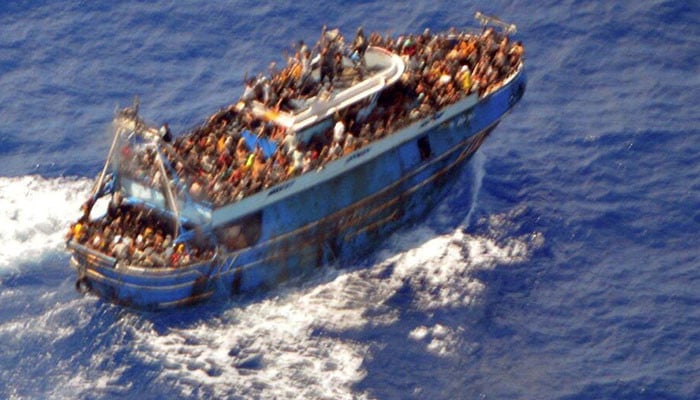
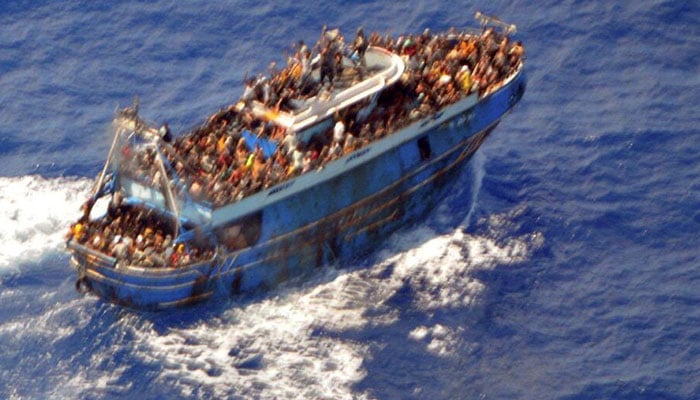
Around 250 people were missing after a boat carrying Rohingya refugees and Bangladeshi nationals capsized in the Andaman Sea, the United Nations’ refugee and migration agencies said in a joint statement on Tuesday.
The UN agencies said the trawler carrying around 250 men, women and children reportedly sank due to heavy winds, rough seas and overcrowding. It had departed from Teknaf in southern Bangladesh and was bound for Malaysia.
“This tragedy highlights the devastating human cost of protracted displacement and the continued absence of durable solutions for the Rohingya,” said the United Nations High Commissioner for Refugees, and the International Organisation for Migration.
For years, many of Myanmar’s Rohingya Muslim minority have embarked on rickety wooden boats to try to reach neighbouring countries, including Malaysia, Indonesia and Thailand, in a bid to flee persecution in Myanmar or overcrowded refugee camps in Bangladesh.
The agencies called on the international community to step up and sustain funding for lifesaving assistance for Rohingya refugees in Bangladesh as well as support for Bangladeshi host communities.
In 2017, Myanmar’s armed forces launched an offensive that forced at least 730,000 Rohingya from their homes and into neighbouring Bangladesh, where they recounted killings, mass rape and arson. A UN fact-finding mission concluded the 2017 military offensive had included “genocidal acts”.
Buddhist-majority Myanmar has denied genocide, and says the UN fact-finding mission was not objective or reliable.


Australian business confidence plunges in March amid uncertainty: NAB

Transfer rumors, news: Bayern eye move for Newcastle’s Gordon

India-US trade deal back in focus: Indian delegation to visit Washington next week for talks – The Times of India

-

 Fashion1 week ago
India’s exports face reset as EU links trade to carbon metrics: EY
-

 Entertainment1 week ago
Queen Elizabeth II emotional message for Archie, Lilibet sparks speculation
-

 Entertainment1 week ago
Lamar Odom shocking response to Khloé Kardashian account of his overdose
-

 Tech7 days ago
As the Strait of Hormuz Reopens, Global Shipping Will Take Months to Recover
-

 Tech7 days ago
Azure customers up in arms over ‘full’ UK South region | Computer Weekly
-

 Fashion1 week ago
CII submits 20-pt agenda to Indian govt to back firms hit by Iran war
-

 Tech6 days ago
This AI Button Wearable From Ex-Apple Engineers Looks Like an iPod Shuffle
-

 Tech1 week ago
A Single Strike Won’t Shut Off the Gulf’s Desalination System