

Business
Why Are IT Stocks Falling? Know Key Factors Behind TCS, Infosys, Wipro Crash On February 13


Last Updated:
The Nifty IT index plunges nearly 5% in early trade on February 13, with heavyweights such as Infosys, Tata Consultancy Services, Wipro and HCLTech leading the fall.




Know Why IT Are Stocks Falling.
Why Are IT Stocks Falling? Indian IT stocks extended their sharp decline for a second straight session on Friday, tracking global weakness in technology shares and mounting concerns that rapid advances in artificial intelligence could disrupt the traditional business models of software exporters.
The Nifty IT index plunged nearly 5% in early trade on February 13, with heavyweights such as Infosys, Tata Consultancy Services, Wipro and HCLTech leading the fall. The sell-off mirrored weakness in US technology stocks overnight, where Apple dropped nearly 5%, Meta fell 2.82%, Nvidia declined 1.61% and Tesla slipped 2.69%. American Depository Receipts of Indian IT firms, including Infosys and Wipro, also slid as much as 9%, signalling negative sentiment ahead of domestic trading.
On the day, Infosys tumbled 6.2%, TCS fell 4.84% to a fresh 52-week low of ₹2,620, HCLTech declined 4.85% and Wipro lost 3.7%. Mid-cap names also saw broad-based selling: Persistent Systems dropped 3%, Coforge fell 5.32%, KPIT Technologies slumped nearly 8%, and Tech Mahindra declined 3.55%.
Why Are IT Stocks Falling?
Market participants say the sector is facing a rare combination of structural disruption and macroeconomic headwinds.
Agentic AI fears: The launch of advanced artificial intelligence systems capable of executing entire workflows — not just assisting coders — has intensified concerns about “seat compression”, or reduced staffing needs. Since Indian IT firms traditionally earn revenue based on billing hours and manpower, automation threatens the very foundation of their pricing model. Recently, Anthropic’s Claud Cowork sent shockwaves to the global IT industry. A new tool from AI company Algorhythm Holdings has also made trucking companies the latest victim of the market’s AI jitters.
Billing model transition: According to analysts, clients might move from time-and-material contracts to outcome-based pricing. While this could improve efficiency in the long term, markets worry that the transition phase may temporarily dent revenues as tech companies recalibrate pricing structures.
Valuation correction: After a strong rally in late 2025 driven by AI optimism, many IT stocks were trading at elevated valuations. The current risk-off environment is triggering profit-booking, especially in companies lacking a clear near-term AI monetisation roadmap.
Global tech layoffs: More than 80,000 tech employees were reportedly laid off globally in the first 40 days of 2026, including at large firms such as Amazon and Salesforce. Investors see this not as routine cost-cutting but as a structural shift toward automation and AI-driven efficiency.
What Analysts Are Saying
Strategists at JPMorgan said in a recent note that the sharp correction in software stocks may be excessive and driven more by fear than by actual deterioration in business fundamentals. According to the brokerage, markets appear to be pricing in AI-led disruption at unrealistic levels, which could create room for a rebound.
Vinod Nair, Head of Research at Geojit Investments, said AI is triggering a structural transformation in Indian IT services by compressing timelines and automating routine tasks. “Layoffs are likely in routine-heavy areas as fewer people will be needed to deliver the same outcomes. Clients are shifting toward outcome-based pricing, and in the coming quarters AI adoption could create headwinds for deal wins, potentially impacting topline. Monitoring deal flow will be critical,” he said.
Kenneth Andrade, CIO at Old Bridge Mutual Fund, noted that sector-wide profit surges are unlikely going forward. Growth is becoming company-specific as market share shifts and structural challenges reshape valuations. “It’s no longer a broad play — only a select company or two truly makes sense in this climate,” he said.
What Should Investors Do Now?
Market strategists say selectivity is key. JPMorgan’s strategy team believes the risk-reward balance is gradually tilting toward recovery, given bearish positioning and still-solid fundamentals. They recommend increasing exposure to high-quality software companies that are better positioned to adapt to AI-driven changes.
For investors, the message is clear: the sector is undergoing a structural transition rather than a cyclical slowdown. Near-term volatility may persist, but long-term winners are likely to be firms that successfully pivot from manpower-driven outsourcing to AI-enabled, outcome-focused technology services.
Not the First Time the Tech Sector Has Faced Disruption Fears
The IT industry has historically gone through phases of panic during technological transitions.
Y2K era (late 1990s): Fears that computer systems would crash at the turn of the millennium triggered massive global spending to fix legacy code. While markets were volatile, the demand surge ultimately helped Indian IT firms scale globally and build their reputation.
Outsourcing wave (mid-2000s): Western economies feared job losses to low-cost destinations such as India and the Philippines. Although it caused short-term disruptions and wage pressure, outsourcing ended up expanding the global tech ecosystem and creating new categories of jobs.
Both episodes show that technological shifts often cause short-term market pain but can expand the industry’s long-term opportunity set.
 Click here to add News18 as your preferred news source on Google.
February 13, 2026, 10:28 IST
Read More




A Nike logo is displayed at a Nike store in Austin, Texas, Feb. 5, 2026.
Brandon Bell | Getty Images
Shares of Nike fell in extended trading Tuesday after the retailer warned sales will fall for the rest of the calendar year, led by an expected 20% decline in its key China market during the current quarter.
Chief Financial Officer Matt Friend said during the company’s earnings call that Nike expects sales for its current fiscal fourth quarter to drop between 2% and 4%, compared with Wall Street estimates of a 1.9% increase, according to LSEG.
For the duration of the calendar year, Friend said, the company expects sales to fall by a low single-digit percentage, led by growth in North America and offset by declines in China. That outlook wasn’t comparable to estimates.
Nike beat expectations across the business on both the top and bottom lines for its fiscal third quarter, but its guidance left investors with more questions about how long its turnaround will take. Friend also cautioned that Nike’s guidance was based off of where the global economic picture stands today — and it could change given recent geopolitical volatility.
“We also recognize that the environment around us has become increasingly dynamic, and we could experience unplanned volatility due to the disruption in the Middle East, rising oil prices and other factors that could impact either input costs or consumer behavior,” said Friend. “We are focused on what we can control.”
Shares fell more than 8% in extended trading.
Here’s how the world’s largest sneaker company did for its fiscal third quarter, compared with estimates from analysts polled by LSEG:
- Earnings per share: 35 cents vs. 28 cents expected
- Revenue: $11.28 billion vs. $11.24 billion expected
The company’s reported net income for the three-month period that ended Feb. 28 was $520 million, or 35 cents per share. That’s a 35% decline from $794 million, or 54 cents per share, a year earlier. That plunge came as Nike’s gross profit margin slid 1.3 percentage points to 40.2%, “primarily due to higher tariffs in North America,” the company said.
Sales were flat at $11.28 billion, compared to $11.27 billion last year.
While Nike beat expectations on the top and bottom lines, it posted a mixed picture regionally. Nike’s largest market of North America continued to show steady growth, as revenue climbed 3% to $5.03 billion, but that was just shy of Wall Street’s expectations of $5.04 billion, according to StreetAccount.
Meanwhile, Nike’s Greater China market continued to shrink, with revenue down 7% to $1.62 billion during the quarter. Still, that total beat analyst estimates of $1.50 billion, according to StreetAccount.
Nike is continuing to work through a colossal turnaround under CEO Elliott Hill. About a year and a half into his tenure, Hill has made strides in repairing parts of the business, but has been clear that it’ll take time for the entire company to improve given the retailer’s scale and complexity.
He reiterated that expectation on Tuesday, saying in a news release that “the pace of progress is different across the portfolio.”
“The areas we prioritized first continue to drive momentum,” Hill said. “The work is not finished, but the direction is clear, our teams are moving with focus and urgency, and our foundation is getting even stronger to build the future of NIKE.”
Friend said Nike’s turnaround efforts “will continue to impact results over the balance of the calendar year.”
Nike’s recovery was already coming at a tough time as a global trade war dented its efforts to improve profitability and drive sales from inflation-weary shoppers. But now the athletic company will have to contend with a new war in the Middle East that’s already led to rising gas prices and is expected to send consumer prices even higher, which could push shoppers to cut back on nice-to-haves like new clothes and shoes to save money elsewhere.
“We continue to be encouraged by the momentum in North America. We’ve got a strong order book for summer,” Friend said. “We’re seeing positive signs and sell through. We’re not seeing a consumer reaction to what’s going on in the Middle East at this point in time, in North America.”
Hill has focused in part on revitalizing Nike’s business with wholesale partners as opposed to direct sales on its website and in stores. Wholesale revenue climbed 5% to $6.5 billion.
Meanwhile, direct sales slid 4% to $4.5 billion.

It is thought that thousands of people may have lost their jobs at Oracle, one of the world’s largest tech companies.
Source link
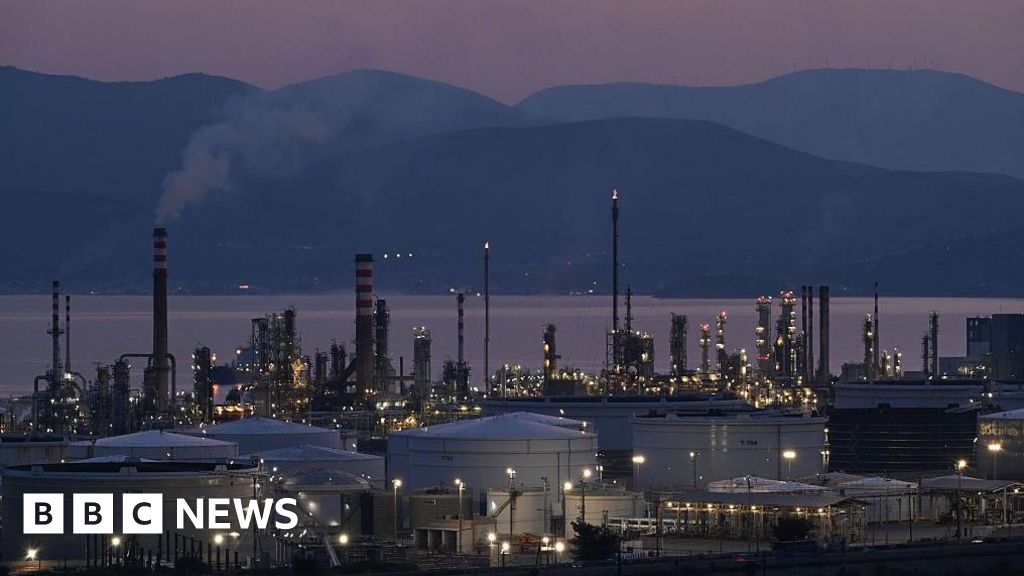
The US-Israel Iran war has halted almost all traffic in a key waterway and the price Brent crude has surged.
Source link

Nike shares fall 9% on weak outlook, expected 20% sales decline in China

Prince Harry surprises crowd by calling attendees his source of hope

Wrigley Field to host Big Ten/SEC volleyball doubleheader

-

 Politics1 week ago
Afghanistan announces release of detained US citizen
-

 Sports1 week ago
Broadcast industry CEO says consolidation is ‘essential’ to compete for NFL soaring media rights prices
-

 Entertainment1 week ago
UN warns migratory freshwater fish numbers are spiralling
-

 Tech1 week ago
Can a Home Appliance Fix the Problem of Soft-Plastic Waste?
-
 Business1 week ago
Property Play: Home flippers see smallest profits since the Great Recession, real estate data firm says
-
 Business1 week ago
Gold prices soar in Pakistan – SUCH TV
-

 Fashion1 week ago
ICE cotton slips on weaker crude, profit booking
-
 Business1 week ago
More women are entering wealth management, but few are in advisory roles, study finds