Sports
Why Chelsea, Man United need League Cup success — and how they can do it

The first chance of silverware is upon us as Chelsea‘s women will look to defend their League Cup trophy against Manchester United on Sunday.
Both sides have had their positives and negatives this season, but who will come out on top?
Why do Chelsea need to win it?
Chelsea have not gone trophyless since 2018-19 and will be determined to ensure this season does not end that run. However, their position has become increasingly precarious.
In the Women’s Super League (WSL), despite winning the past six titles, they are nine points adrift of Manchester City at the top and are even in danger of falling out of the top-three race. So that reality places even greater emphasis on the domestic cup competitions.
It is difficult to imagine supporters or players viewing an FA Cup and League Cup double as a wholly successful campaign, especially if Chelsea suffer an earlier-than-expected exit from the Champions League knockout stages against either Arsenal (quarterfinals) or Wolfsburg/OL Lyonnes (semifinals). But that does not make those trophies any less significant.
Manager Sonia Bompastor recently signed a contract extension until 2030, despite back-to-back league defeats, and finishing this season without any silverware would slightly alter perceptions of her first campaign in charge, when she ended the league unbeaten and won both the FA Cup and League Cup.
The stakes have been heightened further by uncertainty off the pitch. This summer will be the club’s first transfer window in over a decade without head of women’s football Paul Green, who oversaw squad planning for 12 years before departing last month. Bompastor has already begun reshaping the squad she inherited from former manager Emma Hayes — a transition that might partly explain Chelsea’s inconsistency this season — but whether she is able to build a dominant side to compete across all competitions could depend heavily on how this campaign concludes.
Winning some silverware would boost morale for the future and could have a huge knock-on effect for next season. — Emily Keogh
How can Chelsea win it?
The defending champions don’t have to look far for inspiration; Bompastor’s side recently knocked Man United out of the FA Cup with a 2-1 win after extra time thanks to goals by Naomi Girma and Sam Kerr, with both efforts coming from set pieces.
Indeed, manager Marc Skinner’s side has shown vulnerabilities from dead-ball situations this season, and almost 30% of its shots conceded have come from set pieces — the second-highest share in the WSL this season (West Ham United, 29.5%). Furthermore, 25% of United’s expected goals conceded (xGA) have come from set piece situations.
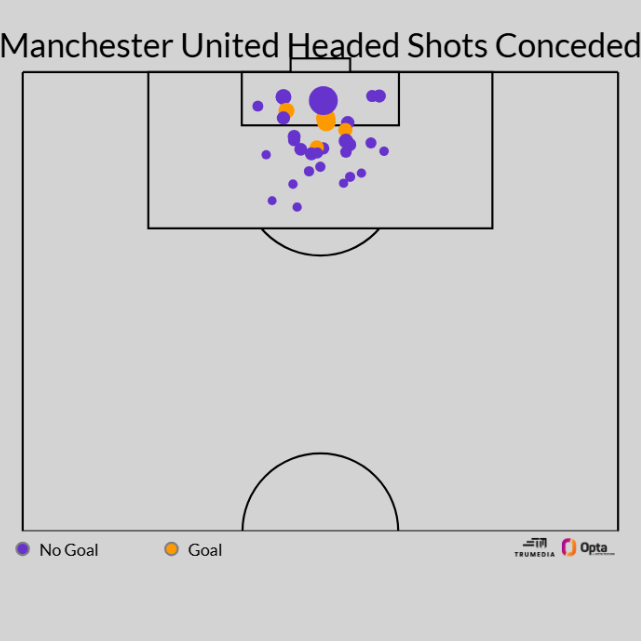

United have also conceded five headed goals this season in the WSL — only Aston Villa have conceded more (7) — and although Chelsea will be missing Kerr’s aerial threat and Carpenter’s crossing (as they are both at the Asian Cup with Australia), the Blues should look to maximize this avenue.
Lauren James, Alyssa Thompson and Johanna Rytting Kaneryd will be key in providing penetration and deliveries inside the box, although Chelsea have looked a bit timid without a focal point in attack given the ongoing injury issues of Mayra Ramírez.
Another area to focus on for Chelsea will be in midfield. Hinata Miyazawa and Julia Zigiotti Olme have been the spine of United’s midfield, but Miyazawa will be unavailable as she’s also at the Asian Cup with Japan. As a result, Bompastor can look to overload United’s weakened center by fielding a midfield three, forcing turnovers and trying to penetrate the opposition box.
The three-time League Cup winners should look to get players into the box as much as possible in order to capitalize on United’s weakness to clear their lines. — Yash Thakur


Why do Man United need to win it?
Man United will consider this season a success even if they finish without a trophy, as their debut European campaign has seen them unexpectedly reach the knockout stages to face Bayern Munich in the quarterfinals. That run represents clear progress for Skinner’s side and sends a message across the continent that United can compete with Europe’s elite, though they still have some clear shortcomings domestically.
Despite their improvement on the losses of previous seasons, defeats in key matches against Manchester City and frustrating draws against Chelsea and Arsenal highlight that United’s development remains incomplete and consistency continues to elude them. With those dropped points likely ending any realistic WSL challenge — they sit eight points adrift of City with six games left — attention inevitably shifts to the cup competitions.
United won the FA Cup in 2024, but a defeat to Chelsea in this season’s fifth round eliminated one option, meaning the League Cup now carries added importance as their most realistic opportunity to secure another trophy.
For a club whose women’s side was reestablished only in 2018, the honors list remains short. Aside from the 2019 promotion to the WSL, the only major silverware in United’s cabinet is that 2024 FA Cup. Two years later, as another potentially trophyless campaign looms, winning the League Cup would provide tangible proof that United are on the rise. — Keogh
How can Man United win it?
United’s attacking line has been firing this season and they have the second-most goals in the WSL (35). Skinner has some interesting profiles in his attacking quartet of Elisabeth Terland, Melvine Malard, Jess Park and Ellen Wangerheim, who are capable of offering directness and fluidity, but it is his wide players who will be key in this final.
Bompastor’s back three have looked vulnerable this season, especially in the space between the wide center backs and the wingbacks, and teams have targeted this channel to find success against Chelsea. Indeed, almost 66% of the chances conceded by Chelsea have come from the wide channels.
The dynamic nature of United’s forwards will be key in exploiting these areas and creating opportunities, and Carpenter’s unavailability weakens the Blues’ right side.
If United want a blueprint to beat Chelsea this season, they should look to how Arsenal played in January to seal a 2-0 win. The tactical plan involved overloading the center of the pitch and forcing turnovers in midfield.
In Bompastor’s 3-4-1-2 formation, midfielder Keira Walsh is responsible for ball progression and protection against transitions, so Skinner could look to mark Walsh out of the game and establish numerical superiority in the center of the field by using Park. The former Manchester City forward could play a role similar to that of Beth Mead in Arsenal’s win, as United engage in duels in the midfield and apply pressure on Chelsea’s center backs while blocking easy access to Walsh.
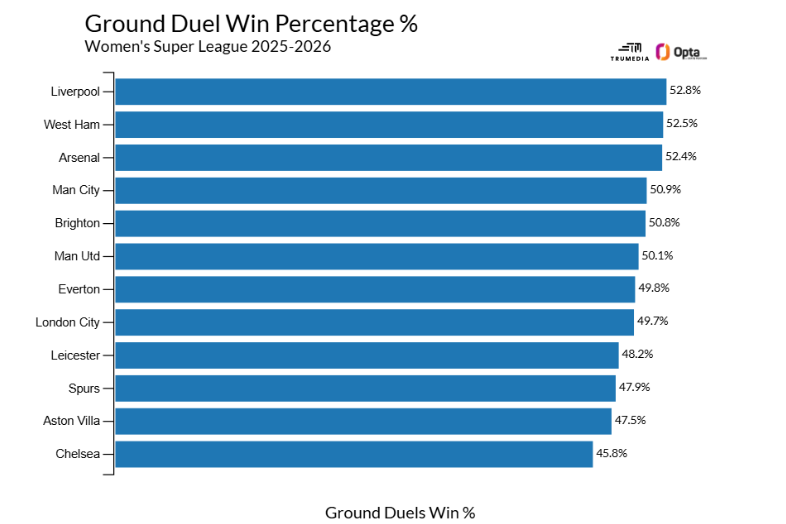

Chelsea also have the lowest average ground duel win percentage in the WSL this season (45.8%), so United should look to maximize their high turnover opportunities, initiate duels and exploit spaces behind Chelsea’s midfield. — Thakur