

Tech
XCOM RAN intros end-to-end private 5G for physical AI | Computer Weekly


Looking to boost the adoption of physical artificial intelligence (AI) across several key applications areas for industrial automation, which the company believes will become the new norm, XCOM RAN by Globalstar has announced the launch of an end-to-end private 5G solution.
The company believes that its mission is to provide the next generation of private 5G infrastructure, which is designed to support “tomorrow’s mission-critical industrial automation requirements”. XCOM RAN claims that it is delivering “unprecedented” performance by taking a new approach to private 5G, increasing capacity by more than four times over current private 5G offerings for “flawless” connectivity in the densest automation environments.
XCOM RAN runs on private 5G shared spectrum allocated around the world, and it can use Globalstar’s licensed Band n53 as a dedicated band for “worry-free” private 5G deployments. Its Supercell architecture is designed to reduce the need for site surveys and RF network design, leading to a private 5G solution that “deploys quickly, is easy to manage, and provides full capacity and coverage” in industrial environments.
The company predicted that the amount and types of physical AI optimisations that can be applied will increase exponentially. It noted that its customers are asking for an underlying wireless network architecture that is comprehensive, can adapt and grow with their automation strategies, and can address the needs of customers and for partners.
The launch introduces an orchestration layer for managing private 5G environments, which the company said speaks to the operational complexity enterprises are running into as deployments scale in the AI era.
The company’s offerings include XCOM RAN’s Supercell architecture, based on O-RAN standards, with XCOM Radio Series with indoor and outdoor options; XCOM Core, which is now offered in addition to private 5G cores from partners; and the XCOM Orchestrator, a multi-tenant management and orchestration system designed to streamline operations and minimise the learning curve for enterprise teams new to private 5G.
XCOM RAN is designed to offer spectrum flexibility with support for Band n48 shared spectrum in the US and Band n78 allocated for private 5G and industrial use in Europe and parts of Asia, while it uses Globalstar Band n53 for licensed, dedicated use. The solution includes the XCOM Industrial Router, an Industry 4.0 CPE device that supports all three spectrum bands, enabling customers to integrate XCOM RAN private 5G into their AI-driven industrial automation environments.
XCOM RAN also works with a set of industry partners to offer a private 5G solution and services that are described as “thoroughly tested, integrated and ready for deployment”. The expanding network of partners is said to be intended to ensure customers benefit from “proven technology, seamless integration” and an end-to-end solution built to scale with their business.
A number of these partners have declared support for the new tech, such as ruggedised industrial solutions provider Zebra Technologies.
“We are at the forefront of adding new technology and spectrum options to our devices to support our customers as they rapidly move toward AI-driven intelligent operations,” said James Poulton, senior vice-president and general manager of enterprise mobile computing at Zebra Technologies.
“We have recently added support for Globalstar Band n53 to our ET 401 Enterprise tablets, giving our customers the opportunity to securely run their most sensitive applications over private, dedicated spectrum on these devices.”
Michiel Lotter, CEO of smart signal booster manufacturer Nextivity, added: “One of the latest trends in enterprise wireless deployments is combining modern DAS systems with private 5G to deliver pervasive indoor and outdoor capacity and coverage.
“These solutions are on the cutting edge of development, and we’re grateful to have a partner like the XCOM RAN team who is working with us to address our customers’ requirements.”

Immense concentration continues apace in the cloud industry, with hyperscalers expected to comprise 67% of global datacentre capacity by 2031, or 14 times the capacity they had in 2018. Back then, enterprise datacentres accounted for 56% of all datacentre capacity.
That’s according to figures from US-headquartered research organisation Synergy Research Group, which says artificial intelligence (AI) is driving huge and accelerated growth, with hyperscaler capacity expected to double in the next three years.
By the fourth quarter of 2025, Synergy found that hyperscaler-operated datacentres accounted for 1,360 of total sites and 48% of worldwide capacity. Datacentres built by hyperscalers form the bulk of that capacity – 60% of it – with the remaining capacity leased.
Non-hyperscale colocation capacity accounts for 20% of current totals, while enterprise datacentres account for 32%.
Synergy expects hyperscaler datacentre capacity to comprise 67% of all capacity in 2031. The share of colocation is expected to drop, although it is still increasing at double-digit rates.
Enterprises’ on-premise datacentre capacity is expected to drop to 19% of the total by 2031, at a rate of about 2% per year, although even here that decline is not so rapid, largely due to the deployment of AI hardware.
Synergy’s data is based on several quarterly tracking research services in hyperscale, colocation and enterprise datacentres, and based on datacentre footprint and operations of the world’s major cloud colocation firms, plus tracking the datacentre hardware market.
John Dinsdale, a chief analyst at Synergy Research Group, said AI is driving the world’s datacentre market towards increased concentration in favour of the hyperscalers.
“Cloud and consumer-oriented digital services have been driving changes in datacentre deployment patterns for many years now, but over the last three years, AI technology has accelerated those changes,” he said.
“We are seeing a different mix of datacentre usage across the regions, but overall, the world is racing towards a situation where hyperscale operators are responsible for the bulk of global datacentre capacity. There are almost 800 hyperscale datacentres in our known future pipeline, enabling hyperscale capacity to double in just three years,” Dinsdale added.
By the third quarter of 2025, worldwide spend on cloud services had reached $107bn, up from $68bn two years before that, in 2023.
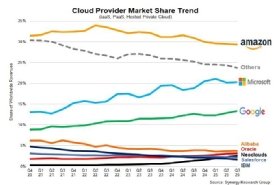
Among the big three, Amazon’s market share has been in a state of gradual decline since 2022. In the third quarter of 2025, it had a 29% market share, down from just under 34% in the third quarter of 2022.
Meanwhile, the third-quarter 2025 market share for Microsoft was 20%, and 13% for Google Cloud. Both of these are seeing increases in market share, with Microsoft up from 13% in the fourth quarter of 2020.
Meanwhile, so-called neocloud providers – those that specialise in AI datacentre capacity – have a market share of 2.5%.
Dinsdale said: “Beyond the three market giants, a wide mix of smaller players is competing for traction, but the reality is that third-placed Google remains nearly four times the size of fourth-placed Alibaba, underscoring the widening gulf between the market leaders and the rest of the field.”

Thousands of men are members of Telegram groups and channels that advertise and sell hacking and surveillance services that can be used to harass friends, wives and girlfriends, and former partners, new research has uncovered. The findings, from a European nonprofit group, also say that the communities are involved in extensive trading, selling, and promotion of a huge variety of abusive content, including nonconsensual intimate images of women, so-called nudifying services, plus folders of images that sellers claim include child sexual abuse material and depictions of incest and rape.
Over six weeks earlier this year, researchers at the algorithmic auditing group AI Forensics analyzed nearly 2.8 million messages sent across 16 Italian and Spanish Telegram communities that are regularly posting abusive content targeting women and girls. More than 24,000 members of the Telegram groups and channels took part in posting 82,723 images, videos, and audio files over the course of the study, the analysis says. Many posts target celebrities and influencers, but men in the groups also frequently victimize women they know.
“We tend to forget that most victims are ordinary women who sometimes don’t even know that their pictures are shared or manipulated in these types of channels,” says Silvia Semenzin, a researcher at AI Forensics who previously exposed Italian Telegram channels engaging in similar behavior as far back as 2019. “The majority of this violence is directed towards people who the perpetrators know,” she says, suggesting that Telegram, which has over 1 billion monthly active users, according to company founder Pavel Durov, should be subject to stricter regulation and classed as a “very large online platform” under Europe’s online safety rules.
The findings come as Durov is fighting back against Russia’s efforts to block the messaging app in that country, which has long positioned itself as a messaging app that allows free speech but has simultaneously been used by some to share terrorist, sexual abuse, and cybercrime materials. Durov is under criminal investigation in France relating to alleged criminal activity taking place on Telegram, although he has consistently denied the allegations.
A Telegram spokesperson tells WIRED that the company removes “millions” of pieces of content per day using “custom AI tools” and has policies in Europe that do not allow the promotion of violence, illegal sexual content including nonconsensual imagery, and other content such as doxing and selling illegal goods and services.
Among the extensive types of abusive content and services observed by the AI Forensics researchers were frequent references to the access, publishing, and doxing of women’s private information, sharing their Instagram or TikTok content, as well as references to spying or hacking. “Victims are often named, tagged, and locatable via shared profile links,” the group’s report says.
One translated post on Telegram titled “Professional hacking on commission” claimed to be able to give customers “access to phone gallery and extraction of photos and videos,” as well as “anonymous social media hacking.” Another message says: “I hack and recover any type of social media service. I can spy on your partner’s account. Send me a private message.”
Across the dataset there were more than 18,000 references to spying or spy content. One post reads: “Hi, do you have the desire to spy on a girl’s gallery? We sell a bot that does it for info DM.” Meanwhile, users were observed asking if people could find phone numbers connected to Instagram accounts and other requests, “who exchanges spy photos and videos?”

Research from Cisco has found that as many as two-thirds of industrial organisations have moved to active artificial intelligence (AI) deployments in live operational environments, yet while adoption momentum is strong, infrastructure and organisational alignment – especially networking and security – will dictate who achieves real transformation.
The latest version of the State of industrial AI report 2026 looked to provide a data‑driven view into how industrial organisations are adopting AI, the challenges they face as AI moves into live operations, and the opportunities created as AI becomes embedded in physical systems, infrastructure and workflows.
The study is based on data from a global survey of more than 1,000 operational technology decision‑makers, conducted by Cisco in association with Sapio Research. Respondents were from 19 countries and across 21 industry sectors, representing a range of industries including manufacturing, transportation, logistics, energy and utilities, and more. The study aggregated findings from decision-makers at companies with annual revenues of more than $100m.
Among the top findings were that AI organisations are harnessing AI to drive progress and overcome industry challenges, and that it is now delivering measurable operational benefits, in particular in use cases such as process automation, automated quality inspection, predictive maintenance, logistics and energy forecasting. Strong expected benefits from AI included productivity (59%), cost reduction (42%) and sustainability.
Industrial AI was seen to have moved from a future consideration to active deployment, with 61% of organisations now using AI in live industrial operations where performance, reliability and security have direct physical consequences, and 20% reporting scaled, mature deployments. Across manufacturing, transportation and utilities, AI was found to be powering machine vision, mobility, robotics and safety‑critical operations.
Most organisations indicated that they planned to increase AI spending (83%), and nearly nine in 10 expect meaningful outcomes in the next two years (87%). Yet just as adoption was accelerating, many firms were struggling to sustain and expand deployments, with readiness across network infrastructure, security and skills increasingly determining whether AI can scale consistently across core physical environments.
Indeed, network readiness and security posture were cited as the primary factors shaping how quickly and safely organisations scale AI across connected assets, machines and sites. The report observed that as AI becomes embedded in machines, sensors, vision systems and autonomous operations, organisations face rising demands for reliable connectivity, wireless mobility, predictable latency, edge compute and power, which were making network readiness a gating factor for physical AI deployments.
Just over half of firms (51%) expect significant increases in connectivity and reliability requirements in their industrial networks, and almost all firms (96%) noted that reliable wireless networks are vital for AI. In addition, 97% expected AI workloads to impact their industrial network requirements.
Yet while legacy infrastructure and skills gaps remain secondary challenges, Cisco also cautioned that the study also revealed many organisations were increasingly constrained by readiness gaps in networking infrastructure, cyber security and IT/OT operating models as AI shifts into real‑time, production‑grade use in physical environments.
Another key discovery was that organisations with closer collaboration between IT and operational teams report greater confidence in expanding AI, more stable networks supporting physical operations, and a stronger emphasis on cyber security as a baseline requirement, underscoring the need to build the skills required for scalable AI adoption.
Nearly two in three firms (57%) reported some level of IT/OT collaboration, while 43% reported limited or no collaboration. Just under half (47%) of organisations with limited IT/OT collaboration cited network instability as a top operational challenge to scale AI.
Cyber security was highlighted as shaping both the pace and confidence of AI adoption. Cisco also found that as AI expands connectivity and data flows across industrial environments, security remained the top barrier to scale. At the same time, organisations increasingly view AI as part of the solution, with a majority expecting AI to strengthen monitoring, detection and operational resilience.
“Industrial AI is moving from experimentation into production, where AI systems sense, reason and act in the real world,” said Vikas Butaney, senior vice-president and general manager of secure routing and industrial internet of things at Cisco. “At this stage, success is no longer determined by models alone, but by whether networks, security and teams are ready to support AI at the edge, in motion, and at scale. The research shows that organisations confident in scaling AI are those treating infrastructure, cyber security and IT/OT collaboration as foundational, not optional.”


Stock markets today (April 8, 2026): Nifty50 & Sensex surge nearly 4%-which are the top gainers and losers today? Check stock list – The Times of India

China’s forex reserves fall to $3.34 tn in March 2026

Ex-NFL star Robert Griffin III eyes Olympic gold in flag football

-
Uncategorized6 days ago
[CinePlex360] Please moderate: “Trump signals p
-

 Entertainment5 days ago
Joe Jonas shares candid glimpse into parenthood with Sophie Turner
-

 Tech5 days ago
Our Favorite iPad Is $50 Off
-

 Fashion1 week ago
China’s Anta Sports posts record $11.62 bn revenue in 2025
-

 Politics5 days ago
Iran can sustain Strait of Hormuz closure for years, will cut US military logistics: Official
-
 Business6 days ago
Jaguar Land Rover sees sales recover after cyber attack
-

 Sports5 days ago
UConn Final Four run could trigger a $50M furniture giveaway for Massachusetts-based Jordan’s Furniture
-

 Politics1 week ago
Trump considers asking Arab allies to help to pay for Iran war