

Business
$300 million deal: In a first, France’s CMA CGM eyes India for LNG-powered container ships; six vessels ordered – The Times of India

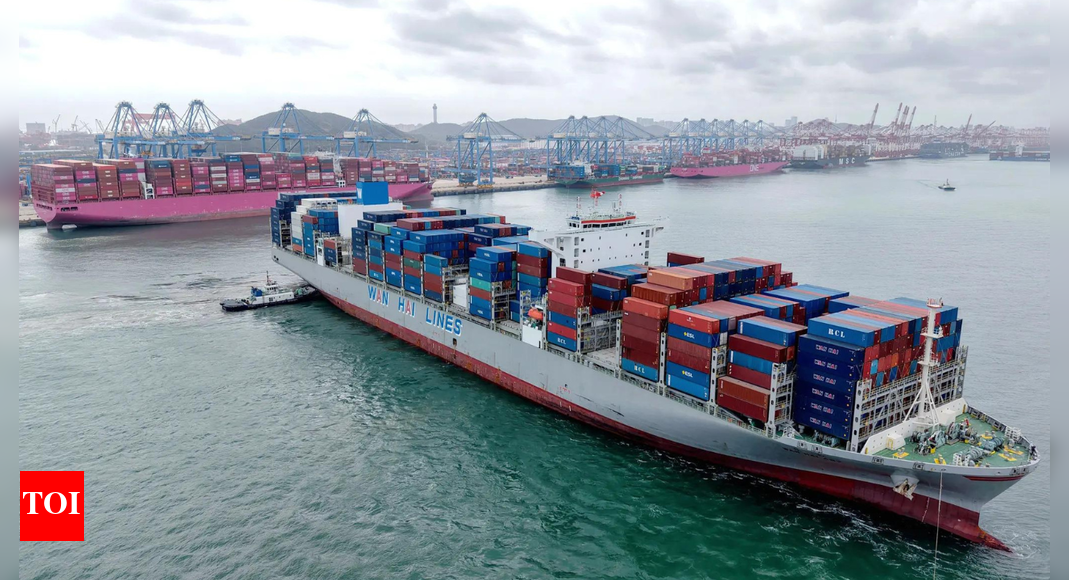
CMA CGM, the French shipping giant and world’s third-largest container carrier, has identified India as a potential hub for constructing small, LNG-powered container vessels. This development follows chairman and CEO Rodolphe Saade’s signing of a letter of intent with Cochin Shipyard for six vessels, valued at approximately $300 million, as reported by Economic Times. This marks a historic moment as the first container ship order from a global mainline operator in India.Saade shared his impressions of Prime Minister Narendra Modi, saying, “What was impressive is… I had the feeling I was talking to a business leader and not a Prime Minister because we spoke business… he said, ‘You need to do more.'”The agreement represents a significant achievement for Indian shipbuilders aiming to establish themselves globally, supported by a Rs 69,725-crore government package approved in September to enhance industry capabilities and compete with established shipbuilding nations. Each vessel will accommodate 1,700 TEUs and utilise LNG propulsion, aligning with CMA CGM’s commitment to shipping decarbonisation.Currently ranked 16th globally with less than 1% market share, India’s shipbuilding industry aims to secure a position among the top 10 by 2030 and top five by 2047. Saade indicated that while their larger vessels are primarily built in China and South Korea, India presents an opportunity for smaller vessel construction.This development follows CMA CGM’s recent decision to register four container ships under the Indian flag, fulfilling a commitment made to Modi during his February 12 visit to their Marseille headquarters. Saade confirmed that the newly ordered vessels would also carry Indian registration.The initiative gained momentum following Modi’s and President Emmanuel Macron’s involvement. Saade explained that Modi’s challenge to invest in India, coupled with collaborative efforts between the government, shipyard and CMA CGM, led to this significant vessel order.


Business
Life sciences lab real estate is clawing back from disaster. Here’s what that means for investors
Business
Trump administration in advanced talks for a rescue package for Spirit Airlines, source says

A Spirit commercial airliner prepares to land at San Diego International Airport in San Diego, California, U.S., January 18, 2024.
Mike Blake | Reuters
The Trump administration is in advanced talks for a financing package for Spirit Airlines as the carrier is facing the risk of a liquidation, according to a person familiar with the matter.
Spirit had been facing a potentially imminent liquidation, people familiar with the matter told CNBC last week, speaking on the condition of anonymity to discuss matters that had not yet been made public. The Dania Beach, Florida-based carrier in August filed for its second Chapter 11 bankruptcy in less than a year, after it struggled to increase revenue to cover rising costs.
President Donald Trump hinted at potential government aid on Tuesday, telling CNBC’s “Squawk Box“, “Spirit’s in trouble, and I’d love somebody to buy Spirit. It’s 14,000 jobs, and maybe the federal government should help that one out.”
The White House didn’t immediately comment.
“We are hopeful that the government will recognize the needs for emergency funds especially in the current economic environment,” a spokesperson for the Associated of Flight Attendants-CWA, which represents Spirit’s cabin crews, said in a statement. “The last thing our economy needs is tens of thousands more people out of work and the last thing the travelling public needs is fewer choices in air travel.”
The terms of the financing deal weren’t immediately known. The Wall Street Journal earlier reported that the talks were in an advanced stage.
The U.S. airline industry accepted more than $50 billion in taxpayer aid to weather the Covid-19 pandemic, which is still its biggest-ever crisis, but those funds weren’t handed to one specific airline. Some of the aid gave the U.S. government stock warrants for airlines.
Airlines also received a government bailout following the Sept. 11, 2001, terrorist attacks, but that money was also for more than one company. The U.S. in 2008-2009 also bailed out the auto industry during the financial crisis and took stakes in manufacturers.
The Trump administration has taken equity stakes in some companies it deemed critical to national security like Intel and USA RareEarth, though Spirit stands out as it is in bankruptcy.
In February, Spirit said it expected to exit bankruptcy in late spring or early summer, telling a U.S. court that it would shrink and focus its planes on high-demand routes and travel periods. Pilot and flight attendant unions had also made concessions, including going on furlough in recent months, in a bid to help Spirit survive.
But jet fuel prices have nearly doubled in some parts of the U.S. since then, further adding to challenges for Spirit and the rest of the airline industry.
As a low-fare airline that also faces competition from larger carriers with their own no-frills, basic economy offerings, it has grown harder for Spirit to cover expenses. Spirit had introduced extra-legroom seats and other premium options to try to cater to higher-spending customers.


5 AI Models Tried to Scam Me. Some of Them Were Scary Good
Tesla widens India bet with launch of Model Y L – The Times of India

Life sciences lab real estate is clawing back from disaster. Here’s what that means for investors

-

 Fashion6 days ago
France’s LVMH Q1 revenue falls 6%, shows resilience amid Iran war
-

 Entertainment1 week ago
Is Claude down? Here’s why users are seeing errors
-

 Sports1 week ago
PSL 11: Peshawar Zalmi win toss, opt to field first against Quetta Gladiators
-

 Tech1 week ago
The Deepfake Nudes Crisis in Schools Is Much Worse Than You Thought
-

 Tech1 week ago
Human-machine teaming dives underwater
-

 Tech1 week ago
Bremont Is Sending a Watch to the Moon’s Surface
-
 Business1 week ago
BP sees ‘exceptional’ oil trading result as Iran war sends crude costs soaring
-

 Fashion1 week ago
What no one is saying about the 2026 apparel slowdown