Connect with us

Entertainment

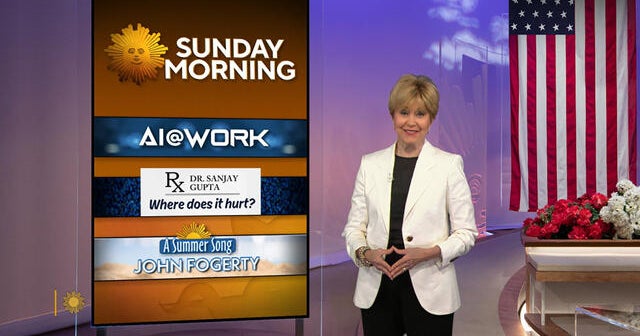
8/31: Sunday Morning

Published

on

8/31: Sunday Morning


Hosted by Jane Pauley. Featured: David Pogue on how AI is affecting job searches; Jane Pauley talks with Dr. Sanjay Gupta about treatments for chronic pain; Robert Costa interviews singer-songwriter John Fogerty; Steve Hartman explores the bedrooms left behind by children killed by gun violence; Elaine Quijano visits the studio of painter Alex Katz; and Luke Burbank checks out the world’s largest truck stop.


Source link

Continue Reading
Click to comment

Leave a Reply

Your email address will not be published. Required fields are marked *

Entertainment

David Del Rio returns online leaving assault claims shadowing back

Published

on

David Del Rio returns online leaving assault claims shadowing back


David Del Rio returns online leaving assault claims shadowing back

David Del Rio returned to Instagram only days after leaving Matlock due to sexual assault allegations.

The actor shared calm family photos with his wife Katherine Del Rio and their two daughters.

The pictures showed a warm holiday moment at home, as Katherine wrote that she felt deeply thankful for her family, which many people believed was her way of showing strength during the situation.

Del Rio left the CBS show after an alleged incident in late September that involved his co star Leah Lewis.

However, the production team acted quickly and removed him from the set while they carried out a private review.

By October the producers decided that his character Billy Martinez would no longer continue in the remaining episodes of the second season.

The writers planned to move the story forward without changing older scenes.

Katherine publicly defended her husband at the time and later deleted her post.

Friends of the family said the couple stayed strong together while dealing with the claims.

Leah Lewis returned to filming and posted online that she was moving forward in love and strength.

Cast members, including Beau Bridges, said the series would continue and production would start again before Christmas.

Matlock aired its midseason finale on December eleven and the rest of the second season is set to return in February twenty twenty six with updated story plans after Del Rio’s exit.


Source link

Continue Reading

Entertainment

Elvis and the Colonel – CBS News

Published

on

Elvis and the Colonel – CBS News


Author Peter Guralnick wrote the definitive two-volume biography of the King: “Last Train to Memphis: The Rise of Elvis Presley” (1994), and “Careless Love: The Unmaking of Elvis Presley” (2000). And now, his latest is about Colonel Tom Parker, Elvis’ legendary manager. Asked if he found anything surprising, Guralnick replied, “It totally surprised me.”

“The Colonel and the King: Tom Parker, Elvis Presley, and the Partnership that Rocked the World” (Little, Brown & Co.) is the story of a partnership that rocked popular culture, and how Parker’s marketing savvy and enduring loyalty helped the King get his crown.

Little, Brown & Co.


Guralnick says Parker did not create the template for being the manager of a musician: “It wasn’t original to him, it wasn’t brand new. But he carried it, I think, to a far greater extent than anyone had before.”

In 1955, the 20-year-old Presley was playing the Louisiana Hayride when Parker first caught his act. “It took no more than a few days after seeing him for the first time that he booked Elvis when nobody else was willing to book him,” Guralnick said.

Parker, who was then handling Hank Snow, quickly put Elvis in the show.

hank-snow-extra-added-elvis-presley.jpg

From Colonel Tom Parker’s scrapbook, an ad for Elvis Presley as an added attraction to Hank Snow’s concert. 

CBS News


Elvis would sell more than 12 million records in 1956. The Colonel negotiated his recording contract, his movie deal, and oversaw all his marketing.  As he would write, “I don’t [just] sit here and smoke cigars hoping for something to happen.”

Guralnick said, “There is so much love in some of his early letters to Elvis. And in one he says, you know, ‘You are just like me. You are sensitive, you’re easily hurt. But only those we love can hurt us.'”

Presley would write back, “I love you like a father.”

Colonel Tom Parker wasn’t actually a colonel; he also wasn’t American. In fact, Andreas van Kuijk was a stowaway from Holland, who arrived in the U.S. in 1926, barely speaking English. The 16-year-old soon invented an origin story. “Once he declared himself to be Tom Parker, born in West Virginia, his identity was never questioned for over 50 years,” said Guralnick. “The only person who may have known it was Elvis Presley.”

The honorary title “Colonel” would be bestowed on him by Louisiana’s Governor. It became his first name. “That was how he signed all of his letters,” said Guralnick.

colonel-parker-elvis-presley-ed-sullivan-graceland-archives.jpg

Colonel Tom Parker, Elvis Presley and Ed Sullivan are seen backstage at “The Ed Sullivan Show” in 1956. 

Graceland Archives


Before Presley, Parker made a star out of Eddy Arnold, booking him as the first “hillbilly act” in Vegas.

Actor George Hamilton, who befriended the Colonel in his early days in Hollywood, said, “He had all the smarts of a con man, but he wasn’t. He knew how to make the other person want whatever he was selling.”

Asked why Parker was so driven, Hamilton replied, “Emotional stuff from his childhood. I feel like he had some horrible damage done. He didn’t like his father.”

Parker would become notorious for taking a 50% cut of some of Presley’s later deals. “Now, I sat with him one day and I said, ‘Is it right to get half of everything?'” Hamilton recalled. “And he said, ‘Well, you know, 50% of something is better than 100% of nothing.’ And I said, ‘Well, you mean your half, or his?’ He said, ‘Well, if I didn’t have my half, he wouldn’t have his!’ And I got it. I got it.”

The Colonel offered Hamilton an opportunity in Vegas: “He said, ‘And by the way, Elvis has gotta take two weeks off at the Hilton. And I booked you in.’ I said, ‘I can’t do that show. That doesn’t make any sense, Colonel.’ He said, ‘George, you want $50,000 a week?’ I said, ‘Yes.’ He said, ‘It’s two weeks. For that, you can do anything, can’t you?’ I said, ‘Yes, sir!'”

In 1973, after Presley bad-mouthed hotel owner Conrad Hilton on stage in Vegas, Parker confronted him backstage. “Essentially, Elvis and Colonel fired each other,” said Guralnick.

The split didn’t last long. “Neither Colonel nor Elvis could imagine a world without the other,” said Guralnick. “They simply didn’t have the ability to walk away.”

But Parker began to worry about the “instability of [his] artist.” 

Asked how he reacted to Presley’s increasing drug use, Guralnick replied, “I think he was at a loss. I think there was an element of denial. But he was well aware of what was going on. Nobody could miss what was going on.”

In Vegas, Colonel developed his own addiction. George Hamilton saw it firsthand: “He used to get me to go gambling with him. God! He would go all-in on, like, I mean, big money. I saw close to a million dollars lost at a table.”

Guralnick said, “They were caught in a trap – as Elvis sang! I mean, neither one of them could confront the other one with his problem.”

According to the author, the two were locked in a relationship of mutual denial – the twin tragedies of their story. And when Elvis died in 1977, the Colonel, according to Guralnick, “went into shock.”

“I’ll never stop trying to keep nis name alive,” Parker said. He would die in 1997.

anthony-mason-and-peter-guralnick-at-graceland-1.jpg

Correspondent Anthony Mason and author Peter Guralnick at Graceland. 

CBS News


While Guralnick was doing research at Elvis’ Memphis mansion Graceland, in what was once the office of Elvis’ father, Vernon Presley, he was told the office telephone was disconnected: “So, one night we were working quite late, and it was 10 o’clock at night. And all of a sudden, the phone rang. And so you know, you’ll have to tell me: Was this Elvis? Was this Vernon? Maybe it was Colonel. 

“We stared at it. Should we answer? Should we not answer? Who knows what would happen if we answered? But we did not answer. We just listened to it ring, until it finally stopped ringing!”

“You wanted the idea that there was one of those three on the other end of the line?” I asked.

“Well, you want to preserve the mystery!”

     
READ AN EXCERPT: “The Colonel and the King” by Peter Guralnick

     
For more info:

     
Story produced by Jon Carras. Editor: Remington Korper.

     
See also:


Source link

Continue Reading

Entertainment

Ethan Hawke on “Blue Moon,” and taking nothing for granted

Published

on

Ethan Hawke on “Blue Moon,” and taking nothing for granted


Nearly a hundred years ago, Richard Rodgers and Lorenz Hart helped put the “great” in the Great American Songbook, with songs like “My Funny Valentine,” “The Lady Is a Tramp,” and “Blue Moon.” 

Composer Richard Rodgers and lyricist Lorenz Hart in 1936.

New York World-Telegram/Sun Newspaper Photograph Collection/PhotoQuest/Getty


But by the early 1940s, Hart’s heavy drinking made him an unreliable partner. So, Rodgers teamed up with Oscar Hammerstein II, and their first production, the landmark musical “Oklahoma!” opened at the St. James Theatre on March 31, 1943.

It was an immediate hit, and that night there was a big party a few doors down at Sardi’s, that legendary Broadway watering hole, with its walls hung with the caricatures of famous faces. Lorenz Hart showed up at Sardi’s that night, and what happened next is now a movie.

In “Blue Moon,” Ethan Hawke is Hart, drowning his sorrows at the bar. 

blue-moon-ethan-hawke-andrew-scott.jpg

Lorenz Hart (Ethan Hawke) congratulates his former partner Richard Rodgers (Andrew Scott) on his success writing with someone else, in “Blue Moon.” 

Sony Pictures Classics


For the film, they re-created Sardi’s on a soundstage, but “Sunday Morning” met Hawke at the real thing.

“I was definitely the type of young person that would walk in and think, ‘When am I gonna get my painting up there?'” he said. “I’m not above that. I’m a little heartbroken that I don’t have one up yet!”

Perhaps his time will come. “My time’s coming,” he said. “I have hope. I’m not done yet!”

And this performance is proof: the real Lorenz Hart was less than five feet tall, so director and frequent Hawke collaborator Richard Linklater used camera tricks to make the 5’9″ actor look short. Hawke also shaved the top of his head to make a real combover, and he learned a mountain of dialogue.  

“It’s definitely the most text I’ve ever had in a movie,” Hawke said. “I remember calling my wife after the first day – I think I had more lines than I had in the previous five films.”

tracy-smith-ethan-hawke-at-sardis.jpg

Correspondent Tracy Smith with actor Ethan Hawke at Sardi’s. 

CBS News


It was a challenge for an actor whose face usually says it all. In the 1989 film “Dead Poets Society,” Hawke played a student, and he says he learned a lot from co-star Robin Williams. “There’s a scene where he’s talking about how to grade poetry, and he has all the kids rip it out – I didn’t realize how much I was being taught, and how that sustained me through negative criticism. It’s like, there’s not any rules about being a great actor. Drop dead. So you don’t like it? Suck an egg. You don’t know what great acting is any more than I do.”

I asked, “When you’re in a movie like that so young, does it set you up? Or does it set you up?”

“It’s a great question, ’cause it’s possibly both,” he replied. “If you let it be the high-water mark of your life, it will be, you know, if you put too much on that. You don’t want anything at 18 to be the high-water mark of your life.”

Between movies, Hawke made his Broadway debut with, he says, a lot more confidence than skill. “That’s the weird thing about being young. I had no business being confident at anything. I was a total moron. And I walked in here like I was, you know, John Barrymore.”

His performance in Chekhov’s “The Seagull” (1992) was described as “promising.” But it was clear that his best work was ahead of him.

Hawke got the first of four Oscar nominations for his role in the 2001 film “Training Day” opposite Denzel Washington. His performance still resonates. Hawke said, “When my son was about six, Levon, he said to me, ‘Dad, what’s “Training Day?”‘ I said, ‘Oh, it’s the movie I did a few years ago. Why?’ He said, “’cause every time we walk down the street, when people pass you, they say, “Training Day”!'”

But after “Training Day,” there was a time when Hawke says he passed on more parts than he took – and the offers started drying up. “When you’re young, you think it’s everybody. You don’t realize that This is a young person’s game, and those kinds of job offers, there’s a shelf life on that.”

“When did your shelf life, when did that hit?” I asked.

“Around the same time gray starts appearing in your beard,” he replied.

The gray in the beard works for him now, as a hard-nosed investigative reporter in the critically-acclaimed FX series “The Lowdown.” In the series, you never know what’s around the next corner – just as in real life. As we were wrapping up at Sardi’s, owner Max Klimavicius suddenly showed up with a surprise for Hawke: “Ethan, I would like your permission to make you part of our collection,” he said.

He was a bit stunned, and to be honest, so were we. But after Ethan Hawke’s career on screen and stage, it wasn’t all that surprising.

“Wow!” he said. “It finally happened. I’ve got my portrait at Sardi’s. I’ve arrived! Things are looking up in this life!”

ethan-hawke-new-face-at-sardis.jpg

Sardi’s owner Max Klimavicius shows Ethan Hawke the latest addition to the fabled Broadway restaurant’s illustrative honors. 

CBS News


And now, with his latest film in mind, there’s talk of more accolades to come.

How does he handle the Oscar buzz surrounding “Blue Moon”? Does he tune it out? He said, “There’s the obvious other part of you that goes, like, ‘Hey, I dedicated my life to this job, and this is seen as a barometer.’ And I would be dishonest if I didn’t say that, like, that would be amazing.

“This is so corny, but it just flashed through my head: I was like 11 or something, I said to my mother, ‘What’s gonna happen with my life? What’s gonna happen?’ And she – and I remember it so vividly – in the kitchen, like Doris Day [sings] ‘When I was just a little girl…’ you know, it goes into ‘Que Sera, Sera.’

“You have to have a little ‘Que Sera, Sera.’ I don’t take any of it for granted. That’s, I guess, the right answer. Any little bit of it.”

WEB EXCLUSIVE: Watch an extended interview with Ethan Hawke


Extended interview: Ethan Hawke

31:49

To watch a trailer for “Blue Moon” click on the video player below:


BLUE MOON | Official Trailer (2025) by
Sony Pictures Classics on
YouTube

For more info:

       
Story produced by John D’Amelio. Editor: Ed Givnish. 


Source link

Continue Reading

Trending