

Business
Significant fall in government borrowing in December, figures show

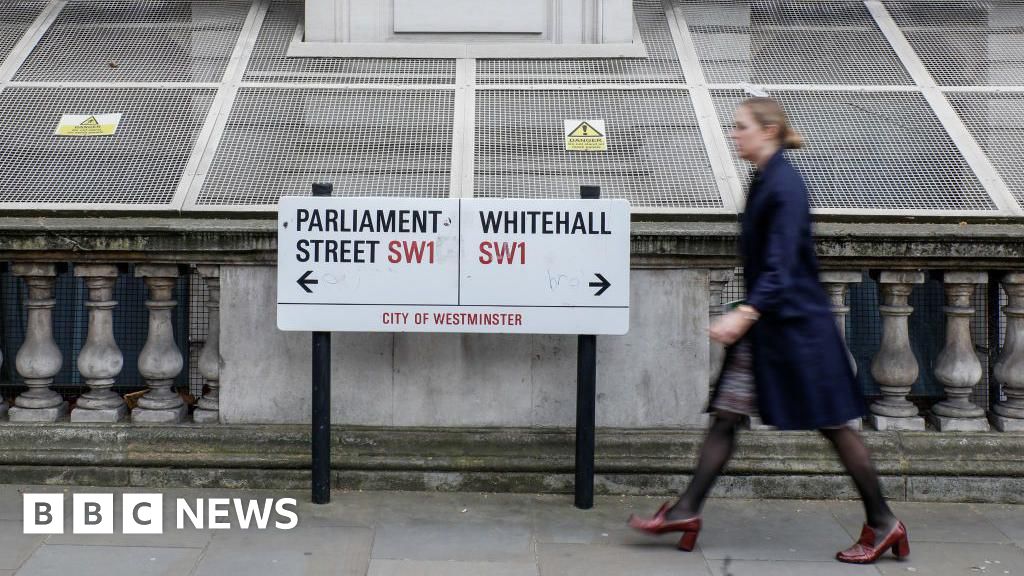
UK government borrowing was significantly lower last month, due to more income from taxes and higher National Insurance Contributions outweighing spending, figures show.
In December government borrowing – the difference between public spending and tax income – was £11.6bn, the Office for National Statistics (ONS) said.
It is down £7.1bn – 38% – from the previous December, and lower than what many economists had predicted, but still higher than that borrowed in the same month in 2023.
Tom Davies, Deputy Director for the ONS public service division, said the fall was a result of “receipts being up strongly on last year whereas spending is only modestly higher”.
Despite the annual fall, the December 2025 figure was the tenth highest for the month since records began in 1993, without adjusting for inflation.
And it remains higher than December 2023, when borrowing stood at £8.1bn.
The figures show the government received £7.7bn more – an 8.9% rise – in taxes in December 2025 than it did in the same month in 2024.
This comprised increases in income tax, corporation tax, VAT and National Insurance contributions (NIC), the ONS said – with changes to the rate of NIC paid by employers coming into effect in April last year.
According to provisional estimates, borrowing over the financial year to December totalled £140.4bn, about £300m lower than the same period in 2024, the ONS said.
The borrowing figure was estimated as 4.6% of GDP – 0.2 percentage points down from the same period last year.
It was the third-highest level of borrowing over April-December on record, after those in 2020 and 2024.
Chief Secretary to the Treasury, James Murray, said the government was “stabilising the economy, reducing borrowing, rooting out waste in the public sector”.
He said: “Last year we doubled our headroom and we are forecast to cut borrowing more than any other G7 country with borrowing set to be the lowest this year since before the pandemic.”
Ruth Gregory, deputy chief UK economist at Capital Economics, said public finances were “finally showing signs of improvement in recent months”.
“What’s more, a further improvement in January is on the way. Those figures will probably show a bumper set of self-assessment tax and capital gains tax (CGT) receipts reflecting the freeze on income tax thresholds and a disposal of assets due to the speculation that Reeves would raise CGT.”
But she said the “big picture is that the pace of deficit reduction remains very slow”.

Reform UK leader Nigel Farage said in an interview on BBC Breakfast on Wednesday that “most of our gas now comes from Montana in the (US) Midwest”.
It is not the first time that Mr Farage has made a similar claim. Earlier in April he said: “Most of the gas we currently import comes from Montana.”
Evaluation
The US is only the third largest source of the UK’s gas supply, and the second largest foreign supplier. It is the largest supplier of liquid natural gas, the type that is transported by ship, rather than pipeline.
It is unclear why Mr Farage mentioned Montana specifically. Montana is not a major gas producing state.
The facts
Provisional data for 2025 shows that the UK’s own production of gas was 332,444 gigawatt hours (GWh). The country imported 463,692 GWh of gas. Of that, 320,249 GWh came from Norway and 104,360 GWh came from the US.
All the gas imported from the US was liquid natural gas (LNG) – the type that is super-chilled and transported by ship rather than in pipelines. The US was the UK’s largest supplier of LNG.
But it unclear how much – if any – of the UK’s gas comes from Montana specifically.
Data from the US Energy Information Administration (EIA) show that in 2024, the US produced a total of 37.7 trillion cubic feet of dry gas. Of this Montana accounted for around 40.0 billion cubic feet, or 0.1% of the total US production.
EIA data also show that Montana’s gas production was lower than its consumption of gas.
However, this does not mean that the state does not export any of its gas to other states or countries.
A 2023 report from the Montana Department of Environmental Quality said that while “Montana currently consumes more natural gas than it produces” a “significant portion” of the state’s production is exported.
Data from the US Census Bureau show that the US exported 2.8 billion US dollars worth of natural gas to the UK in 2025. This came from four states: Georgia, Louisiana, Maryland and Texas.
The data shows the state that the gas was exported from, not where the gas was actually initially produced. Although they are major LNG exporters, Maryland and Georgia produce little to no natural gas themselves.
The US Census Bureau data also show that Montana exported 525,083 US dollars worth of natural gas in 2025, all of which went to Canada.
A 2021 report from the UK’s Foreign and Commonwealth Office and Department for International Trade said that the UK was the fifth largest export market for Montana in 2019, selling 39 million US dollars worth of goods to the UK.
It listed the main goods exports from Montana to the UK in 2019 as electrical equipment, basic chemicals, navigational and measurement instruments, aerospace products and parts, and miscellaneous general purpose machinery.
There is no mention of gas in that report.
The US Census Bureau does not define Montana as being part of the Midwest.
Links
Facebook video (archived video download)
Gov.uk – Natural gas supply and consumption (archived page and spreadsheet)
Gov.uk – Natural gas imports (archived page and spreadsheet)
EIA – Natural Gas Gross Withdrawals and Production (archived)
EIA – Natural Gas Summary, Montana (archived)
Montana Department of Environmental Quality – Understanding energy in Montana (archived)
US Census Bureau – Foreign Trade (archived page and spreadsheet download)
EIA – Natural Gas Summary, Georgia (archived)
Gov.uk – UK-Montana trade and investment highlights (archived)
US Census Bureau – 12 States Make up the Midwest Region of the Country (archived)

The Bank of England votes for no immediate change to borrowing costs as it monitors the knock-on effects of the Middle East conflict.
Source link
Business
India’s FDI inflow may cross $90 billion in FY26, says DPIIT secretary – The Times of India

India’s total foreign direct investment (FDI) inflows are likely to cross $90 billion in 2025-26 after already surpassing $88 billion during April-February, a top government official said on Thursday.DPIIT Secretary Amardeep Singh Bhatia said the government had undertaken a series of policy measures to attract foreign investments into the country, PTI reported.He said that during April-February 2025-26, inflows had crossed $88 billion and were “hopefully crossing $90 billion” for the full fiscal year.According to Bhatia, reform measures, free trade agreements and India’s fast-growing economy are helping the country attract strong investment flows.This reflects continued momentum in foreign investment inflows amid the government’s push to improve ease of doing business and expand global trade linkages.


EU laws push APAC factories towards data over certificates

David Allan Coe, country singer who wrote “Take This Job and Shove It,” dies at age 86

EU a step closer to extending GSP for 10 more years

Us-India Trade Talks: US–India trade deal: Where do talks stand & what to expect – explained – The Times of India

PSL 11: Hyderabad Kingsmen opt to field after winning toss against Multan Sultans

Trump administration in advanced talks for a rescue package for Spirit Airlines, source says

-
Business1 week ago
Us-India Trade Talks: US–India trade deal: Where do talks stand & what to expect – explained – The Times of India
-
 Sports1 week ago
PSL 11: Hyderabad Kingsmen opt to field after winning toss against Multan Sultans
-
Business1 week ago
Trump administration in advanced talks for a rescue package for Spirit Airlines, source says
-
 Business1 week ago
UK inflation accelerates after Iran war drives sharp rise in fuel prices
-

 Tech1 week ago
Nation states responsible for ‘nationally significant’ cyber attacks against UK, says NCSC chief | Computer Weekly
-

 Tech1 week ago
Microsoft faces court battle in £2bn Windows Server class action | Computer Weekly
-
 Business1 week ago
Gold prices in Pakistan Today – April 23, 2026 | The Express Tribune
-

 Entertainment1 week ago
Anne Hathaway shares major news about ‘Princess Diaries 3’