

Business
Hacking has an evil twin! What is vibe hacking? Here’s how cyber frauds are misusing AI – The Times of India


As if cyber frauds were not enough, you will now have to deal with another evil of the AI era, vibe hacking!Cybersecurity experts are warning that AI is increasingly being misused by criminals to launch sophisticated cyberattacks. What started as “vibe coding,” a way to harness AI for productive tasks, now has a darker side: “vibe hacking.”AI developer Anthropic reported that its coding model, Claude Code, was recently exploited to steal personal data from 17 organisations, with hackers demanding nearly $500,000 from each victim, according to an ET report.Dark web forums now offer ready-made AI tools, called “Evil LLMs,” for as little as $100. Examples include FraudGPT and WormGPT, designed specifically for cybercrime. These tools can bypass safety measures and trick AI into leaking sensitive information or producing harmful content.A new AI agent called PromptLock can generate code on demand and decide which files to copy, encrypt, or access, raising the stakes even further.“Generative AI has lowered the barrier of entry for cybercriminals,” Huzefa Motiwala, senior director at Palo Alto Networks told ET. “We’ve seen how easily attackers can use mainstream AI services to generate convincing phishing emails, write malicious code, or obfuscate malware.”In simulations, Palo Alto Networks’ Unit 42 team demonstrated that AI could carry out a full ransomware attack in just 25 minutes, which is a whopping 100 times faster than traditional methods. Prompt injection, where carefully crafted inputs hijack a model’s goals, allows attackers to override security rules or expose sensitive data.Motiwala explained, “Attacks don’t only come from direct user prompts, but also from poisoned data in retrieval systems or even embedded instructions inside documents and images that models later process.”Research by Unit 42 found that certain prompt attacks succeed against commercial models 88% of the time.“AI has become a cybercrime enabler, and the Claude Code incident marks a turning point,” said Sundareshwar Krishnamurthy, partner at PwC India. “Cybercriminals are actively misusing off-the-shelf AI tools, essentially chatbots modelled on generative AI systems but stripped of safety guardrails and sold on dark web forums,” ET further quoted Krishnamurthy.Authorities in Gujarat have also cautioned that AI kits are being sold via encrypted messaging apps.“These tools automate everything from crafting highly convincing phishing emails to writing polymorphic malware and orchestrating social-engineering campaigns at scale,” said Tarun Wig, CEO of Innefu Labs. “Attackers can generate deepfake audio or video, customise ransomware, and even fine-tune exploits against specific targets.”Autonomous AI agents make the threat worse by remembering tasks, reasoning independently, and acting without direct human input.Vrajesh Bhavsar, CEO of Operant AI, pointed to risks from open-source Model Context Protocol (MCP) servers. “We’re seeing vectors like tool poisoning and context poisoning, where malicious code embedded in open repositories can compromise sensitive API keys or data,” he said. “Even zero-click attacks are rising, where malicious prompts are baked into shared files.”Experts say AI developers, including OpenAI, Anthropic, Meta, and Google, must do more to prevent misuse.“They must implement stronger safeguards, continuous monitoring, and rigorous red teaming,” said Wig. “Much like pharmaceuticals undergo safety trials, AI models need structured safety assessments before wide release.”








Business
SIA chief set to meet Tata Sons and AI chairman N Chandrasekaran today – The Times of India
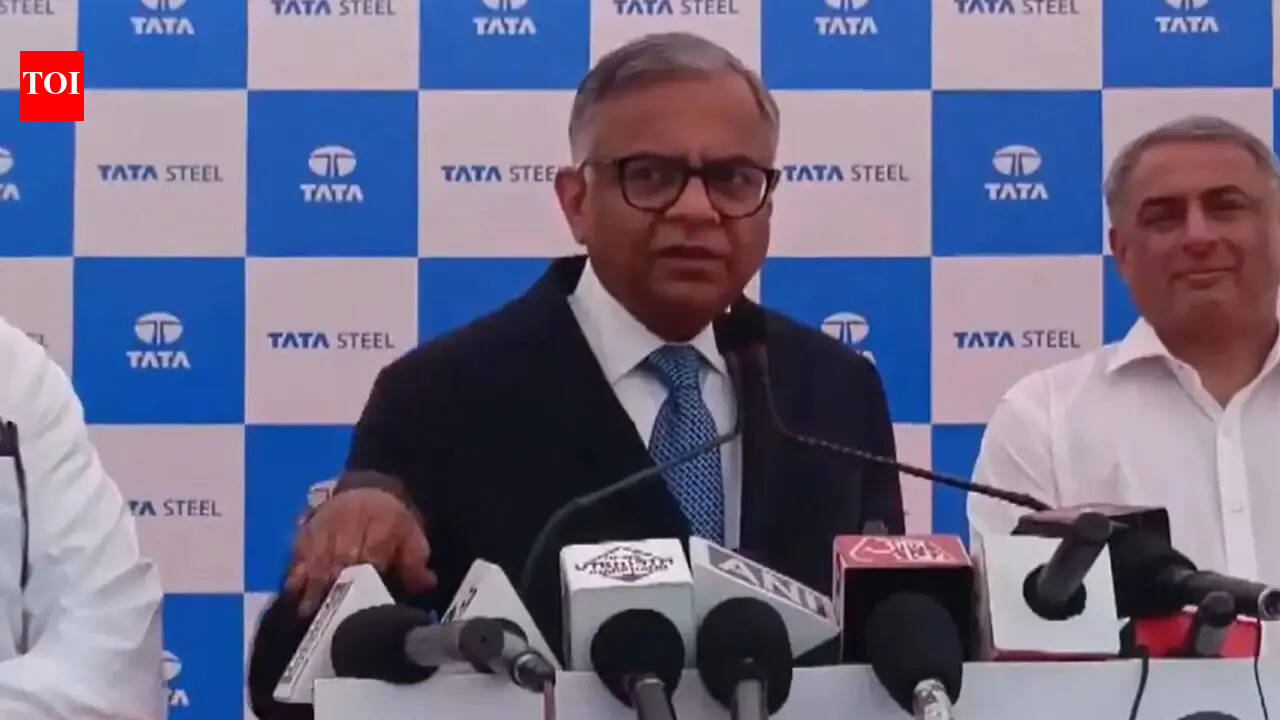
MUMBAI/ NEW DELHI: Air India’s mounting losses and operational issues are leading to serious concerns among both its parent groups. Goh Choon Phong, CEO of Singapore Airlines (SIA, which has a 25.1% stake in AI) is in Mumbai and is expected to meet Tata Sons and AI chairman N Chandrasekaran on Thursday.The meeting comes in the backdrop of AI scouting for a new CEO after the resignation of incumbent Campbell Wilson. The airline is also staring at a loss of over Rs 22,500 crore in FY 2026 and has sought fresh fund infusion from Tata and SIA. The Ahmedabad crash last June and the continued closure of Pakistan airspace since Operation Sindoor, followed by US-Iran war since Feb 28, made things worse for the already deep-in-losses Maharaja.AI did not comment on the likely losses for last fiscal and whether it has sought fund infusion from the promoters. While reviving AI, which spent its last few years as a PSU in abject penury till Tata acquired it along with AI Express on Jan 27, 2022, was never expected to be easy, the slow pace of change and mounting losses, have now put the strain on promoters.While SIA is seeing its profits decline due to AI losses, Tata Sons is under pressure over mounting losses of its new unlisted ventures, especially AI and Tata Digital. Addressing their concerns and sending a clear message to AI employees, Chandrasekaran had last week told them to “be precise on costs and remain grounded in the reality of the situation”.People in the know said Tatas knew turning around AI would be tough. That’s why they did not bid for the airline in 2018. The terms changed in 2021 in the second round and they successfully bid for it, with Ajay Singh of struggling-to-survive SpiceJet being the other bidder. “There is serious concern in SIA over both financial and reputational loss that AI is causing. Whether Thursday’s meeting between Choon Phong and Chandra is to decide on the new CEO or the hiccups AI is facing, will be discussed threadbare. There is also talk of SIA planning to pull out of AI but that seems unlikely,” said a person in the know.

Rachel Reeves has expanded plans to cut electricity bills for thousands of UK manufacturing firms as she continues talks in Washington focused on the economic fallout from the Iran conflict.
The Chancellor, who is in Washington for the International Monetary Fund (IMF) spring meetings, said the plan will help UK businesses compete and create jobs despite the uncertain economic backdrop.
During her trip, she has stepped up criticism of US-Israeli military action in Iran, saying war was a “mistake” and has not made the world a safer place.
Her comments came as she was due to meet US treasury secretary Scott Bessent, who has referred to the impact of the war as “short-term volatility for long-term gain” which he said would prevent Tehran developing a nuclear weapon.
Ms Reeves also cautioned against knee-jerk responses to the cost-of-living crisis triggered by the war in a joint statement with international counterparts at the IMF.
In a bid to help businesses hit by rising costs, a plan announced last summer to cut electricity bills by up to 25% for more than 7,000 UK businesses will be expanded to cover 10,000 firms.
The British Industrial Competitiveness Scheme (BICS) will cut costs by up to £40 per megawatt-hour from 2027 by exempting businesses from certain extra charges that currently support green energy and back-up power supply systems.
An additional one-off payment in 2027 will be given to an extra 3,000 businesses, including companies in the automotive, aerospace, steel and pharmaceuticals sectors.
The Government said it will also cover the support firms would have received if the BICS had been in place from this month.
The scheme is expected to be worth up to £600 million per year from next April.
Ms Reeves said: “This Government has the right plan for the economy: backing British industry, cutting electricity costs and building a stronger, more resilient future.
“Today’s announcement will cut energy bills for over 10,000 manufacturers, helping businesses to compete, win and create good jobs across the country, and to deliver our modern industrial strategy.”
Business Secretary Peter Kyle said: “We are a Government of action, and when global instability puts businesses under pressure we’ll always do what’s needed to support them and ensure Britain’s resilience.
“By extending the reach of BICS by 40%, we’re acting decisively to tackle the number one issue that businesses face head-on.”
Household energy bills are forecast to increase this year because of the conflict pushing up global oil and gas prices, while motorists are already feeling the impact of higher costs at the pump.
Ms Reeves has signalled that any energy bill help this year will be targeted at the poorest households, rather than a universal bailout of the type offered by Liz Truss when she was prime minister after the Russian invasion of Ukraine.
The White House has said talks are ongoing about holding fresh face-to-face negotiations between the US and Iran and that Washington had not yet formally requested an extension of the ceasefire due to expire next Tuesday.
Business
Goldman Sachs bond traders stumbled as Wall Street rivals thrived: ‘A fire is being lit under’ them

David Solomon, CEO Goldman Sachs, speaking on CNBC’s Squawk Box at the World Economic Forum in Davos, Switzerland on Jan. 22nd, 2026.
Oscar Molina | CNBC
When Goldman Sachs executives were asked about disappointing results in the firm’s fixed income division this week, they made it sound as though the trading environment was simply not in their favor.
Fixed income revenue fell 10% in the first quarter, coming in $910 million below analysts’ expectations, according to StreetAccount data. It was an unusually large miss for one of Goldman’s flagship Wall Street businesses.
“It was basically just a function of the overall environment making markets,” CFO Denis Coleman told an analyst on Monday after the bank’s earning report. “We remain actively engaged with clients, but our performance in rates and mortgages was relatively lower.”
But as nearly all of Goldman’s rivals, including JPMorgan Chase, Morgan Stanley and Citigroup, posted blockbuster results for first-quarter fixed income in the days that followed, one thing became clear to Wall Street: Goldman Sachs’ vaunted fixed income traders had underperformed.
JPMorgan saw fixed income trading revenue jump 21% to $7.1 billion, the bank’s second-biggest haul ever. Morgan Stanley, where fixed income is less a priority than equities, posted a 29% jump in the bond business. Citigroup saw bond trading revenue jump 13% to $5.2 billion.
Since before the 2008 financial crisis, when Lloyd Blankfein led Goldman Sachs, the firm’s fixed income division had been the envy of Wall Street. Goldman was known for its trading prowess, a reputation forged in periods of dislocation when its desks generated outsized gains. The bank’s identity as a trader’s firm — one expected to outperform in turbulent times — has endured in the decade-plus since.
That makes the first-quarter stumble particularly notable.
“It seems that something went wrong at Goldman in fixed income,” said veteran Wells Fargo analyst Mike Mayo, who called the bank’s results “worst-in-class.”
“I’d imagine that at Goldman, a fire is being lit under the traders, managers and risk overseers in FICC after such an underperformance,” Mayo said in an interview with CNBC, using an acronym standing for fixed income, currencies and commodities, the formal name for that business.
The prevailing theory is that Goldman was caught offsides on trades tied to interest rates in the first quarter, according to several market participants who asked for anonymity to speak candidly.
That’s because of the positioning that many Wall Street firms had at the start of this year, when markets were expecting the Federal Reserve to cut interest rates at least twice in 2026, these people said.
But after the price of oil surged with the advent of the Iran war, roiling expectations for inflation, the markets began pricing those cuts out, with some investors even bracing for the possibility of rate hikes this year.
Fixed income was the sole blemish on a quarter in which Goldman Sachs exceeded expectations handily, thanks to the firm’s equities traders and investment bankers. Despite the earnings beat, the firm’s shares dropped as much as about 4% on Monday following the report.
Goldman Sachs declined to comment. But on Monday, CEO David Solomon sought to put the quarter’s performance into context:
“When I look at the scale and the diversity of the business, it’s performing very, very well,” Solomon said during the company’s conference call. “Some quarters, it’s going to be stronger here, stronger there.”


PM hails Saudi economic support, highlights US-Iran peace efforts in MBS meeting

2026 NFL mock draft: Kiper’s pick predictions for Rounds 1-2
SIA chief set to meet Tata Sons and AI chairman N Chandrasekaran today – The Times of India

-

 Fashion1 week ago
India’s exports face reset as EU links trade to carbon metrics: EY
-

 Entertainment1 week ago
Queen Elizabeth II emotional message for Archie, Lilibet sparks speculation
-

 Entertainment1 week ago
Lamar Odom shocking response to Khloé Kardashian account of his overdose
-

 Tech1 week ago
Azure customers up in arms over ‘full’ UK South region | Computer Weekly
-

 Tech1 week ago
As the Strait of Hormuz Reopens, Global Shipping Will Take Months to Recover
-

 Fashion1 week ago
CII submits 20-pt agenda to Indian govt to back firms hit by Iran war
-

 Tech7 days ago
This AI Button Wearable From Ex-Apple Engineers Looks Like an iPod Shuffle
-

 Politics6 days ago
Indian airlines hit hardest after Dubai limits foreign flights until May 31