

Business
Renewables overtake coal as world’s biggest source of electricity

 Justin RowlattClimate Editor
 AFP via Getty Images
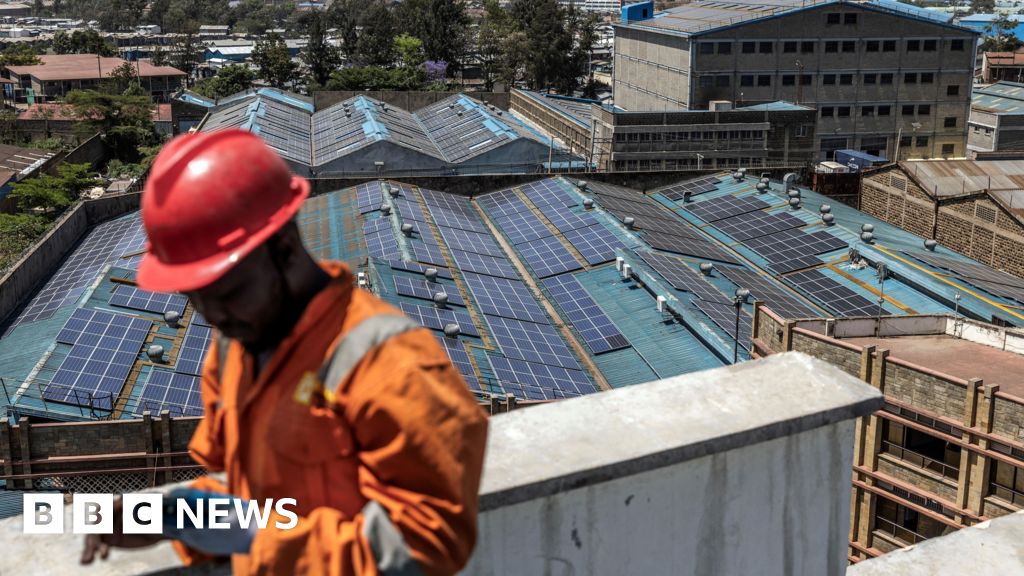
Renewable energy overtook coal as the world’s leading source of electricity in the first half of this year – a historic first, according to new data from the global energy think tank Ember.
Electricity demand is growing around the world but the growth in solar and wind was so strong it met 100% of the extra electricity demand, even helping drive a slight decline in coal and gas use.
However, Ember says the headlines mask a mixed global picture.
Developing countries, especially China, led the clean energy charge but richer nations including the US and EU relied more than before on planet-warming fossil fuels for electricity generation.
This divide is likely to get more pronounced, according to a separate report from the International Energy Agency (IEA). It predicts renewables will grow much less strongly than forecast in the US as a result of the policies of President Donald Trump’s administration.
Coal, a major contributor to global warming, was still the world’s largest individual source of energy generation in 2024, a position it has held for more than 50 years, according to the IEA.
China remains way ahead in clean energy growth, adding more solar and wind capacity than the rest of the world combined. This enabled the growth in renewable generation in China to outpace rising electricity demand and helped reduce its fossil fuel generation by 2%.
India experienced slower electricity demand growth and also added significant new solar and wind capacity, meaning it too cut back on coal and gas.
In contrast, developed nations like the US, and also the EU, saw the opposite trend.
In the US, electricity demand grew faster than clean energy output, increasing reliance on fossil fuels, while in the EU, months of weak wind and hydropower performance led to a rise in coal and gas generation.
In a separate report the IEA has halved its forecast for the growth of renewable energy in the US this decade. Last year, the agency predicted the US would add 500GW of new renewable capacity – mostly from solar and wind – by 2030. That has been cut that back to 250GW.
The IEA analysis represents the most thorough assessment to date of the impact the Trump administration’s policies are having on global efforts to transition to cleaner energy sources and underscores the dramatically different approach of the US and China.
As China’s clean tech exports surge, the US is focusing on encouraging the world buy more of its oil and gas.
 Getty Images
‘Crucial’ turning point
Despite these regional differences, Ember calls this moment a “crucial turning point”.
Ember senior analyst Malgorzata Wiatros-Motyka said it “marks the beginning of a shift where clean power is keeping pace with demand growth”.
Solar power delivered the lion’s share of growth, meeting 83% of the increase in electricity demand. It has now been the largest source of new electricity globally for three years in a row.
Most solar generation (58%) is now in lower-income countries, many of which have seen explosive growth in recent years.
That’s thanks to spectacular reductions in cost. Solar has seen prices fall a staggering 99.9% since 1975 and is now so cheap that large markets for solar can emerge in a country in the space of a single year, especially where grid electricity is expensive and unreliable, says Ember.
Pakistan, for example, imported solar panels capable of generating 17 gigawatts (GW) of solar power in 2024, double the previous year and the equivalent of roughly a third of the country’s current electricity generation capacity.
Africa is also experiencing a solar boom with panel imports up 60% year on year, in the year to June. Coal-heavy South Africa led the way, while Nigeria overtook Egypt into second place with 1.7GW of solar generating capacity – that’s enough to meet the electricity demand of roughly 1.8m homes in Europe.
Some smaller African nations have seen even more rapid growth with Algeria increasing imports 33-fold, Zambia eightfold and Botswana sevenfold.
In some countries the growth of solar has been so rapid it is creating unexpected challenges.
In Afghanistan, widespread use of solar-powered water pumps is lowering the water table, threatening long-term access to groundwater. A study by Dr David Mansfield and satellite data firm Alcis warns that some regions could run dry within five to ten years, endangering millions of livelihoods.
Adair Turner, chair of the UK’s Energy Transitions Commission, says countries in the global “sun belt” and “wind belt” face very different energy challenges.
Sun belt nations – including much of Asia, Africa, and Latin America – need large amounts of electricity for daytime air conditioning. These countries can significantly reduce energy costs almost immediately by adopting solar-based systems, supported by increasingly affordable batteries that store energy from day to night.
Wind belt countries like the UK face tougher obstacles, however. Wind turbine costs have not come down by anything like as much as solar panels – down just a third or so in the last decade. Higher interest rates have also added to borrowing costs and raised the overall price of installing wind farms significantly in the last few years.
Balancing supply is harder too: winter wind lulls can last for weeks, requiring backup power sources that batteries alone can’t provide – making the system more expensive to build and run.
But wherever you are in the world, China’s overwhelming dominance in clean tech industries remains unchallenged, other new data from Ember shows.
In August 2025, its clean tech exports hit a record $20bn, driven by surging sales of electric vehicles (up 26%) and batteries (up 23%). Together, China’s electric vehicles and batteries are now worth more than twice the value of its solar panel exports.

Business
India’s FDI inflow may cross $90 billion in FY26, says DPIIT secretary – The Times of India

India’s total foreign direct investment (FDI) inflows are likely to cross $90 billion in 2025-26 after already surpassing $88 billion during April-February, a top government official said on Thursday.DPIIT Secretary Amardeep Singh Bhatia said the government had undertaken a series of policy measures to attract foreign investments into the country, PTI reported.He said that during April-February 2025-26, inflows had crossed $88 billion and were “hopefully crossing $90 billion” for the full fiscal year.According to Bhatia, reform measures, free trade agreements and India’s fast-growing economy are helping the country attract strong investment flows.This reflects continued momentum in foreign investment inflows amid the government’s push to improve ease of doing business and expand global trade linkages.

“It does seem as though escalation in the war is back on the table, be it in the guise of the US continuing its blockade in Iran, but also reports and rumours that in order to get out of this bind, Iran may start to strike again,” said Naveen Das, senior oil analyst at Kpler.
Business
Gold, silver price prediction: Will gold head down to Rs 1.40 lakh/10 grams & silver hit Rs 2.20 lakh/kg? – The Times of India

Gold and silver price prediction today: Gold and silver are exhibiting a slightly bearish bias, according to Abhilash Koikkara, Head – Forex & Commodities, Nuvama Professional Clients Group.
MCX Gold Price Outlook
MCX Gold, on the weekly timeframe, has retreated from its recent highs and remained under selling pressure over the past week. From a technical standpoint, prices have faced resistance at a significant trendline, with the daily chart now forming a sequence of lower lows, a classically bearish pattern. A sustained breakout above the trendline, however, could shift sentiment and invite fresh upside. For now, the intermediate trend remains rangebound to negative, reflecting a broader corrective structure, with a firm break below key support potentially accelerating the downside.Looking ahead to the coming week, the region around the weekly low of 140,000 is anticipated to emerge as a pivotal support zone, highlighting its importance from a technical perspective. As the ongoing correction runs its course, prices are expected to test this level making any short-term uptick a potential opportunity for fresh short positions rather than a cause for bullish conviction.Conversely, gold faces a notable resistance wall around the recent peak of 155,500 in the near term. Should prices manage a convincing breakout above this threshold, it would effectively invalidate the current bearish momentum and pave the way for a fresh upside move. A consistent hold above this level, moreover, would offer stronger confirmation that the corrective phase has run its course, and bullish sentiment has reclaimed control.To summarize, gold’s overall bias remains tilted to the downside, supported by a determined negative trend that keeps further losses on the table. The intermediate bearish framework is expected to stay intact so long as prices fail to reclaim the key resistance threshold of 155,500. With momentum indicators reinforcing the bearish case and market sentiment echoing the downside narrative, the metal looks poised to sustain its corrective momentum and press lower in the near term.
MCX Gold Trading Strategy
- CMP: 149,000
- Target: 140,000
- Stoploss: 155,500
MCX Silver Price Outlook
From a weekly standpoint, silver’s price action reflects a sideways to bearish bias, as the silver faces conflict at trendline resistance. The second straight week of negative closes reinforces the case for an intermediate bearish period taking hold. In this setting, we expect traders would be well-served to align their positions with the dominant trend while placing stop-loss levels around the prior weekly highs to effectively manage downside risk.The market opened the week on a weak footing, with prices trading below the 30-day Exponential Moving Average (EMA), a sign that the negative bias remains in force. The bearish outlook is likely to persist as long as prices stay capped under key weekly resistance levels. Immediate support and the near-term target converge around the recent swing lows at 220,000, and a decisive close below this level could further deepen bearish bias. In the interim, any short-term bounce back is expected to be treated as opportunities to sell.To the upside, silver appears poised to challenge the trendline resistance in the area of 255,000 in the coming sessions. If the prices manage a convincing and sustained close above this threshold, it will weaken the ongoing bearish trend, a view currently reinforced by momentum indicators. On balance, the bearish structure is likely to remain dominant as long as 255,000 continues to act as a ceiling, paving the way for additional downside corrections ahead.
MCX Silver Trading Strategy
- CMP: 240,500
- Target: 220,000
- Stoploss: 255,000
(Disclaimer: Recommendations and views on the stock market, other asset classes or personal finance management tips given by experts are their own. These opinions do not represent the views of The Times of India)


Sandra Bullock reportedly shares ‘natural chemistry’ with THIS star
India’s FDI inflow may cross $90 billion in FY26, says DPIIT secretary – The Times of India

Middle East conflict hits UK exports, down 20%: BCC

Us-India Trade Talks: US–India trade deal: Where do talks stand & what to expect – explained – The Times of India
UK inflation accelerates after Iran war drives sharp rise in fuel prices

PSL 11: Hyderabad Kingsmen opt to field after winning toss against Multan Sultans

-
Business1 week ago
Us-India Trade Talks: US–India trade deal: Where do talks stand & what to expect – explained – The Times of India
-
Business1 week ago
UK inflation accelerates after Iran war drives sharp rise in fuel prices
-
 Sports1 week ago
PSL 11: Hyderabad Kingsmen opt to field after winning toss against Multan Sultans
-
 Business1 week ago
Trump administration in advanced talks for a rescue package for Spirit Airlines, source says
-

 Tech1 week ago
Nation states responsible for ‘nationally significant’ cyber attacks against UK, says NCSC chief | Computer Weekly
-

 Tech1 week ago
Microsoft faces court battle in £2bn Windows Server class action | Computer Weekly
-

 Tech1 week ago
Blackbox replaces two racks of HPE storage with 8U of Everpure | Computer Weekly
-

 Fashion1 week ago
Bangladesh RMG units call for allowing local FOC raw material sourcing