

Business
Stamp duty: Five ways abolishing the tax could change the housing market

Kevin PeacheyCost of living correspondent
 Getty Images
The debate around stamp duty is intensifying. When Kemi Badenoch said a future Conservative government would abolish it on the purchase of main homes, it went down well at the Tory Party conference.
There has also been speculation that the Chancellor, Rachel Reeves, is considering replacing it.
Scrapping stamp duty would be popular among some home buyers, including first-time buyers. There’s been widespread support in the housing sector as well as among some independent economists.
Analysts say there would be some significant consequences of scrapping stamp duty for primary residences, affecting buyers, sellers and the wider UK economy.
1. House prices might rise
Whenever there has been a temporary easing of stamp duty, such as in the immediate aftermath of the Covid lockdowns, house prices have then risen.
It is more difficult to judge whether a permanent abolition would have the same long-term impact on prices as the short-term sweetener of a stamp duty holiday.
However, greater demand is likely to feed through to asking prices.
“If, and this is a big if, it is a simple tax giveaway, the likelihood is that the current stamp duty bill simply passes through into prices,” says Lucian Cook, head of residential research at Savills.
In turn, that could mean first-time buyers paying less in stamp duty, but having to find a bigger deposit.
“Given the way stamp duty works, this would be unevenly distributed across the country,” Mr Cook added.
The most obvious point here is that the government in Westminster can only control stamp duty in England and Northern Ireland. Scotland and Wales have their own land and transaction taxes overseen by the devolved administrations.
2. Tax cut for wealthy
A swathe of first-time buyers do not pay stamp duty. That’s because, in England and Northern Ireland, they are exempt when buying properties of up to £300,000.
“For them, the enormous challenge is raising a deposit,” says Sarah Coles, head of personal finance at investment platform Hargreaves Lansdown.
Data from property portal Rightmove suggests that 40% of homes for sale in England are stamp duty free for first-time buyers.
While the vast majority of movers pay stamp duty, the rate increases at certain price thresholds.
So, the bigger the home, the bigger the benefit, if stamp duty was scrapped.
This will also mean a big regional difference in the impact of such a policy.
At the moment, 76% of properties on sale in the North East of England are free of stamp duty for first-time buyers, according to Rightmove’s figures. In London, it is only 11%.
Richard Donnell, from Zoopla, points out that 60% of all stamp duty is paid in southern England – so the majority of the benefit of abolition would be felt in the south.
3. Easier to find somewhere to move to
One of the great selling points of stamp duty abolition is the extra mobility it should provide for workers, buyers, sellers and downsizers, according to experts.
“Homeownership is the foundation of a fairer and more secure society – but stamp duty has denied that opportunity to too many for too long,” says Paula Higgins, chief executive of the Homeowners Alliance.
“Our research shows over 800,000 homeowners have shelved moving plans in the past two years, and stamp duty is a major barrier.”
The Institute for Fiscal Studies (IFS), an independent economic think tank, describes stamp duty as “one of the most econmically damaging taxes”. In its most recent analysis, it says particular winners will be those who want to move frequently, to more or less expensive homes.
It should, for example, clear an obstacle for older homeowners, who want to sell a family home but are discouraged by stamp duty. If they are more likely to move, then their homes become available to younger families and the whole market becomes more fluid.
However, others suggest the influence of stamp duty could be overblown.
“Take someone downsizing, from a £750,000 property to a £300,000 one. In England and Northern Ireland, they’d pay £5,000 in stamp duty. It’s a fraction of what they’re likely to pay in estate agency fees, and sits along a huge range of costs from conveyancing to removals,” Ms Coles from Hargreaves Lansdown says.
“It begs the question of whether removing the cost of the tax is a gamechanger.”
4. Potential tax rises elsewhere
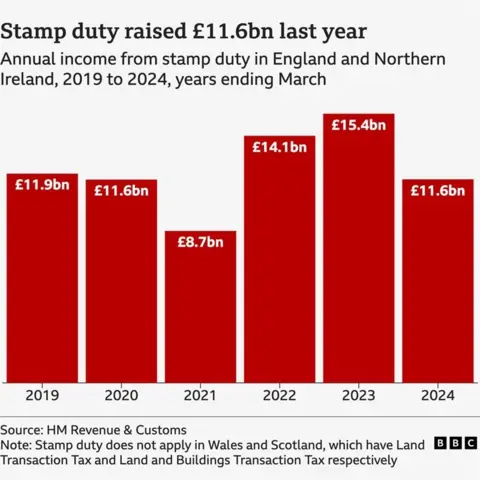
Stamp duty raises a lot of money for the Treasury, so scrapping it would leave a gap in the public finances.
The IFS said that the direct cost of the Conservative policy might be around £10.5bn to £11bn in 2029-30, although the Tories’ own estimate is about £9bn.

The question for any administration tempted to scrap or reduce stamp duty is how else it finds the money.
The Conservatives say they will make savings elsewhere. They also say the policy will boost growth and the housing sector in general, and therefore bring in more tax receipts.
The other option is to raise other taxes. As some analysts have said, the main consideration is not what is scrapped, but what replaces it.
5. Impact on renters
The idea of scrapping stamp duty for primary residences will benefit homeowners but could end up meaning less choice for renters.
The IFS suggests it could discourage the purchase of rental properties by landlords, as they would still have to pay stamp duty.
The think tank says it would increase the more favourable tax treatment of owner-occupation relative to renting.

Jenny Lennick’s colourful hair clips are sold across the US and around the world.
Source link

Lululemon store sign in London, March 2, 2026.
Peter Dazeley | Getty Images
Lululemon on Wednesday named Heidi O’Neill as the athleisure company’s new CEO, effective Sept. 8.
The news comes after the company has seen more than a year of disappointing performance and is embroiled in a dramatic proxy battle, with founder Chip Wilson criticizing the business.
Shares of the company sank more than 5% in extended trading.
O’Neill has held multiple roles at Nike, contributing to the sportswear behemoth’s growth. She also held positions at Levi Strauss, Hyatt Hotels and Spotify.
“Heidi is an inspiring leader and proven, consumer-driven brand strategist, with a rare ability to both imagine a new future for a brand and to create the structure and processes to deliver on that vision,” said Marti Morfitt, Lululemon’s executive chair of the board of directors, in a statement. “We selected Heidi because of the breadth of her experience, her demonstrated success delivering breakthrough ideas and initiatives at scale, and her ability to be a knowledgeable change and growth agent.”
O’Neill said in a statement that she plans to focus on building off of the company’s core foundation and unlock growth in global markets. O’Neill will start with a base salary of $1.4 million, according to an 8-K filing.
“I am humbled by the opportunity and energized by what the team is already building,” she said in her statement. “I look forward to joining the company and helping to define and deliver the organization’s next chapter of success.”
Lululemon has been struggling with weak sales and increased competition, as well as mounting costs from tariffs. In its last earnings report, the retailer said it expects tariffs to cost the company $380 million this year.
Wilson, Lululemon’s largest shareholder, has also been placing increased public pressure on the company to make changes to its board of directors. He did not immediately respond to a request to comment on the appointment.
In a statement, GlobalData managing director Neil Saunders said O’Neill has “a very strong pedigree in the activewear and sporting space” and “has an intimate knowledge of how the industry works.”
“There will be some, mostly activist investors, who see O’Neill as something of a safe and traditional choice,” Saunders said. “This argument is partly valid as a lot of cultural change is needed at Lululemon in order to improve performance. However, in our view, O’Neill is her own person who will come with an agenda of change.”
While at Nike, O’Neill played a key role in the company’s doomed direct-to-consumer sales strategy, where the brand pivoted away from wholesale partners in favor of its own website and stores under former CEO John Donahoe. When current CEO Elliott Hill took over as Nike’s next chief executive, he made it a priority to walk back the direct-selling plan.
Prior to leaving Nike, O’Neill also oversaw product and innovation at a time when the brand faced criticism for falling behind on new products and focusing too heavily on the same legacy lifestyle franchises, Dunks, Air Force Ones and Air Jordans. While the franchises briefly led to a surge in sales, fueling Nike’s growth to a $50 billion-plus brand, they ultimately became ubiquitous in the market and viewed as uncool by some consumers.
Now, Hill is still working on unwinding that strategy and clearing inventory from those franchises from the marketplace, which has hit Nike’s margins and led to a decline in sales online.

A Southwest Airlines Boeing 737 airplane lands at Los Angeles International Airport after arriving from Chicago on March 7, 2026 in Los Angeles, California.
Kevin Carter | Getty Images
Southwest Airlines forecast second-quarter earnings below analyst estimates, citing higher fuel prices, while holding off on updating its full-year 2026 forecast.
Southwest expects to earn between 35 cents and 65 cents a share in the current quarter, while analysts polled by LSEG expected 55 cents a share.
The airline in January forecast earnings per share of $4 this year, saying that it expected its new initiatives would pay off. Southwest has sought to increase revenue with checked bag fees and seat assignment fees.
“Achieving this outcome would require lower fuel prices and/or stronger revenue performance to offset higher fuel expense. The Company expects to provide updates to this guidance as appropriate,” Southwest said in an earnings release Wednesday.
Airlines have been either cutting their full-year forecasts or holding off on further forecasts because of volatile prices for jet fuel, generally their biggest expense after labor. They are also pulling back on their capacity growth plans to cut costs, which can drive up airfare when fewer seats are for sale.
Southwest said it expects its capacity to be flat to up no more than 1% in the second quarter, and unit revenues to rise by 16.5% to as much as 18.5% over last year.
“Demand continues to be strong, and we remain focused on controlling what we can control by managing costs, optimizing revenue initiatives, and directing capacity toward higher‑return opportunities,” CEO Bob Jordan said in the earnings release.
Here’s what the company reported for first quarter compared with Wall Street expectations, according to consensus estimates from LSEG:
- Earnings per share: 45 cents vs. 47 cents cents expected
- Revenue: $7.25 billion vs. $7.27 billion expected
Southwest swung to a profit of $227 million, or 45 cents a share in the first quarter, compared with a $149 million loss, or a loss of 26 cents per share, a year earlier.
Revenue rose nearly 13% to $7.25 billion compared with $6.43 billion in the year-earlier period.


‘RHOA’ alum and Kim Zolciak’s ex was 68

2026 NFL Draft Odds: Draft Positions for Ty Simpson, Jeremiyah Love, More
How a pivot to hair accessories led to business success

-

 Fashion7 days ago
France’s LVMH Q1 revenue falls 6%, shows resilience amid Iran war
-

 Entertainment1 week ago
Is Claude down? Here’s why users are seeing errors
-

 Tech1 week ago
The Deepfake Nudes Crisis in Schools Is Much Worse Than You Thought
-

 Tech1 week ago
Bremont Is Sending a Watch to the Moon’s Surface
-

 Sports1 week ago
PSL 11: Peshawar Zalmi win toss, opt to field first against Quetta Gladiators
-

 Tech1 week ago
Human-machine teaming dives underwater
-
 Business1 week ago
Standard Life buys rival in £2b deal to create savings giant
-
 Business1 week ago
BP sees ‘exceptional’ oil trading result as Iran war sends crude costs soaring