Business
China has found Trump’s pain point – rare earths
Osmond ChiaBusiness reporter
ReutersLast week, China’s Ministry of Commerce published a document that went by the name of “announcement No. 62 of 2025”.
But this wasn’t just any bureaucratic missive. It has rocked the fragile tariffs truce with the US.
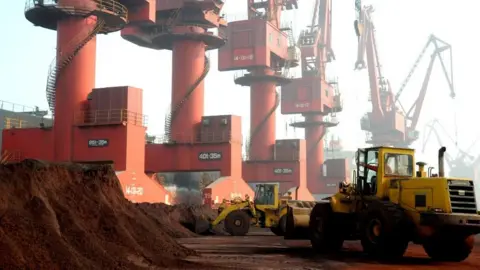
The announcement detailed sweeping new curbs on its rare earth exports, in a move that tightens Beijing’s grip on the global supply of the critical minerals – and reminded Donald Trump just how much leverage China holds in the trade war.
China has a near-monopoly in the processing of rare earths – crucial for the production of everything from smartphones to fighter jets.
Under the new rules, foreign companies now need the Chinese government’s approval to export products that contain even a tiny amount of rare earths and must declare their intended use.
In response, US President Donald Trump threatened to impose an additional 100% tariff on Chinese goods and put export controls on key software.
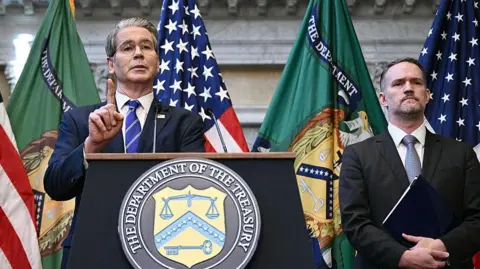
“This is China versus the world. They have pointed a bazooka at the supply chains and the industrial base of the entire free world, and we’re not going to have it,” said US Treasury Secretary Scott Bessent.
On Thursday, China said the US had “deliberately provoked unnecessary misunderstanding and panic” over the rare earths restrictions.
“Provided the export licence applications are compliant and intended for civilian use, they will be approved,” a commerce ministry spokesperson added.
This week, the world’s two biggest economies also imposed new port fees on each other’s ships.
The flare-up in the trade war brings to an end months of relative calm after top US and Chinese officials brokered a truce in May.
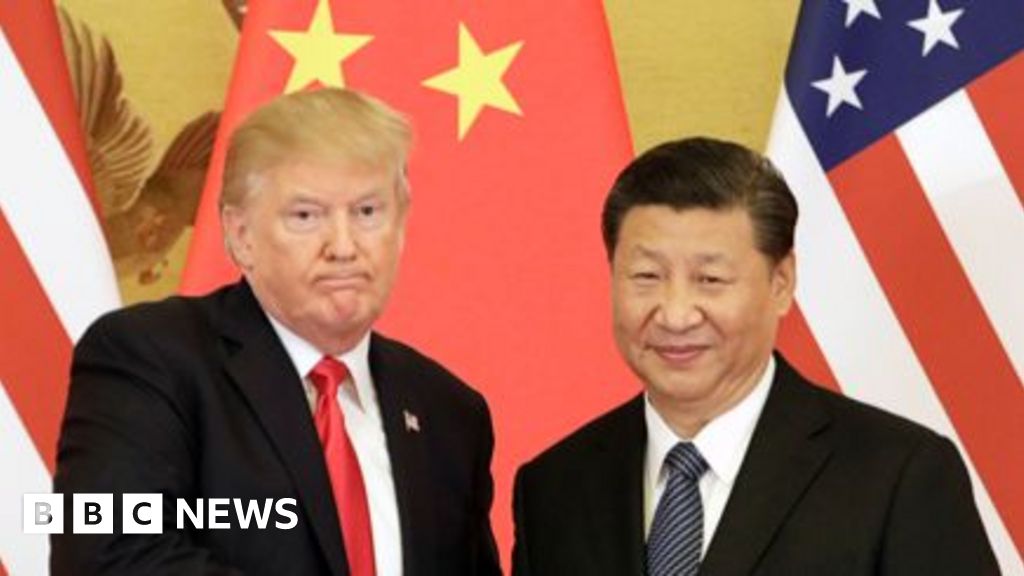
Later this month, Trump and China’s President Xi Jinping are expected to meet and experts have told the BBC the rare earths restrictions will give China the upper hand.
China’s new controls are bound to “shock the system” as they target vulnerabilities in American supply chains, said international business lecturer Naoise McDonagh from Australia’s Edith Cowan University.
“The timing has really upset the kind of timeline for negotiations that the Americans wanted,” he added.

Getty ImagesRare earth minerals are essential for the production of a whole range of technology such as solar panels, electric cars and military equipment.
For example, a single F-35 fighter jet is estimated to need more than 400kg (881.8lb) of rare earths for its stealth coatings, motors, radars and other components.
China’s rare earth exports also account for around 70% of the world’s supply of metals used for magnets in electric vehicle motors, said Natasha Jha Bhaskar from advisory firm the Newland Global Group.
Beijing has worked hard to gain its dominance of the global rare earth processing capacity, said critical minerals researcher Marina Zhang from the University of Technology Sydney.
The country has nurtured a vast talent pool in the field, while its research and development network is years ahead of its competitors, she added.
While the US and other countries are investing heavily to develop alternatives to China for supplies of rare earths, they are still some way from achieving that goal.
With its own large deposits of rare earths, Australia has been tipped as a potential challenger to China. But its production infrastructure is still underdeveloped, making processing relatively expensive, Ms Zhang said.
“Even if the US and all its allies make processing rare earths a national project, I would say that it will take at least five years to catch up with China.”
The new restrictions expand measures Beijing announced in April that caused a global supply crunch, before a series of deals with Europe and the US eased the shortages.
The latest official figures from China show that exports of the critical minerals were down in September by more than 30% compared to a year ago.
But analysts say China’s economy is unlikely to be hurt by the drop in exports.
Rare earths make up a very small part of China’s $18.7tn a year economy, said Prof Sophia Kalantzakos from New York University.
Some estimates put the value of the exports at less than 0.1% of China’s annual gross domestic product (GDP).
While rare earths’ economic value to China may be tiny their strategic value “is huge”, she said, as they give Beijing more leverage in talks with the US.
Despite accusing China of “betrayal”, Bessent has left the door open to negotiations.
“I believe China is open to discussion and I am optimistic this can be de-escalated,” he said.
During a meeting with the US private equity group Blackstone’s chief executive Stephen Schwarzman on Thursday, China’s Foreign Minister Wang Yi also highlighted the need for talks.
“The two sides should engage in effective communication, properly resolve differences and promote stable, healthy and sustainable development of China-US relations,” Wang said, according to the ministry’s website.
What China has done recently is “getting its ducks in a row” ahead of those trade talks with the US, said Prof Kalantzakos.
In curbing rare earth exports, Beijing has found its “best immediate lever” to pressure Washington for a favourable deal, Ms Bhaskar said.
Getty ImagesJiao Yang from Singapore Management University believes that although Beijing holds the cards in the short-run, Washington does have some strategic options at its disposal.
The US could offer to lower tariffs, which is likely to be attractive to Beijing as the trade war has hit its manufacturers hard, said Prof Jiao said.
China’s economy is reliant on the income from the goods it makes and exports. The latest official figures show its exports to the US were down by 27% compared to a year ago.
Washington can also threaten to hit China with more trade restrictions to hamper efforts to develop its technology sector, said Prof McDonagh.
For example, the White House has already targeted China’s need for high-end semiconductors by blocking its purchases of Nvidia’s most advanced chips.
But experts say that is likely to have only limited effects.
Measures targeting Beijing’s tech industry may slow China but won’t “stop it dead in the water,” said Prof McDonagh.
China has shown with its recent economic strategy that it is willing to take some pain to achieve its long-term goals, he added.
“China can carry on even if it costs a lot more under US export controls.
“But if China cuts off these rare earth supplies, that can actually stop everyone’s industry. That’s the big difference.”
Business
Coffeemakers are the new centerpiece? India’s growing craze for cafe-like coffee at home; lakhs splurged on aroma and style – The Times of India
Spent a fortune on a coffee machine and those exotic beans to replicate that cappuccino you loved overseas? You are not alone. For many rich Indians, the coffee machine on the kitchen counter is no longer just for making a drink, rather it has become a lifestyle statement, as more people are trying to bring the cafe experience they enjoyed overseas, right in their homes.A growing number of young, affluent consumers are spending several lakh rupees on high-end coffee machines, specialty beans and cafe-style equipment to mirror the ambience of European coffee houses. These machines, which offer far more than basic espresso or latte functions, have become objects of prestige. Brands such as Versuni, SMEG and DeLonghi are increasingly being displayed as centrepieces in kitchens and lounges, erasing the line between appliance and art.
India’s coffee craze
From only a few hunderds six years ago, now, almost 20,000 premium coffee machines are estimated to be sold locally, every year, a figure that includes direct imports by companies, ET reported. This does not includes the large number of machines that individuals bring into the country themselves while travelling abroad or order through international e-commerce platforms. With limited availability of high-end brands and models in India, parallel imports continue to rise. Ravi Saxena, founder and chief executive of Wonderchef Home Appliances, links this trend to the rapid spread of neighbourhood cafes across Indian cities. He says this has created strong interest in recreating cafe-quality coffee at home. A trained barista, Saxena sells about 1.4 lakh coffee machines a year, including premium automatic models priced between Rs 60,000 and Rs 90,000. The appetite for premium machines is also visible among frequent international travellers. Gurgaon-based hotelier Rajat Gera placed an order for an SMEG machine in December for Rs 1.3 lakh and is still waiting for it to arrive at Indian ports. “It’s a piece of art that deserves to be placed as a centrepiece in the kitchen or lounge,” he says. The overall coffee machine market in India is valued at Rs 250–300 crore and is growing at more than 15% a year. Total sales across price categories reached about 4.2–4.5 lakh units in the last calendar year, compared with roughly 1.8 lakh units in 2019. While machines priced up to Rs 15,000 continue to dominate volumes, premium models are steadily expanding their share.
Struggling for the right taste
For some buyers, the shift is rooted in dissatisfaction with cafe offerings at home. Satyendra Shukla, who runs a boutique investment firm, bought a La Carimali machine for Rs 1.5 lakh two years ago. “I had to struggle for every cup of coffee in India. No cafe could give me coffee I liked. The right texture, temperature or taste seldom came together. Now, my well travelled friends say I make the best coffee. I look after the machine and spend a lot of time sourcing the best beans.” Others are prepared to absorb heavy import costs. Kolkata-based independent professional A Banerjee purchased a Philips machine priced at Rs 57,000 from Amazon UK for Rs 95,000 after accounting for shipping, customs duties and currency conversion. Gulbahar Taurani, chief executive of Versuni India, attributes rising demand to young consumers exploring different beans, flavours, aromas and brewing styles, including coffee mocktails mixed with tonic water. He said the company’s pilot launch of premium models priced up to Rs 80,000 in India has been highly successful. Versuni plans to combine its global technology with adaptations for Indian preferences. While its entire range is currently imported, Taurani has not ruled out domestic manufacturing as volumes grow. Retailers are also reporting strong traction. Coffee machines are among the fastest-moving categories in stores. Vijay Sales sells 400–500 units every month. “Coffee machines have become a lifestyle product. While most of the demand is still in the entry- to mid-segment, premium models are also selling fast. This could become a big category in the next three to four years,” said Nilesh Gupta, director, Vijay Sales. What was once a simple kitchen tool is rapidly turning into a lifestyle statement, as coffee drinkers in the country are investing not just in caffeine, but in culture and cachet at home.
Business
Bharat Coking Coal IPO To List Tomorrow: GMP Indicates Over 50% Bumper Gains
Last Updated:
Bharat Coking Coal IPO, a Coal India subsidiary, lists on BSE and NSE January 19, 2026, with a strong GMP.
Bharat Coking Coal IPO: Listing Price Prediction. Shares to be listed tomorrow, January 19, 2026.
Bharat Coking Coal IPO Listing Price Prediction, GMP: The allotment of the Bharat Coking Coal IPO was concluded on January 14, 2026. Now, investors are eyeing the listing of the shares on the Bombay Stock Exchange (BSE) and National Stock Exchange (NSE), which is likely to take place on Monday, January 19, 2026.
The investors who have been allotted the unlisted shares of the Bharat Coking Coal IPO might be checking the grey market premium regularly.
The IPO was open for public subscription between January 9 and January 13. It received a massive overall subscription of 143.85 times subscription. Its retail category received 49.37x subscription, its non-institutional investor (NII) category received 240.49 times subscription, and its qualified institutional buyer (QIB) portion got 310.81 times bidding.
Bharat Coking Coal IPO Listing Date
The shares of Bharat Coking Coal Ltd (BCCL), a subsidiary of Coal India Ltd (CIL), will be listed on both the BSE and the NSE on January 19, Monday.
Bharat Coking Coal IPO Listing Price Prediction, GMP Today
According to market observers, unlisted shares of Bharat Coking Coal Ltd are currently trading at Rs 35.4 apiece in the grey market, which is a 53.91 per cent premium over the IPO price of Rs 23. It indicates a strong listing gains for investors. Its listing will take place on Monday, January 19.
The GMP is based on market sentiments and keeps changing. ‘Grey market premium’ indicates investors’ readiness to pay more than the issue price.
Bharat Coking Coal IPO Allotment Status
The Bharat Coking Coal IPO allotment has already been finalised.
The allotment status can be checked online by following these steps:
Via Official Registrar
1) Visit registrar Kfin Technologies’ portal – https://ipostatus.kfintech.com/.
2) Under ‘Select Company’, select ‘Bharat Coking Coal Limited’ from the drop-box.
3) Enter your application number, demat account, or permanent account number (PAN).
5) Then, click on the ‘Submit’ button.
Your share application status will appear on your screen.
Via the BSE
1) Go to the official BSE website via the URL — https://www.bseindia.com/investors/appli_check.aspx.
2) Under ‘Issue Type’, select ‘Equity’.
3) Under ‘Issue Name’, select ‘Bharat Coking Coal Limited’ in the drop box.
4) Enter your application number, or the Permanent Account Number (PAN). Those who want to check their allotment status via PAN can select the ‘Permanent Account Number’ option.
5) Then, click on the ‘I am not a robot’ to verify yourself and hit the ‘Search’ option.
Your share application status will appear on your screen.
Via NSE’s Website
The allotment status can also be checked on the NSE’s website at https://www.nseindia.com/invest/check-trades-bids-verify-ipo-bids.
Bharat Coking Coal IPO: More Details
According to the red herring prospectus (RHP), the maiden public issue is entirely an offer for sale (OFS) of 46.57 crore equity shares by Coal India.
The listing of BCCL is part of the government’s broader divestment push in the coal sector, aimed at unlocking value in Coal India’s subsidiaries and enhancing transparency through market discipline.
In its prospectus, the company stated that the IPO will help achieve the benefits of listing.
BCCL will make its stock market debut on January 16. The company said that half of the issue size has been reserved for qualified institutional buyers, 35 per cent for retail investors and the remaining 15 per cent for non-institutional investors.
Last year, Central Mine Planning and Design Institute Ltd (CMPDIL), another wholly-owned arm of Coal India, had also filed its draft papers with Sebi for an IPO via the OFS route.
While BCCL is a coal-producing entity, CMPDIL serves as Coal India’s technical and planning arm.
Bharat Coking Coal was the largest coking coal producer in India in fiscal 2025, according to a Crisil report. It produces various grades of coking coal, non-coking coal and washed coals for applications primarily in the steel and power industries.
The company was incorporated in 1972 to mine and supply coking coal concentrated in mines located at Jharia, Jharkhand and Raniganj, West Bengal coalfields.
The public sector firm has expanded operations significantly over the years, with coal production increasing from 30.51 million tonnes in fiscal 2022 to 40.50 million tonnes in fiscal 2025, which is an increase of 33 per cent. Its coal production stood at 15.75 million tonnes in the six months ended September 30, 2025, as compared to 19.09 million tonnes in the year-ago period.
The company operates a network of 34 operational mines, including 4 underground mines, 26 opencast mines, and 4 mixed mines as of September 30, 2025.
On the financial front, Bharat Coking Coal’s revenues from operations stood at Rs 13,802 crore and profit of Rs 1,204 crore in FY25.
BCCL’s issue comes against the backdrop of a blockbuster year for the primary market.
In 2025, companies raised a record nearly Rs 1.76 lakh crore through IPOs, buoyed by strong domestic liquidity, resilient investor sentiment and a supportive macroeconomic environment. This surpassed the Rs 1.6 lakh crore mobilised by 90 firms in 2024 and the Rs 49,436 crore raised by 57 companies in 2023.
Disclaimer: The views and investment tips by experts in this News18.com report are their own and not those of the website or its management. Users are advised to check with certified experts before taking any investment decisions.
January 18, 2026, 09:31 IST
Read More
Business
British Gas took 15 months to refund me £1,500. It’s absurd
Dan WhitworthMoney Box reporter, London
Beth KojderA woman says it is “absurd” it took British Gas 15 months to produce a final bill and refund more than £1,500 of credit, despite the energy ombudsman telling the firm to do so nearly one year ago.
Beth Kojder moved out of her one-bed flat in south-east London in October 2024 but complained to the ombudsman a few months later when the company did not send her a final bill or refund her credit.
In February 2025 the ombudsman decided in Beth’s favour and told British Gas to carry out her request. But it has no legal powers to force it.
Beth only received the offer of her money this week, just days before her case was due to be heard in a small claims court.
British Gas said it was “implementing the ombudsman’s remedy” for Beth, adding it was “very sorry” for how long it had taken.
Beth told the BBC the process had been “relentless and it’s tiring and it’s completely draining”.
When she moved out of her flat, she asked British Gas for a final bill using the meter readings she provided. She also asked it to refund her £1,700 less a few hundred pounds she expected to owe for her final bill.
“It’s a significant amount of money. Maybe not to British Gas but it is to me,” said Beth, who had her first baby in December. “That’s almost £2,000 I could have done with. Then there’s all the admin.”
Not legally enforceable
When she didn’t receive her final bill or refund she complained to British Gas.
But Beth said she “got nowhere” so took her complaint to the energy ombudsman.
It is an independent, impartial dispute resolution scheme that energy customers can complain to eight weeks after first complaining to their supplier.
Energy suppliers are legally obliged as part of their licence conditions to be a member of an independent customer dispute scheme.
But the energy ombudsman is not a statutory body and it cannot legally force suppliers to act.
In 2024, there were 93,000 complaints accepted by the energy ombudsman with around 70% of those cases ruled in favour of consumers, with suppliers required to take action within 28 days.
In the vast majority of cases, suppliers met that deadline, but in many thousands of cases the deadline was either missed or no action was taken at all.
It has prompted the Department for Energy to look at ways to strengthen the energy ombudsman saying the number of decisions not being implemented quickly enough was too high.
Beth KojderIn Beth’s case the ombudsman issued four resolutions in February 2025.
British Gas actioned three minor ones including a written apology and a goodwill credit of £100 for shortfalls in service.
But the decision also required British Gas to “complete the final billing of the account… based on the [meter] readings already provided by Beth.” But 11 months on and that still hadn’t happened.
Beth said the only option she had left was to go down a legal route via a small claims court.
“I just felt completely desperate and like it was the only option to try to get some traction,” she said.
Beth KojderBBC Radio 4’s Money Box first contacted British Gas about this case in early December and, up until late Thursday night, Beth was resigned to having to go to the small claims court to get what she strongly feels she’s owed.
Then, British Gas came back with an offer of everything Beth was asking for, which she has happily accepted.
Beth said she was pleased to get the matter resolved but said she was frustrated that it had taken so many months to do so and felt British Gas had “completely failed” to engage with the ombudsman process.
“I still think the fact it’s taken this long to reach [a resolution] is absurd. And the level of intervention that’s been required on my part as a consumer is unbelievable.”
British Gas said: “We’re implementing the Ombudsman’s remedy and, together with Ms Kojder, are finalising a resolution to her claim. We appreciate this has been difficult for her and we’re very sorry for the length of time it has taken to put things right.”
Ofgem’s deputy director of retail compliance, Jackie Gehrmann, told the BBC that in the last year suppliers have paid out £27m in fines and voluntary payment agreements in consumer related issues.
“The message to suppliers is really, really clear. When the ombudsman makes a ruling they should implement that ruling as quickly as possible,” she said.
The DESNZ told the BBC: “We are strengthening the Energy Ombudsman so consumers can be confident that when it has ruled in their favour, action will be taken.”
-
Tech5 days agoNew Proposed Legislation Would Let Self-Driving Cars Operate in New York State
-
Sports1 week agoClock is ticking for Frank at Spurs, with dwindling evidence he deserves extra time
-
Sports1 week ago
Commanders go young, promote David Blough to be offensive coordinator
-
Entertainment5 days agoX (formerly Twitter) recovers after brief global outage affects thousands
-
Fashion1 week agoSouth India cotton yarn gains but market unease over US tariff fears
-
Fashion1 week agoChina’s central bank conducts $157-bn outright reverse repo operation
-
Business1 week agoSoftBank reduces Ola Electric stake to 13.5% from 15.6% – The Times of India
-
Sports1 week agoUS figure skating power couple makes history with record breaking seventh national championship