Business
Fining firms for sewage spills will get ‘quicker and easier’, says government
Jonah FisherEnvironment correspondent

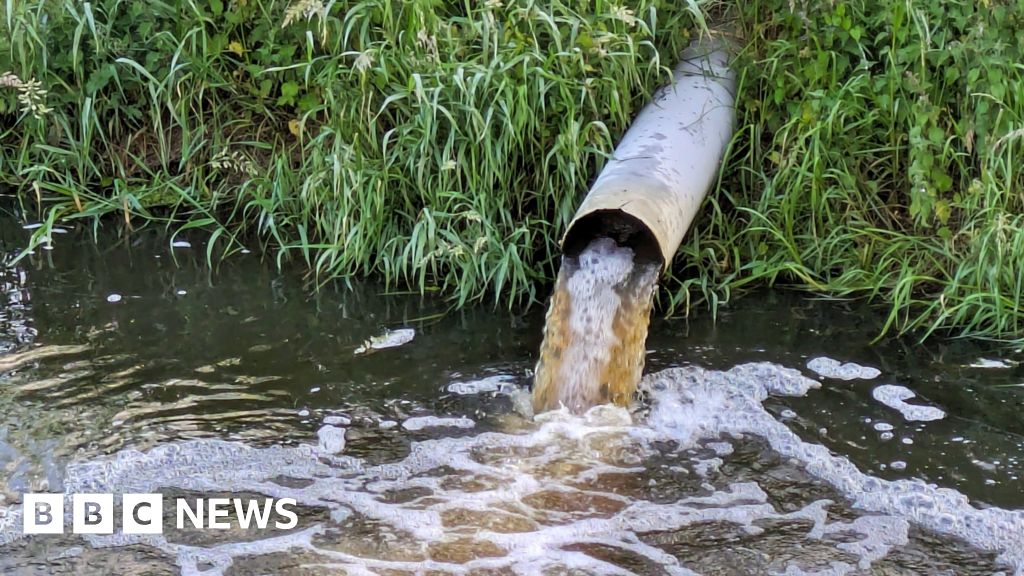
Getty ImagesFining English water companies for spilling raw sewage will soon become quicker and easier, the government has said.
New proposals would see automatic fines of up to £20,000 issued for some minor offences and make it simpler to punish more serious ones.
In recent years data from the water industry’s own monitoring equipment has shown how frequently rules are broken around sewage spills. But the regulator, the Environment Agency, has by its own admission struggled to act.
“I want to give the Environment Agency the teeth it needs to tackle all rule breaking,” said Environment Secretary Emma Reynolds, announcing the proposals.
“With new, automatic and tougher penalties for water companies, there will be swift consequences for offences – including not treating sewage to the required standard, and maintenance failures,” she said.
The plans will be put to a six-week public consultation starting on Wednesday.
The English water companies welcomed the proposals, with a spokesperson for trade body Water UK saying: “It is right that water companies are held to account when things go wrong.”

Getty ImagesFor the most serious pollution offences, the enforcement system remains the same. The EA has to take water companies to court and prove to a criminal standard that an offence has been committed “beyond a reasonable doubt”. If that prosecution results in a conviction the company could have to pay a large fine, possibly in the millions of pounds.
The new proposals are focused on more minor offences which happen frequently and have in the past gone largely unpunished.
The plans would see automatic financial penalties of up to £20,000 introduced for rule breaches such as failure to report a significant pollution incident within four hours, failure to report spill data properly or if emergency overflow outlets discharge sewage more than three times in a year.
For some more serious offences the government wants to make it easier for the EA to take action.
So it’s proposing that the burden of proof be reduced from “beyond all reasonable doubt” – the norm for criminal proceedings – to “on the balance of probabilities”, which is used in civil cases. The fines which the EA can impose without going to court could be increased to a maximum of half a million pounds.
The reduced burden of proof for some offences is already written into law, having been part of the Water (Special Measures) Act which received Royal Assent in February 2025. This six-week consultation is to determine which offences should be included, and the level of the fines.
“Fines of £500,000 are pocket change to billion-pound companies like Thames Water,” says James Wallace, the CEO of campaign group River Action.
“Higher penalties and urgent, wholesale reform are essential to prevent negligent firms polluting our rivers and short-changing their customers.”
Business
Jamie Dimon says U.S. should impose Trump’s credit card rate cap in Vermont and Massachusetts
Jamie Dimon, CEO of JPMorgan Chase, speaks at the American Business Forum at the Kaseya Center in Miami on Nov. 6, 2025.
Chandan Khanna | AFP | Getty Images
JPMorgan Chase CEO Jamie Dimon on Wednesday advocated for a test of President Donald Trump‘s proposed 10% cap on credit card interest rates in two U.S. states: Vermont and Massachusetts.
Dimon, speaking on a panel at the World Economic Forum at Davos, Switzerland, addressed a question about Trump’s order for banks to voluntarily limit their interest rates for a year. The president had called for the lower rates to take effect Tuesday.
Several large credit card lenders contacted by CNBC on Tuesday said they had made no changes to their interest rates, but they all declined to be identified as defying Trump’s proposal.
“It would be an economic disaster,” Dimon said Wednesday. “In the worst case, you’d have a drastic reduction of the credit card business” for 80% of Americans, he said.
In earnings conference calls last week and behind the scenes, banks have pushed back against Trump’s order this month to voluntarily forgo billions of dollars in revenue.
Their main argument, that price controls will result in lenders canceling accounts for many card customers, has resonated with several Republican lawmakers, including House Speaker Mike Johnson. Most banking analysts believe that Trump would need legislation to enact a nationwide cap on card rates.
‘A great idea’
Dimon then said he had a “great idea” to help quell disagreement over the proposed card cap, suggesting that the U.S. government impose the pricing controls on Americans in just two states.
Vermont and Massachusetts are the home states of Sens. Bernie Sanders and Elizabeth Warren, respectively, both of whom support a bill capping card rates at 10% for five years. Dimon didn’t mention the lawmakers by name Wednesday.
The U.S. government “should force all the banks to do it in two states, Vermont and Massachusetts, and see what happens,” Dimon said, drawing laughter from the audience.
Dimon said “the left” and people who argue for price controls “will learn a real lesson, and the people crying the most won’t be the credit card companies,” he said.
“It’ll be the restaurants, the retailers, the travel companies, the schools, the municipalities, because people miss their water payments,” he said. “It would be something else to watch.”
The offices of Sanders and Warren did not immediately return calls for comment.
Dimon added that JPMorgan was planning on giving the Trump administration its analysis on what would happen under a national credit card rate cap.
“I think it’s wrong for the government to get involved extensively in pricing of stuff, but I got to deal with the world I got,” Dimon said.
Business
Stocks rally as Trump calms Greenland rhetoric
The FTSE 100 shrugged off a weak start to close slightly higher on Wednesday after US president Donald Trump said he would not use force to take control of Greenland, but insisted America must still have “ownership” of it.
Kathleen Brooks, research director at XTB, said Mr Trump’s speech at Davos, in Switzerland, had two key takeaways for markets.
“Firstly, Trump will not take Greenland by force and second, Trump wants the economy to run hot to send US stocks flying north,” she said.
The FTSE 100 index closed up 11.31 points, 0.1%, at 10,138.09.
The FTSE 250 ended 113.42 points higher, 0.5%, at 23,071.29, and the AIM All-Share closed up 7.45 points, 0.9%, at 808.59.
In a wide-ranging, often rambling speech at the World Economic Forum, Mr Trump said: “We probably won’t get anything unless I decide to use excessive strength and force where we would be, frankly, unstoppable, but I won’t do that.”
But he demanded “immediate” talks on Washington’s acquisition of Greenland, renewing his push to seize control of the autonomous territory from Nato ally Denmark.
“It’s the US alone that can protect this giant mass of land, this giant piece of ice, develop it and improve it,” Mr Trump told world leaders.
“That’s the reason I’m seeking immediate negotiations to once again discuss the acquisition of Greenland by the US.”
Prime Minister Sir Keir Starmer earlier told Parliament he would not give in to pressure from Mr Trump over the future of Greenland.
“I will not yield, Britain will not yield on our principles and values about the future of Greenland under threats of tariffs, and that is my clear position,” he told MPs, adding that he would host Danish counterpart Mette Frederiksen in London on Thursday.
Mr Trump has threatened to slap tariffs on Britain and other European countries for opposing his claims on Greenland.
“Greenland could still be an issue for financial markets, since Trump has said that he wants to gain control of Greenland and will start immediate negotiations to do so. However, today’s speech suggests that Nato is not under immediate threat, for now,” Ms Brooks said.
In European equities on Wednesday, markets were mixed. The CAC 40 in Paris closed up 0.1%, while the DAX 40 in Frankfurt ended 0.6% lower.
In New York, financial markets were higher at the time of the London equity market close.
The Dow Jones Industrial Average was up 0.9%, as was the S&P 500, while the Nasdaq Composite climbed 1.0%.
Bond markets were calmer after Tuesday’s sharp moves. The yield on the US 10-year Treasury was quoted at 4.27%, trimmed from 4.28% on Tuesday. The yield on the US 30-year Treasury was quoted at 4.89%, narrowed from 4.91%.
Back in London, analysts played down a surprise spike in UK inflation, calling it a “blip”.
“It was always likely that the December figures would post a rebound on account of the rise in tobacco duty rates showing up in the December data rather than November (as it did in 2024) due to the later timing of last year’s budget,” analysts at Lloyds Bank said.
“Some unwinding of the ‘early’ Black Friday discounting seen in the November data also looks to have been behind the upward move, as well as base effects associated with a sharp rise in airfares last month relative to a more subdued increase in December 2024,” the bank added.
Headline consumer prices index (CPI) inflation accelerated in December, with CPI rising by 3.4% year-on-year, up from 3.2% in November, according to data published on Wednesday by the Office for National Statistics (ONS). It was ahead of the FXStreet-cited consensus of 3.3%.
It was the first time headline inflation has risen since July, when the annual rate rose to 3.8% from 3.6% in June. Figures for October at 3.6% and November at 3.2% were lower than the consensus forecast at the time.
The ONS said alcohol, tobacco and transport made the largest upward contributions to the monthly change.
Core CPI, which excludes energy, food, alcohol and tobacco, was unchanged at 3.2%, better than the 3.3% consensus.
The CPI goods annual rate rose to 2.2% from 2.1%, while the CPI services annual rate rose to 4.5% from 4.4%, but below the 4.6% consensus.
RBC Capital Markets expects the December “blip” to fall away sharply in the first half of 2026.
“Not only therefore did the December outturn leave services and headline CPI inflation broadly in line with the BoE’s (Bank of England’s) projections from November but also the main upward contributions to both headline and CPI were concentrated in non-core or more volatile categories,” the broker said.
Deutsche Bank expects inflation will take a big step down in January, pushing to near 3% year-on-year.
And by spring, the bank expects the BoE’s 2% inflation target “to be in sight”.
The pound was quoted lower at 1.3437 US dollars at the time of the London equities close on Wednesday, compared to 1.3462 dollars on Tuesday.
The euro stood at 1.1707 dollars, lower against 1.1733 dollars. Against the yen, the dollar was trading at 158.18 yen, higher from 157.95 yen.
On the FTSE 100, trading statements boosted Burberry but weighed on Experian.
Luxury goods manufacturer Burberry rose 5.0% after announcing an increase in comparable store sales over the festive period, while it expects its annual adjusted operating profit to be in line with analyst consensus estimates.
Comparable sales by region in the third quarter of financial year 2026, which runs until March 28, were up 6% in Greater China and 5% higher in Asia Pacific. They were up 2% in the Americas. Further, comparable sales were flat in Europe, Middle East, India & Africa due to declines in tourist spend.
Miners were in demand with Rio Tinto, up 5.2% after a well-received fourth quarter production update, and Glencore, which Rio is trying to buy, up 3.7%.
Bank of America said it believes “GlenTinto” – should a deal be sealed – offers “compelling value”.
Rio has until February to firm up an approach for Glencore.
Heading south, insurer Admiral, down 4.2%, after Goldman Sachs downgraded to “sell” from “buy”, while Experian slipped 4.9% despite reporting in-line trading.
On the FTSE 250, Currys shares sparked 7.7% higher as the electricals retailer rose profit guidance, while Premier Foods climbed 7.1% after it signalled top-end full-year profits.
But pub chain JD Wetherspoon failed to cheer investors, with shares down 8.1%, as it said higher costs were offsetting growth in sales.
Brent oil traded lower at 64.82 dollars a barrel on Wednesday, down from 64.89 dollars late on Tuesday.
Gold was quoted at 4,833.66 dollars an ounce on Wednesday, after hitting another record high, up from 4,742.56 dollars on Tuesday.
The biggest risers on the FTSE 100 were Rio Tinto, up 327.00 pence at 6,641.00p, Burberry, up 61.00p at 1,280.00p, Bunzl, up 97.00p at 2,086.00p, Anglo American, up 158.00p at 3,401.00p, and JD Sports Fashion, up 3.78p at 82.06p.
The biggest fallers on the FTSE 100 were Experian, down 157.00p at 3,070.00p, Admiral Group, down 128.00p at 2,948.00p, London Stock Exchange, down 198.00p at 8,782.00p, Rolls Royce, down 26.00p at 1,255.00p and Sage Group, down 16.50p at 1,025.00p.
Thursday’s global economic calendar has public sector net borrowing figures, plus GDP data, initial jobless claims and personal consumption expenditures data.
Thursday’s UK corporate calendar has trading statements from discount retail chain B&M European Value Retail and trading platform AJ Bell.
Contributed by Alliance News
Business
Local audit push: CAG flags capacity gaps, calls for stronger PAIs and tech-led audits – The Times of India
The Comptroller and Auditor General of India has called for strengthening the institutional framework, professional capacity building and audit practices of primary auditing institutions (PAIs) responsible for local governments, highlighting the need to improve audit quality and transparency at the grassroots level, PTI reported.The call came at the conclusion of a three-day national workshop for Directorates of Local Fund Audit (DLFAs) and state audit departments, organised by CIARD–NIRDPR in collaboration with iCAL, the CAG office said in a statement on Wednesday.Speaking at the valediction function, CAG Sanjay Murthy said the challenges and best practices highlighted by different states during the workshop would be taken up at the forthcoming All-State Secretaries’ Workshop for “appropriate follow-up and improvement of the system”.The workshop focused on strengthening PAIs, which play a key role in auditing local governments. Workshop Director U Hemantha Kumar said deliberations covered issues such as challenges in local fund audits, assessment of PAI maturity, the CAG’s Technical Guidance and Support (TGS) framework, and experience-sharing on audit planning, reporting and engagement with local bodies.Directors of Local Fund Audit from various states participated in five thematic group discussions, which examined PAI maturity levels, virtual audit systems, remote audits of gram panchayats, standardisation of inspection reports and audit planning, and ways to strengthen the TGS framework.According to the CAG statement, group presentations stressed the need for simplified and standardised audit frameworks, wider adoption of technology-enabled and remote audit systems, and stronger follow-up and enforcement mechanisms. Participants also underlined the importance of focused capacity building of DLFAs to enhance audit coverage, improve audit quality and increase transparency in local governance.The workshop concluded with a consensus that upgrading institutional capacity and modernising audit practices are essential to ensure effective oversight of local bodies and better utilisation of public funds.
-
Tech1 week agoNew Proposed Legislation Would Let Self-Driving Cars Operate in New York State
-
Entertainment1 week agoX (formerly Twitter) recovers after brief global outage affects thousands
-
Politics5 days agoSaudi King Salman leaves hospital after medical tests
-
Sports7 days agoPak-Australia T20 series tickets sale to begin tomorrow – SUCH TV
-
Business5 days agoTrump’s proposed ban on buying single-family homes introduces uncertainty for family offices
-
Fashion5 days agoBangladesh, Nepal agree to fast-track proposed PTA
-
Tech6 days agoMeta’s Layoffs Leave Supernatural Fitness Users in Mourning
-
Tech7 days agoTwo Thinking Machines Lab Cofounders Are Leaving to Rejoin OpenAI