

Business
The fall and future of Manchester Pride

Jasmine Sandhar,BBC Newsbeat and
Pete Allison,BBC Newsbeat
 Getty Images
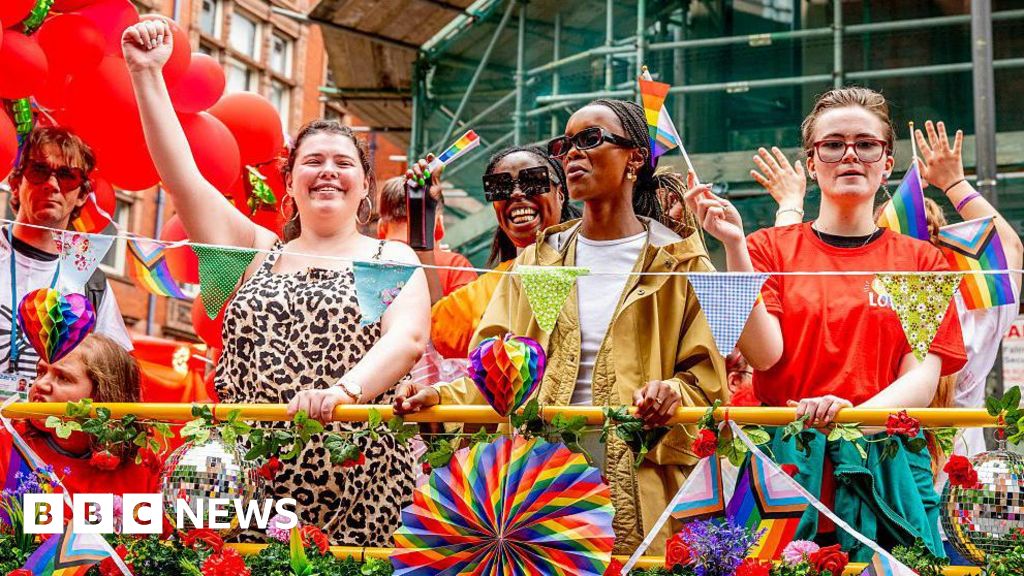
When Saki Yew stepped off stage at this year’s Manchester Pride, she felt “joyous”.
The former Drag Race UK queen had spent weeks rehearsing and creating costumes for the performance at the city’s Sackville Gardens in August.
It was effort she was happy to make for one of the UK’s biggest LGBTQ+ events, and the reaction from the crowd made it worth it.
But when she asked Pride’s organisers for her payment, she says there was silence.
The charity behind Manchester Pride went bust this week, leaving dozens of performers, vendors and backstage workers unpaid.
In a statement confirming it had gone into liquidation, bosses blamed a “combination of rising costs, declining ticket sales and an ambitious refresh of the format aimed to challenge these issues”.
But some believe repeated warning signs about the sustainability of the event weren’t heeded.
Warning signs
Manchester Pride started in 1985 as a two-week fundraising event.
Since then, it’s grown in size and influence, becoming the first UK organisation to add black and brown stripes to the rainbow flag to represent LGBTQ+ people of colour.
By 2025 Manchester was one of the biggest Pride events in the UK, alongside London and Brighton’s annual celebrations.
With its increasing size came bigger names, including Ariana Grande, Sophie Ellis-Bexter, Anastacia and Zara Larsson.
This year’s star-studded line-up featured Nelly Furtado, Olly Alexander, and former Little Mix star Leigh-Anne.
But behind the scenes there were signs all was not well, according to people who worked on this year’s event.

 Abbie Ashall
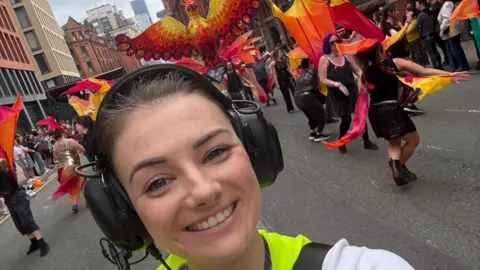
Event manager Abbie Ashall had worked for Manchester Pride since 2023, and was a project manager for this year’s parade.
She tells BBC Newsbeat many charities were hit hard by the Covid-19 pandemic, and there was evidence Manchester Pride had also been affected.
Abbie says she was given strict budgets to stick to, and noticed that former colleagues who left were not replaced.
Yet, at the same time, Abbie says, Pride’s organisers launched Mardi Gras this year – a two-day, ticketed event at Manchester’s high-capacity Mayfield Depot.
Attendees reported that crowds were small, and Abbie says the event was not considered successful.
Contractor Chris O’Connor worked at Manchester Pride for five years as a runner, a role he describes as a mixture of organisation and “troubleshooter-slash-firefighter”.
He says working in the run-up to previous Pride weekends had been “a joy”, but that 2025 had presented “red flags” and “major issues” for him to resolve from the start.
He believes Manchester Pride, which reported a loss of about £468,000 in 2023, should have had better control of the finances.
‘I rely on that money to live’
Both Chris and Abbie say they are still owed money for their work on 2025’s event.
In Chris’s case, he says not being paid prevented him visiting his son, who has just started university in Ireland.
Saki Yew tells Newsbeat she has “a life outside of drag” and “bills and groceries to pay for”.
Like Chris, Saki believes Pride’s organisers could have been more transparent about their financial troubles while people waited for payment.
“It’s highly disrespectful,” says Saki.
“You’ve kept us in the dark, you’ve just disrespected every single person on what they do and what they provide for you.”
 Getty Images
Some suspect the lack of communication from Manchester Pride’s organisers over payment is linked to its failed bid to host 2028’s Europride.
The international event usually attracts huge crowds, and Abbie believes Pride bosses were banking on “the funding that would have come with that from Manchester City Council and beyond”.
When it was announced that Limerick and Clare, in Ireland, had won the bid earlier this month, hopes for potential Europride investment disappeared.
“I think they took a massive swing and it was a miss,” says Abbie.
The exact details of the circumstances leading up to Manchester Pride going into liquidation aren’t yet known.
However, the Charity Commission, which works to ensure organisations in England and Wales comply with the law, is “assessing concerns” after Pride’s bosses submitted a “serious incident report relating to its finances”.
There are also questions about future events in Manchester, and what shape they will take.
 Getty Images
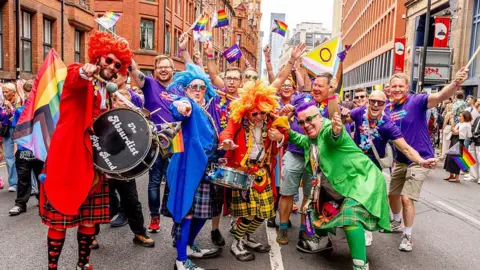
On the streets of the city, it’s not hard to find people who attended this year’s Pride and want to see the celebration return.
Kieran, 24, from Oldham, believes “it’s something that everyone in Manchester looks forward to”.
“It brings all types of culture and people together,” he says.
Lexi agrees Pride is “a big part of not only the culture of this city, but so important for the community itself”.
“If we don’t have Pride, what else do we have?”
Lexi says attending Pride events after she’d just come out was “a really important time” and “it would be horrible for people to lose that opportunity”.
‘A new chapter’?
Manchester City Council has said it will “support a new chapter for Manchester Pride weekend, which will take place next August”.
Lexi is optimistic.
“I would be happy to put my money into something, especially if it’s going to go back to the community,” she says.
There had been complaints about staging events outside Manchester’s gay village and focusing on spectacle over supporting LGBTQ+ causes.
“Maybe there’s a way around it in creating a cheaper, more sustainable Pride,” Lexi hopes.
But for the workers that may depend on, trust has been lost as well as money.
“This charity is there to platform and support queer artists and practitioners,” says Abbie.
“For all of those people to be at a loose end when this is the charity that is meant to raise them up more than anybody – that’s where it’s deeply frustrating and really upsetting.”
The BBC approached Manchester Pride for comment but it did not respond.
In a statement shared on social media, Manchester Pride’s Board of Trustees expressed “regret” for delays in communication, but said it was “keen not to jeopardise financial opportunities while our discussions were ongoing”.
It said it had hoped to find a way to continue to support those who had contributed, and was “sincerely sorry for those who will now lose out financially from the current situation”.
“We have put our hearts and souls into the celebration and community activities over two decades,” it added.
“We hope and believe that this leaves a positive and lasting legacy for the Pride movement in Greater Manchester.”
Additional reporting by Georgia Levy-Collins.

Business
Airlines must offer 60% seats free from April 20, DGCA says amid row over seat selection charges – The Times of India
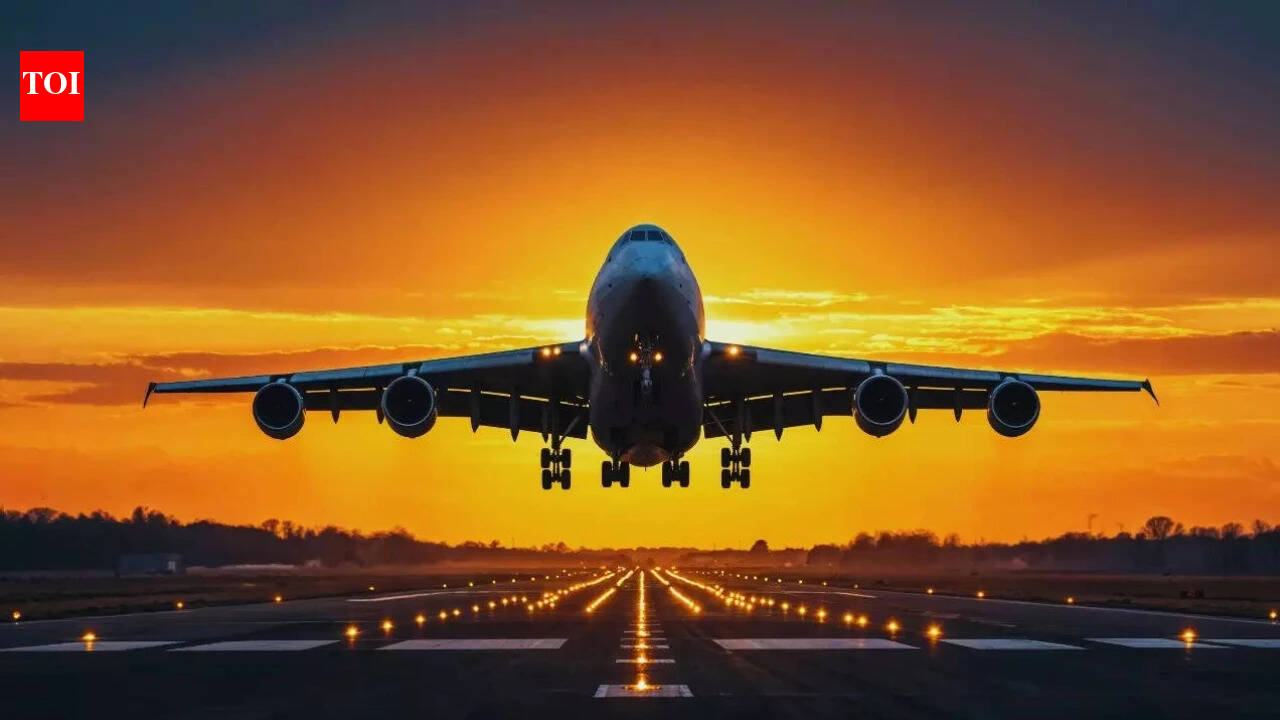
Passengers flying within India will be able to choose a larger share of seats without paying extra from April 20, after aviation regulator DGCA directed airlines to offer at least 60 per cent of seats on every flight free of charge.The move follows concerns over airlines charging steep fees for seat selection, with the civil aviation ministry announcing on March 18 that it had asked the regulator to ensure fairer access for passengers.
New rule raises free seat quota from 20% to 60%
Acting on the ministry’s direction, the Directorate General of Civil Aviation (DGCA) issued an amended Air Transport Circular on March 20, which will come into force 30 days later, effectively from April 20.Under the revised rules, airlines must ensure that at least 60 per cent of seats on any flight are available for selection without any additional charge. At present, only around 20 per cent of seats are generally offered free, while the rest attract a fee.The DGCA has also told airlines to keep their seat allocation policies transparent and clearly show the availability of free seats, along with any applicable conditions, on their booking platforms.“Airlines should maintain transparent seat allocation policies and clearly communicate the availability of free seats and applicable conditions on their booking interfaces,” the regulator said in the revised circular dated March 20.
Families on same booking should be seated together where possible
The regulator has further said that passengers travelling on the same PNR (Passenger Name Record) should, as far as practicable, be seated close to one another, which would ordinarily mean adjacent seats in the same row.An official cited by news agency PTI said that airlines are now preparing to implement the new directive.Seat selection charges currently range from Rs 200 to Rs 2,100, depending on factors such as front-row placement and extra legroom.
Airlines object, warn of possible fare hikes
The new rule comes against the backdrop of growing criticism over airlines levying hefty charges for add-on services, especially seat selection.However, the move has faced strong resistance from carriers. As per PTI, IndiGo, Air India and SpiceJet objected to the decision last week, arguing that forcing airlines to make at least 60 per cent of seats free would hurt revenues and could eventually push up airfares.In a letter sent to the civil aviation ministry on March 20, the Federation of Indian Airlines (FIA), which represents the three carriers, urged the government to withdraw the decision.
Other optional service charges must also be clearly shown
Apart from seat selection, the DGCA has also directed airlines to display all charges for optional services such as carrying sports equipment or musical instruments in a clear and unambiguous manner on websites and booking portals.The regulator said airlines must also disclose any liability conditions in case of damage linked to such items.The change comes at a time when Indian airports are handling more than five lakh passengers daily, underlining the wide impact the new rule could have across the country’s fast-growing aviation market.DGCA chief Faiz Ahmed Kidwai recently said the regulator is trying to simplify rules for airlines while also protecting passenger rights. Speaking at the Indian Chamber of Commerce Aviation and Tourism Summit, he said the aim is to strike a balance between supporting airline growth and safeguarding travellers.“India’s aviation market is one of the fastest-growing in the world, but airlines are currently dealing with several operational hurdles,” Kidwai said, as quoted by news agency IANS.

Samantha Hutchison, the council’s assistant director of community services, said the classes offered “a fantastic opportunity for people to come together, share skills, experience different cultural cuisines and improve both their health and community wellbeing”.
Business
Logan Paul sold a Pokémon card for more than $16 million. Here’s why investors are watching

Pokémon cards aren’t just childhood collectibles anymore.
Some owners are increasingly treating the popular 1990s and 2000s trading cards like alternative assets, with some of the rarest cards outperforming traditional benchmarks like the S&P 500 in recent years.
During key periods like the pandemic boom and another surge in 2025, trading card indexes tracking Pokémon sales posted gains that far exceeded the S&P 500’s long-term average annual return of 10% to 12%, according to trading card valuation tool Card Ladder. The comparison isn’t perfect — stock data spans decades, while trends in trading card values are shorter and more volatile — but the outperformance in certain windows is still striking.
The jump in prices come down to scarcity, grading and a surge of deep-pocketed buyers chasing a limited supply of top-tier assets.
At the high end, that dynamic is clear. A rare Pikachu Illustrator card, owned by influencer and wrestler Logan Paul, sold for more than $16 million in February, which set a record for the most expensive trading card ever sold at auction.
“There are certain individuals trying to acquire the rarest, highest-grade cards and taking them off the market for as long as they can,” said auctioneer Ken Goldin, whose online marketplace, owned by eBay, consigned and sold Paul’s rare Pokémon card. “It’s possible you may never see that card come up for sale again in our lifetime.”
Rare Pokémon card designed by Atsuko Nishida.
Courtesy: Goldin
That supply squeeze helps explain why prices can surge and why a small slice of the market is driving most of the gains.
The condition of a card in particular, which drives its grade on a scale of up to 10, can make or break value, Goldin added.
“You can have a card graded a 10 [perfect score] and nobody cares if the underlying card isn’t important,” Goldin said. “But when you have the right card, the condition become critical — especially in Pokémon, where there’s a massive premium for a 10.”
That premium can be extreme, Goldin said. A perfect condition $100,000 card evaluated by Professional Sports Authenticator, the premier authentication and grading company, might only get 1% or 2% of that value in a much lower condition.
Outside the most rare handful of cards, retail investors and collectors are flipping back open their dusty collection books from 20 or more years ago and hoping to strike gold. The boom in card sales accelerated during the pandemic as stimulus money and interest in alternative assets surged. Spending on non-sports trading cards, including Pokémon, jumped 350% between 2020 and 2025, according to market research firm Circana. At the same time, celebrities like Post Malone, Steve Aoki and Kevin O’Leary fueled mainstream attention.
“We are seeing people use this as an alternative asset and allocation of wealth,” said Goldin. “Whether that becomes more institutional over time is still to be determined.”
But risk remains for hopeful investors in the market. The same forces driving gains also create risk. Prices are volatile, heavily influenced by hype, and card prices lack the stability and track record of traditional markets.
Still, some highly sought after Pokémon cards continue to outperform the market.


Meet Tahiti United, the soccer team that plays all of its games tomorrow

Tyrell Fortune wins UFC debut after score error reversal, years after being pronounced dead
Airlines must offer 60% seats free from April 20, DGCA says amid row over seat selection charges – The Times of India

-
 Business1 week ago
Flipkart group CFO to leave co amid IPO plans – The Times of India
-

 Sports1 week ago
Rating Adidas’ 2026 World Cup away shirts: Argentina, Spain, Mexico and more
-

 Fashion1 week ago
China’s textile & apparel exports surge 17% to $50 bn in Jan-Feb 2026
-

 Sports1 week ago
American Conference Commissioner Tim Pernetti thanks Trump for Army-Navy game executive order
-

 Tech1 week ago
Gamers Hate Nvidia’s DLSS 5. Developers Aren’t Crazy About It, Either
-

 Entertainment5 days ago
UN warns migratory freshwater fish numbers are spiralling
-
 Business5 days ago
Property Play: Home flippers see smallest profits since the Great Recession, real estate data firm says
-

 Sports1 week ago
How to watch 2026 NCAA swimming and diving championships