

Business
The fall and future of Manchester Pride


Jasmine Sandhar,BBC Newsbeat and
Pete Allison,BBC Newsbeat
 Getty Images
When Saki Yew stepped off stage at this year’s Manchester Pride, she felt “joyous”.
The former Drag Race UK queen had spent weeks rehearsing and creating costumes for the performance at the city’s Sackville Gardens in August.
It was effort she was happy to make for one of the UK’s biggest LGBTQ+ events, and the reaction from the crowd made it worth it.
But when she asked Pride’s organisers for her payment, she says there was silence.
The charity behind Manchester Pride went bust this week, leaving dozens of performers, vendors and backstage workers unpaid.
In a statement confirming it had gone into liquidation, bosses blamed a “combination of rising costs, declining ticket sales and an ambitious refresh of the format aimed to challenge these issues”.
But some believe repeated warning signs about the sustainability of the event weren’t heeded.
Warning signs
Manchester Pride started in 1985 as a two-week fundraising event.
Since then, it’s grown in size and influence, becoming the first UK organisation to add black and brown stripes to the rainbow flag to represent LGBTQ+ people of colour.
By 2025 Manchester was one of the biggest Pride events in the UK, alongside London and Brighton’s annual celebrations.
With its increasing size came bigger names, including Ariana Grande, Sophie Ellis-Bexter, Anastacia and Zara Larsson.
This year’s star-studded line-up featured Nelly Furtado, Olly Alexander, and former Little Mix star Leigh-Anne.
But behind the scenes there were signs all was not well, according to people who worked on this year’s event.

 Abbie Ashall
Event manager Abbie Ashall had worked for Manchester Pride since 2023, and was a project manager for this year’s parade.
She tells BBC Newsbeat many charities were hit hard by the Covid-19 pandemic, and there was evidence Manchester Pride had also been affected.
Abbie says she was given strict budgets to stick to, and noticed that former colleagues who left were not replaced.
Yet, at the same time, Abbie says, Pride’s organisers launched Mardi Gras this year – a two-day, ticketed event at Manchester’s high-capacity Mayfield Depot.
Attendees reported that crowds were small, and Abbie says the event was not considered successful.
Contractor Chris O’Connor worked at Manchester Pride for five years as a runner, a role he describes as a mixture of organisation and “troubleshooter-slash-firefighter”.
He says working in the run-up to previous Pride weekends had been “a joy”, but that 2025 had presented “red flags” and “major issues” for him to resolve from the start.
He believes Manchester Pride, which reported a loss of about £468,000 in 2023, should have had better control of the finances.
‘I rely on that money to live’
Both Chris and Abbie say they are still owed money for their work on 2025’s event.
In Chris’s case, he says not being paid prevented him visiting his son, who has just started university in Ireland.
Saki Yew tells Newsbeat she has “a life outside of drag” and “bills and groceries to pay for”.
Like Chris, Saki believes Pride’s organisers could have been more transparent about their financial troubles while people waited for payment.
“It’s highly disrespectful,” says Saki.
“You’ve kept us in the dark, you’ve just disrespected every single person on what they do and what they provide for you.”
 Getty Images
Some suspect the lack of communication from Manchester Pride’s organisers over payment is linked to its failed bid to host 2028’s Europride.
The international event usually attracts huge crowds, and Abbie believes Pride bosses were banking on “the funding that would have come with that from Manchester City Council and beyond”.
When it was announced that Limerick and Clare, in Ireland, had won the bid earlier this month, hopes for potential Europride investment disappeared.
“I think they took a massive swing and it was a miss,” says Abbie.
The exact details of the circumstances leading up to Manchester Pride going into liquidation aren’t yet known.
However, the Charity Commission, which works to ensure organisations in England and Wales comply with the law, is “assessing concerns” after Pride’s bosses submitted a “serious incident report relating to its finances”.
There are also questions about future events in Manchester, and what shape they will take.
 Getty Images
On the streets of the city, it’s not hard to find people who attended this year’s Pride and want to see the celebration return.
Kieran, 24, from Oldham, believes “it’s something that everyone in Manchester looks forward to”.
“It brings all types of culture and people together,” he says.
Lexi agrees Pride is “a big part of not only the culture of this city, but so important for the community itself”.
“If we don’t have Pride, what else do we have?”
Lexi says attending Pride events after she’d just come out was “a really important time” and “it would be horrible for people to lose that opportunity”.
‘A new chapter’?
Manchester City Council has said it will “support a new chapter for Manchester Pride weekend, which will take place next August”.
Lexi is optimistic.
“I would be happy to put my money into something, especially if it’s going to go back to the community,” she says.
There had been complaints about staging events outside Manchester’s gay village and focusing on spectacle over supporting LGBTQ+ causes.
“Maybe there’s a way around it in creating a cheaper, more sustainable Pride,” Lexi hopes.
But for the workers that may depend on, trust has been lost as well as money.
“This charity is there to platform and support queer artists and practitioners,” says Abbie.
“For all of those people to be at a loose end when this is the charity that is meant to raise them up more than anybody – that’s where it’s deeply frustrating and really upsetting.”
The BBC approached Manchester Pride for comment but it did not respond.
In a statement shared on social media, Manchester Pride’s Board of Trustees expressed “regret” for delays in communication, but said it was “keen not to jeopardise financial opportunities while our discussions were ongoing”.
It said it had hoped to find a way to continue to support those who had contributed, and was “sincerely sorry for those who will now lose out financially from the current situation”.
“We have put our hearts and souls into the celebration and community activities over two decades,” it added.
“We hope and believe that this leaves a positive and lasting legacy for the Pride movement in Greater Manchester.”
Additional reporting by Georgia Levy-Collins.

Business
Big drop! Why bench strength of TCS, Infosys, Wipro & other IT companies has fallen by around 75,000 people – The Times of India

Indian IT sector majors – Tata Consultancy Services (TCS), Wipro, Infosys, HCL Tech, and Tech Mahindra – have seen their bench strength drop by 25% in the last two years. Bench strength acts as a traditional reserve workforce with an aim to be a cushion during demand fluctuations. This buffer has contracted sharply, declining by roughly one-fourth over the past two years, and industry observers believe it may not return to earlier levels even if growth revives.Across major firms such as TCS, Infosys, Wipro, HCLTech and Tech Mahindra, the number of employees on the bench has dropped by around 75,000, falling from nearly three lakh to about 2.25 lakh, according to industry estimates cited by experts in an ET report.The proportion of unassigned employees has also narrowed considerably. “The bench across IT services is currently between 8-15% of the workforce compared to over 20% earlier,” said Pareekh Jain, CEO of EIIRTrend. Similarly, TeamLease Digital estimates the current range at 8-12%, down from 20-30% in previous years.
Deeper Shift In IT Sector Bench Strength Trends
Historically, companies maintained a sizeable bench by hiring in anticipation of future projects, ensuring that skilled personnel were readily available when demand materialised. This approach was viable during periods of rapid expansion. However, firms are now moving away from that model and tightening workforce utilisation.Companies that once operated with 4-5% of employees on the bench are now targeting significantly lower levels, often between 1% and 1.5%. In some cases, stricter policies have been introduced. For instance, in TCS bench duration has been capped at around 35 days annually, after which performance evaluations are initiated, and employees who remain unallocated may be asked to exit.Experts indicate that this shift is not merely cyclical but reflects a deeper structural change. “The concept of bench does not make sense unless an IT services firm can predict skill or role-based demand with 90% accuracy three months in advance,” said Gaurav Vasu, founder of UnearthInsight.Slower industry growth has been identified as the primary driver behind this contraction, rather than technological disruption. “Low growth is the bigger factor in bench reduction today. When growth returns, firms may not need to rebuild their bench because local hiring in different countries has increased significantly over the last five to six years,” Jain said.Over the past two years, hiring patterns have undergone a clear shift. Demand for traditional mid-level delivery roles has declined by roughly 20–30 per cent, while requirements for skills in artificial intelligence, generative AI, data, and cloud technologies have increased by about 30–40 per cent across the same firms, according to Neeti Sharma, CEO of TeamLease Digital.Global capability centres, however, present a more varied trend, with mid-level recruitment showing relatively greater resilience. “Leadership hiring has grown in line with overall demand, with the share of such roles increasing from around 15% in 2024 to around 20% in 2025. What has changed is the nature of these roles. Today, more than 50% of job demand is driven by emerging skills, especially in AI, cloud, and platform engineering,” said Kapil Joshi, CEO of IT staffing at Quess Corp. In contrast, hiring at the entry level has declined by around 30–35 per cent during the same period, he added.The changes are also affecting how quickly professionals are placed. The average time required to assign a benched engineer with 8–12 years of experience has lengthened to 60–90 days, compared with 30–45 days earlier, Sharma told ET.
Salary Trends
Compensation trends are diverging as well. Premiums for lateral hiring in non-AI roles have reduced to 10–20 per cent, down from 25–35 per cent in FY 2022–23. In contrast, professionals with AI capabilities continue to command premiums of 20–30 per cent and tend to secure offers more quickly, Sharma said. According to Quess data, premiums for generative AI roles range between 15–40 per cent depending on the position.The broader career structure within IT services firms is also evolving. “The people manager role is not disappearing, but its responsibilities are narrowing, shifting toward revenue expansion and profitability management away from headcount oversight,” Vasu said.
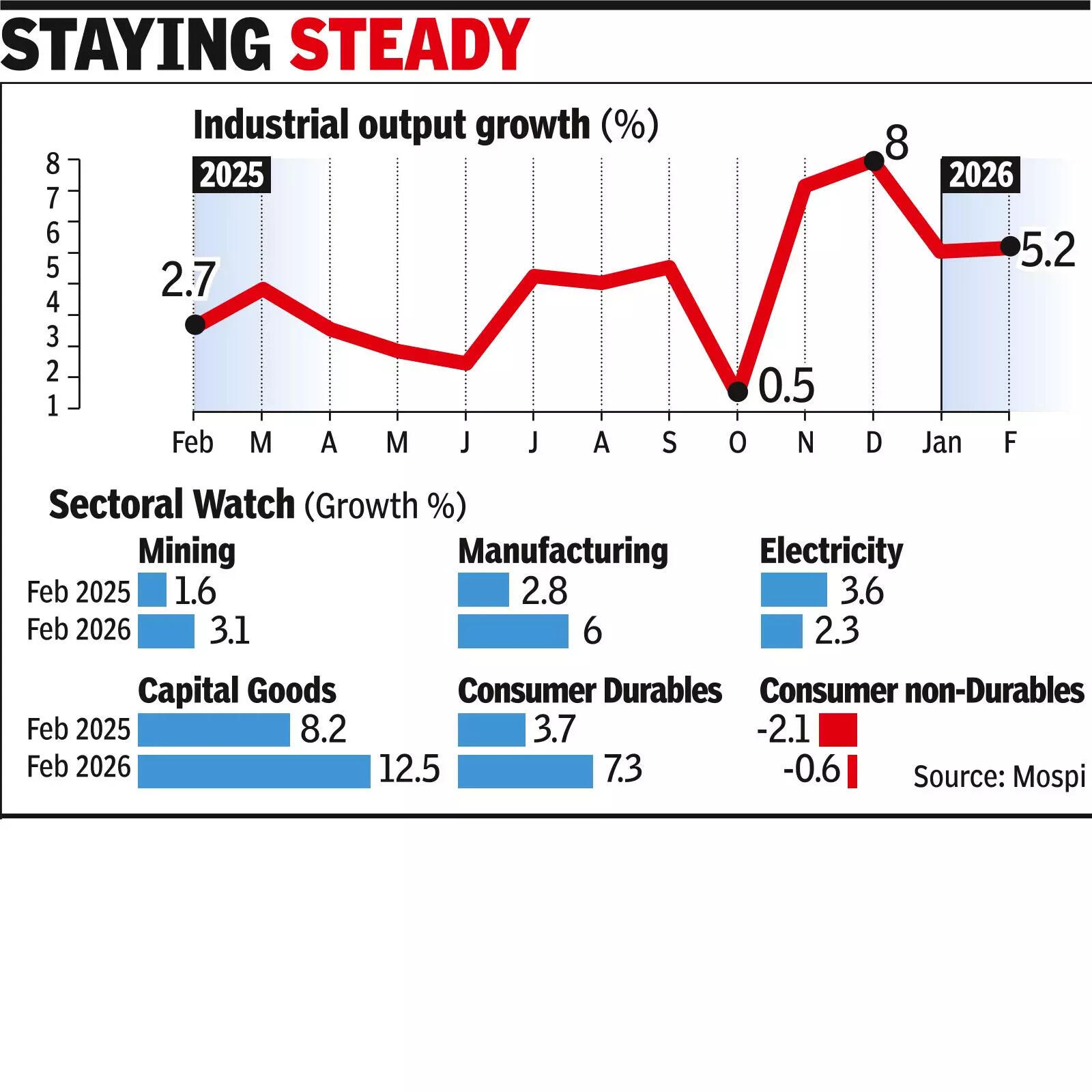
NEW DELHI : The country’s industrial output growth accelerated in Feb, led by a recovery in the manufacturing sector, but the West Asia conflict is expected to weigh heavily on the crucial sector in the months ahead.Data released by the National Statistics Office (NSO) on Monday showed the index of industrial production rose 5.2 per cent in Feb, a tad higher than the upwardly revised 5.1% in Jan. The manufacturing sector rose 6 per cent in Feb, higher than 2.8 per cent in Feb last year and above the 5.3 per cent in Jan.Within the manufacturing sector, 14 out of 23 industry groups grew in Feb compared to the same month a year earlier. The top three positive contributors in Feb were — manufacture of basic metals (13.2 per cent), manufacture of motor vehicles, trailers and semitrailers (14.9 per cent) and manufacture of machinery and equipment (10.2 per cent), according to the statistics office. The electricity and mining sectors remained sluggish, rising 2.3 per cent and 3.1 per cent respectively.Experts expect the West Asia conflict to hurt factory sector expansion. Aditi Nayar, chief economist, ICRA, said the agency expects IIP growth to decelerate to 3 per cent-4 per cent in March, amid the unfolding adverse impact of the West Asia crisis on some manufacturing segments, both through the price and availability channels, and weaker electricity performance in the month.

Oil markets have been sensitive to Donald Trump’s comments on the war. But are traders growing less responsive?
Source link


2026 World Cup playoffs: Who will claim the final six spots?

Rain, strong winds likely in Karachi from April 1

Netherlands manufacturing output prices fall 2.3% YoY in February

-

 Politics7 days ago
Afghanistan announces release of detained US citizen
-

 Entertainment7 days ago
UN warns migratory freshwater fish numbers are spiralling
-

 Sports7 days ago
Broadcast industry CEO says consolidation is ‘essential’ to compete for NFL soaring media rights prices
-

 Tech7 days ago
Can a Home Appliance Fix the Problem of Soft-Plastic Waste?
-
 Business7 days ago
Property Play: Home flippers see smallest profits since the Great Recession, real estate data firm says
-
 Business7 days ago
Gold prices soar in Pakistan – SUCH TV
-

 Fashion7 days ago
ICE cotton slips on weaker crude, profit booking
-
 Business7 days ago
More women are entering wealth management, but few are in advisory roles, study finds