

Politics
IDF lawyers warned of possible Gaza war crimes: US intel findings


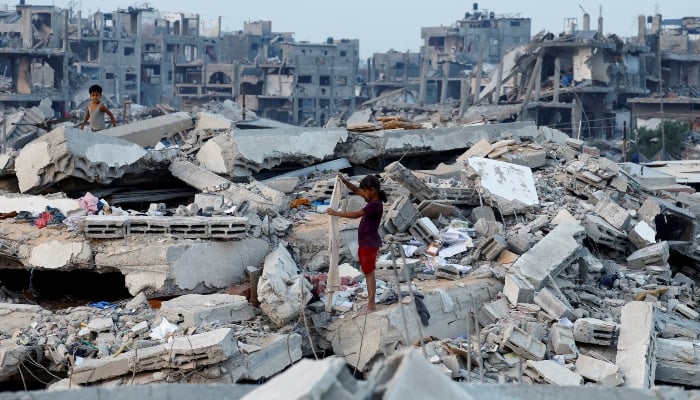
WASHINGTON: The US gathered intelligence last year that Israel’s military lawyers warned there was evidence that could support war crimes charges against Israel for its military campaign in Gaza —operations reliant on American-supplied weapons, five former US officials said.
The previously unreported intelligence, described by the former officials as among the most startling shared with top US policymakers during the war, pointed to doubts within the Israeli military about the legality of its tactics that contrasted sharply with Israel’s public stance defending its actions.
Two of the former US officials said the material was not broadly circulated within the US government until late in the Biden administration, when it was disseminated more widely ahead of a congressional briefing in December 2024.
The intelligence deepened concerns in Washington over Israel’s conduct in a war it said was necessary to eliminate Palestinian Hamas fighters embedded in civilian infrastructure. There were concerns Israel was intentionally targeting civilians and humanitarian workers, a potential war crime which Israel has strongly denied.
US officials expressed alarm at the findings, particularly as the mounting civilian death toll in Gaza raised concerns that Israel’s operations might breach international legal standards on acceptable collateral damage.
The former US officials Reuters spoke to did not provide details on what evidence — such as specific wartime incidents — had caused concerns among Israel’s military lawyers.
Israel has killed more than 68,000 Palestinians during a two-year military campaign, say Gaza health officials. Israel’s military has said at least 20,000 of the fatalities were combatants.
Reuters spoke to nine former US officials in then-President Joe Biden’s administration, including six who had direct knowledge of the intelligence and the subsequent debate within the US government. All spoke on the condition of anonymity because of the sensitivity of the matter.
Reports of internal US government dissent over Israel’s Gaza campaign emerged during Biden’s presidency. This account — based on detailed recollections from those involved — offers a fuller picture of the debate’s intensity in the administration’s final weeks, which ended with President Donald Trump’s inauguration in January.
Israeli Ambassador to the US, Yechiel Leiter, declined to comment when asked for a response about the US intelligence and the internal Biden administration debate about it. Neither the Israeli prime minister’s office nor the Israeli military spokesperson immediately responded to requests for comment.
Debate intensified in final days of Biden term
The intelligence prompted an interagency meeting at the National Security Council where officials and lawyers debated how and whether to respond to the new findings.
A US finding that Israel was committing war crimes would have required, under US law, blocking future arms shipments and ending intelligence sharing with Israel. Israel’s intelligence services have worked closely with the US for decades and provide critical information, in particular, about events occurring in the Middle East.
Biden administration conversations in December included officials from across the government, including the State Department, the Pentagon, the intelligence community and the White House. Biden was also briefed on the matter by his national security advisers.
The White House did not immediately respond to a request for comment. “We do not comment on intelligence matters,” a State Department spokesperson said in response to emailed questions about Reuters reporting.
The American debate about whether the Israelis had committed war crimes in Gaza ended when lawyers from across the US government determined that it was still legal for the US to continue supporting Israel with weapons and intelligence because the US had not gathered its own evidence that Israel was violating the law of armed conflict, according to three former US officials.
They reasoned that the intelligence and evidence gathered by the US itself did not prove the Israelis had intentionally killed civilians and humanitarians or blocked aid, a key factor in legal liability.
Some senior Biden administration officials feared that a formal US finding of Israeli war crimes would force Washington to cut off arms and intelligence support — a move they worried could embolden Hamas, delay ceasefire negotiations, and shift the political narrative in favour of the group. Hamas killed 1,200 people and abducted 251 in its October 7, 2023, attack, prompting Israel’s military response.
The decision to stay the course exasperated some of those involved who believed that the Biden administration should have been more forceful in calling out Israel’s alleged abuses and the US role in enabling them, said former US officials.
President Trump and his officials were briefed by Biden’s team on the intelligence but showed little interest in the subject after they took over in January and began siding more powerfully with the Israelis, said the former US officials.
State Department lawyers repeatedly raised concerns
Even before the US gathered war crimes intelligence from within the Israeli military, some lawyers at the State Department, which oversees legal assessments of foreign military conduct, repeatedly raised concerns with US Secretary of State Antony Blinken that Israel might be committing war crimes, according to five former US officials.
As early as December 2023, lawyers from the State Department’s legal bureau told Blinken in meetings that they believed Israel’s military conduct in Gaza likely amounted to violations of international humanitarian law and potentially war crimes, two of the US officials said.
But they never made a conclusive assessment that Israel was violating international humanitarian law, a move that other US officials at the State Department saw as the legal bureau pulling its punches.
“They saw their job as being justifying a political decision,” one of the former US officials said. “Even when the evidence clearly pointed to war crimes, the Get-Out-Of-Jail-Free card was proving intent,” one of the officials said.
The lack of a definitive conclusion by the State Department’s lawyers was largely reflected in a US government report produced during the Biden administration in May 2024, when Washington said Israel might have violated international humanitarian law using US-supplied weapons during its military operation in Gaza.
The report, which was prepared by the State Department, stopped short of a definitive assessment, citing the fog of war.
“What I can say is that the Biden administration constantly reviewed Israel’s adherence to the laws of armed conflict, as well as the requirements of our own laws,” Blinken said through a spokesperson for this story.
Blinken declined to comment on the intelligence matters.
International concerns about possible war crimes
Last November the International Criminal Court in The Hague issued arrest warrants for Israeli Prime Minister Benjamin Netanyahu and his former defence chief, as well as Hamas leader Mohammed Deif, for alleged war crimes and crimes against humanity in the Gaza conflict. Hamas has since confirmed Israel killed Deif.
Israel has rejected the jurisdiction of the Hague-based court and denies war crimes in Gaza. Hamas leaders have dismissed allegations that they committed war crimes.
Among the issues debated by US officials in the final weeks of the Biden administration was whether the government would be complicit if Israeli officials were to face charges in an international tribunal, said people familiar with this debate.
US officials publicly defended Israel but also privately debated the issue in light of intelligence reports, and they became a point of political vulnerability for Democrats. Biden and later Vice President Kamala Harris waged ultimately unsuccessful presidential campaigns.
Biden did not respond to a request for comment.
Democratic US Senator Chris Van Hollen, a critic of Israel’s Gaza campaign, its restrictions on aid to Palestinian civilians and US support for the operation, said the Reuters report underscored “a pattern of deliberate blindness on behalf of the Biden administration with respect to the use and abuse of American weapons in Gaza.”
“The Biden administration deliberately looked the other way in the face of overwhelming evidence that war crimes were being committed with US weapons in Gaza,” Van Hollen, of Maryland, told Reuters.
Israel, which is fighting a genocide case at the International Court of Justice, rejects genocide allegations as politically motivated and says that its military campaign targets Hamas, not Gaza’s civilian population.
The Israeli military says it seeks to minimise civilian harm while targeting Palestinian fighters embedded in hospitals, schools and shelters, using warnings and appropriate munitions. An Israeli military official told Reuters in September that the military was investigating about 2,000 incidents of possible misconduct, including civilian deaths and damage to infrastructure.
Some cases came to light through the genocide case filed at the International Court of Justice, the official said.
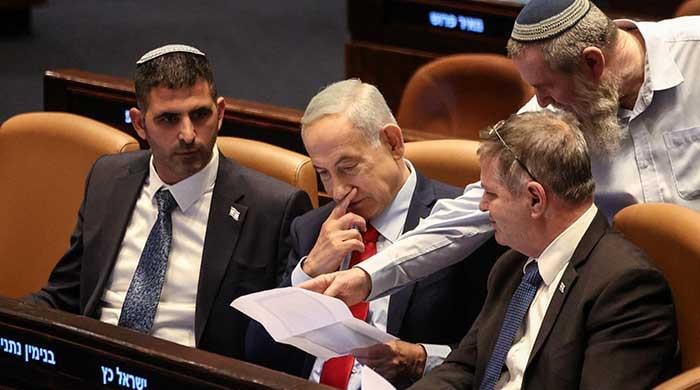
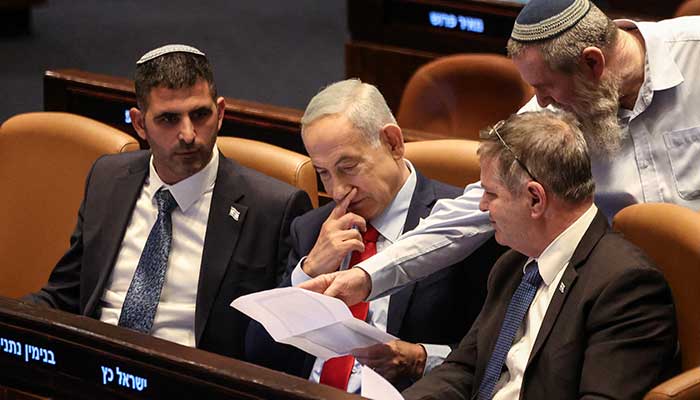
With elections approaching in Israel, the war with Iran has handed Prime Minister Benjamin Netanyahu an opportunity to restore an image deeply scarred by October 7, 2023 Gaza attack, experts say.
But any political dividend would depend on how the conflict unfolds and how long it lasts, they say.
A day after Iran’s supreme leader Ayatollah Ali Khamenei was martyred in a wave of US-Israeli strikes, Netanyahu said that his close ties with Washington had enabled Israel to “do what I have long aspired to do for 40 years: to strike the terrorist regime decisively”.
The Gaza war eroded Netanyahu’s popularity. Critics have accused him of seeking to evade responsibility for the authorities’ failure to prevent the deadliest day in Israel’s history.
At 76, the leader of the right-wing Likud party is Israel’s longest-serving prime minister, with more than 18 cumulative years in office across multiple stints.
Known for his political resilience, Netanyahu has been without a parliamentary majority since the summer, amid a crisis with his ultra-Orthodox religious allies.
He is also standing trial in a long-running corruption case and has sought a presidential pardon, with US President Donald Trump repeatedly pressuring President Isaac Herzog to grant one.
‘Total victory’
Elections must be held by October 27 at the latest.
Netanyahu will call early elections, says Emmanuel Navon, a political analyst at Tel Aviv University.
“It’s obvious. He won’t wait until October given the commemoration of the October 7 anniversary,” Navon said.
“If Netanyahu was at rock bottom after the Gaza attack, he has since gradually turned the tide,” he added.
A Likud party led by Netanyahu would emerge ahead in elections held today, opinion polls suggest.
That would likely see him tasked with forming the next government, though he would still lack a majority with his current allies.
A victory over Iran could change that calculus, experts say.
“This offensive undeniably reinforces the image Netanyahu seeks to cultivate, the one associated with his ‘total victory’ slogan,” independent geopolitical analyst Michael Horowitz told AFP.
“Netanyahu wants to show that this is not a campaign slogan but a reality. It is his national agenda and his electoral strategy,” he added.
‘Iran remains Iran’
Raviv Druker, a prominent journalist on Channel 13 television, argued that Netanyahu “will try to convince people that the victory is total even if that is an illusion,” noting that “Hamas still runs Gaza, and Iran remains Iran even after Saturday’s strike”.
On the popular news website Walla, journalist Ouriel Deskal went further, suggesting Netanyahu may have chosen the timing of the hostilities to automatically delay — under a state of emergency — the March 30 deadline for passing a budget for which he has struggled to secure a majority.
Without a budget, the government would fall on April 1 and elections would be called.
In that scenario, Netanyahu would enter the campaign from a position of weakness.
By contrast “if this war against Iran is a success for Israel, it will be a political victory for Netanyahu,” Navon said.
But should the war drag on, the picture could shift dramatically, Horowitz warned.
“Public tolerance for a long war with heavy casualties, combined with a high cost of living, remains extremely low,” he said.
During the war last June, Iranian missiles killed 30 people in Israel. Since Saturday, 10 people have been killed in Iran’s retaliatory strikes.
“Israel’s victories are primarily attributed to the army and to civilian resilience, which enabled the country to wage the longest war in its history,” Horowitz noted.
“The army’s popularity is rising, not necessarily Netanyahu’s.”


UAE says it will not allow its airspace to be used for attacks against Iran, announces security and economic measures amid regional tensions.The United Arab Emirates has announced it will not allow its airspace or territory to be used for attacks against Iran, as officials outlined security, economic and humanitarian measures during a media briefing in Abu Dhabi.
Reem Al Hashimy, Minister of State for International Co-operation, said the UAE’s position was “clear and measured.”
“The UAE will not permit its airspace or land to be used in any attack against Iran,” she said, adding that the country reserves the right to defend its sovereignty and ensure the safety of citizens, residents and visitors.
She also confirmed that the UAE had closed its embassy in Tehran and withdrawn its ambassador following recent Iranian attacks.
High Combat Readiness
Major General Abdul Nasser Al Humaidi, spokesperson for the Ministry of Defence, said the UAE would not tolerate any compromise of its sovereignty or security.
He explained that sounds heard in recent days were due to missile interceptions and confirmed that armed forces remain at a high level of combat readiness. The UAE, he said, possesses sufficient strategic defence reserves to counter aerial threats for an extended period.
Economic Measures & Supplies
On the economic front, Abdulla bin Touq Al Marri, Minister of Economy and Tourism, said the country holds strategic reserves of essential goods sufficient for four to six months.
“There is no risk of shortages,” he said, adding that authorities are monitoring markets to prevent unjustified price increases and urging residents to avoid panic buying.
He also announced that around 80 flights per day would operate during the current phase to facilitate travel for those wishing to leave.
Daily Life Continues
The National Emergency Crisis and Disaster Management Authority (NCEMA) said daily life across the UAE continues as normal, with essential services fully operational.
The statements come amid heightened regional tensions, as Gulf countries navigate security concerns while seeking to maintain stability at home.
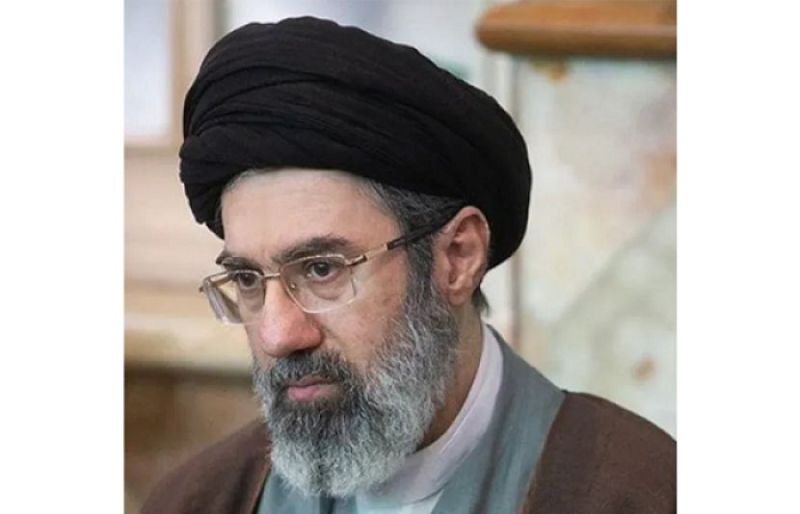

Iranian media has claimed that Mojtaba Khamenei, son of Supreme Leader Ali Khamenei, is alive and in good health, dismissing earlier foreign media reports that suggested he had been killed.
According to Iranian outlets, Mojtaba Khamenei has fully recovered and is currently overseeing key state affairs. The reports reject claims that he was killed alongside his father during recent airstrikes.
Strikes on Iran
On Saturday, Israel and the United States reportedly carried out coordinated strikes across Iran, targeting multiple locations.
Iranian media stated that:
-
The office compound of Ayatollah Ali Khamenei was struck.
-
The building of the Assembly of Experts in Qom was bombed.
-
Explosions were also reported near Enghelab Square in Tehran.
The Assembly of Experts is the clerical body responsible for appointing Iran’s Supreme Leader.
Conflicting Reports
While foreign media earlier claimed Mojtaba Khamenei had been killed, Iranian state-linked sources have strongly denied those reports. Independent verification of the claims remains limited amid ongoing hostilities and restricted information flow.
The situation continues to evolve as regional tensions remain high.


Demi Lovato, Keke Palmer question relationship with older men

Iran Conflict: Middle East tensions: Global insurers exit Iranian waters as conflict deepens – The Times of India

Barcelona gets bigger spending cap, opens door on new signings

-

 Politics6 days ago
What are Iran’s ballistic missile capabilities?
-

 Politics6 days ago
US arrests ex-Air Force pilot for ‘training’ Chinese military
-
 Business7 days ago
Households set for lower energy bills amid price cap shake-up
-

 Sports1 week ago
Top 50 USMNT players of 2026, ranked by club form: USMNT Player Performance Index returns
-

 Sports6 days ago
Sri Lanka’s Shanaka says constant criticism has affected players’ mental health
-

 Fashion5 days ago
Policy easing drives Argentina’s garment import surge in 2025
-
 Business1 week ago
Lucid widely misses earnings expectations, forecasts continued EV growth in 2026
-

 Fashion5 days ago
Texwin Spinning showcasing premium cotton yarn range at VIATT 2026