

Entertainment
William Shatner and Neil deGrasse Tyson: When stars collide

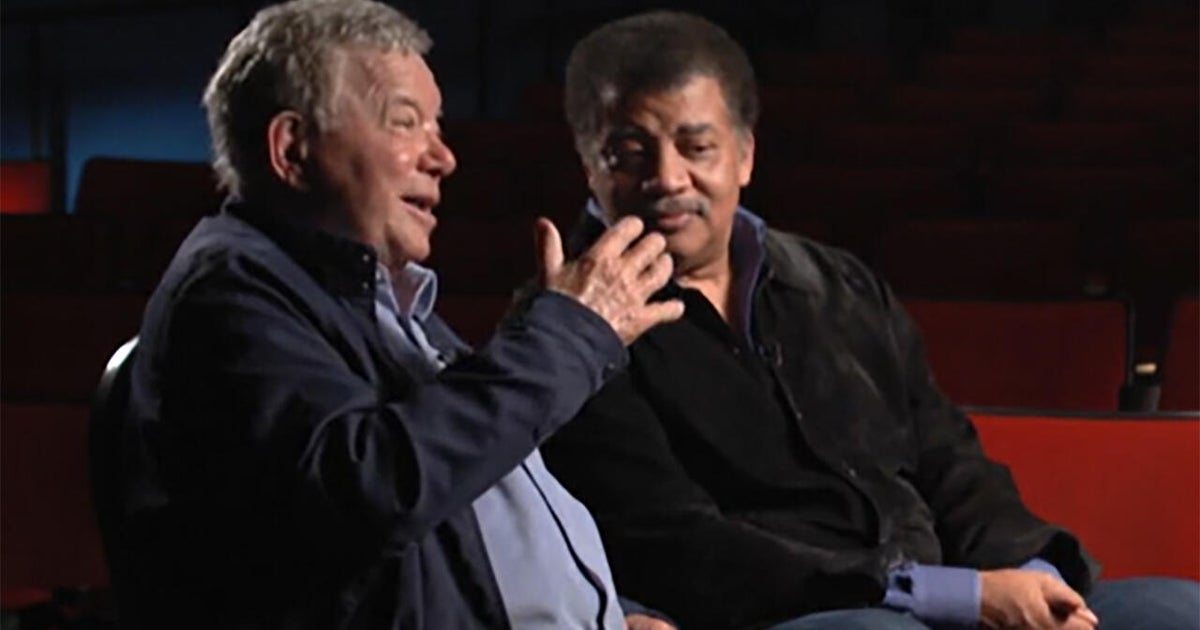
Not long ago in Seattle, an astronomical event of sorts happened: Two superstars collided. William Shatner, of “Star Trek” fame, and Neil deGrasse Tyson, America’s favorite astrophysicist, took to the stage to explore the nature of exploration. Think of it as sort of Martin & Lewis, but with more quantum mechanics.
“It’s a bromance,” said Tyson. “I think what Bill Shatner and I have together should be the textbook definition of the bromance.”
“If we have a bromance,” said Shatner, “I’d be very privileged.”
The two grew close last year on an upscale cruise to Antarctica, where they ended up being the after-dinner entertainment. “The organizer said, ‘Why don’t we put the two of you on this mini-stage that they have on the ship, and we just chew the fat?'” said Tyson. “And then the organizer said, ‘Why don’t you guys take this on the road?'”
Their first port of call? Seattle, where they debuted a wide-ranging, sometimes meandering, but always intriguing stage show they’re calling “The Universe Is Absurd!”
CBS News
When Shatner asked his partner for a sound bite, deGrasse Tyson solicited a suggestion from the audience: “Pick anything out of the universe. Go. Anything. Doesn’t matter.”
“Pluto!” yelled one enthusiastic audience member.
DeGrasse Tyson obliged: “More than half of Pluto is made of ice, so that, if it were where Earth is right now, heat from the Sun would evaporate that ice and it would grow a tail. And that is no kind of behavior for a planet!” Mic drop. “That’s a sound bite!”
For deGrasse Tyson, director of New York City’s Hayden Planetarium, and an authority on just about everything we know about the universe, it’s a chance to get inside the insatiably curious mind of the 94-year-old Shatner. “What kind of magic potion is he drinking?” deGrasse Tyson laughed. “By the way, you can do the math, he’s been alive for three billion seconds, okay? I did the math, you don’t have to. So when Bill Shatner speaks, it’s coming from a place way deeper than any of the rest of us can possibly match.”
And for Shatner, who never formally studied astrophysics, it’s a chance to make up for what he sees as lost time. “I feel bad about it, because that knowledge of what constitutes the construction of nature, we know so little, but the little we know is so awesome, it’s so spellbinding,” he said. “The fact that I wasn’t conscious of how spellbinding it is as a youth, I could have been much more educated about it.”
CBS News 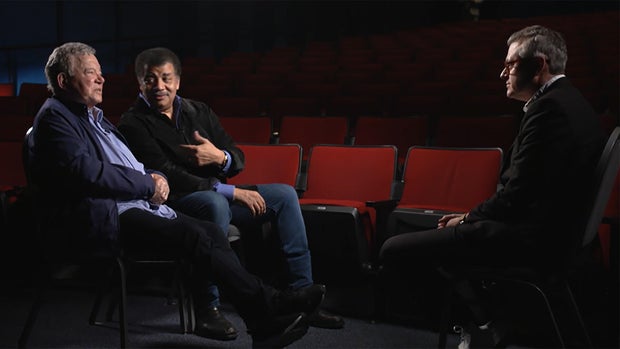
Four years ago, Shatner became the oldest person ever to go into space, and he’s been globetrotting ever since.
Shatner asked deGrasse Tyson, “Do you still scratch your head in awe?”
“Every night I look up,” he replied.
So, is this the dynamic between the two – Shatner with questions, deGrasse Tyson with answers? “Unfortunately, that’s the way it is,” Shatner replied.
“No, but he’s got wisdom and life experience that I value, and I respect,” deGrasse Tyson added. “So, I’m here to grab some of that.”
As for Shatner’s take on deGrasse Tyson, “He has access, both because of his mentality, and the books and the studies, so he’s into modern-day mysticism, which is the study of the stars and how it works and what goes on.”
“You call that modern-day mysticism?” deGrasse Tyson asked.
“Because you don’t know for sure that what you’re saying is absolutely truth until more experimentation.”
“That’s the frontier. We’re scratching our heads.”
“Exactly,” said Shatner. “So, he is an explorer. He is an explorer. He is on that verge. He teaches that. And it is mystical in every sense of the word.”
I asked, “This is where I think you are politely and respectfully in disagreement, because Dr. deGrasse Tyson will say something like, ‘We know what the speed of light is and what the fastest things can move is.’ And you say, ‘Well, we’ll see about that!'”
“Yeah, we’ve had that argument,” said Shatner.
DeGrasse Tyson seems just fine not knowing everything – for example, what was going on before the Big Bang, and the profound idea of somethingness coming from nothingness. “We don’t know. Next question!” he said. “No, as a scientist, you need to be comfortable in the presence of a question that does not yet have an answer.”
Of course, the ultimate question, the one we really don’t know definitively, is where we go when we die, something that Shatner, as he loses friends and colleagues, finds himself considering more often. “You know, I vary between the fear of death, my fear,” he said. But, “I have so much love around me. I have a wife, and children, and grandchildren. I even have two great-grandchildren. And I have two great dogs. I’ve had dogs all my life, all my adult life. And so, all my life is fertile, is vibrant. And I don’t want to leave it. And that’s the sadness. I don’t want to go.”
“Are you curious, though, about what you will find out?” I asked.
“Not enough to die!” he laughed.
“Even your curiosity has a limit?”
“Right. It stops right there!”
So, William Shatner’s famous curiosity bumps up against the edge of his universe. And as the show wrapped up in Seattle, Shatner closed things out with one of his unique spoken-word songs, accompanied by trumpeter Keyon Harrold.
Do not grow old
no matter how long you live.
Do not forget pain
but somehow learn to forgive.
The universe, it turns out, might be a bit absurd, but what an interesting ride!
WEB EXCLUSIVE: Watch an extended interview with William Shatner and Neil deGrasse Tyson (Video)
For more info:
Story produced by Anthony Laudato. Editor: Karen Brenner.
Entertainment
CBS News Radio signs off Friday night after nearly 100 years of broadcasting: “An American institution”
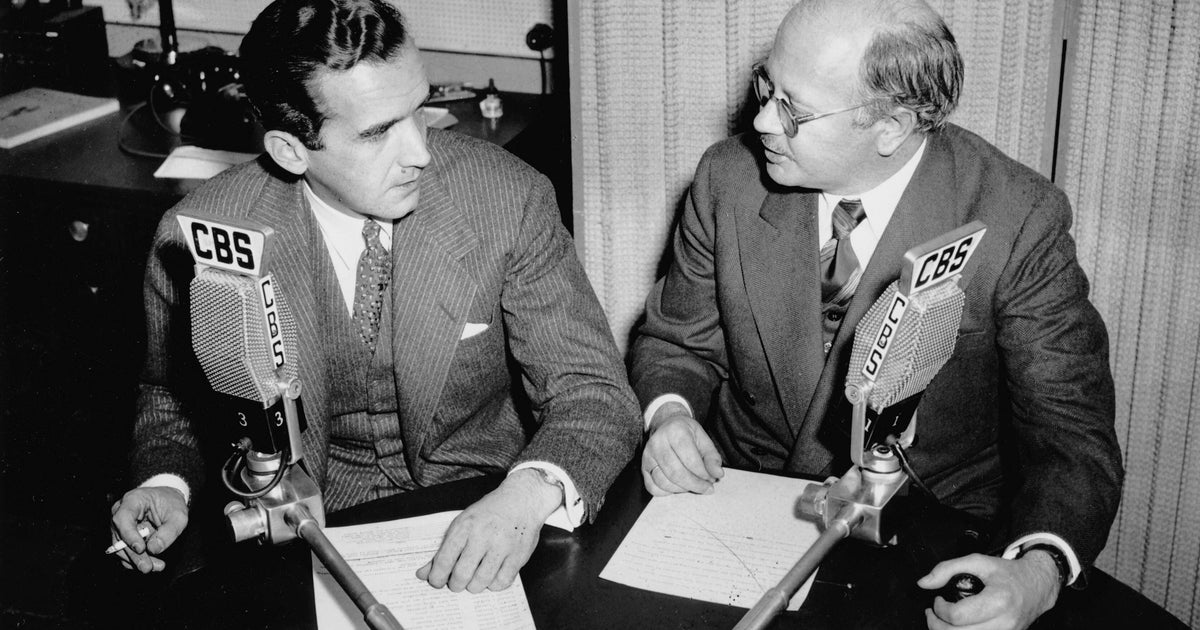
CBS News Radio, which provides news programming to an estimated 700 stations spanning the United States, will sign off the air Friday night after nearly a century of broadcasting.
The storied service, launched in September 1927, was home to broadcast legends Edward R. Murrow, Robert Trout, Douglas Edwards, Charles Osgood, Dan Rather and many other familiar and trusted voices over its decades in operation.
“It’s been around for a long time. Really, an American institution is what we’re losing here,” said Steve Kathan, the longtime anchor of the CBS World News Roundup.
“CBS Radio should be remembered for becoming a national institution very important to the development of news other than newspapers,” Rather recently told “CBS Sunday Morning.” “It, for many, many years, was a part, and I would argue not a small part, of what held the country together.”
The decision to shutter the radio news service was announced in March, with the company citing “challenging economic realities.”
In a statement at the time, CBS News President Tom Cibrowski and Editor-in-Chief Bari Weiss paid tribute to the historic role of CBS News Radio in covering major events worldwide since the dawn of the broadcasting era.
“For nearly 100 years, CBS News Radio has delivered original reporting to the nation — from Edward R. Murrow’s World War II reports in London to today’s daily White House updates,” they said. “Our signature broadcast, ‘World News Roundup,’ remains the longest-running newscast in the country. CBS News Radio served as the foundation for everything we have built since 1927.”
CBS News Radio first hit the airwaves just seven years after what’s been widely recognized as the first commercial radio broadcast.
The first broadcast of baseball’s World Series could be heard on CBS News Radio in 1938, and in 1939 it aired an interview with Babe Ruth.
CBS News Radio brought millions of Americans coverage of major events including the attack on Pearl Harbor and the D-Day invasion, Queen Elizabeth II’s coronation, the 1962 Cuban missile crisis, the New York City blackout of 1977, the Gulf War, the 9/11 terrorist attacks, and the 2003 Space Shuttle Columbia disaster.
Murrow’s voice was first heard on air in 1938. As “CBS Sunday Morning” recently recounted, he was in Europe to recruit voices for radio, but after observing how dangerous Hitler was, he sent back a broadcast.
“This is Edward Murrow speaking from Vienna. It’s now nearly 2:30 in the morning, and Herr Hitler has not yet arrived. No one seems to know just when he will get here. But most people expect him sometime after 10 o’clock tomorrow morning,” Murrow said in that report.
He later provided rooftop reports in London during the Blitz and from the Buchenwald concentration camp after the Germans had fled.
“I’m not searching for adjectives to make this sound dramatic,” he said in one wartime report. “I’m just telling you what I’ve seen.”
The legendary broadcaster was inducted into the Radio Hall of Fame in 1988.
CBS program host and correspondent Allison Keyes covered the news from Lower Manhattan on 9/11.
“People needed to know what was going on that day,” Keyes said, “in real time, no filter, no politics. Here’s what’s happening.”
As the final days of CBS News Radio approached, she and her coleagues reflected on its legacy.
“It leaves a huge gap in the field of news,” Keys said. “I want the listeners to know how proud and honored I am to have worked for this amazing place, with these amazing people.”
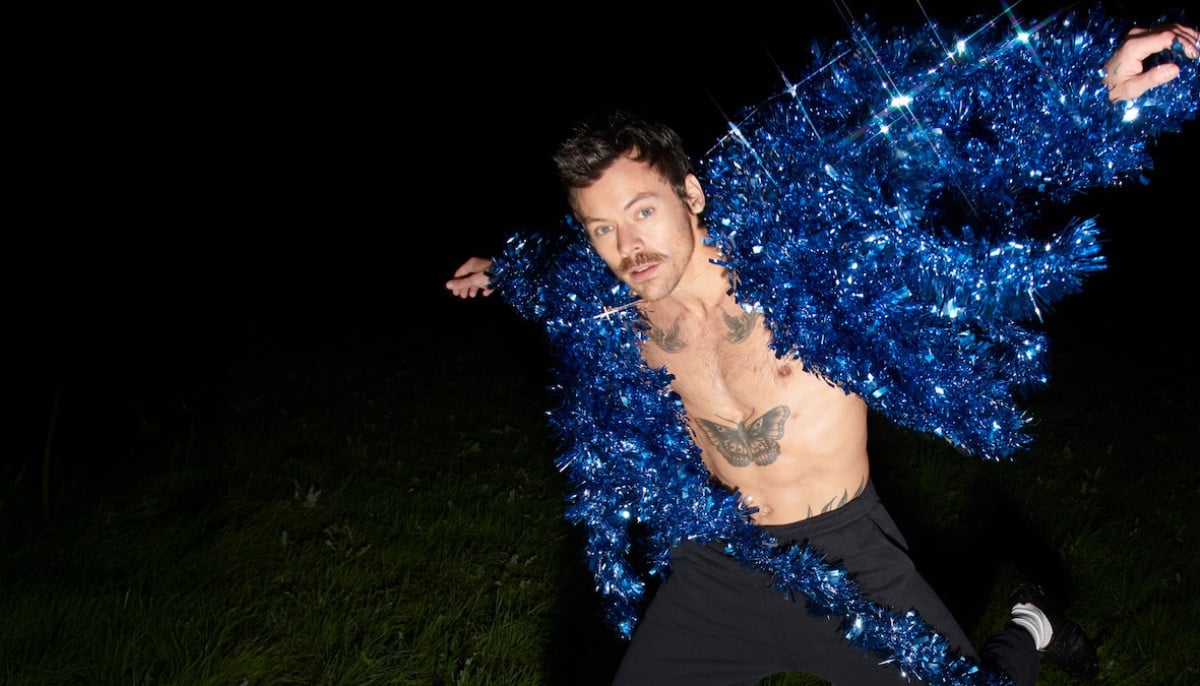
Harry Styles just turned a serious awards speech into something… nobody saw coming.
At the Ivor Novello Awards in London on May 21, the 32-year-old singer was there to honour Radiohead frontman Thom Yorke – but somehow ended up casually rewriting internet history in real time.
While praising Radiohead’s impact on his music, the As It Was crooner got unexpectedly personal.
“I cannot overstate how his work has influenced my belief in the purpose of the arts in our world today. And I cannot overstate how much his work continues to influence me,” he said.
Then things took a sharp left turn.
“I lost my virginity to ‘Talk Show Host,’” Harry said — before immediately clarifying, “I lost my virginity to the intro of ‘Talk Show Host.’”
Yes, the intro. About 10 seconds of it. No further details were offered… thankfully.
He also quipped that Radiohead’s “Exit Music (for a Film)” basically helped shape his own track Watermelon Sugar, adding, “Imagine that: a world without that song.”
The singer did not stop there. He credited seeing Radiohead perform in Berlin with convincing him to go back on tour – meaning, technically, they might be responsible for his current global run too.
And speaking of tours, Harry’s ongoing Together, Together stadium run is already stirring drama online, with fans complaining about restricted views and stage setups that occasionally block sightlines entirely.
One viral post read: “im sorry but wtf is this??? im at the barricade and i can’t even see the main stage anymore?????”
Another added: “we got harry close for 2% of the show.”
A rep for the tour defended the design, saying the floor setup was meant to be “free-flowing,” while also confirming some areas are being reviewed after complaints.
So yes – one night: Radiohead praise, virginity confession, and a stadium tour debate. Only Harry Styles could pack all that into one week.
Entertainment
Stephen Colbert signs off “The Late Show” one last time: “We were lucky enough to be here for the last 11 years”

Stephen Colbert said goodbye to “The Late Show” Thursday night in the franchise’s finale following a 33-year run, saying he was “lucky enough to be here for the last 11 years” and never took the experience for granted.
“There is so much history here in the Ed Sullivan Theater, and we’ve been honored to have been just a small part of it,” Colbert said in his opening monologue.
In the opening of the show, Colbert emphasized the “joy” the show brought him and cast members throughout the 11 years and over 1,800 episodes.
Scott Kowalchyk/CBS via Getty Images
“We call it the joy machine, because to do this many shows, it has to be a machine. But the thing is, if you choose to do it with joy, it doesn’t hurt as much when your fingers get caught in the gears,” Colbert said. “And I cannot adequately explain to you what the people who work here have done for each other and how much we mean to each other.”
The final show, which ran 17 minutes longer than its usual hour, was packed with surprise cameos from celebrities such as “The Daily Show” host Jon Stewart, comedian Tig Notaro, actors Ryan Reynolds, Paul Rudd, Bryan Cranston and Don Cheadle and astrophysicist Neil deGrasse Tyson.
“I didn’t think my show would end like this, but still grateful,” Colbert told Stewart.
Fellow late-night hosts Jimmy Kimmel, Jimmy Fallon, Seth Meyers and John Oliver also joined Colbert on Thursday.
“We came to say we’re gonna miss you. Late night is not gonna be the same without you,” Kimmel said.
Scott Kowalchyk/CBS via Getty Images 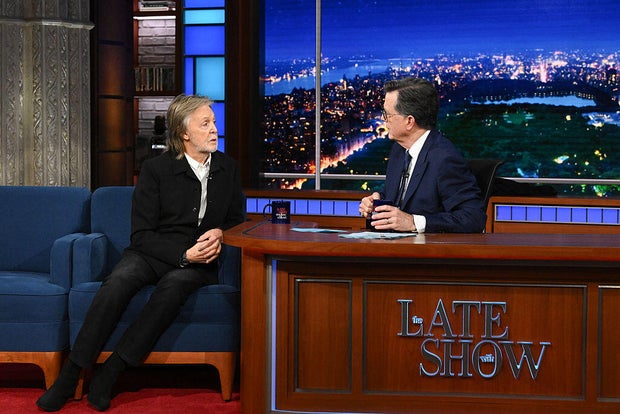
In recognition of Colbert’s final show, Kimmel and Fallon both aired reruns on Thursday.
Before the show, it was speculated that Pope Leo XIV might be Colbert’s final guest, but Colbert jokingly tried to introduce him before a cast member said Leo refused to come out of his dressing room.
The show’s actual final guest was none other than Paul McCartney.
He performed at the Ed Sullivan Theater with The Beatles during their American television debut on Feb. 9, 1964. McCartney was a guest on the show in 2019 and in 2009, when David Letterman was still the host.
Singers Elvis Costello and Jon Batiste performed Costello’s “Jump Up” as the shows musical performance. Batiste’s return to the Ed Sullivan Theater as a musical guest comes after he was the bandleader and musical director for “The Late Show” from 2015 until 2022.
Scott Kowalchyk/CBS via Getty Images 
In the final moments of Thursday’s finale, McCartney closed out the show with a performance of “Hello, Goodbye,” as Colbert joined in and audience members flooded the stage.
In the lead-up to the franchise finale, a stream of star guests had appeared on the show, such as actors Tom Hanks and Billy Crystal, director Steven Spielberg, Letterman, the show’s host when it debuted in 1993, Bruce Springsteen and Martha Stewart
CBS announced back in July that it would end “The Late Show with Stephen Colbert” and retire “The Late Show” franchise at the end of this season. The company said it was “purely a financial decision against a challenging backdrop in late night.”
That explanation was met with skepticism from some viewers and media critics, who questioned whether political motives were involved, given Colbert’s outspoken criticism of President Trump.
It didn’t take him long to weigh in. Shortly before 2 a.m. Eastern Time, Mr. Trump said on his Truth Social platform, “Colbert is finally finished at CBS. Amazing that he lasted so long! No talent, no ratings, no life. He was like a dead person. You could take any person off of the street and they would be better than this total jerk. Thank goodness he’s finally gone!”
Colbert took a jab at the network Thursday when his band played “Linus and Lucy,” the theme song from the “Peanuts” television special as part of a bit about a copyright infringement lawsuit.
“Is the band right now playing the same music I said people are being sued for, for using without permission?…Oh no, I hope this doesn’t cost CBS any money,” Colbert said.
Colbert, 62, took over as host of “The Late Show” in September 2015 after Letterman retired from the role he’d held for 22 years.
The entire set of “The Late Show” is being donated to the Museum of Broadcast Communications in Chicago, a city where Colbert has deep roots. Colbert attended Northwestern University and performed in Chicago with the famous Second City improv troupe at the beginning of his comedy career.
“The Late Show with Stephen Colbert” had been the No. 1 late-night program for nine consecutive seasons, CBS said last year. In September, it won the Emmy for outstanding talk series and received a standing ovation from the Emmys crowd.
CBS announced last month that Byron Allen’s “Comics Unleashed” will replace Colbert’s show in the 11:35 p.m. ET time slot.


Philippines’ T&A imports fall 9%, exports rise in Q1 2026

Vietnam, US to finalise reciprocal trade agreement soon

Cloudways vs Hostinger, tested by a tech expert

-

 Fashion1 week ago
Italy’s Zegna Group’s Q1 growth boosted by strong organic performance
-

 Entertainment6 days ago
Where Pete Davidson, Elsie Hewitt stand after breakup: Details revealed
-

 Entertainment1 week ago
Emilia Clarke recalls near-death incident while filming ‘Game of Thrones’
-
 Business1 week ago
Jersey Election 2026: Cost of living concern in St Helier Central
-

 Fashion1 week ago
Global cotton production, stocks to fall; consumption to rise: WASDE
-

 Fashion1 week ago
US’ Kontoor Brands’ posts strong Q1, plans Lee divestiture
-

 Politics6 days ago
Rising diesel costs from Iran war strain US school budgets
-

 Politics1 week ago
UK’s Starmer faces survival battle as potential rivals circle