

Business
Good for mortgages, bad for food prices – how inflation dip affects you


Kevin PeacheyCost of living correspondent
 Getty Images
Walking around your local supermarket and you’ll struggle to find much that’s healthy for your finances on the shelves – food price rises are accelerating.
The cost of the weekly shop is, and will continue to be, a worry for millions of people.
Beyond just food, prices of goods and services in general are going up, but the rate of those price rises have slowed.
And that is likely to bring better news for the cost of borrowing, in particular mortgage rates for homeowners and first-time buyers.
Are prices going up or down?
Prices pretty much always rise. Official statistics chart the movement in the cost of hundreds of goods and services in the UK.
It is the rate of increase that is crucial, and that inflation rate is published every month by the Office for National Statistics (ONS).
On Wednesday, the ONS said the rate of inflation had fallen to 3.6%, which means prices are rising more slowly than they were and will foster hope that inflation has peaked.

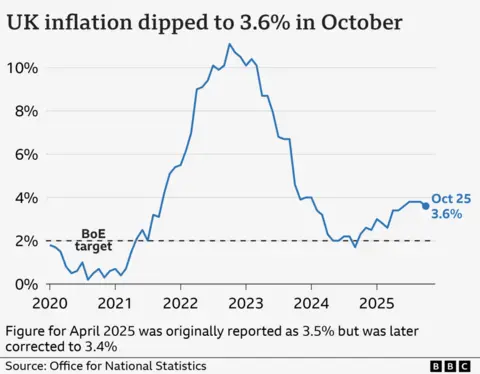
Delve a little further into the data, and there are more details about what is behind the latest trends.
For example, fish, vegetables, chocolate and confectionary were among the products that rose in price, although fruit prices fell slightly.
Recent research by the Bank of England found that people on average are still buying the same amount of food, but paying more for it. That said, they are changing the way they shop.
“Concerns about rising food costs and utility bills still dominate conversations,” it said.
“Households continue to change their shopping habits to reduce spending, such as buying more vegetables and reducing meat consumption.”
 Getty Images
“Staples like bread, meat and potatoes all cost more than they did even a month ago,” says Danni Hewson, head of financial analysis at investment platform AJ Bell.
But she does point to a silver lining – the dip in the inflation rate means the Bank of England is now more likely to cut interest rates in December.
The Bank uses its benchmark interest rate – which heavily influences the cost of borrowing for households and businesses – to try to bring inflation to its target rate of 2%.
“Inflation remains well above the Band of England’s happy place of 2%,” says Alice Haine, personal finance analyst at Bestinvest.
But, she says, the latest figures could pave the way for a sixth interest rate cut since August last year.
The prospect of an interest rate cut has seen lenders make changes already. In recent weeks, many major lenders have lowered their rates for people getting a new fixed-rate mortgage or renewing their current one.
“There has been particular emphasis placed on rates for home movers with some of the best rates available for purchases,” says David Hollingworth, of mortgage brokers L&C.
Data from the financial information service Moneyfacts shows that the average rate on a new two-year fixed deal has fallen to 4.88%, and is down to 4.93% for the average five-year fixed deal.
Average rates for those only able to put down a deposit of 5% or 10% – often first-time buyers – are now looking lower than they have been at any time in the last two or three years.
Why are lenders cutting rates now?
Inflation is only one factor in lenders’ decisions to cut mortgage rates now.
Generally, Christmas is a quiet time for the housing market as potential buyers and sellers concentrate on turkey and trimmings instead.
So, they may be lowering rates in a bid to stimulate custom.
The same cannot be said for savings rates. “Competition has been scarce,” says Caitlyn Eastell, from Moneyfacts.
That is compounded by the fact that many of those buyers, sellers and savers have put plans on hold until they find out what happens in the Budget delivered by Chancellor Rachel Reeves on 26 November.
The Budget looms large over the housing market, with talk of taxation on high value properties, as well as over economic activity in general.
Reeves wants to introduce measures to lower the rate of inflation, and help people with the cost of living. However, she also needs to bring in more money or cut government spending to meet her own fiscal rules.
It is a delicate balancing act that will affect individual and family finances, affecting the money people have to spend in the supermarket and the appetite they have to save, as well as buy or sell a home.

A student aged about 13 opened fire at random in a Turkish school Wednesday killing four people and wounding 20, just one day after a shooter wounded 16 people and then killed himself in another school, officials said.
Kahramanmaras province governor Mukerrem Unluer said a teacher and three students were killed in the latest attack. The attacker was also dead.
“A student came to school with guns that we believe belonged to his father in his backpack. He entered two classrooms and opened fire randomly, causing injuries and deaths,” Unluer told reporters.
Four of the wounded were in serious condition and undergoing surgery, he said.
The attacker, an eighth-grade student, was the son of a former police officer, Unluer said, adding that the suspect was carrying five guns and seven magazines.
“We suspect he may have taken his father’s weapons,” the governor said.
Unluer said the attacker was also dead.
“He shot himself. It is not yet clear whether this was suicide or happened amid the chaos,” he said.
Footage released by IHA private news agency showed a person, body and face covered, being evacuated in an ambulance, as well as tearful parents who had rushed to the school in the southern province’s main city, Kahramanmaras.
Witnesses quoted by media said intense gunfire was heard.
Police increased security around the building, and television footage showed ambulances in the area.
‘Will be held accountable’
Justice Minister Akin Gurlek said prosecutors had launched an immediate investigation into the shooting.
On Tuesday, an ex-student opened fire with a shotgun at his former high school in Siverek district of Sanliurfa province, wounding 16 people before killing himself in a showdown with police. Ten students were among the casualties.
Speaking to the ruling AKP party in parliament, President Recep Tayyip Erdogan promised that those found to have been negligent or at fault “will certainly be held accountable” over the school shootings.
Police detained one suspect after Tuesday’s attack and suspended four officials from duty, Erdogan said. The school was ordered closed for four days.
School shootings in Turkiye had been rare until this week. In May 2024, a former student killed a private high school principal in Istanbul with a firearm five months after he was expelled.
Turkiye has strict gun laws that require licensing, registration, mental and criminal background checks, and severe penalties for illegal possession.
Business
Donald Trump targets Fed chief Jerome Powell again, threatens to fire him if he is ‘not leaving on time’ – The Times of India
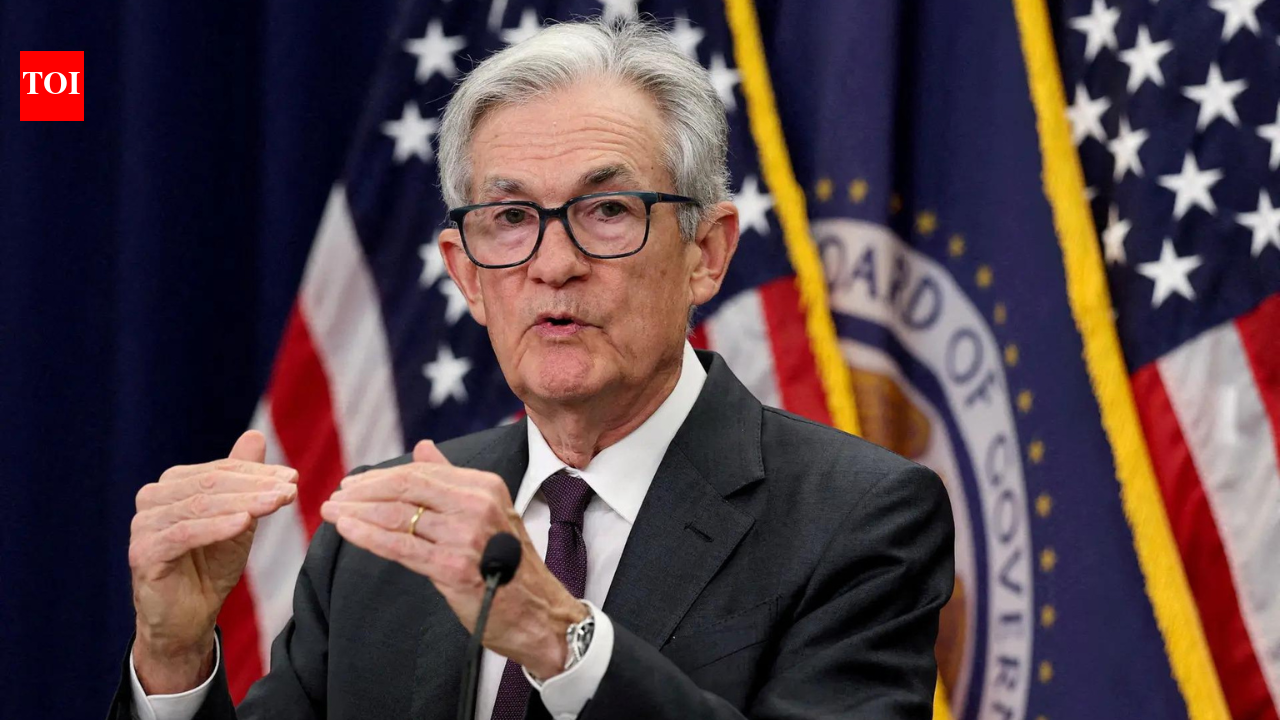
US President Donald Trump on Wednesday renewed his attack on Federal Reserve Chair Jerome Powell, saying he would fire him if he continues in the role beyond the end of his mandate.Powell’s term as Fed chair ends in mid-May, and Trump has repeatedly criticised him for not cutting interest rates more aggressively, AFP reported.
“I’ll have to fire him,” Trump told Fox Business, if Powell “is not leaving on time.”The president added: “I’ve wanted to fire him.”The remarks come as the Trump administration steps up pressure on the independent central bank, including initiating a Department of Justice probe into Powell over alleged renovation cost overruns and seeking to remove Fed governor Lisa Cook.Asked if he would drop the DOJ investigation, Trump said: “I’m not playing. I have to find out.”Trump has nominated former central banker Kevin Warsh to succeed Powell, but his appointment requires confirmation by the US Senate.Warsh is scheduled to appear before the Senate Banking Committee next Tuesday, though his confirmation faces resistance.Senator Thom Tillis, a Republican member of the committee, has said he would hold up the nomination while the probe into Powell remains unresolved.As long as the nomination process is delayed, Powell can legally continue as Fed chair.While uncommon, it is possible for a Fed chair to remain on the board even after their term as chief expires.Powell first became Fed chair in 2018 during Trump’s earlier presidency and was reappointed in 2022 under then president Joe Biden.

Morgan Stanley on Wednesday posted results that topped analyst estimates as the firm’s trading operations generated almost $1 billion more in revenue than expected.
Here’s what the company reported:
- Earnings: $3.43 a share vs. $3 LSEG estimate
- Revenue: $20.58 billion vs. $19.72 billion estimate
The bank said profit jumped 29% to $5.57 billion, or $3.43 a share. Revenue rose 16% to $20.58 billion, fueled by gains in the firm’s trading, investment banking and wealth management businesses.
Equities trading revenue jumped 25% to a record $5.15 billion, or about $450 million above the StreetAccount estimate. The firm cited strong volumes across its global equities franchise, especially in its prime brokerage business catering to hedge funds and its derivatives unit.
Fixed income revenue rose 29% to $3.36 billion, or about $540 million more than expected, helped by commodities trading that benefited from volatility in energy markets in the period.
Morgan Stanley, led by CEO Ted Pick since 2024, appears to have capably navigated the tumult of the first quarter, which saw rolling corrections in software stocks and the upheaval caused by the Iran war. Of note, the bank edged out rival Goldman Sachs in the key arena of fixed income trading, where Goldman posted an unusually large miss of $910 million versus the StreetAccount estimate.
Morgan Stanley’s investment banking revenue surged 36% to $2.12 billion, essentially matching the StreetAccount estimate, on rising fees from completed mergers, as well as stock and bond underwriting.
Wealth management revenue climbed 16% to a record $8.52 billion as the firm cited rising asset values and fee-generating transactions.
The firm’s smallest division, its investment management business, saw revenue drop 4.2% to $1.54 billion, or about $110 million below expectations. Morgan Stanley cited lower carried interest on private funds for the drop in performance.
Analysts will want to know what Pick has to say on the business outlook for the rest of the year as geopolitical tensions remain high.
This story is developing. Please check back for updates.


Raymond unveils luxury Chairman’s Collection Store in Mumbai

MAGA Is Starting to Look Beyond Trump

Breaking down the offseason for Michigan, Arizona, UConn, Illinois, Duke

-

 Fashion1 week ago
India’s exports face reset as EU links trade to carbon metrics: EY
-

 Entertainment1 week ago
Queen Elizabeth II emotional message for Archie, Lilibet sparks speculation
-

 Entertainment1 week ago
Lamar Odom shocking response to Khloé Kardashian account of his overdose
-

 Tech7 days ago
As the Strait of Hormuz Reopens, Global Shipping Will Take Months to Recover
-

 Tech1 week ago
Azure customers up in arms over ‘full’ UK South region | Computer Weekly
-

 Fashion1 week ago
CII submits 20-pt agenda to Indian govt to back firms hit by Iran war
-

 Tech6 days ago
This AI Button Wearable From Ex-Apple Engineers Looks Like an iPod Shuffle
-

 Tech1 week ago
A Single Strike Won’t Shut Off the Gulf’s Desalination System