

Business
Good for mortgages, bad for food prices – how inflation dip affects you


Kevin PeacheyCost of living correspondent
 Getty Images
Walking around your local supermarket and you’ll struggle to find much that’s healthy for your finances on the shelves – food price rises are accelerating.
The cost of the weekly shop is, and will continue to be, a worry for millions of people.
Beyond just food, prices of goods and services in general are going up, but the rate of those price rises have slowed.
And that is likely to bring better news for the cost of borrowing, in particular mortgage rates for homeowners and first-time buyers.
Are prices going up or down?
Prices pretty much always rise. Official statistics chart the movement in the cost of hundreds of goods and services in the UK.
It is the rate of increase that is crucial, and that inflation rate is published every month by the Office for National Statistics (ONS).
On Wednesday, the ONS said the rate of inflation had fallen to 3.6%, which means prices are rising more slowly than they were and will foster hope that inflation has peaked.

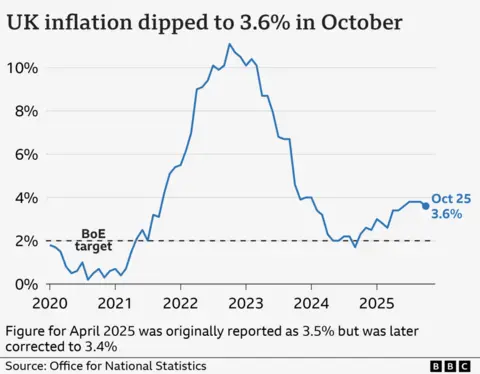
Delve a little further into the data, and there are more details about what is behind the latest trends.
For example, fish, vegetables, chocolate and confectionary were among the products that rose in price, although fruit prices fell slightly.
Recent research by the Bank of England found that people on average are still buying the same amount of food, but paying more for it. That said, they are changing the way they shop.
“Concerns about rising food costs and utility bills still dominate conversations,” it said.
“Households continue to change their shopping habits to reduce spending, such as buying more vegetables and reducing meat consumption.”
 Getty Images
“Staples like bread, meat and potatoes all cost more than they did even a month ago,” says Danni Hewson, head of financial analysis at investment platform AJ Bell.
But she does point to a silver lining – the dip in the inflation rate means the Bank of England is now more likely to cut interest rates in December.
The Bank uses its benchmark interest rate – which heavily influences the cost of borrowing for households and businesses – to try to bring inflation to its target rate of 2%.
“Inflation remains well above the Band of England’s happy place of 2%,” says Alice Haine, personal finance analyst at Bestinvest.
But, she says, the latest figures could pave the way for a sixth interest rate cut since August last year.
The prospect of an interest rate cut has seen lenders make changes already. In recent weeks, many major lenders have lowered their rates for people getting a new fixed-rate mortgage or renewing their current one.
“There has been particular emphasis placed on rates for home movers with some of the best rates available for purchases,” says David Hollingworth, of mortgage brokers L&C.
Data from the financial information service Moneyfacts shows that the average rate on a new two-year fixed deal has fallen to 4.88%, and is down to 4.93% for the average five-year fixed deal.
Average rates for those only able to put down a deposit of 5% or 10% – often first-time buyers – are now looking lower than they have been at any time in the last two or three years.
Why are lenders cutting rates now?
Inflation is only one factor in lenders’ decisions to cut mortgage rates now.
Generally, Christmas is a quiet time for the housing market as potential buyers and sellers concentrate on turkey and trimmings instead.
So, they may be lowering rates in a bid to stimulate custom.
The same cannot be said for savings rates. “Competition has been scarce,” says Caitlyn Eastell, from Moneyfacts.
That is compounded by the fact that many of those buyers, sellers and savers have put plans on hold until they find out what happens in the Budget delivered by Chancellor Rachel Reeves on 26 November.
The Budget looms large over the housing market, with talk of taxation on high value properties, as well as over economic activity in general.
Reeves wants to introduce measures to lower the rate of inflation, and help people with the cost of living. However, she also needs to bring in more money or cut government spending to meet her own fiscal rules.
It is a delicate balancing act that will affect individual and family finances, affecting the money people have to spend in the supermarket and the appetite they have to save, as well as buy or sell a home.

Some vehicles are still taking part in a convoy at a roundabout in County Tyrone.
Source link
Business
Gold prices today (April 14, 2026): MCX gold jumps over 1%; June, August contracts extend gains – The Times of India

Gold prices traded higher in the domestic futures market on Tuesday, tracking firm global cues and improved sentiment amid easing dollar pressure and hopes of renewed geopolitical talks.On the Multi Commodity Exchange (MCX), gold futures for the June 2026 contract rose Rs 1,981, or 1.30%, to Rs 1,54,053 per 10 grams. The contract touched a high of Rs 1,54,170 and a low of Rs 1,52,700 during the session.The August 2026 contract also gained Rs 2,024, or 1.31%, to trade at Rs 1,56,645 per 10 grams, after hitting an intraday high of Rs 1,56,855.Meanwhile, the October 2026 contract edged higher by Rs 1,231, or 0.78%, to Rs 1,58,401 per 10 grams.Separately, in international market, spot gold rose 1.5% to $4,808.69 per ounce by 11:31 a.m. ET, while US gold futures gained 1.4% to $4,833.10, Reuters reported.Market sentiment improved after reports that negotiating teams from the US and Iran could return to Islamabad this week to restart talks, following the collapse of weekend discussions that led Washington to impose a blockade on Iranian ports.“The direction of the gold market will depend on how the talks go in Pakistan and what kind of progress is made heading into the weekend. If we see positive news, metals will continue higher,” said Bob Haberkorn, senior market strategist at RJO Futures, Reuters quoted.“Lower dollar, lower oil right now is helping gold out, being that when the war started, there was a rush to cash and a concern about being able to accumulate energy supplies,” he added.The US dollar drifted lower while oil prices also eased, making dollar-denominated bullion more affordable for holders of other currencies.Data showed US producer prices increased less than expected in March as the cost of services remained unchanged, although rising energy prices linked to the Iran war continued to fuel inflation pressures.Despite being seen as an inflation hedge, gold tends to lose appeal in a higher interest rate environment since it does not offer yield.Traders are now pricing in a 28% probability of a US rate cut this year, compared with expectations of two rate cuts before the conflict began.“As long as the market does not begin to seriously consider a rate hike by the US Federal Reserve – there are no signs of this so far – the gold price is unlikely to fall much further,” analysts at Commerzbank said.Among other precious metals, spot silver surged 4.7% to $79.12 per ounce, platinum rose 0.9% to $2,088.13, while palladium edged 0.2% lower to $1,571.02.
Business
US wholesale inflation data: Producer prices rise 4% as Iran war fuels energy surge, Fed faces policy dilemma – The Times of India

US wholesale prices rose sharply in March as the Iran war drove up energy costs, adding to inflation pressures and complicating the Federal Reserve’s policy outlook.Producer prices, which measure inflation at the wholesale level before it reaches consumers, rose 0.5% from February and 4% from March 2025, marking the biggest annual increase in more than three years, AP reported.Energy prices surged 8.5% month-on-month, reflecting the impact of the Middle East conflict on global oil markets.However, core producer prices –which exclude volatile food and energy components- rose a modest 0.1% from February and 3.8% year-on-year, indicating relatively contained underlying inflation.The rise in wholesale inflation adds to challenges for the US Federal Reserve, which has been under pressure from President Donald Trump to cut interest rates, even as some policymakers lean toward tightening due to persistent price pressures.Food prices, a politically sensitive component ahead of next year’s midterm elections, declined 0.3% in March after rising 2.4% in February.Economists track wholesale inflation closely as it provides early signals on consumer prices, with components such as healthcare and financial services feeding into the Fed’s preferred gauge — the personal consumption expenditures (PCE) index.“The decline in food prices is overdue, and welcome news for everyone,” Carl Weinberg, chief economist at High Frequency Economics, said. “Food price increases are at the core of political arguments over affordability.”The latest data follows a sharp rise in consumer inflation, with gasoline prices pushing the consumer price index up 3.3% year-on-year in March — the biggest increase since May 2024 — and 0.9% month-on-month, the steepest gain in nearly four years.Meanwhile, the International Energy Agency (IEA) warned that the Iran war could lead to an annual decline in global oil demand for the first time since the pandemic.The agency said oil demand is expected to fall by an average of 80,000 barrels per day this year, a sharp reversal from its earlier forecast of an increase of 850,000 barrels per day.The drop in demand has been driven by attacks on energy infrastructure and the shutdown of the Strait of Hormuz, with the IEA projecting a decline of 1.5 million barrels per day in the current quarter.While the initial impact has been concentrated in the Middle East and Asia-Pacific, demand destruction is expected to spread as oil prices rise and supply constraints persist.


Telegram Is Still Hosting a Sanctioned $21 Billion Crypto Scammer Black Market

Ships leave Iranian ports in Persian Gulf despite US ‘blockade’: Data
Northern Ireland fuel protests: Fines issued after traffic disrupted

-

 Fashion1 week ago
India’s exports face reset as EU links trade to carbon metrics: EY
-

 Entertainment6 days ago
Queen Elizabeth II emotional message for Archie, Lilibet sparks speculation
-

 Tech6 days ago
As the Strait of Hormuz Reopens, Global Shipping Will Take Months to Recover
-

 Tech6 days ago
Azure customers up in arms over ‘full’ UK South region | Computer Weekly
-

 Entertainment1 week ago
Lamar Odom shocking response to Khloé Kardashian account of his overdose
-

 Tech5 days ago
This AI Button Wearable From Ex-Apple Engineers Looks Like an iPod Shuffle
-

 Fashion6 days ago
CII submits 20-pt agenda to Indian govt to back firms hit by Iran war
-

 Tech1 week ago
A Single Strike Won’t Shut Off the Gulf’s Desalination System