

Business
Stocks to buy: What’s the outlook for Nifty for the week starting November 24? Check list of top stock recommendations – The Times of India


According to Sudeep Shah, Head – Technical Research and Derivatives, SBI Securities, the top stock picks for this week are
Nifty View
“When the tide begins to rise but only a few boats lift with it, the ocean is hinting at a deeper story.”That’s the pulse of the Indian market right now. The Nifty index is hovering near fresh record highs — a stage typically filled with celebration and broad market excitement. Yet this time, the cheer appears confined to a select group of heavyweights. The rally looks impressive in headlines, but on the trading floor, the mood feels uneven like the market is trying to climb higher without full support from its players.Dig a little deeper and the picture shifts. Midcaps and Smallcaps — the segments that generally add strength and breadth to a bull run are undergoing a corrective phase. Their weakness signals that the ongoing upside may be missing the widespread participation needed for a truly robust trend. This split between the index and the broader market prompts a key question: Are we witnessing a genuine, healthy breakout, or is the shine of all-time highs hiding growing vulnerabilities?The broader market is clearly flashing caution. A strong and durable rally is built when leadership and breadth move in harmony — where frontline stocks lead and the broader universe keeps pace. Currently, strength remains concentrated in a handful of index majors, while a large set of stocks still struggles to find footing. This imbalance suggests that conviction is far from unanimous. The coming few trading sessions become critical — especially to monitor whether Midcaps and Smallcaps can stabilize and rejoin the upside, as their tone often determines the real depth of the trend.In the near term, the zone of 25900–25850 will be a crucial support cushion for Nifty. As long as the index holds above 25850, the upside structure remains intact, with potential moves toward 26300 and 26500 on the cards. For now, the index may be celebrating near the peak — but only the broader market’s behavior in the days ahead will reveal whether this climb transforms into a full-fledged bull run or stays a selective ascent wearing a bullish mask.
Bank Nifty View
Bank Nifty has been the standout performer in recent sessions, consistently leading the market with strong upward momentum and marking fresh all-time highs for four consecutive days. This robust advance underlines the strength and leadership of banking stocks within the current market environment.But Friday’s session signaled a temporary halt, as profit booking drove the index back below the 59000 mark. This pullback resulted in the formation of a Shooting Star candlestick on the weekly chart — a well-known bearish reversal pattern that often emerges near the top of an uptrend. The long upper wick reflects an initial bullish push that was ultimately overpowered by selling pressure, highlighting fatigue in buying interest at elevated levels.Momentum indicators are also hinting at caution. The RSI has slipped below its 9-day EMA, and both are pointing downward. A bearish divergence on the daily timeframe further supports the view of a potential near-term cooling phase. Collectively, these signals indicate that the index may shift into consolidation mode before attempting another breakout.From a levels perspective, 58600–58500 is the immediate support zone to watch. A decisive close below 58500 could accelerate weakness toward 57700. On the flip side, 59200–59400 stands as the first major barrier for the bulls. Only a sustained move above 59400 would invalidate the current cautionary signals and reopen the path for a continued northward move.In short, Bank Nifty remains structurally strong — but short-term fatigue calls for a vigilant approach in the coming sessions.
Stock recommendations:
Narayana Hrudayalaya
Since early August, NH had been consolidating in a 1863–1693 range. On 17th November, the stock delivered a strong breakout above this zone, backed by a sharp spike in volumes, indicating aggressive buying interest. Post breakout, NH has continued to move steadily higher, showing sustained strength. The rising MACD histogram bars indicate that bullish momentum is building on the upside. Meanwhile, the ADX has inched marginally above 25, signalling that a strong trend is beginning to form. Overall, the price action combined with improving momentum indicators suggests that the stock is well-positioned for further upside. Hence, we recommend accumulating the stock in the zone of 2050-2030 with a stoploss of 1960. On the upside, it is likely to test the level of 2200 in the short term.
Indigo
Indigo (Interglobe Aviation) has been rising steadily after taking strong support near its 100-day EMA around 5685–5690 three sessions ago. The RSI has climbed from 49 on 18th November to 55 on 21st November, indicating improving bullish momentum as buyers regain control. In the ADX indicator, the +DI crossing above –DI signals that buying strength is now dominating over selling pressure. The combination of a rebound from a key moving-average support and strengthening momentum indicators suggests that the stock is well-positioned for further upside, with the recent bounce likely marking the start of a short-term positive phase. Hence, we recommend to accumulate the stock in the zone of 5850-5800 with a stoploss of 5660. On the upside, it is likely to test the level of 6250 in the short term.
(Disclaimer: Recommendations and views on the stock market, other asset classes or personal finance management tips given by experts are their own. These opinions do not represent the views of The Times of India)






Business
NaBFID signs pact with PDCOR to expand advisory support for state projects – The Times of India

The National Bank for Financing Infrastructure and Development (NaBFID) has signed a Memorandum of Agreement with Projects Development Company of Rajasthan Limited (PDCOR) to strengthen advisory services for state and city-level infrastructure projects.The agreement will also allow both institutions to jointly explore financing and transaction advisory opportunities, including transaction structuring, commercial and technical due diligence, and support for financial closure of projects undertaken by state governments and urban local bodies across India, according to PTI.“This collaboration seeks to enhance access to long-term institutional finance for State Governments and Urban Local Bodies, while strengthening the infrastructure advisory and financing ecosystem,” Rajkiran Rai G., Managing Director of NaBFID, said.He added that the partnership would help both institutions jointly pursue project advisory opportunities, develop replicable financing frameworks, accelerate financial closures and mobilise capital across the infrastructure value chain.Monika Kalia, DMD-CFO, NaBFID, said the tie-up would leverage the strengths of both organisations to provide much-needed advisory support to states and urban local bodies for impactful urban infrastructure projects.Dileep Chingapurath, Chief Executive Officer, PDCOR, said the agreement would address the long-felt need for end-to-end professional support to structure and mobilise sustainable financing solutions, particularly for state governments and their agencies.“Through this collaboration, both institutions aim to enhance the quality of project preparation, mobilise institutional capital more effectively and accelerate the implementation of sustainable infrastructure projects across states and municipalities,” he said.NaBFID is a Development Financial Institution focused on long-term infrastructure financing, while PDCOR is an undertaking of the Government of Rajasthan.
Business
Explained: On way to 4th largest, how India slipped to 6th rank & what it means for 3rd largest economy dream – The Times of India
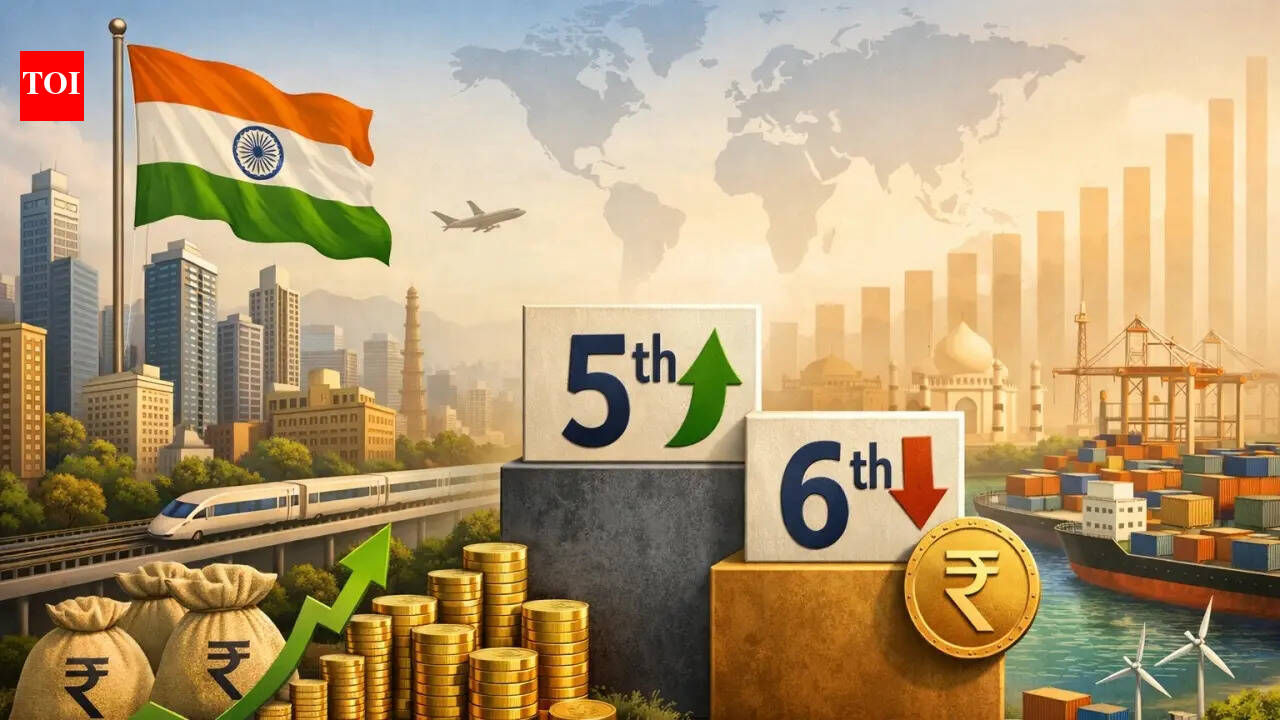
In April 2025 when the International Monetary Fund (IMF) released its World Economic Outlook, India was seen overtaking Japan to become the world’s fourth largest economy by the end of 2025-26. One year later, India has slipped to the sixth position on the largest economies rankings, with the United Kingdom reclaiming its spot as the fifth largest economy.In fact, IMF’s latest World Economic Outlook (April 2026) sees India sitting at the sixth spot this financial year too. This projection comes even as India has grown better than expected in FY26 and is seen retaining its tag of being the world’s fastest growing major economy.What has led to the sudden fall? Why has India dropped to the sixth position, falling behind the UK, instead of overtaking Japan to become the fourth largest economy? And what does this setback mean for its dream of becoming the third largest economy by the end of this decade? We decode:
Data drive: India projected as 4th largest, but fell to 6th spot
First let’s look at some IMF data to see which way the Indian economy was headed in April 2025, and what the April 2026 outlook data suggestsAs per April 2025 estimates of IMF, India’s economy would have been at $4601.225 billion at the end of FY 2025-26, overtaking Japan which was estimated at $4373.091 billion. The UK at the 6th spot was projected to have a nominal GDP of $4040.844 billion.However, as per the April 2026 estimates, India’s economy had a nominal GDP of $4,153 billion at the end of FY 2025-26, with the UK overtaking it with $4,265 billion GDP. Japan’s GDP is seen at $4,379 billion.As the above estimates show, India’s GDP estimates have seen a drop over one year, while UK’s nominal GDP has grown better than expected. Japan has been steady.So, what went wrong? Blame the rupee and GDP data itself!
Rupee Depreciation Blow & New GDP Series
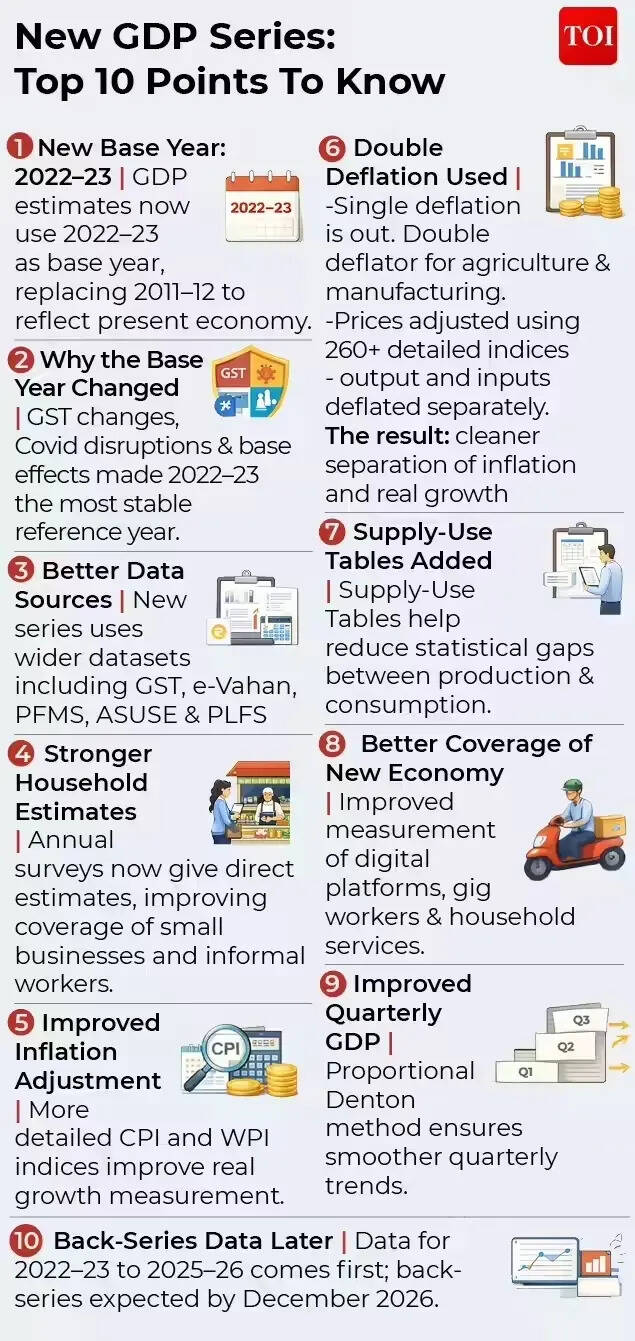
The first thing to understand is that IMF’s data on the size of a country’s nominal GDP is in dollar terms. Hence, with global rankings based on dollar‑denominated GDP, they are highly sensitive to exchange rate movements. The biggest party pooper for India’s dream of becoming the fourth largest has been the rupee’s slide. The Indian currency has depreciated more than expected over the last year, dropping from 84.57 versus the US dollar in 2024 to 88.48 in 2025, as per IMF data. The IMF estimates see it at 92.59 this year.Several factors have contributed to the rupee’s decline, including capital outflows, uncertainty related to India-US trade deal up until February, and the recent Middle East conflict which has raised crude oil prices and India’s import bill. Also, the RBI while actively managing volatility in the forex market, is not targeting any particular level of the rupee.Arun Singh, Chief Economist, Dun & Bradstreet India says that India’s recent slip to sixth place in global GDP rankings does not reflect a weakening of the economy, but is largely the result of currency conversion effects and a one‑time statistical revision.The rupee’s depreciation from 2024 to 2026, has mechanically compressed India’s GDP in dollar terms, effectively halving apparent growth despite strong domestic expansion, says Arun Singh.According to Ranen Banerjee, Partner and Leader, Economic Advisory Services, PwC India, GDP in US dollar terms would shave off with rupee depreciation. “We have had almost 7-8% depreciation over the last few months owing to the conflict and portfolio outflows. Thus, in effect in US dollar terms, it is close to shaving out almost a year’s nominal GDP,” he tells TOI.And it’s not just about the Indian economy. The United Kingdom which has overtaken India to bag the 5th spot again also has economic factors working in its favour. UK’s GDP growth at 0.5% has recently beaten forecasts of 0.1% by a wide margin. Not only that, its currency – pound – has actually appreciated against the US dollar.The second factor that has impacted the rankings is India’s adoption of a new base year for its latest GDP series. As per the new data, which also makes use of a more refined methodology, the size of India’s nominal GDP in rupee terms has gone down. Sample this: As per the older base year of 2011-12, India’s GDP at the end of 2025-26 would have been Rs 35,713,886 crore. But under the new series, it is estimated to be Rs 34,547,157 crore. The new calculation methodology and base year revision presents a more accurate picture of the size of the Indian economy.Hence the currency effect has been compounded by a one‑time downward revision following India’s shift to a new GDP base year, which has lowered reported nominal levels without affecting real activity.
Does India’s drop to 6th indicate fundamental weakness?
Experts are confident that India’s growth story is intact and fundamentally strong, a fact that is reflected in projections of it continuing to be the world’s fastest growing major economy. They see technical factors behind the current slip, rather than any deterioration in economic fundamentals.It’s also interesting to note that while India will be the sixth largest economy in FY27, in the upcoming financial year, it is likely to overtake both the UK, and Japan to bag the fourth spot.Arun Singh of Dun & Bradstreet India explains this resilience with numbers:IMF World Economic Outlook (April 2026) data show that India’s GDP at current prices in domestic currency rose strongly from ₹318 trillion in 2024 to ₹346.5 trillion in 2025 and further to ₹384.5 trillion in 2026, translating into robust nominal growth of about 8.9% in 2024–25 and nearly 11% in 2025–26, among the fastest globally. In contrast, other large economies recorded more moderate domestic nominal growth – around 5% in the US, roughly 4% in China, 3–5% in the UK, 3–3.5% in Germany, and lower or volatile growth in Japan – underscoring India’s strong underlying momentum. In times of global economic turmoil, while GDP growth is expected to take some hit, most agencies and experts have pegged India’s growth to be strong. Incidentally, the IMF has even marginally raised its GDP growth forecast for FY27 to 6.5% despite the ongoing Middle East conflict.
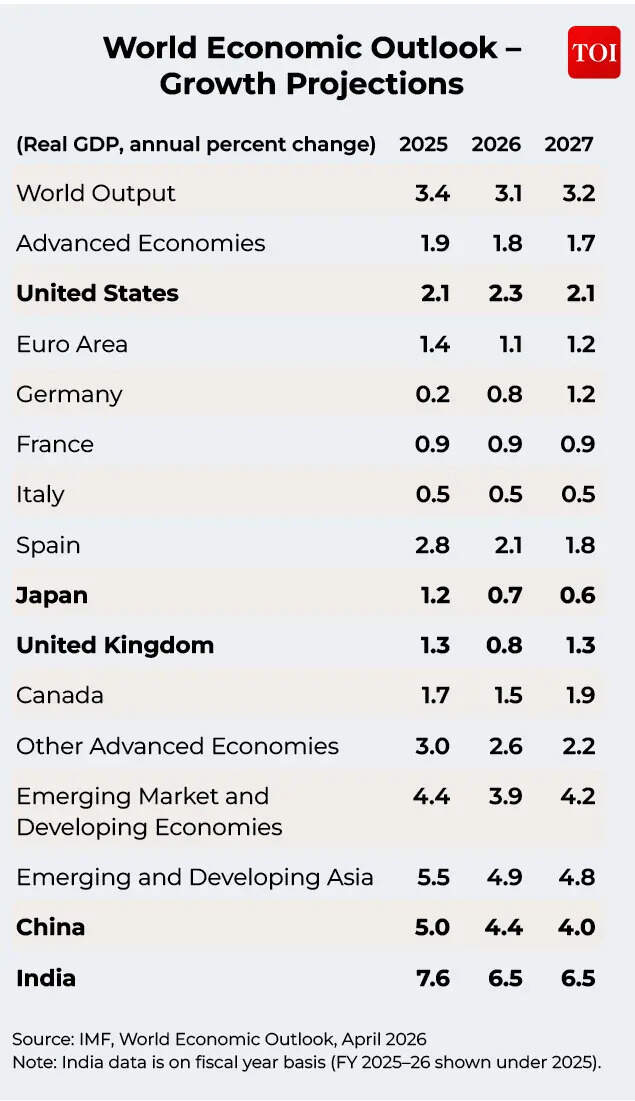
“In India, growth for 2025 is revised upward by 1.0 percentage point relative to October, to 7.6 percent, reflecting the better-than-expected outturn in the second and third quarters of the fiscal year and sustained strong momentum in the fourth quarter,” IMF said in its latest outlook. “For 2026, growth is revised upward moderately by 0.3 percentage point (0.1 percentage point relative to January) to 6.5 percent, led by positive contributions from the carryover of the strong 2025 outturn and the decline in additional US tariffs on Indian goods from 50 to 10 percent, which outweigh the adverse impact of the Middle East conflict. Growth is projected to stay at 6.5 percent in 2027,” it added.
Will India become 3rd largest anytime soon?
The rupee depreciation and the nominal GDP revision has also pushed back India’s dream of becoming the third largest economy by the end of this decade. In the October 2025 estimates, IMF had said that India will overtake Germany to become third largest by FY30. However, the April 2026 projections see it reaching the third rank only by FY 2030-31.Experts point to the rupee’s depreciation versus the dollar to note that the road ahead is likely to be uncertain. Madan Sabnavis, Chief economist, Bank of Baroda is confident that India will continue to do well in the coming years.“We will definitely improve in terms of GDP growth which will be higher than that of other countries especially UK and Japan which are just above us. However, the rupee value will finally determine how India gets placed on the global scale,” he told TOI.Ranen Banerjee of PwC India sees rupee beginning to get support with the conflict containment, relatively lower oil prices and portfolio flow reversals with valuations getting attractive in recent times. “Thus, we should not be experiencing any further sharp depreciation of the rupee in the immediate term provided the conflict does not escalate and oil prices relatively softening from their highs and come down to a range of $85-90 a barrel,” he says.For Arun Singh of Dun & Bradstreet, looking ahead, India’s relative position in US dollar‑based GDP rankings will remain highly sensitive to currency movements rather than domestic growth dynamics. “Continued global dollar strength or capital‑flow volatility may cause periodic slippage in rankings despite robust fundamentals. Sustaining external macro stability and limiting undue rupee volatility will be crucial for India’s strong growth performance to translate more fully into higher global economic rankings,” Arun Singh told TOI.The Indian economy, largely driven by domestic fundamentals, is not immune to external shocks. High US tariffs of 50% from August 2025 to early February, and the ongoing US-Iran war have spelt back-to-back shocks for the economy. Even as experts stress on the resilience of the growth story, the vulnerability to higher crude oil prices, and other global supply chain disruptions is a reality. In such a scenario, India may well have to contend with fluctuating world rankings, while banking on its strong GDP growth to tide over disruptions.

new video loaded: Why Your Paycheck Feels Smaller
By Ben Casselman, Nour Idriss, Sutton Raphael and Stephanie Swart
April 18, 2026


Ariana Grande teases new era after ‘Eternal Sunshine’ with cryptic video

I don’t regret gifting Nobel prize to Trump: Venezuela’s Machado
NaBFID signs pact with PDCOR to expand advisory support for state projects – The Times of India

-

 Politics1 week ago
Indian airlines hit hardest after Dubai limits foreign flights until May 31
-

 Entertainment6 days ago
Palace left in shock as Prince William cancels grand ceremony
-

 Sports5 days ago
The case for Man United’s Fernandes as Premier League’s best
-

 Politics1 week ago
Chinese, Taiwanese will unite, Xi tells Taiwan opposition leader
-
 Business5 days ago
UK could adopt EU single market rules under new legislation
-

 Entertainment1 week ago
Dua Lipa hits major career high ahead of wedding with Callum Turner
-
 Business1 week ago
The FAA wants gamers to apply for air traffic control jobs
-
 Business1 week ago
He paid $248 in illegal tariffs for this coat. Will he ever get it back?