

Sports
The most impactful T20I performer: Who is Virandeep Singh? | The Express Tribune

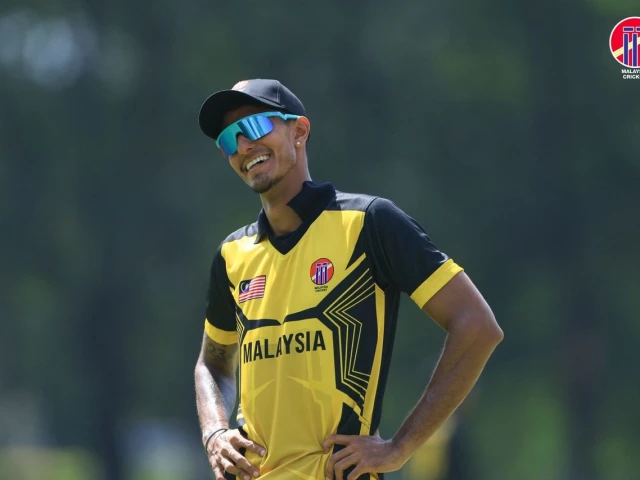
The Malaysian all-rounder became the first cricketer to score 3,000 runs and take 100 wickets in T20Is
KARACHI:
Malaysia’s Virandeep Singh, former captain and flamboyant all-rounder’s goal is to transcend beyond the label of associate cricketer and his specialty is delivering impactful performances.
He recently became the first all-rounder to score 3,000 runs and take 100 wickets in T20Is. He has the most Player of the Match awards under his belt in the shortest format of the game with 22.
“The reality is, as an associate cricketer, those records don’t carry the same weight in the eyes of the world,” he lamented. “Cricket is cricket, no matter the level, but the value attached to performances is much lower for us,” said Singh during an exclusive interview.
The 26-year-old is also the fifth-fastest batter to reach 3,000 T20I runs, achieving the milestone in just 98 innings.
The wicket-keeper made history by becoming the youngest player to represent his country at the international level, at just 15 years of age. He transitioned from a bowler to a hard-hitting batter.
Still, he remains in the shadows, struggling to gain the recognition he deserves.
Born in Kuala Lumpur, Malaysia, Singh was introduced to cricket through his father, who had played the game in school.
Initially, more inclined toward football, he began playing cricket in primary school, following in his brother’s footsteps.
At just ten years old, he joined the Royal Selangor Club, getting his first taste of leather-ball cricket.
Although, he didn’t love the game at first, India’s triumph in the 2011 World Cup ignited his passion for cricket.
He dreamed of representing his own country on the world stage, from that point on.
Destined to play
His natural ability, hard work, and consistent performances set him on a remarkable journey and at 13, he was selected for the Malaysia U-16, at 14, he had made the Malaysia U-19 team, and at 15, he was selected for the senior team.
In age-group cricket, Singh delivered a series of impressive performances with both bat and ball, earning him a call-up to selection matches, which eventually landed him in the national team. The selection, however, came with a whirlwind of emotions and drama.
“Malaysia had a tour to Dubai for the ACC Premier Cup. I got called up for the selection games and scored a couple of fifties, which earned me a spot in the top 18 as a bowler. I was in the reserve four, not traveling with the team,” he recalled.
“Then, during training, one of my teammates twisted his ankle during a fitness drill, and I was told I’d be traveling with the team as his replacement. I was over the moon.”
But just as quickly, his excitement faded because another player was chosen in his place at the last moment.
Still, Singh refused to lose hope. Fate intervened again when one of the players was denied entry into the country, paving the way for his debut.
In his first outing, batting at number five, he scored 23 runs off 17 deliveries.
“I wasn’t really nervous,” he said. “It was easier because I was too young to think about the consequences. When you’re young, you’re fearless.”
Getting selected for the national team was just the beginning. In an age of fast-paced T20 cricket, Singh was a more traditional, steady batter, having played a few 20-over games at the junior level. He soon realized he needed to adapt to the demands of the modern game.
“My role back then was to bat for long periods and be the guy who finished games for the team. I played plenty of innings where I’d face over 100 balls and score barely 50 runs, which worked for the longer formats at that time,” he shared.
Malaysia’s status-change spelt new role for Singh
When Malaysia gained T20I status in 2019, everything changed. He knew scoring runs was not enough; creating impact was essential.
“Teams look for that quick-fire 40 off 20 balls, rather than run-a-ball 50,” he shared.
“This form of cricket didn’t come naturally to me. In the beginning, I struggled a lot. I even remember crying to my psychologist, saying,
‘I’m just not made for T20 cricket.’ I worked incredibly hard, spent hours with my coach, and even then, I wasn’t happy with my strike rate.
“I told myself that if I wanted to break into elite leagues and make a name for myself, I had to evolve and play a different brand of cricket.”
Singh’s evolution
Singh, a left-arm slow bowler, evolved his game and transformed himself into an explosive batter who could bowl handy overs at any stage of the game, the perfect recipe for a T20 all-rounder.
The Malaysian star admires Virat Kohli’s mental strength and AB de Villiers’ sheer skill, but his biggest inspiration is Australia’s power-hitter Tim David.
The Aussie, who previously played for Singapore, used the Pakistan Super League as a platform to catch the attention of Australia’s selectors.
“I really admire David because of the way he has transformed himself. I remember watching him play for Singapore early on, and now to see him evolve into such an explosive, in-demand batsman is incredible,” Singh said.
“There’s even a video of him absolutely smashing Malaysia in a game — he scored 90-odd in around 30 balls. I was the wicket-keeper that day, so I had the best seat in the house. Even though my bowlers were getting taken apart, I loved watching him bat. It was a special innings and a reminder of just how good he is.”
David’s story gives hope to Singh and many associate cricketers, though he acknowledges the vast difference in exposure and opportunity he got, having played his initial years of cricket in Australia. “I’d love to share a dressing room with him someday, there’s so much to learn from a player like David.”
Now, Singh has begun to gain international attention, earning contracts in global leagues such as GT20 Canada and the UAE’s ILT20, where he has shared the dressing room with stars like Marcus Stoinis, Sunil Narine, Mohammad Nabi, and Tim Southee.
But, he is not satisfied yet.
The Malaysian star wants his team to qualify for the coming editions of the T20 World Cup — a milestone he believes would transform cricket in Malaysia and put him and his teammates on the radar of top global leagues like the Indian Premier League, Pakistan Super League, and Caribbean Premier League.
“On a personal level, I want to break into more franchise leagues and build a career that allows me to retire comfortably after cricket,” he stated.
He calls on financially strong individuals and corporations to support cricket and other sports in Malaysia to give a platform to talented younger athletes to showcase their skills and make a career out of it.
Singh’s career reflects the larger story of associate cricket — where extraordinary performances often unfold beyond mainstream attention.
As he and Malaysia strive for greater recognition, their journey raises a simple question for the cricketing world: how many more talents like him are waiting to be seen?






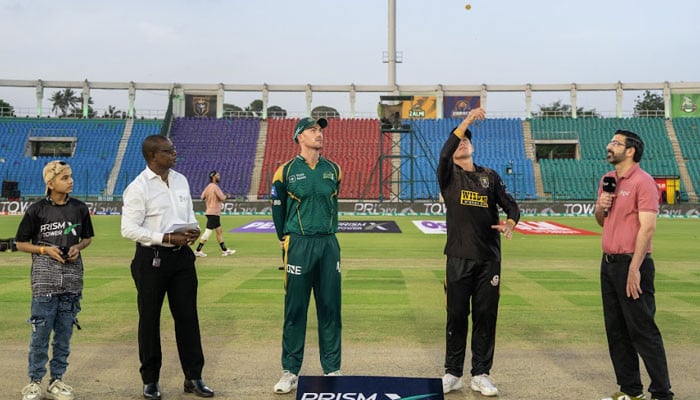
Hyderabad Kingsmen won the toss and elected to bowl first against Multan Sultans in the 33rd match of the Pakistan Super League (PSL) 11 at Karachi’s National Bank Stadium on Wednesday.
Playing XI
Hyderabad Kingsmen: Maaz Sadaqat, Marnus Labuschagne (c), Usman Khan (wk), Saim Ayub, Kusal Perera, Gleen Maxwell, Irfan Niazi, Hassan Khan, Hunain Shah, Mohammad Ali, and Akif Javed.
Multan Sultans: Sahibzada Farhan, Steve Smith, Ashton Turner (c), Shan Masood, Josh Philippe (wk), Muhammad Nawaz, Arafat Nawaz, Muhammad Imran, Peter Siddle, Muhammad Waseem Jnr, and Muhammad Ismail.
Head-to-head
The upcoming fixture marks only the second meeting between Sultans and Kingsmen, while their maiden face-off saw the 2021 champions emerge victorious by six wickets.
- Matches: 1
- Multan Sultans: 1
- Hyderabad Kingsmen: 0
Form Guide
Multan Sultans and Hyderabad Kingsmen enter the fixture with similar momentum in their favour as the 2021 champions have four victories in their last five completed matches, while the debutants have three triumphs in as many games.
Overall, Sultans have six victories in the ongoing PSL 11 and thus sit second on the points table with 12 points after eight matches, and a victory over Kingsmen would seal their qualification for the playoffs with a match to spare.
Kingsmen, on the other hand, have three triumphs in seven matches, which came consecutively after four successive defeats.
Multan Sultans: W, W, L, W, W (most recent first)
Hyderabad Kingsmen: W, W, W, L, L
Sports
Austin Reaves nearing return for Lakers as Luka Doncic remains out indefinitely with hamstring strain: report

NEWYou can now listen to Fox News articles!
In early April, with just five games remaining in the regular season, the Los Angeles Lakers announced that star guard Luka Doncic would be sidelined at least until the NBA playoffs.
Doncic’s setback was a Grade 2 left hamstring strain, an MRI confirmed. The reigning NBA scoring champion sustained the injury during an April 2 game against the Oklahoma City Thunder. The Lakers also entered the playoffs without another key member of their backcourt, Austin Reaves.
The shorthanded Lakers upset the Houston Rockets in the opening game of their first-round Western Conference series Saturday. Ahead of Game 2 on Tuesday, the Lakers reportedly received a clearer update on the health of at least one of their injured stars.
CLICK HERE FOR MORE SPORTS COVERAGE ON FOXNEWS.COM
Lakers guard Austin Reaves brings the ball up court against the Washington Wizards in Los Angeles on March 30, 2026. (Ryan Sun/AP)
Reaves, who was diagnosed with an oblique strain, appears to be progressing toward a return later in the first-round series if it extends to six or seven games. If the Lakers advance sooner, he could be on track to return for the Western Conference semifinals.
According to ESPN, Reaves recently returned to the practice court for 1-on-1 drills. The 27-year-old will still need to progress to 2-on-3 and then 5-on-5 work before he can be cleared for playoff action, but he appears significantly further along than Doncic, who remains out indefinitely.

Luka Doncic of the Los Angeles Lakers controls the ball against the Orlando Magic at the Kia Center on March 21, 2026. (Nathan Ray Seebeck/Imagn Images)
Doncic is unlikely to play in the first round, regardless of the series length. ESPN footage showed him on the practice court on Tuesday, though the six-time All-Star was not doing high-intensity work.
2025-26 NBA PLAYOFF ODDS: SPREADS, LINES FOR FIRST-ROUND SERIES
The Rockets, despite being widely favored in the opening round playoffs series, also contended with key injuries. Kevin Durant missed Game 1 with a knee contusion. He was cleared to play in Game 2 on Tuesday night.
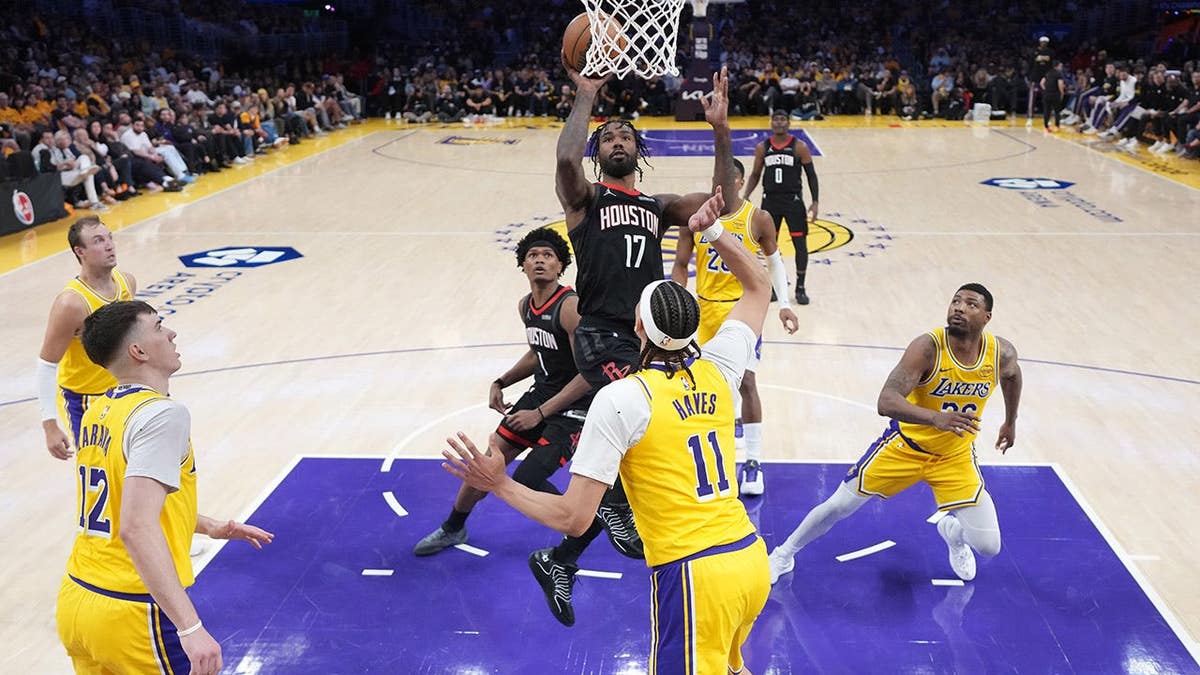
Houston Rockets forward Jabari Smith Jr. shoots the ball against the Lakers during Game 1 in the NBA playoffs at Crypto.com Arena in Los Angeles, California, on April 18, 2026. (Kirby Lee/Imagn Images)
CLICK HERE TO DOWNLOAD THE FOX NEWS APP
LeBron James scored 19 points, while Luke Kennard led Los Angeles with 27 in Saturday’s win.
Follow Fox News Digital’s sports coverage on X, and subscribe to the Fox News Sports Huddle newsletter.

Ugly scenes marred the end of Tuesday’s AFC Champions League Elite semifinal between Machida Zelvia of Japan and United Arab Emirates’ Shabab Al Ahli — and it was perhaps understandable why the latter were infuriated by the manner in which they had just been eliminated from Asian football’s premier club competition.
Shabab Al Ahli’s hopes of becoming champions of Asia had just come to an end in the penultimate stage of the tournament with a 1-0 loss, but they were adamant that tie should have been headed for extra-time after their 92nd-minute equaliser was disallowed.
The U.A.E side immediately remonstrated with referee Shaun Evans. Then once more at the final whistle, where the Australian official eventually required a police escort off the field as he was surrounded by a mob of seething Shabab Al Ahli players.
Peculiarly, and perhaps for the first time ever, it was a substitution that led to VAR intervention which prompted Evans to overturn his original decision of letting Guilherme Bala‘s brilliant solo effort stand.
So, what exactly caused the controversy?
After Machida had seemingly made their fifth and final substitution of the tie, they immediately started making appeals to Evans the moment Shabab Al Ahli restarted play from a throw-in — although the reason behind those were initially unclear.
Shabab Al Ahli worked the way from one flank to the other, where Bala embarked on a dazzling 40-yard run and proceeded to skip inside two opponents before unleashing an unstoppable effort in the far corner.
It sparked wild scenes of celebration in the Shabab Al Ahli camp but, almost immediately, Machida continued their pleas to Evans.
And when VAR — upon conducting its mandatory check — called Evans to the pitch-side monitor, things became clearer.
As Machida’s Hotaka Nakamura was still on the field of play, briefly exchanging words with the man who was about to replace him in Henry Heroki Mochizuki, Shabab Al Ahli defender Kauan Santos had already thrown the ball back into play.
It then goes down to the minute details. Nakamura was as good as off the field with one foot almost on the touchline. Barely a second later, Mochizuki was charging onto the pitch.
It initially appeared that Evans had not sensed anything was amiss because of such a fine margin. And the rules are the rules.
Machida will defend the decision by arguing they were — quite blatantly — unprepared for the restart, especially considering he was replacing Nakamura at right-wingback — down the exact side where Bala produced his moment of magic.
Still, even if it had been a legal restart, he probably might not have made it to his designated position considering he had the entire width of the field to cover. Indeed, when Bala’s shot hit the back of the net, Mochizuki had only made it as far as the middle of the box — filling in the central role that was vacated by captain Gen Shoji‘s own covering of the aforementioned void down the right.
Obviously, teams are not obliged to wait till their opponents are completely ready — and in their designated positions — after substitutions. In the grand scheme of things, Bala would probably still have scored even if Shabab Al Ahli had waited that extra second before restarting play. The fact of the matter is they didn’t.
But here’s where it gets even more intriguing. Evans’ whistle could be heard being blown, calling for play to be restarted. Whether or not it came before or after Santos’ throw-in is — again — so marginal that it is a difficult to determine in real-time.
This bit is purely conjecture but, at the juncture of the game when teams are often suspected of bringing on players to take time of the clock, and with Machida taking a bit of time to complete their substitution, he may have — in an attempt to force the Japanese team to get on with the game — called for Shabab Al Ahli to continue proceedings.
So, when VAR decided that there was a serious missed incident that warranted an on-field review, it is quite possible that it was one that had actually been instigated by Evans himself. Even then, if he had decided to restart play prematurely because Machida were wasting time, then wouldn’t he have been well within his rights to stick by his original decision?
After all, there is no law in the game that decrees both teams must have 11 players on the pitch for the game to go on. Even discounting the scenario of sending-offs, numerical discrepancies are commonplace when players require medical treatment off the field.
Expectedly, Shabab Al Ahli coach Paulo Sousa — who vacated his dugout for the remainder of the contest after the disallowed goal — was indignant after the game.
“There was a goal that was scored and then it was cancelled — this is a very technical mistake by the referee,” said Sousa. “Unfortunately, this is what is turning football into rubble. It was a big mistake to choose this referee for this match.
“What saddens me is the organisation [the Asian Football Confederation] choosing referees who aren’t up to the quality of this tournament, these players, and the coaches present.”
“We deserved to be in the final and we deserve to play this important game.”
Of course, nothing can now change the outcome of the contest. It is Machida who are moving on to Saturday’s decider — a story in itself considering this is their tournament debut and they were still in the second tier of Japanese football as recently as in 2023.
Nonetheless, Shabab Al Ahli are well within their rights to be aggrieved that they did not at least have extra-time, or even penalties, to pull off a victory of their own.
Not for the first time, VAR has courted controversy. But perhaps for the first time, over a substitution.


Cambodia & Canada discuss strengthening economic ties

Trump administration in advanced talks for a rescue package for Spirit Airlines, source says

Iran war: Trump sanctions waiver or not – why India continues to buy Russian oil – The Times of India

-

 Fashion6 days ago
France’s LVMH Q1 revenue falls 6%, shows resilience amid Iran war
-

 Entertainment1 week ago
Is Claude down? Here’s why users are seeing errors
-

 Sports1 week ago
PSL 11: Peshawar Zalmi win toss, opt to field first against Quetta Gladiators
-

 Tech1 week ago
The Deepfake Nudes Crisis in Schools Is Much Worse Than You Thought
-

 Tech1 week ago
Human-machine teaming dives underwater
-

 Tech1 week ago
Bremont Is Sending a Watch to the Moon’s Surface
-
 Business1 week ago
BP sees ‘exceptional’ oil trading result as Iran war sends crude costs soaring
-

 Fashion1 week ago
What no one is saying about the 2026 apparel slowdown